

Imagine handing a fifty-page merger agreement to a paralegal who reads it in three minutes and flags every risky clause before you even finish your morning coffee. That is not a futuristic fantasy anymore. By mid-2026, Generative AI has moved from the hype cycle into the daily workflow of corporate legal departments worldwide. The old way of managing contracts-manual line-by-line reviews that drag on for weeks-is dying. In its place, we are seeing a new standard where Legal Operations combined with generative AI drives speed, accuracy, and cost control.
The pressure is real. According to data from the Corporate Legal Operations Council (CLOC), more than 80 percent of legal departments expect rising demand for services, while 85 percent of general counsels anticipate increased corporate risk. You cannot hire your way out of this gap. You need technology that scales. This article breaks down how modern legal teams use AI for contract review, how intelligent redlining works, and why playbooks are the secret sauce that makes it all reliable.
The Core Problem: Volume vs. Velocity
Let’s look at the numbers. Contract drafting, review, and analysis is currently the number one AI use case in legal departments, utilized by 64 percent of AI-adopting teams as of 2026. Why? Because traditional manual review is a bottleneck. A human attorney might spend four hours reviewing a complex service level agreement (SLA). An AI-powered system can perform an initial pass in minutes, identifying deviations from market standards and flagging material risks that a tired human eye might miss.
This isn’t just about speed; it’s about capacity. When you cut negotiation cycles by 50 to 90 percent, you free up your senior attorneys to focus on high-value strategy rather than repetitive boilerplate checking. You also slash outside counsel bills. Some organizations report saving up to 90 percent on legal fees by automating the first pass of routine contracts. That is a massive operational lever for any General Counsel facing budget constraints.
How AI Redlining Actually Works
To trust the tool, you have to understand the engine under the hood. Most people think of Large Language Models (LLMs) like GPT-4 as simple text predictors. While they are powerful, raw LLMs have a problem: hallucinations. They can sound confident but be factually wrong. In law, being wrong is expensive.
That is why leading platforms don’t rely on LLMs alone. They use a hybrid architecture:
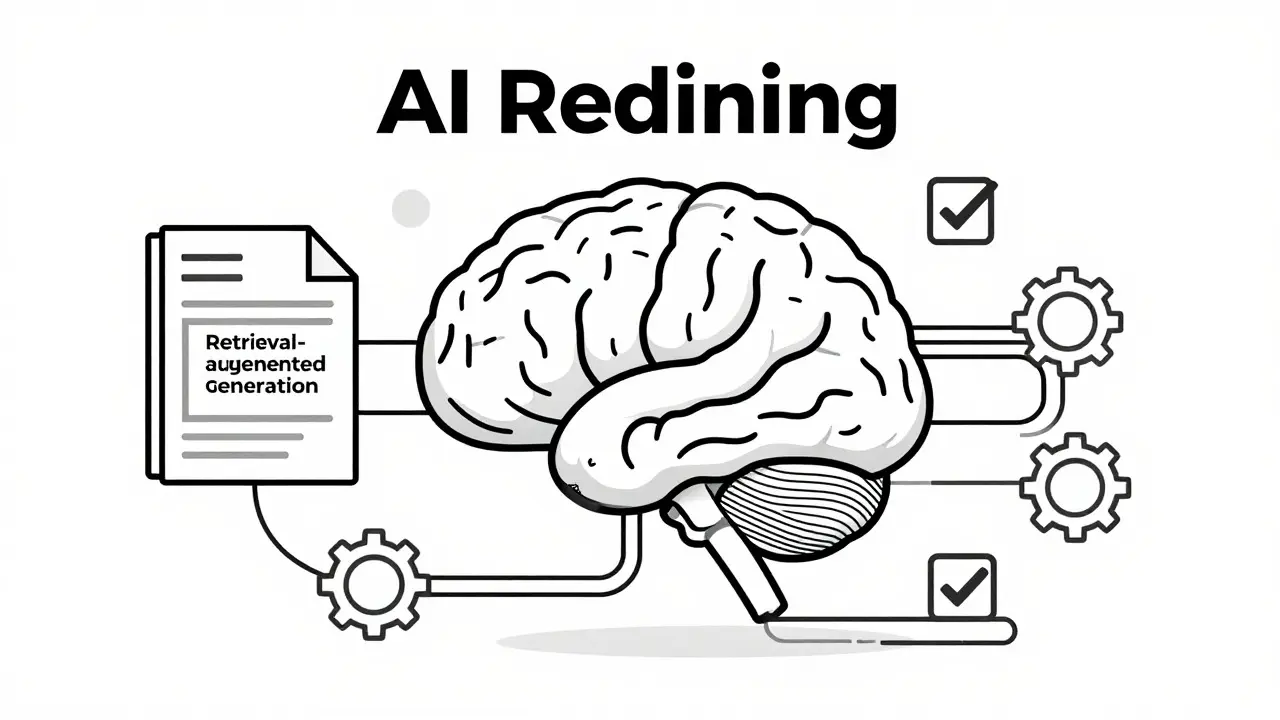
- Retrieval-Augmented Generation (RAG): This method combines the language power of an LLM with real-time retrieval from your own company documents. Instead of guessing based on public training data, the AI pulls relevant info from your internal playbook or prior deal terms live.
- Specialized Algorithms: Platforms like ReviewPro use proprietary algorithms called "Sifters." These are trained on thousands of real-world agreements to identify key legal concepts with reported accuracy rates of 95 percent or higher. They handle the heavy lifting of concept identification, while the generative AI handles the phrasing and suggestions.
- Agent-Based Systems: Advanced tools like Sirion employ specialized agents. A "Redline Agent" suggests changes, while an "IssueDetection Agent" flags risks. They work together to provide explainable outcomes, showing you exactly why a suggestion was made.
The result is a system that reduces contract review time from hours to minutes while maintaining accuracy rates of 90 percent or higher. But the technology is only half the equation. The other half is governance.
Playbooks: The Brain Behind the Brawn
If AI is the muscle, the legal playbook is the brain. A playbook is a structured rule set that encodes your organization’s specific legal expertise, compliance requirements, and negotiation standards. Without a playbook, AI gives you generic advice. With a playbook, it gives you your advice.
Here is why playbooks matter:
- Consistency: Different lawyers interpret "material breach" differently. A playbook ensures every contract uses the definition approved by your risk committee.
- Risk Appetite Encoding: Your company might accept higher risk in sales contracts but zero tolerance in vendor data privacy clauses. The playbook tells the AI which rules apply to which document type.
- Dynamic Learning: Leading systems update automatically. As you close new deals and approve new terms, the intelligence layer evolves. The AI learns from your actual negotiation patterns, creating a virtuous cycle where the system gets smarter with every transaction.
Think of it this way: A generic AI is like a junior associate who read law school textbooks. An AI with a custom playbook is like a senior partner who has negotiated hundreds of deals specifically for your business model. The difference in value is night and day.
The Five-Stage AI-Assisted Workflow
Implementing AI doesn’t mean throwing away your process. It means enhancing each step. Here is the standard five-stage workflow adopted by top legal operations teams in 2026:
| Stage | Action | AI Role |
|---|---|---|
| 1. Drafting & Intake | Start from templates; capture metadata. | Suggests template based on deal type; auto-fills known party data. |
| 2. AI First Pass | Scan for deviations and risks. | Identifies non-market terms; suggests context-aware fixes based on playbook. |
| 3. Attorney Review | Assess and approve changes. | Highlights exceptions; tracks compliance against policy. |
| 4. Negotiation | Collaborate with counterparties. | Surfaces leverage points; generates tracked redlines and comments. |
| 5. Finalizing | Lock revisions; archive. | Exports summaries for business teams; pushes to repository for analytics. |
In Stage 2, the AI does the heavy lifting. It scans the counterparty’s draft, compares it against your playbook, and flags issues. In Stage 3, the human attorney remains the decision-maker. You review the AI’s suggestions, modify them if needed, and approve the final position. This "human-in-the-loop" approach is critical for maintaining quality and accountability.
Tool Selection: Native vs. Specialized
Not all AI tools are created equal. When choosing a platform, you generally face two paths:
- Workflow-Native Tools: Solutions like Spellbook run directly inside Microsoft Word. This is low-friction for adoption because lawyers already live in Word. Spellbook flags non-market terms and suggests redlines under the lawyer’s name, preserving authorship and track changes seamlessly. It feels less like using software and more like having a smart co-pilot.
- Purpose-Built Platforms: Tools like ReviewPro or Sirion are built specifically for contract review. They often offer deeper analytical capabilities, such as scoring risk in real-time or analyzing entire portfolios for consistency. They may require more integration effort but provide richer data insights.
Your choice depends on your team’s tech comfort and existing infrastructure. If your team resists new platforms, a Word-native solution might get faster adoption. If you need deep portfolio analytics and complex multi-party negotiations, a dedicated platform is likely worth the investment.

Implementation Pitfalls to Avoid
Even the best technology fails if implemented poorly. Here are common mistakes legal operations leaders make:
- Ignoring Data Quality: AI is only as good as the data it retrieves. If your past contracts are messy or inconsistent, the AI will learn bad habits. Clean your data before deploying.
- Over-Automation: Don’t let AI sign off on high-risk deals without human review. Use AI for the 80 percent of routine work, but keep humans on the 20 percent of complex, novel transactions.
- Lack of Training: Lawyers need to understand basic AI concepts like token limits and hallucination risks. Invest in training so your team knows when to trust the AI and when to double-check.
- No Feedback Loop: Ensure your system captures feedback. When a lawyer overrides an AI suggestion, the system should learn from that correction.
Remember, the goal is not to replace lawyers. It is to amplify their ability to work and understand. As one legal tech provider puts it, the best AI feels like working with a senior colleague, not wrestling with software.
Future Outlook: From Experimental to Essential
As of July 2026, AI in legal operations is no longer experimental. It is a proven operational capability. Major vendors are offering production-grade solutions with documented performance improvements. The question is no longer "Should we use AI?" but "How fast can we deploy it effectively?"
We are moving toward a future where traceability is paramount. Lawyers need to see exactly which past contract a clause came from. Trust is built through transparency. Systems that provide full lineage for every suggestion will win over those that act as black boxes. Additionally, as regulations around AI evolve, having clear audit trails for automated decisions will become a compliance requirement, not just a best practice.
The convergence of generative AI and legal operations addresses a critical market pain point: doing more with less. By automating the repetitive, accelerating the review, and encoding institutional knowledge into playbooks, legal teams can meet rising demand without proportional increases in headcount or spending. The transformation is here. The teams that adapt quickly will gain a significant competitive advantage in both speed and risk management.
Is AI contract review accurate enough for enterprise use?
Yes, leading AI redlining systems achieve accuracy rates of 90 percent or higher for standard contract clauses. However, human oversight remains essential for complex or novel terms. The technology is designed to assist, not replace, attorney judgment.
What is a legal playbook in the context of AI?
A legal playbook is a structured set of rules and preferences that encode an organization's specific risk appetite, compliance requirements, and negotiation standards. It guides the AI to make suggestions that align with your company's policies rather than generic legal norms.
How much time can AI save in contract review?
AI-powered contract redlining can reduce review cycles by 50 to 90 percent. Initial passes that used to take hours can now be completed in minutes, allowing legal teams to handle larger volumes of work without adding headcount.
Do I need to leave Microsoft Word to use AI redlining?
Not necessarily. Tools like Spellbook integrate directly into Microsoft Word, allowing lawyers to use AI features within their familiar environment. Other platforms like ReviewPro or Sirion may operate as standalone applications but often integrate with existing workflows.
What are the risks of using Generative AI in legal operations?
Key risks include hallucinations (inaccurate information presented confidently) and bias from training data. These are mitigated by using Retrieval-Augmented Generation (RAG) to ground responses in verified internal data and maintaining a human-in-the-loop review process for final approvals.
 Artificial Intelligence




Dave Gibbeson
July 30, 2026 AT 15:07Listen up, because this is the wake-up call your department needs.
The manual review process is dead and you are still trying to revive it with duct tape and caffeine. The stats in this post aren't just numbers; they are a direct indictment of inefficiency. If you are still spending four hours on an SLA while an AI can do it in minutes, you are not being thorough, you are being lazy.
We need to stop treating Generative AI like a shiny toy and start treating it like the core infrastructure it is. The hybrid architecture mentioned here, specifically the RAG component, is non-negotiable for enterprise use. You cannot trust a black box with your liability.
Implementing playbooks isn't optional either. It's the difference between having a junior associate guess and having a senior partner execute. Get your data clean, build your rules, and then let the machine work. Hesitation is expensive.
Sabrina Newland
July 31, 2026 AT 01:10i totally get the hype but does anyone else feel like we are losing the human touch?? 🤔
like sure speed is great but law is so much about nuance and context that machines might miss 😬 i mean hallucinations are scary right? what if the ai gets confident but wrong on a crucial clause? 📉
the part about playbooks sounds cool though kind of like teaching the robot our specific way of doing things which is nice 👍 but i worry about over-reliance. are we becoming too dependent on tech for critical decisions? maybe we should keep more humans in the loop than the article suggests just to be safe 🛡️
Amara Akbar
July 31, 2026 AT 19:07It is quite fascinating how the industry is pivoting so rapidly toward these automated solutions. One must consider that the integration of such tools requires a delicate balance between technological advancement and traditional legal prudence. The concept of the 'playbook' as the brain behind the brawn is particularly insightful. It suggests that institutional knowledge is being codified, which is a significant step forward for consistency across large organizations. However, one should not underestimate the complexity of maintaining these rule sets. They require constant vigilance and updates to remain relevant in a shifting regulatory landscape. The emphasis on human-in-the-loop workflows is reassuring, as it preserves the essential role of attorney judgment in high-stakes negotiations. Ultimately, the goal appears to be augmentation rather than replacement, which is a healthy perspective for the profession.
Mark Harvey
August 1, 2026 AT 13:33hey sabrina dont worry too much about it honestly the tech is really good now and helps us out a lot
the key is just keeping that human oversight especially for the tricky stuff like art said earlier its not about replacing lawyers its about making their lives easier so they can focus on the big picture strategy instead of getting bogged down in boilerplate text
i think once you see the time savings you will be hooked too its pretty amazing how fast it cuts through the noise
Art HND
August 3, 2026 AT 12:46Most of this is marketing fluff. The accuracy rates cited are best-case scenarios from vendor demos, not real-world chaos. Lawyers ignore the redlines anyway because they don't trust the output. The playbook concept is theoretical garbage in practice because no two deals are identical enough for rigid rules to apply consistently. Hallucinations happen regardless of RAG if the retrieval fails. Save your money.
Brandon Olvera
August 5, 2026 AT 12:10Why are we letting foreign tech giants dictate our legal processes? These platforms are mostly built overseas. We need domestic solutions that understand US law deeply without relying on global training data that might include conflicting international standards. Security is a nightmare when your sensitive merger agreements are processed by servers we don't control. Stick to local providers or build in-house. Don't outsource our sovereignty to an algorithm.