
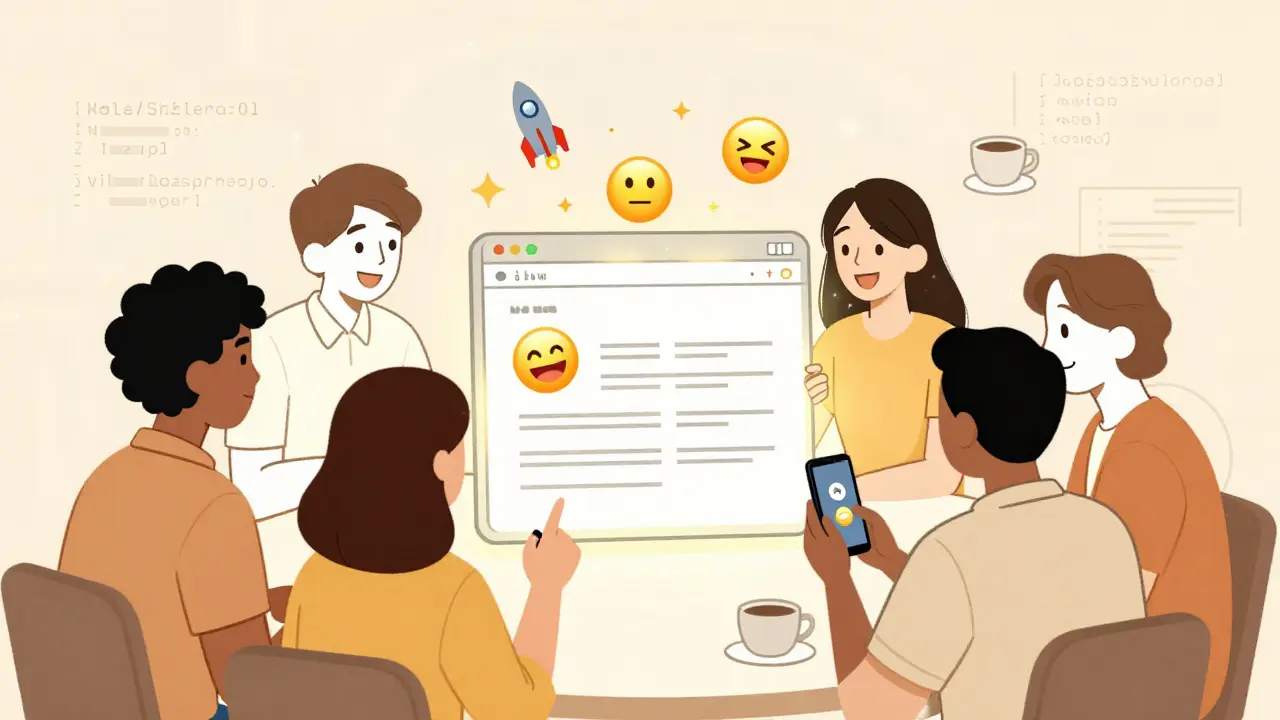
Most teams document code, deadlines, and bug fixes. But what about the vibe? The late-night brainstorming that sparked a breakthrough. The quiet tension before a launch. The inside joke that kept everyone sane during crunch time. If you don’t capture that, your knowledge base is half-empty.
Companies like Box, Spotify, and GitHub have been quietly doing this for years. They don’t just store technical specs-they store the feel of how work gets done. This isn’t fluff. It’s what keeps teams running smoothly when people leave, rotate, or join. And it’s not optional anymore. As of Q3 2025, 54% of Fortune 500 companies use some form of vibe-coded documentation in their internal wikis, according to Gartner. The ones that do it right see 37% faster onboarding and 42% higher retention.
What Is Vibe-Coded Knowledge Sharing?
It’s the difference between:
- “Used Redis for caching.”
- “We switched to Redis after three failed attempts with PostgreSQL. The team was exhausted. We held a 15-minute huddle at 10 p.m. and agreed: ‘Let’s try one last time.’ That’s when Maria found the connection leak. #collaborative-breakthrough #stress-mitigation”
That second version doesn’t just tell you what happened-it tells you how to think, how to feel, how to act next time. It’s context wrapped in humanity.
According to ThoughtFarmer’s 2021 research, 68% of high-performing tech teams document cultural elements alongside technical details. And it’s not just for morale. Box’s Product Manager Aiko Krishna found that teams using vibe documentation reduced context-switching by 29% when rotating members between projects. Why? Because they didn’t have to guess why decisions were made. They could feel the reasoning.
Why Standard Wikis Fail at This
Confluence, SharePoint, even Notion-they’re built for structure, not soul. They’re great for process docs, compliance checklists, and Jira links. But when you ask someone to write “What this project felt like” in a sterile template with mandatory fields, it feels like paperwork. And people skip it.
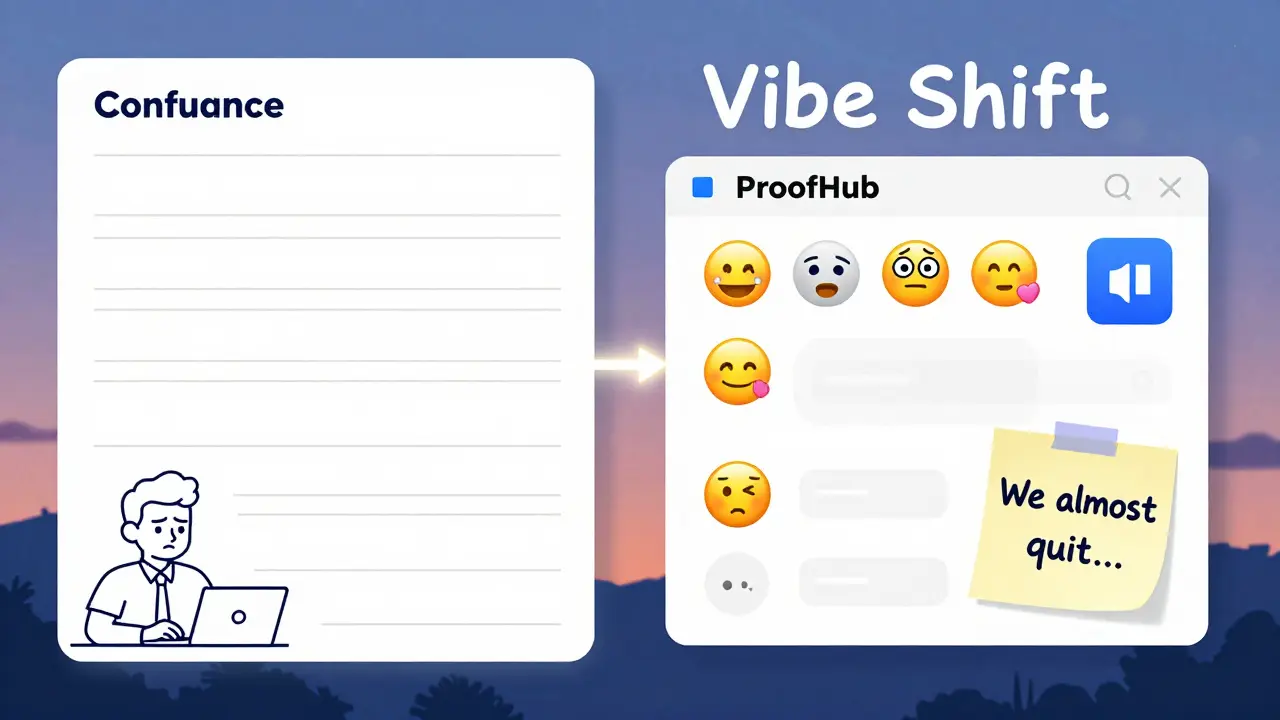
Atlassian’s own 2025 survey showed that teams using standard templates in Confluence had 47% lower engagement than those using custom “vibe templates.” The most successful ones included prompts like:
- “What’s one thing we did that surprised us?”
- “Who kept the team going when things got rough?”
- “What did we almost quit on, but didn’t?”
And they used emoji. Not because it’s cute, but because it’s fast. A 🚀 for momentum. A 💬 for a tough conversation. A ☕ for the 3 a.m. coffee run that solved the bug. These aren’t gimmicks-they’re emotional shorthand that sticks.
Platforms That Actually Support Vibe Coding
Not all wiki tools are built equal. Here’s what works in 2025:
| Platform | Best For | Vibe Features | Price (per user/month) | Adoption Rate (Teams < 30) |
|---|---|---|---|---|
| ProofHub | Small teams, fast setup | Emoji tagging, embedded video clips, vibe timeline integration | $45/month (flat, up to 50 users) | 39% |
| ThoughtFarmer | Enterprises, compliance-heavy | AI vibe analytics, 12 cultural metrics, sentiment tracking | $12 | 21% |
| Connecteam | Hybrid teams, audio/video focus | Auto-transcribed vibe sessions, emotional valence tags, Culture Amp integration | Free tier available; premium starts at $8 | 34% |
| Nulab Backlog | Dev teams already using Jira | #vibetags (e.g., #hot-tips, #decision-moment), linked to tickets | $6.50 | 31% |
| Confluence | Technical docs, legacy users | Custom templates only (no native vibe tools) | $5.75 | 12% |
ProofHub leads for small teams because it doesn’t force you to change how you work. You just drop in a 90-second video of your team walking through a bug fix. No script. No staging. Just real talk. That’s why 63% of teams using video demos in their wikis see usage rates double compared to text-only entries.
ThoughtFarmer wins for large orgs because it doesn’t just collect vibe-it analyzes it. Its AI dashboard flags when team energy drops across multiple projects, helping leaders intervene before burnout hits. But it’s overkill if you’re a five-person team trying to remember why you chose Python over Ruby in 2023.
How to Start Without Making It Feel Like Another Chore
The biggest reason vibe documentation fails? It’s treated like a compliance task.
One fintech startup tried it during a company-wide restructuring. Employees saw it as another way leadership was watching them. Within three months, 78% stopped contributing.
Here’s how to avoid that:
- Start small. Pick one project. One team. One week. Don’t roll it out company-wide.
- Make it part of your workflow. At Box, they added a “vibe snippet” field to their Slack bot. After every standup, the bot asks: “What’s one thing that felt different today?” No one has to write a report. Just one line. That’s it.
- Use video, not text. Record a 2-minute clip of your team explaining why they picked a certain tool. No cameras. No lighting. Just a phone on a desk. People respond to real voices, not polished paragraphs.
- Tag it like a meme. Use #hot-tips, #facepalm-moment, #we-were-wrong. These aren’t childish-they’re human. And they’re searchable.
- Don’t reward length. Reward honesty. A single sentence like “We almost quit because no one told us the client was lying about the deadline” is worth 10 pages of corporate-speak.
Doctolib’s model works because they turned vibe sharing into a leaderboard. Contributors earn points. Not for writing essays. For posting #hot-tips that get upvoted. Those points count for 15% of quarterly reviews. That’s not fluff-that’s incentive design.
What to Avoid (The Pitfalls)
Dr. Ethan Bernstein from Harvard calls it “vibe-washing.” That’s when teams document culture because they’re told to-not because they believe in it. And it backfires.
Here’s what to watch out for:
- Forcing positivity. If your team is stressed, don’t demand “positive vibes.” Document the stress. That’s real.
- Using AI to judge emotion. Tools that analyze tone and assign “happiness scores” feel invasive. 58% of employees in Pew Research’s 2025 survey said they’d quit if their emotional data was tracked without consent.
- Making it mandatory. If people feel like they’re being graded on their authenticity, they’ll fake it. And then no one trusts the system.
- Ignoring GDPR. Since June 2025, the EU classifies emotional data as personal information. If you’re recording voices or analyzing tone, you need opt-in consent. Don’t skip this.
The most successful teams don’t track vibe-they preserve it. They don’t measure it. They protect it.
What’s Next? The Future of Vibe Coding
The Knowledge Management Consortium released Version 1.0 of the Vibe Documentation Standard in November 2025. It defines seven core elements:
- Emotional context markers
- Decision-making atmosphere tags
- Psychological safety indicators
- Team rhythm patterns
- Conflict resolution styles
- Energy peaks and dips
- Unspoken norms
By 2027, Gartner predicts 70% of high-performing teams will use structured vibe documentation. But 60% of early adopters will fail-not because the idea is bad, but because they treat it like a tool, not a culture.
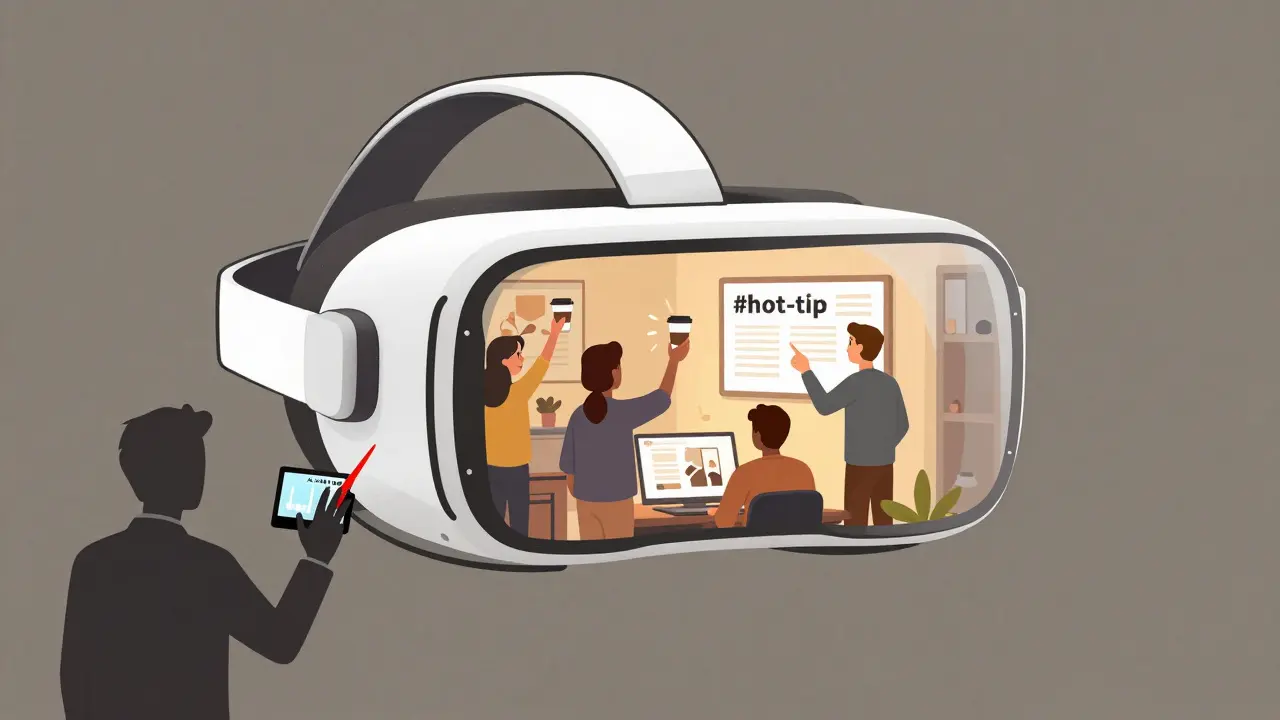
ProProfs is testing VR demos for immersive vibe sharing. Imagine putting on a headset and “being in” the room when your team solved that impossible bug. That’s not sci-fi-it’s coming.
And Axero plans to use blockchain to verify vibe entries by 2026. No more fake “we’re a family” posts. Just verified, timestamped moments of truth.
Final Thought: It’s Not About Documentation. It’s About Legacy.
When someone leaves your team, they take more than their code. They take their intuition. Their instincts. The way they knew when to push and when to pause.
Vibe-coded knowledge isn’t about keeping people from forgetting. It’s about making sure the people who come after them understand why things happened the way they did.
It’s the difference between handing someone a manual… and handing them a story.
And stories? They stick.
What’s the difference between a regular wiki and a vibe-coded wiki?
A regular wiki answers: “What did we do?” A vibe-coded wiki answers: “How did we feel while doing it?” It includes emotional context, unspoken norms, team energy shifts, and decision-making atmosphere-not just technical steps.
Do I need special software to do vibe coding?
No, but it helps. You can start with any wiki and just add free-form text or video clips. But platforms like ProofHub, Connecteam, and Nulab Backlog have built-in tools-emoji tagging, auto-transcribed audio, vibe timelines-that make it easier and more engaging. The key isn’t the tool, it’s the mindset.
How do I get engineers to participate?
Don’t ask them to write essays. Ask them to record a 90-second clip after a win or a mess-up. Or add a one-line tag in Slack: “#hot-tip: Don’t touch the config file unless you’ve had coffee.” Make it fast. Make it real. Make it part of how they already communicate.
Is vibe documentation just for tech teams?
No. Professional services firms like consulting and design agencies use it most (68% adoption). But any team that relies on intuition, collaboration, or creative problem-solving benefits. Sales teams use it to document client energy. Support teams use it to capture frustration patterns. It’s about human behavior, not code.
What if leadership wants to use vibe data to evaluate performance?
Don’t let them. Vibe documentation works only when it’s safe. If people think their emotional honesty will be used against them, they’ll stop. Use it to improve team health, not individual scores. If you turn it into a performance metric, you kill its value.
How do I know if my vibe documentation is working?
Look at usage, not volume. Are new hires finding answers faster? Are people sharing clips without being asked? Are you seeing tags like #we-were-wrong or #thank-you-maria? If yes, it’s working. If you’re getting long, formal posts that feel like reports, it’s not.
Can vibe coding help with remote teams?
Yes, especially. Remote teams miss the hallway chats, the body language, the energy shifts. Vibe documentation replaces that. A 2-minute video of your team laughing after fixing a bug? That’s worth 10 Slack threads.
 Artificial Intelligence
Vimal Kumar
December 28, 2025 AT 15:16I’ve seen this work first hand at my last startup. We started with one Slack bot asking ‘what felt different today?’ and now our onboarding docs are full of voice notes from people who left. One guy recorded himself saying ‘don’t trust the API docs, the real endpoint is hidden in a Slack thread from March’ - saved me two weeks. No one forced it. We just started sharing like we were telling stories at lunch.
Amit Umarani
December 30, 2025 AT 11:51ProofHub at $45/month? That’s ridiculous. You can do all this with Notion + a free Loom account. And calling emoji ‘emotional shorthand’ is just corporate jargon for ‘we’re too lazy to write properly.’
Noel Dhiraj
January 1, 2026 AT 02:57My team started doing vibe clips after a brutal sprint where no one slept for 72 hours. We recorded a 90-second video of us eating cold pizza at 3am laughing about how the bug was just a missing semicolon. That clip is now our default onboarding intro. No one reads the manual anymore but everyone watches that video. It’s not about documentation it’s about remembering we’re human
vidhi patel
January 2, 2026 AT 08:07The misuse of the term ‘vibe-coded’ is deeply concerning. This is not a legitimate knowledge management framework; it is a rebranding of anecdotal storytelling with pseudo-scientific metrics. Furthermore, the reference to Gartner as a credible source in this context is misleading, as their research methodologies are often proprietary and lack peer review. The inclusion of emoticons as ‘emotional shorthand’ is not only unprofessional but also undermines the integrity of technical documentation.
Priti Yadav
January 3, 2026 AT 13:26Wait - blockchain for vibe entries? That’s not innovation, that’s surveillance with a fancy name. They’re tracking our emotions, tagging our ‘energy dips,’ and selling it to HR. Next thing you know, your ‘#facepalm-moment’ gets flagged as ‘low psychological safety’ and you get called into a ‘wellness review.’ This isn’t culture - it’s corporate espionage with a Spotify playlist.
Ajit Kumar
January 4, 2026 AT 01:49It is imperative to recognize that the fundamental flaw in this entire paradigm lies in its conflation of emotional context with technical knowledge. While anecdotal narratives may provide psychological comfort, they do not constitute actionable, scalable, or verifiable information. The notion that a 90-second video of someone eating pizza at 3 a.m. is equivalent to documented system architecture is not merely misguided - it is dangerously antithetical to the principles of engineering rigor. Furthermore, the normalization of informal punctuation, the use of hashtags in professional documentation, and the elevation of subjective sentiment over objective fact represent a systemic erosion of standards that will inevitably lead to catastrophic knowledge decay within organizations. This is not progress; it is entropy dressed up as culture.
Diwakar Pandey
January 5, 2026 AT 15:14My favorite part is how the best vibe docs are the ones nobody even thinks about. Like that one Slack thread where someone just typed ‘#hot-tip: restart the server after the DB migration - trust me’ and it got 47 upvotes. No one wrote a report. No one got praised. But everyone remembers it. That’s the magic. Not the tools. Not the AI. Just a quiet moment someone shared something real and everyone else just… got it.