
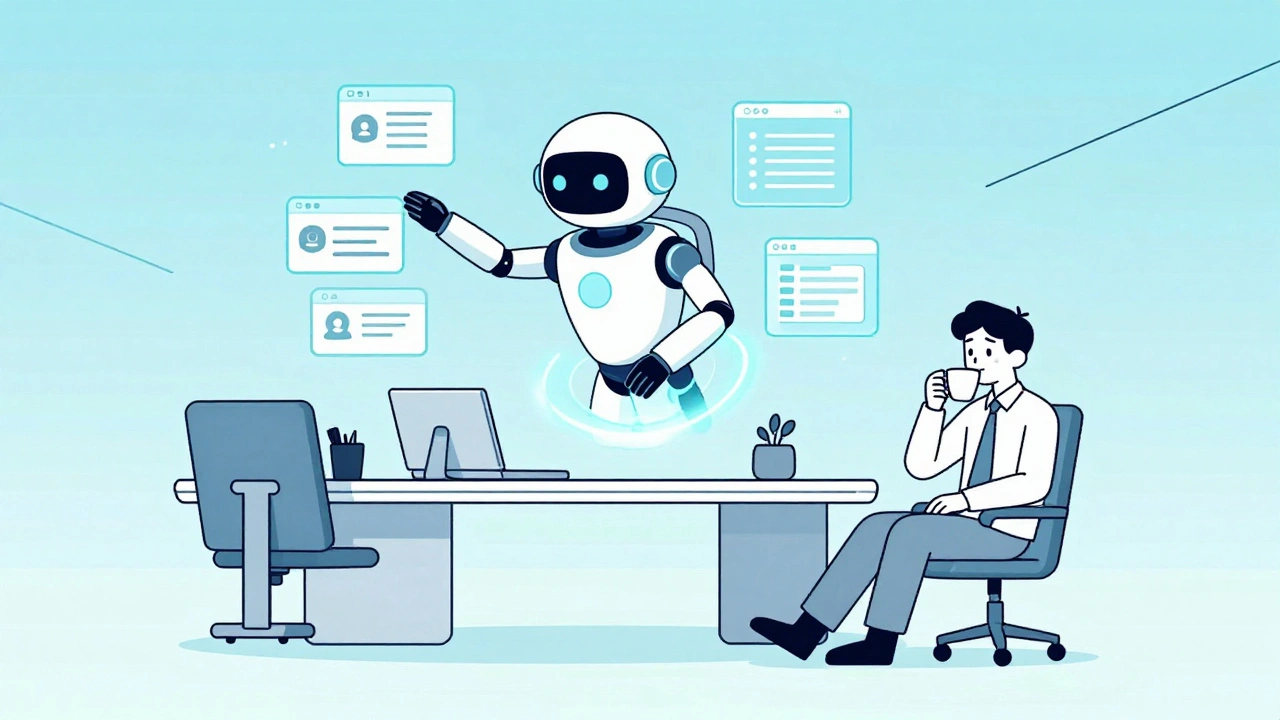
Generative AI is no longer just writing emails or generating images
Five years ago, generative AI was a novelty-something you used to draft a blog post or turn a sketch into a photorealistic landscape. Today, it’s making decisions. It’s managing workflows. It’s running parts of your business without you lifting a finger. The shift isn’t subtle. It’s a complete overhaul of what AI can do. The future of generative AI isn’t about bigger models or more parameters. It’s about agentic systems, falling costs, and better grounding. These three forces are reshaping industries, redefining productivity, and creating a new divide between companies that move fast and those that don’t.
Agentic AI is the new frontier
Think of the AI you used last year. It waited for you to ask a question. You typed, it responded. Simple. Now, imagine an AI that doesn’t wait. It spots a drop in customer satisfaction scores, pulls up support tickets, drafts a response, schedules a follow-up with a human agent, and updates the knowledge base-all without you saying a word. That’s an agentic system.
These aren’t chatbots. They’re autonomous agents. They plan, execute, learn from feedback, and adjust. By 2025, 17% of all AI value comes from these systems. By 2028, that number will jump to 29%. Companies like Amazon are already using them in warehouses to optimize robot paths, cutting delivery delays by 18%. Customer service teams are deploying agents that handle 70% of routine inquiries without escalation. The ROI? Each dollar spent on agentic AI returns $3.70, according to AmplifAI’s 2025 analysis.
But here’s the catch: they’re not magic. They still struggle with deep domain expertise. If you ask one to interpret a legal contract or diagnose a rare medical condition, it’ll likely guess wrong. The gap is widest between top-tier users and everyone else. OpenAI’s 2025 report found that only 12% of enterprises have fully integrated these agents into core operations. The rest are still testing them in isolated pilots.
Costs are collapsing-fast
Running generative AI used to mean renting expensive GPUs and paying for massive cloud compute. That’s changing. Model optimization, pruning, and distilled versions of large models are cutting inference costs by up to 60% since 2023. Companies no longer need to train their own models from scratch. They’re using open-weight models and fine-tuning them with their own data. The synthetic data market, which lets firms generate realistic training data without using real customer records, is growing at over 40% annually. That’s huge for healthcare and finance, where privacy rules used to block AI adoption.
Small businesses are feeling the shift. A startup in Seattle can now run a customer support agent on a $200/month cloud instance. Two years ago, that same task would’ve cost $2,000. Even more impressive: generative AI is now being used to generate its own training data. A logistics company in Chicago used AI to simulate 10 million delivery routes-something that would’ve taken human analysts years. The result? A 22% reduction in fuel costs.
By 2028, enterprise spending on agentic AI alone is projected to hit $51.5 billion. That’s up from less than $1 billion in 2024. The cost of entry is falling so fast that the biggest barrier isn’t tech anymore-it’s talent. Few companies have people who know how to design, monitor, and maintain these autonomous systems.

Grounding is what keeps AI from lying
Remember when AI would confidently invent fake citations or make up product features? That was called hallucination. Early models had a 25% hallucination rate. Today? It’s under 8%. The reason? Better grounding.
Grounding means connecting AI to real-time, accurate information. The key tool? Retrieval-Augmented Generation, or RAG. Instead of relying solely on what it learned during training, the AI pulls in live data from your company’s databases, CRM, or internal docs. If a customer asks about a recent price change, the AI checks your pricing system before answering. No guessing. No made-up numbers.
Gartner predicts that by 2026, 60% of AI applications will use real-time data retrieval. That’s not optional anymore. In regulated industries like banking and pharma, ungrounded AI is a compliance risk. A single hallucinated drug interaction could lead to legal action. Companies that skipped grounding are already getting burned. One health tech firm lost $4.2 million in 2024 after an AI-generated patient summary contained a false medication dosage.
Grounding isn’t just about accuracy-it’s about trust. When employees know the AI won’t make up facts, they start using it for critical decisions. Sales teams use it to draft proposals. Engineers use it to review code. Executives use it to summarize quarterly reports. Trust is the silent multiplier.
The divide is widening
Not everyone is moving at the same speed. A new term has emerged in boardrooms: “future-built companies.” These are the organizations that treat AI like infrastructure-not a tool. They spend 15% of their total resources on AI development. They hire AI engineers, not just data scientists. They build monitoring systems to track agent behavior. And they’re seeing results: twice the revenue growth and 40% more cost reduction than laggards by 2028, according to BCG.
The rest? They’re stuck in pilot purgatory. They run a chatbot for customer service. They use AI to write marketing copy. They call it “AI adoption.” But they don’t integrate it into workflows. They don’t train their teams. They don’t measure outcomes. By 2026, this gap will be impossible to ignore. The companies that treat AI as a side project will fall behind. The ones that build it into their DNA will pull ahead.
What’s next? The world model revolution
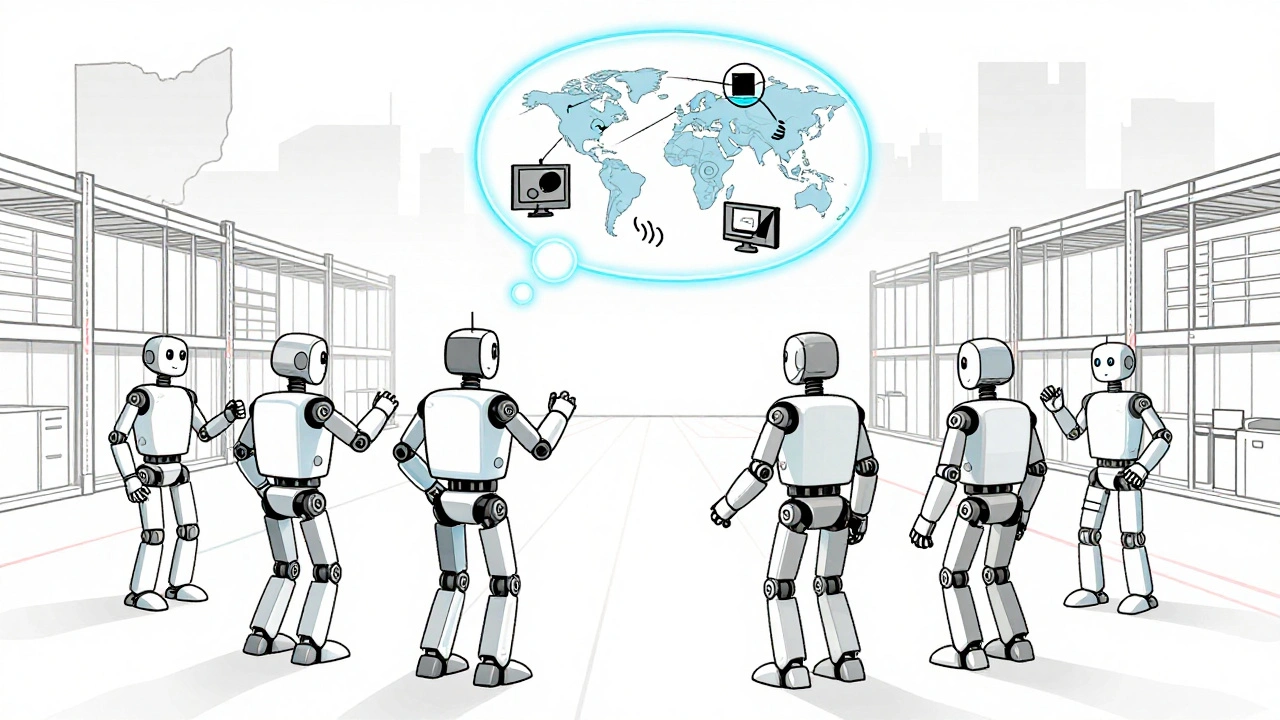
Yann LeCun, Meta’s Chief AI Scientist, says the next leap won’t come from bigger language models. It’ll come from “world models”-systems that learn like babies, by observing and interacting with their environment. Right now, AI learns from text. A world model learns from video, sound, sensor data, and physical feedback. Imagine a robot in a warehouse that watches a human pick up a box, then tries it on its own. No training data. No prompts. Just observation and trial.
Amazon is already testing this. Its robots now learn new warehouse layouts by watching human workers. The result? Faster adaptation, fewer errors. This isn’t science fiction. It’s happening in real warehouses in Ohio and Nevada.
By 2030, generative AI could add $19.9 trillion to the global economy, according to AmplifAI. That’s more than the entire GDP of Japan and Germany combined. But it won’t happen overnight. The biggest bottleneck isn’t technology. It’s organizational readiness. Companies need to change how they hire, train, and manage teams. They need to accept that AI won’t always be perfect-and that’s okay, as long as it’s grounded, cost-effective, and agentic.
Where to start today
If you’re wondering how to begin, don’t start with a big project. Start small. Pick one repetitive task that eats up hours: scheduling meetings, summarizing calls, drafting internal updates. Build an agent to handle it. Use RAG to connect it to your internal docs. Monitor its output for five weeks. Measure time saved. Track errors. Then scale.
Look for platforms that offer pre-built agent templates. Avoid vendors who promise “fully autonomous AI.” No system is fully autonomous yet. Look for ones that let you add human review steps. That’s the sweet spot: AI does the heavy lifting, humans stay in the loop for judgment calls.
And don’t wait for perfect. The best time to start was two years ago. The second-best time is now.
 Artificial Intelligence


Pramod Usdadiya
December 14, 2025 AT 11:26also, typo: 'pricng' in my notes. sorry.
Aditya Singh Bisht
December 16, 2025 AT 05:31my cousin runs a small chai shop in Delhi and he just used AI to auto-schedule deliveries + reply to WhatsApp orders. sales up 30% in 2 weeks. no coders needed. just a phone and guts.
we’re not waiting for perfection-we’re building while we learn. 💪
Agni Saucedo Medel
December 18, 2025 AT 02:04my team used to get so mad when the AI said 'the product is available in 3 colors' but we only had 2. now it pulls from our CRM and boom-no more angry clients.
also, i added a ❤️ to every correct response. small thing, big morale boost.
ANAND BHUSHAN
December 19, 2025 AT 16:55Indi s
December 20, 2025 AT 15:35Rohit Sen
December 21, 2025 AT 03:06every ‘breakthrough’ since 2022 has been a rebrand of rule-based bots. 17% value? sure. by 2028, we’ll be paying $50/month to let AI write ‘Hi, thanks for your patience’.
Vimal Kumar
December 21, 2025 AT 16:13it’s not magic, but it’s not snake oil either. start small. pick one boring task. let AI do it. watch how much mental space you get back.
we’re not replacing humans-we’re unburdening them. and that’s huge.
Amit Umarani
December 22, 2025 AT 23:06you people need to proofread. this is the future? with typos?
also, ‘world models’ aren’t new. they’ve been in robotics since the 90s. just repackaged with buzzwords.