

Have you ever stared at an API bill and wondered why a simple question cost more than your coffee budget? If you have started integrating reasoning models, you know the feeling. These powerful tools solve complex math and coding problems that standard language models struggle with. But they come with a hidden price tag: think tokens. These are the intermediate steps the model generates before giving you a final answer. In late 2024 and early 2025, the industry shifted dramatically when OpenAI launched its o1 series and competitors like DeepSeek followed suit. Suddenly, getting the right answer meant paying for the thinking process itself.
The Hidden Cost of Thinking
To understand the cost implications, we first need to look at how these models work differently from standard Large Language Models (LLMs). Standard models predict the next word based on patterns. Reasoning models, however, use a technique called inference-time scaling. Instead of jumping straight to an answer, they generate a chain of thought (CoT). This is where think tokens come in. They are not just extra words; they are the computational effort required to verify logic step-by-step.
According to research by Nous Research cited in early 2025, this process can increase total token usage by 1.5 to 4 times compared to standard LLMs. If a standard query uses 100 tokens, a reasoning query might use 400. You pay for every single one of those tokens. MIT researchers Elena De Varda and Evelina Fedorenko noted in their November 2025 PNAS publication that this mirrors human cognition costs. The model takes 3 to 5 times longer to respond because it is literally "thinking" through the problem. This latency and volume directly impact your bottom line.
Decoding the Price Tags: A Comparative Analysis
Not all reasoning models cost the same. The market has split into premium closed-source options and more affordable open-weight alternatives. Understanding these differences is crucial for budgeting. Let's look at the numbers as they stood in mid-2026.
| Model | MMLU Accuracy | Coding Accuracy (GPQA/SWE-bench) | Cost per Million Output Tokens | Key Characteristic |
|---|---|---|---|---|
| OpenAI o1/o3 | 90.5% | 70.3% (SWE-bench) | $75.00 | Compressed reasoning traces; highest accuracy |
| DeepSeek-R1 | 84.2% | 87.7% (GPQA) | $40.00 | Full reasoning steps; balanced performance |
| DeepSeek-R1-distilled | 84.0% | High | $9.00 | Open-source; significantly lower cost |
| Qwen-Max | 78.2% | Moderate | $15.00 - $22.50 | Long context support; enterprise focus |
As the table shows, OpenAI o1 commands a premium price of $75 per million output tokens. While it offers top-tier accuracy, the cost adds up quickly if you are processing thousands of queries. On the other hand, DeepSeek-R1 provides strong performance at $40 per million tokens. However, because it outputs full reasoning steps, the actual cost per successful task can be higher due to the sheer volume of tokens generated. The game-changer for many developers has been the distilled versions, like DeepSeek-R1-distilled, which maintain high accuracy (84.0% MMLU) but drop the cost to around $9 per million tokens. This represents a massive saving for enterprises willing to manage open-source infrastructure.

When Should You Actually Use Reasoning Models?
You should not use reasoning models for everything. In fact, using them for simple tasks is one of the biggest money pits in AI development today. Gartner predicted in January 2026 that by 2027, 60% of enterprise reasoning workloads will implement cost-aware token allocation. This means companies are finally learning to turn off the "brain" when it is not needed.
Here is a practical rule of thumb: Use reasoning models only when the cost of a wrong answer exceeds the cost of the API call. Consider these scenarios:
- Complex Mathematical Problem-Solving: If you are building a financial modeling tool or a physics simulation engine, accuracy is paramount. DeepSeek-R1 achieved 87.7% on GPQA benchmarks, solving problems that standard models failed on. For a data scientist named Mark Rodriguez, this justified the $40/million token cost because it saved weeks of debugging.
- Critical Code Generation: When generating code for security-sensitive applications or complex algorithms, the ability of models like OpenAI o3 to achieve 70.3% on SWE-bench tasks reduces developer time significantly. As one developer on Reddit noted, while o1 costs 5x more than GPT-4 Turbo, it saves hours of manual review.
- Logical Deduction Tasks: Tasks requiring multi-step logical deduction, such as legal contract analysis or scientific hypothesis generation, benefit from the chain-of-thought process.
Conversely, avoid reasoning models for:
- Simple Q&A: Asking "What is the capital of France?" does not require deep reasoning. A standard LLM handles this instantly and cheaply.
- Real-Time Chatbots: If your user expects a response in under 2 seconds, the 3-5x latency of reasoning models will frustrate them. Hacker News discussions from October 2025 highlighted consistent complaints about unpredictable billing and slow responses for non-critical queries.
- Content Summarization: Unless the text requires deep semantic understanding beyond surface level, standard summarization models are faster and cheaper.
Strategies to Control Think Token Costs
If you decide to integrate reasoning models, you need a strategy to keep costs manageable. Developers typically face a 2-4 week learning curve to effectively integrate these models with token budgeting, according to DeepSeek's documentation updated in January 2026. Here are proven strategies to reduce spend.
1. Implement Adaptive Reasoning Depth
Not every question needs the same amount of thinking. The DisCIPL framework, introduced by MIT researchers in December 2025, demonstrated that having models reason through Python code rather than text can shorten reasoning traces by 40.1%. More broadly, implementing adaptive depth means simpler queries trigger minimal chain-of-thought, while complex problems trigger full reasoning. This approach reduced average token usage by 35-50% in tests.
2. Use Distilled Models Where Possible
For many applications, the distilled versions of large reasoning models offer the best balance. DeepSeek-R1-distilled models, for example, leverage smaller architectures that are 1,000 to 10,000 times cheaper per token than their parent models. If your task does not require the absolute peak performance of o3, switching to a distilled model can slash your bill by nearly 90%.
3. Monitor and Set Hard Limits
Unpredictable billing is a major pain point. Startup CTO Sarah Chen reported reducing her company's reasoning model usage by 70% after implementing strict token monitoring. Tools like LangSmith's Reasoning Cost Dashboard, released in November 2025, help visualize where tokens are being spent. Set hard limits on maximum tokens per request. If a model starts rambling in its reasoning steps, cut it off. You do not need infinite thinking time to solve a medium-complexity problem.
4. Hybrid Approaches
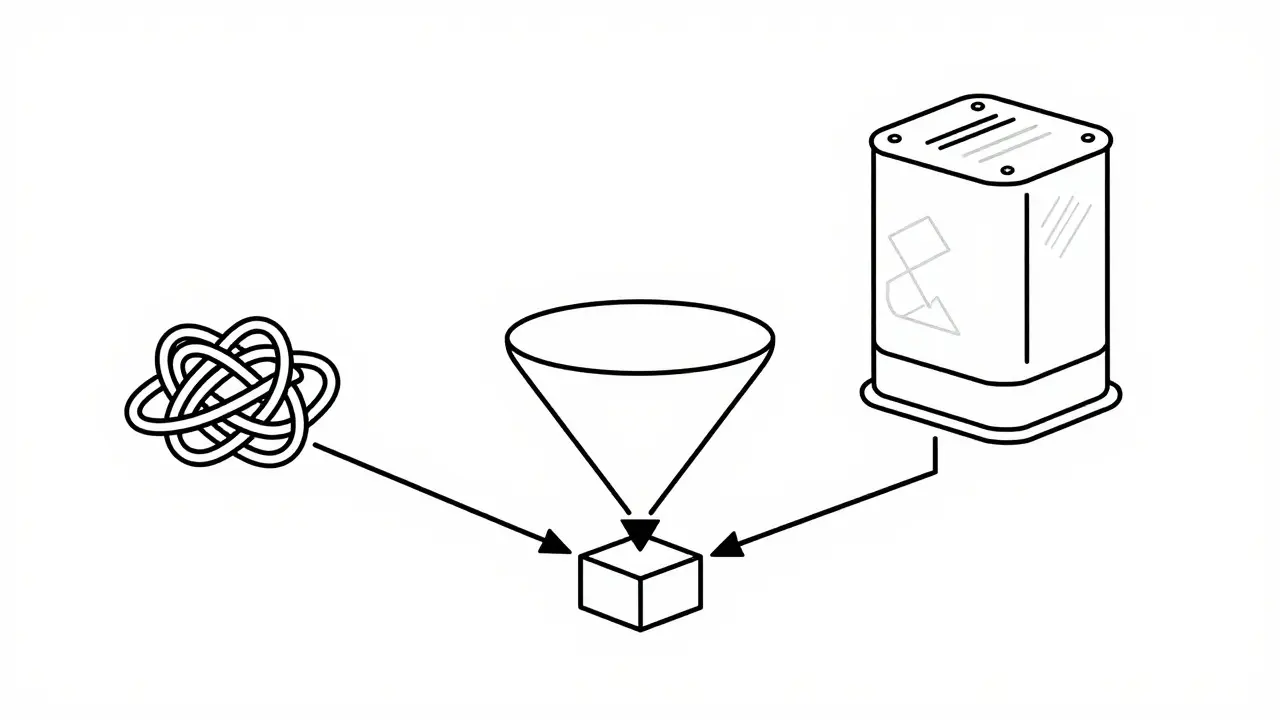
Consider a hybrid system where a small, fast LLM acts as a router. It analyzes the incoming query and decides whether to send it to a standard model or a reasoning model. This prevents the expensive reasoning engine from wasting cycles on trivial questions. By 2027, industry analysts predict these hybrid approaches will dominate, combining compact techniques with selective deep thinking.
The Future of Reasoning Economics
The landscape is shifting rapidly. The global market for reasoning models was valued at $1.2 billion in Q4 2025 and is projected to reach $4.8 billion by 2027. However, pressure is mounting on efficiency. Gartner notes that models generating more than 3x the necessary tokens may face market淘汰 (elimination) by 2028. We are moving toward a "reasoning economy" where efficiency is just as important as accuracy.
Future developments include OpenAI's upcoming o3-mini, scheduled for February 2026, which aims to deliver 80% of o3's performance at 40% of the cost. Meanwhile, open-source communities continue to innovate, with frameworks like DisCIPL showing that parallelization and code-based reasoning can significantly reduce latency and cost. As you plan your AI architecture for 2026 and beyond, remember that the most expensive model is not always the best choice. The smartest choice is the one that matches the complexity of the task to the cost of the computation.
What exactly are think tokens?
Think tokens are the intermediate steps or chain-of-thought (CoT) generated by reasoning models before producing a final answer. Unlike standard LLMs that output text directly, reasoning models use these tokens to perform logical deductions, mathematical calculations, or code verification internally. You are billed for these tokens just like any other output token.
Why are reasoning models more expensive than standard LLMs?
Reasoning models are more expensive due to inference-time scaling. They generate significantly more tokens (1.5 to 4 times more) because they write out their reasoning process. Additionally, they require more computational power and time, often taking 3 to 5 times longer to generate a response. This increased resource usage translates to higher per-token costs.
Is DeepSeek-R1 cheaper than OpenAI o1?
Yes, generally speaking. As of mid-2026, DeepSeek-R1 costs approximately $40 per million output tokens, while OpenAI o1/o3 costs around $75 per million tokens. However, DeepSeek-R1 outputs full reasoning steps, which can lead to higher total token counts per query. Its distilled version, DeepSeek-R1-distilled, is even cheaper at roughly $9 per million tokens.
When should I avoid using reasoning models?
You should avoid reasoning models for simple tasks like basic Q&A, content summarization, or real-time chat interactions where latency matters. Using them for these tasks wastes resources because the additional reasoning steps do not add value. Stick to standard LLMs for straightforward requests and reserve reasoning models for complex math, coding, or logical deduction tasks.
How can I reduce my spending on think tokens?
To reduce spending, implement adaptive reasoning depth so simple queries use less computation. Switch to distilled models like DeepSeek-R1-distilled for tasks that don't require peak accuracy. Use token monitoring tools to set hard limits on max tokens per request. Finally, consider a hybrid routing system that directs only complex queries to expensive reasoning models.
 Artificial Intelligence





Bonnie Watt
August 12, 2026 AT 02:57Oh please. Another article telling us how to save money on tech that costs more than a kidney. The real issue isn't the tokens, it's that we're paying for AI to think about whether it should answer us at all. It's a scam wrapped in a subscription model wrapped in another subscription.
Meagan Mueller
August 12, 2026 AT 21:45they want you to believe its just math but its control plain and simple deepseek is chinese tech and openai is big brother watching your every keystroke while charging you for the privilege of being monitored
Dave Gibbeson
August 14, 2026 AT 06:12Stop whining and start optimizing! If you are still burning cash on o1 for basic queries you are doing it wrong. Implement the router pattern immediately. Use a cheap model to classify intent. If it needs reasoning send it to R1-distilled otherwise keep it local. Efficiency is king right now. Get your act together or get left behind.
Sabrina Newland
August 14, 2026 AT 07:24i mean... do machines have souls when they think? 🤔 if we pay for their thoughts does that make them workers? 👷♀️ maybe we should unionize the tokens ✊ also typos happen bc im typing fast lol 😅
Amara Akbar
August 14, 2026 AT 20:05It is truly fascinating how the landscape is evolving. One must consider the ethical implications of cost-cutting measures versus accuracy. However, as a supportive observer, I find the hybrid approach quite reasonable. It allows for balance. We should encourage developers to adopt these strategies gently.
Mark Harvey
August 14, 2026 AT 23:27you got this bro just use the distilled models and watch your bill drop like a stone no need to overthink it literally
Art HND
August 16, 2026 AT 00:10Everyone is missing the point. The cost is irrelevant because the output is garbage anyway. Reasoning models hallucinate with confidence. Paying extra for confident lies is stupid. Just use a standard LLM and fact check it yourself. Save the money.
Brandon Olvera
August 17, 2026 AT 00:15Why are we even talking about Chinese models dominating the market? DeepSeek is eating our lunch. American tech used to be superior. Now we are begging for scraps from Beijing. Wake up people. Support domestic AI development before we lose everything to foreign entities.
Elizabeth Brooks
August 17, 2026 AT 08:07I actually tried the DisCIPL framework mentioned in the post and wow it really does cut down on the rambling. My python code generation went from 5k tokens to like 2k easily. You gotta try setting hard limits though. LangSmith dashboard is super helpful for seeing where u r bleeding money. Hope this helps someone else out there!
Courtney Wagstaff
August 18, 2026 AT 21:29So basically if you want to keep your coffee budget intact, stop asking the AI to explain quantum physics unless you really need it. I switched to the distilled version last week and my API bill looked way less scary. It feels like cheating but hey, free money is free money. 🌈✨