You might think that bigger is always better in the world of Large Language Models. After all, we see headlines about models with hundreds of billions of parameters dominating benchmarks. But here’s the uncomfortable truth: throwing more parameters at a problem doesn’t always solve it, especially if you don’t have enough high-quality data to teach them. The relationship between model size and data volume isn’t linear-it’s a complex balancing act where one variable often compensates for the lack of the other.
If you’re building an AI application or just trying to understand why some tiny models outperform giants, you need to grasp these tradeoffs. It’s not just about bragging rights on leaderboards; it’s about cost, speed, environmental impact, and whether your model actually works when deployed in the real world. Let’s break down what happens when you scale up versus when you scale out.
The Scaling Laws: More Parameters Need More Data
At the heart of modern AI development lies a concept known as scaling laws. First popularized by researchers like Jared Kaplan at OpenAI, these laws describe how model performance improves as you increase three things: parameter count, dataset size, and compute power. The catch? You can’t just add parameters indefinitely without adding data.
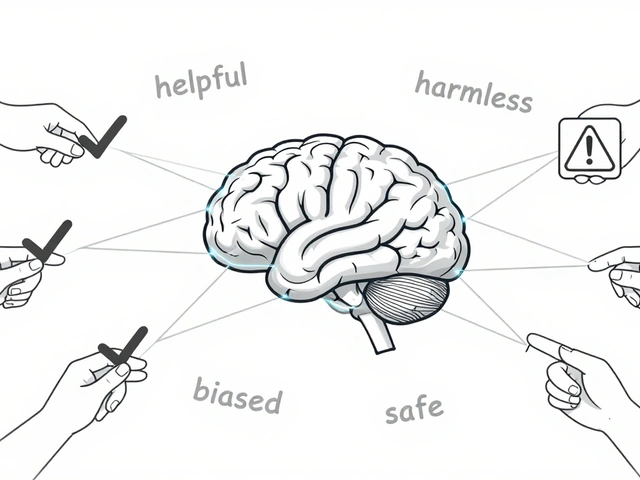
Think of a model’s parameters as its brain capacity. A larger brain (more parameters) can store more patterns and nuances. But if you feed that large brain only a small amount of information, it memorizes the data instead of learning general rules. This is called overfitting. Conversely, if you have massive amounts of data but a tiny model, the model simply doesn’t have enough capacity to capture the complexity of the language, leading to underfitting.
Recent research from Epoch AI highlights that datasets are growing exponentially-about 3.7x per year. Yet, even this growth rate is struggling to keep pace with model expansion. IBM analysis suggests we could run out of unique, high-quality human-generated text on the internet by 2026. This creates a bottleneck: do we stop making models bigger, or do we find new ways to generate data?
The Case for Large Models: Depth and Context
Why do companies still train massive models like GPT-4 or PaLM despite the costs? Because size buys you capability depth. Larger models excel at tasks requiring deep contextual understanding, such as writing coherent essays, solving multi-step coding problems, or maintaining consistency over long conversations.
A key advantage of large models is their context window. Bigger models often support longer context windows, allowing them to process entire books or legal contracts at once. This reduces hallucinations because the model has more source material to reference when generating answers. For example, if you ask a medical question based on a 50-page guideline document, a large model with a wide context window can cite specific sections accurately, whereas a smaller model might forget the beginning of the document by the time it reaches the end.
| Feature | Small Models (<1B Params) | Medium Models (7B-13B Params) | Large Models (>70B Params) |
|---|---|---|---|
| Inference Speed | Very Fast (Mobile/Edge compatible) | Fast (Single GPU friendly) | Slow (Requires multiple GPUs) |
| Data Requirement | Low to Moderate | Moderate to High | Extremely High |
| Reasoning Ability | Limited (Struggles with complex logic) | Good (Capable of most daily tasks) | Excellent (Handles nuanced reasoning) |
| Cost Efficiency | High | Balanced | Low (High operational cost) |
The Rise of Small Models: Efficiency and Specialization
Don’t underestimate the power of small models. Architectures like DistilBERT, TinyLLaMA, and Phi-3 prove that you don’t need billions of parameters to be useful. In fact, for many business applications, smaller models are superior because they are faster, cheaper, and easier to deploy.
Consider a customer support chatbot. Does it need to write Shakespearean sonnets? Probably not. It needs to answer common questions quickly and accurately. A small language model fine-tuned on specific domain data can outperform a generic giant model in this scenario. Why? Because it’s specialized. It knows exactly what your customers ask and how to answer, without wasting resources processing irrelevant general knowledge.
Techniques like quantization allow developers to shrink models further. By reducing the precision of weights from 16-bit to 4-bit, you can cut memory usage by 75% with minimal loss in accuracy for many tasks. This makes it possible to run powerful AI features directly on smartphones or IoT devices, enabling real-time applications without sending data to the cloud.
Data Quality vs. Quantity: The Synthetic Data Solution
As we approach the limit of available human text, the industry is shifting focus from quantity to quality. If you can’t get more data, you have to make the data you have work harder. This is where synthetic data comes into play.
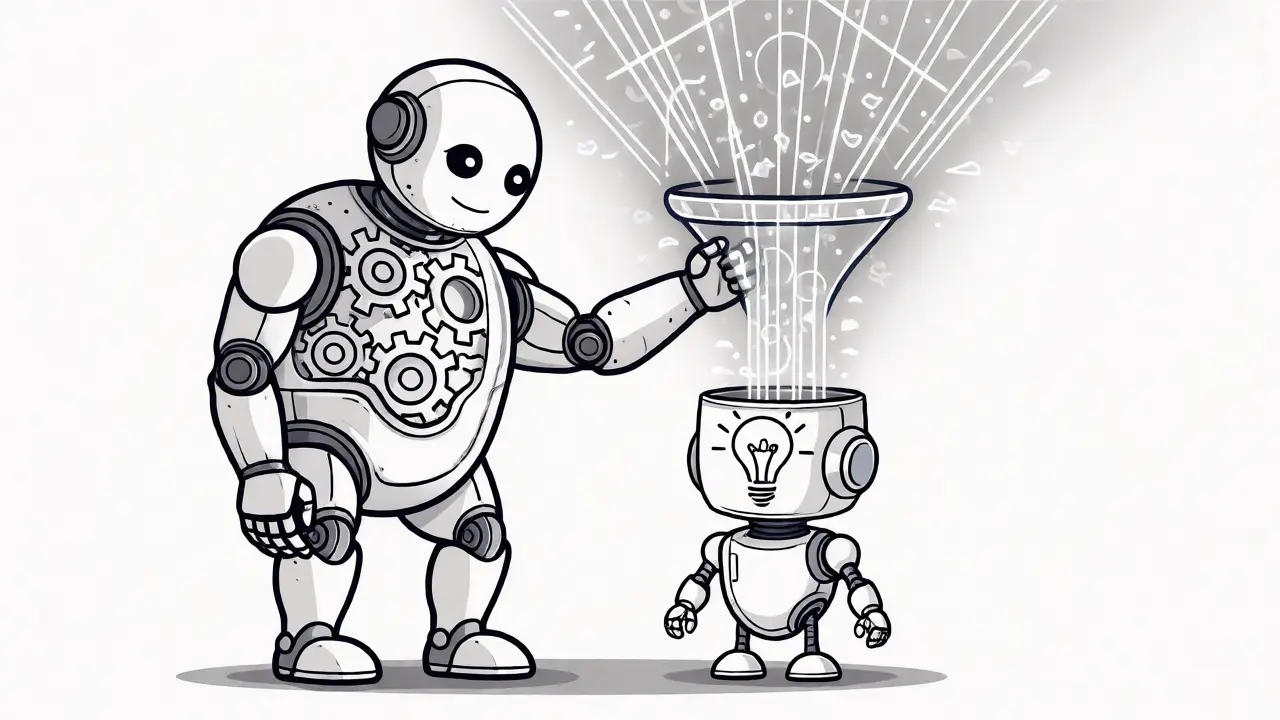
Companies like Microsoft and Meta are increasingly using large models to generate training data for smaller models. They create synthetic examples-complex reasoning chains, code snippets, or logical puzzles-that are then used to train compact models. This "distillation" process transfers knowledge from a teacher model to a student model, allowing the student to punch above its weight class.
However, synthetic data isn’t magic. If the teacher model has biases or errors, the student will inherit them. Moreover, relying too heavily on synthetic data can lead to "model collapse," where future models trained on previous AI outputs lose diversity and factual grounding. Balancing real-world data with synthetic augmentation is now a critical skill for ML engineers.
Environmental and Economic Implications
We can’t ignore the elephant in the room: cost and carbon. Training a frontier model requires thousands of GPUs running for weeks, consuming megawatts of electricity. Emily Bender, a linguist at the University of Washington, has pointed out that the climate costs of these massive computations disproportionately affect communities near data centers who may not benefit from the technology.
For startups and mid-sized enterprises, this economic reality dictates architecture choices. Running a 175-billion-parameter model in production might require multiple A100 GPUs, costing thousands of dollars per month. In contrast, a well-optimized 7-billion-parameter model can run on a single consumer-grade GPU or even a CPU cluster, slashing operational expenses by orders of magnitude. When latency matters-like in autonomous driving or live translation-the smaller model wins every time.

How to Choose: A Decision Framework
So, how do you decide which side of the tradeoff to lean on? Here’s a practical checklist:
- Task Complexity: Is the task creative and open-ended (writing, brainstorming)? Go big. Is it structured and repetitive (classification, extraction)? Go small.
- Latency Requirements: Do users need instant responses? Small models are faster. Can you tolerate a few seconds of delay? Large models are viable.
- Data Availability: Do you have massive, clean datasets? Large models can leverage them. Do you have limited niche data? Fine-tune a smaller model.
- Privacy Constraints: Can data leave your servers? If not, you must use models that fit on local hardware, favoring smaller architectures.
- Budget: Be realistic about inference costs. A slightly less accurate model that fits your budget is better than a perfect model you can’t afford to run.
Hybrid approaches are also gaining traction. Some systems use a large model for offline preprocessing-summarizing documents or extracting entities-and then pass that condensed information to a smaller, faster model for real-time interaction. This leverages the strengths of both worlds.
Frequently Asked Questions
Is it true that larger models always perform better?
No. While larger models generally have higher potential capability, they can underperform if trained on insufficient data or if the task is simple enough that a smaller, specialized model suffices. Recent studies show that well-trained small models can match large ones on specific classification tasks within a margin of error.
What happens if I train a huge model on a small dataset?
The model will likely overfit. It will memorize the training data rather than learning generalizable patterns, resulting in poor performance on new, unseen data. It essentially becomes a very expensive parrot that repeats what it heard during training without truly understanding context.
Can synthetic data replace real human data entirely?
Not yet. Synthetic data is excellent for augmenting scarce datasets and teaching reasoning skills, but it lacks the nuance, creativity, and ground-truth accuracy of human-generated content. Over-reliance on synthetic data risks propagating errors and reducing diversity in model outputs.
Which is more important for LLM performance: parameters or data?
They are interdependent. However, current trends suggest that data quality and diversity are becoming the limiting factors. As model architectures mature, access to unique, high-quality data provides a competitive edge that simply adding more parameters cannot replicate.
Are small models bad at reasoning?
Not necessarily. Modern small models like Phi-3 or Gemma use advanced training techniques and curated data to achieve strong reasoning capabilities. While they may struggle with extremely complex, multi-hop logic compared to frontier models, they handle everyday reasoning tasks surprisingly well.
 Artificial Intelligence