
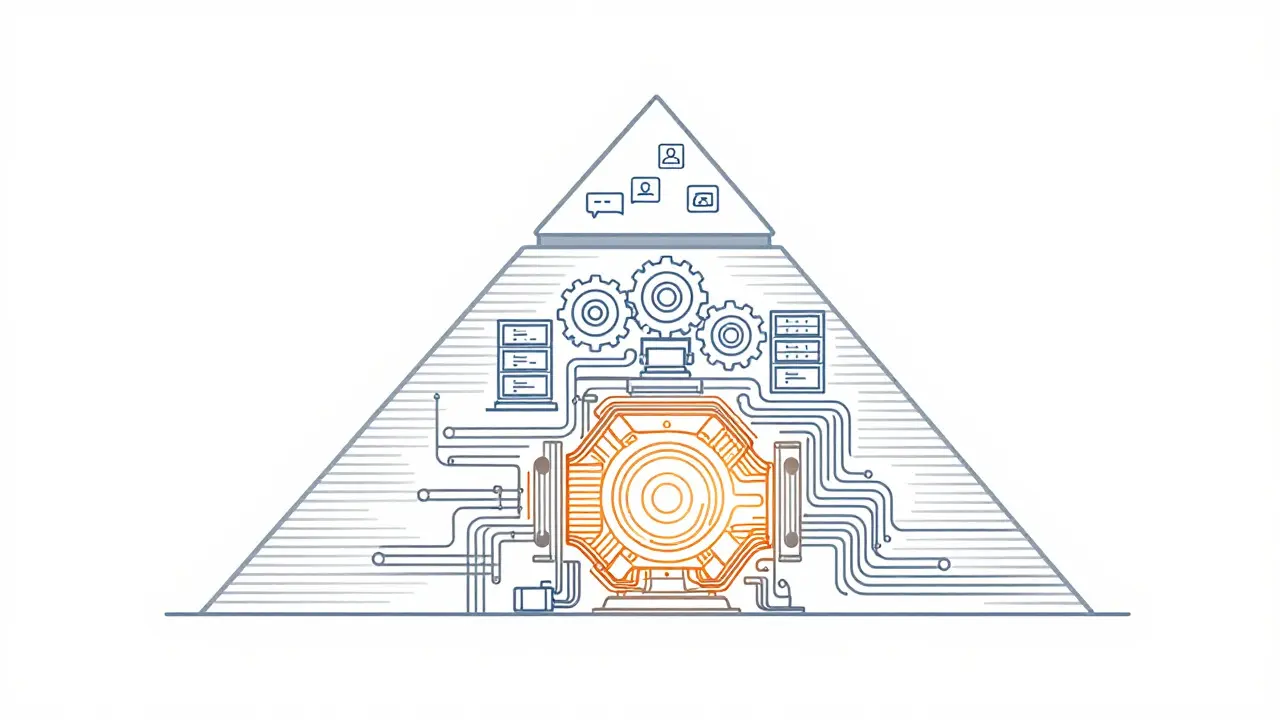
The generative AI landscape has stopped being a chaotic jumble of startups and now looks like a distinct three-tier pyramid. At the base sit the massive Foundation Models that power everything; in the middle are the AI Platforms that make those models usable; and at the top are the specific apps people actually touch every day. Understanding this structure is critical right now because the money, the talent, and the regulatory focus are all shifting from the bottom tier to the top. If you are trying to figure out where to invest, build, or buy in 2026, knowing who owns which layer tells you exactly where the leverage lies.
The Three-Tier Architecture Explained
Think of the generative AI market as a stack. The bottom layer consists of large-scale neural networks trained on vast datasets to perform general-purpose tasks. These are not built for one job; they are built to do almost anything. Companies like OpenAI, Anthropic, and Google DeepMind spend billions here. Their goal is raw capability. They don't care if you use their model to write code or generate images; they just want the engine to be the best in the world. This layer is characterized by extreme capital intensity and high barriers to entry. You need petabytes of data and thousands of GPUs to compete here.
The middle layer is where things get practical. AI Platforms take those raw foundation models and wrap them in infrastructure. They provide APIs, vector databases, orchestration tools, and security layers. Think of AWS Bedrock, Azure AI Studio, or Hugging Face. These companies don't always build the underlying model themselves; instead, they curate, fine-tune, and deploy them. They solve the "how do I integrate this into my existing tech stack" problem. For enterprise IT teams, this is the most important layer because it offers control, compliance, and scalability without requiring them to become machine learning experts overnight.
The top layer is the application. This is what end-users see. It’s the chatbot in your customer service portal, the image generator in your marketing suite, or the coding assistant in your IDE. These apps are often vertical-specific. A legal AI app uses a foundation model but applies strict rules for citation accuracy and confidentiality. A healthcare app focuses on diagnostic imaging. The value here isn't the model itself; it's the workflow integration and the domain-specific user experience. This is where most of the consumer-facing innovation happens, and where competition is fiercest because the barrier to entry is lower than in the other two tiers.
Market Size and Growth Trajectories
The numbers in this space are staggering, though they vary depending on who is counting. According to Global Market Insights, the global generative AI market was valued at USD 53.7 billion in 2025. By 2026, that figure is projected to jump to USD 83.3 billion. The long-term outlook is even more dramatic, with forecasts suggesting the market could reach nearly USD 1 trillion by 2035. That represents a compound annual growth rate (CAGR) of about 31.6% over the next decade. Precedence Research offers a slightly different view, placing the 2025 market at USD 37.89 billion but projecting a higher CAGR of nearly 37%. Why the discrepancy? It usually comes down to scope. Some analysts include only software licenses, while others include services, hardware, and consulting fees. Regardless of the exact number, the consensus is clear: this is one of the fastest-growing technology sectors in history.
Software dominates the mix, accounting for roughly 81% of the total market value in 2025. Services make up the rest, but that slice is growing as enterprises realize that buying a tool is easy; making it work in production is hard. This shift from pure software sales to solution-based services is a key indicator of market maturity. Companies are no longer just selling tokens; they are selling outcomes.
Technology Drivers: Transformers and Beyond
You can’t talk about market structure without talking about the technology underneath it. The dominant architecture remains the transformer, introduced in the 2017 paper "Attention is All You Need." Transformers account for over 40% of the market share simply because they are so versatile. They handle text, images, audio, and video. But the landscape is evolving. Diffusion models have taken over the image generation space, offering superior quality and controllability compared to older GANs (Generative Adversarial Networks). Meanwhile, reinforcement learning from human feedback (RLHF) is becoming standard practice. It’s not just about generating text; it’s about generating text that humans find helpful and safe. This alignment process adds a new layer of complexity and cost, but it also creates a moat for companies that master it.
Data modality is another key driver. Text generation still leads with a 48% market share, largely due to the ubiquity of large language models in business operations. However, multimodal models-those that can process and generate multiple types of data simultaneously-are the fastest-growing segment. Enterprises want an AI that can read a contract, look at a diagram, and listen to a meeting recording all at once. This demand is pushing foundation model developers to build increasingly complex, unified architectures rather than separate silos for text and vision.
Deployment Strategies: Cloud vs. On-Premises
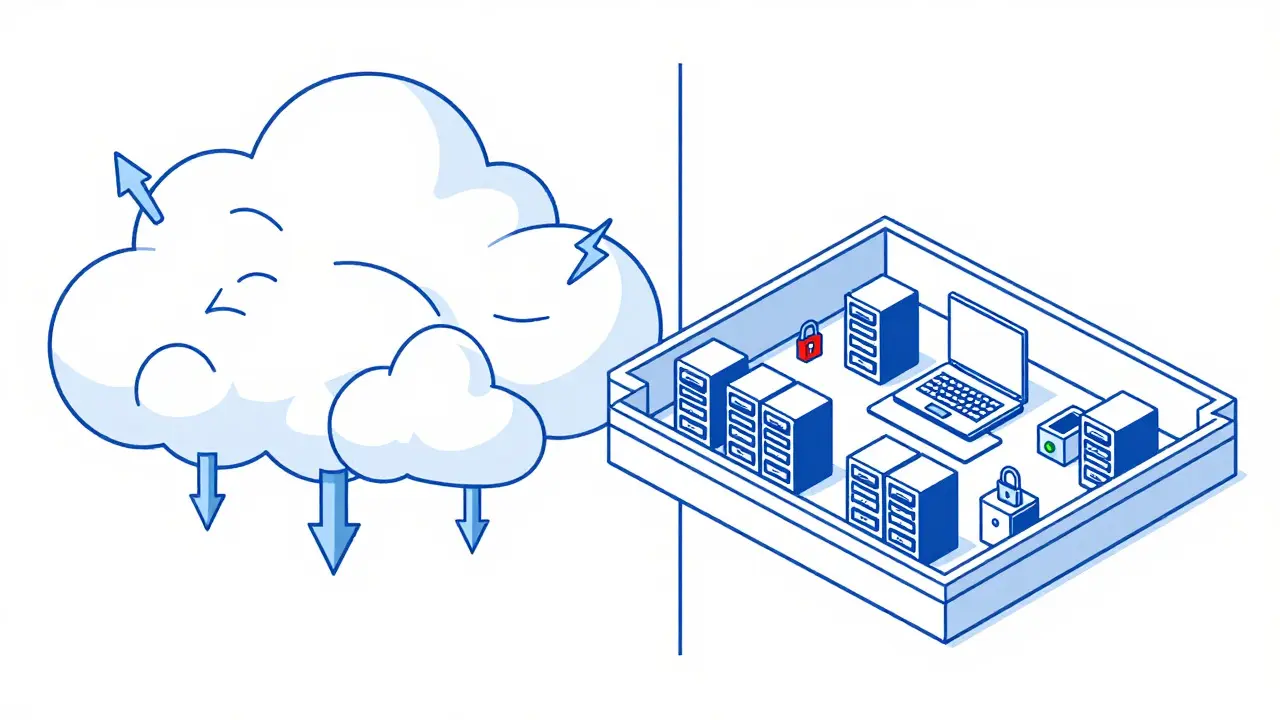
Where you run your AI matters just as much as what you run. In 2025, cloud deployment dominated with a 73.8% market share. It makes sense: training and running foundation models requires massive compute power that most companies don't want to buy and maintain themselves. Cloud providers offer elastic scaling, meaning you pay for what you use. This lowers the initial capital expenditure and allows startups to compete with giants.
However, on-premises deployment is gaining traction, especially in regulated industries like finance, healthcare, and government. Data sovereignty is a huge concern. Many organizations prefer to keep their proprietary data within their own walls. This trend is driving the development of smaller, efficient models that can run on local hardware. Edge AI is also emerging as a significant segment, expected to grow at a CAGR of 21.5%. These edge devices process data locally, reducing latency and bandwidth costs. For real-time applications like autonomous vehicles or factory automation, edge deployment is often the only viable option.
Geographic Dynamics and Regional Leaders
North America is currently the undisputed leader, capturing about 41% of the global market revenue in 2025. The United States alone generated nearly USD 24 billion, driven by the concentration of major tech hubs and venture capital. Europe follows with an 18.69% share, with Germany leading the charge. European adoption is heavily influenced by regulation, particularly the EU AI Act, which forces companies to build compliance into their products from day one. This regulatory rigor is creating a unique niche for European AI vendors who specialize in explainable and compliant AI solutions.
Asia Pacific is the growth story to watch. While it currently holds a smaller share than North America, it is projected to grow at the highest rate, around 35.3% CAGR through 2035. China is the primary driver, with aggressive government support and a massive domestic market. Other regions, like Latin America and the Middle East, are showing promising signs of growth, particularly in countries like Brazil and the UAE, which are investing heavily in digital transformation and AI infrastructure.

Competitive Landscape and Industry Verticals
The competitive field is crowded but stratified. At the top, you have the hyperscalers: Microsoft, Google, Amazon, and Meta. They control the infrastructure and the foundational research. Below them are specialized platform providers and application developers. The IT and telecom sector is the largest end-user group, accounting for over 20% of the market. They adopt AI first because they understand the technology and have the budget to implement it. But the real action is happening in vertical specialization. Legal, medical, and industrial domains are seeing a surge in customized AI solutions. Horizontal platforms are struggling to win these deep-vertical clients because they lack the specific domain expertise required to solve nuanced problems. This is why we are seeing so many acquisitions of niche AI startups by larger enterprise software companies. They want to bolt on that specialized intelligence to their existing product portfolios.
Future Trends and Strategic Implications
As we move deeper into 2026, several trends will define the market structure. First, agentic AI is moving from hype to reality. Autonomous agents that can plan and execute multi-step tasks with minimal human oversight are becoming a core feature of enterprise platforms. Second, the focus is shifting from "building an AI" to "realizing value from AI." Many early pilots failed to deliver measurable ROI. Now, enterprises are demanding concrete business cases. This pressure is pushing vendors to offer outcome-based pricing and clearer metrics for success. Finally, consolidation is accelerating. The number of standalone foundation model labs may shrink as the cost of maintaining state-of-the-art performance becomes too high for mid-sized players. Expect to see more partnerships and mergers between platform providers and application developers to create end-to-end solutions.
| Tier | Key Players | Primary Value Proposition | Barrier to Entry |
|---|---|---|---|
| Foundation Models | OpenAI, Anthropic, Google DeepMind | Raw computational capability and general intelligence | Very High (Capital & Talent) |
| AI Platforms | AWS, Azure, Hugging Face | Integration, security, and deployment infrastructure | High (Technical Complexity) |
| Applications | Vertical SaaS, Startups | Specific user workflows and domain expertise | Moderate (UX & Domain Knowledge) |
Frequently Asked Questions
What is the difference between a foundation model and an AI platform?
A foundation model is the underlying neural network engine trained on massive datasets to perform general tasks. An AI platform is the infrastructure layer that allows businesses to access, fine-tune, and deploy these models securely and efficiently. Think of the model as the car engine and the platform as the chassis, transmission, and safety systems that make the car drivable for everyday users.
Why is cloud deployment so dominant in the generative AI market?
Cloud deployment dominates because training and running large generative AI models requires immense computational power. Most companies prefer to rent this capacity from cloud providers rather than buying and maintaining their own data centers. This approach reduces upfront costs and allows for rapid scaling based on demand.
Which industry vertical is adopting generative AI the fastest?
The IT and telecommunications sector currently leads adoption, holding over 20% of the market share. However, vertical-specific applications in legal, healthcare, and manufacturing are growing rapidly as companies seek specialized solutions that address domain-specific compliance and workflow challenges.
How does regulation affect the generative AI market structure?
Regulation, such as the EU AI Act, is pushing companies to build compliance, transparency, and security directly into their products. This favors established players who can afford robust governance frameworks and creates opportunities for specialized vendors who focus on explainable and compliant AI solutions, particularly in regulated industries like finance and healthcare.
What is the role of edge AI in the future of generative AI?
Edge AI involves running AI models locally on devices rather than in the cloud. It is becoming increasingly important for applications that require low latency, high privacy, or offline capability. As models become smaller and more efficient, edge deployment will expand, allowing generative AI to power devices like smartphones, IoT sensors, and autonomous vehicles without constant internet connectivity.
 Artificial Intelligence




Jeff Falcon
August 28, 2026 AT 18:44Look, I think this three-tier pyramid thing is actually a really solid way to visualize where the money is going right now! It’s not just about having the smartest model anymore, because honestly, most of those foundation models are pretty similar in capability these days. The real differentiator is definitely in that middle platform layer, which is where all the heavy lifting for integration happens. If you are trying to build something, you need to know if you are competing on raw compute or on workflow integration, and this post makes that distinction super clear. I also love how they highlighted the shift from software licenses to services; it feels like the market is finally maturing past the hype phase. The numbers about the CAGR are wild too, but then again, everything in tech grows exponentially until it crashes or stabilizes. For anyone in enterprise IT, the point about compliance and control in the middle tier is probably the most actionable takeaway here. It’s rare to see an article that breaks down the value proposition so cleanly without getting bogged down in jargon. I’m definitely saving this to share with my team who keeps asking us why we can’t just 'use ChatGPT' for everything. The barrier to entry discussion is spot on as well; you really do need billions to play at the bottom, but you only need good UX at the top. It’s a bit scary how much leverage the platforms have, though, since they control the distribution channel. But overall, a very helpful framework for understanding the 2026 landscape!
Alyson Karson
August 29, 2026 AT 15:50omg finally someone said it out loud!! the app layer is where the actual magic (and money) is happening and everyone keeps obsessing over the models like theyre the end goal?? i mean sure openai is cool but can they even run my specific legal workflow without me rewriting half their output? exactly what i was thinking when i read the section on vertical specialization. the fact that horizontal platforms are struggling to win deep-vertical clients is such a relief to hear because it means niche startups still have a shot. also the edge ai stuff is gonna be huge for privacy nerds like me who hate sending data to the cloud. keep up the great work posting this info its so hard to find clean breakdowns without the sales pitch attached. totally agree with the consolidation trend too, we cant sustain another 500 foundation model labs burning cash. this is the kind of content that actually helps people make decisions instead of just scrolling past headlines. love the energy here!!!
Chris Neal
August 30, 2026 AT 23:47You’re missing the nuance. The "pyramid" is a false dichotomy. In reality, the lines between foundation models and platforms are blurring faster than you think. Look at how Microsoft is integrating Azure AI Studio directly into their Copilot stack. They aren't just a platform; they're becoming the application layer themselves. The idea that there is a distinct "middle" is a temporary artifact of the current hardware constraints. Once inference costs drop by another order of magnitude, the platform layer becomes commoditized infrastructure, indistinguishable from the cloud itself. So don't get too comfortable with this three-tier mental model. It's already shifting. The real moat isn't the model or the platform; it's the proprietary data loop. That's what actually matters. Everything else is just plumbing.
Vishnu Vardhan Reddy M S
September 1, 2026 AT 20:50Haha, classic take. "Plumbing." Yeah, sure. Until your API rate limits kick in during peak hours and your whole product goes down. Then it's not plumbing, it's the entire building. But hey, if you've got the proprietary data loop, go ahead and build your own transformer from scratch. I'm sure your investors will love the burn rate. Meanwhile, the rest of us are just trying to figure out how to deploy a decent RAG pipeline without hiring a PhD in distributed systems. The post is a bit idealistic, but it's a good starting point for folks who are new to the space. Don't let the cynicism stop you from reading the full analysis. The geographic dynamics section alone is worth the click, especially if you're looking at APAC growth opportunities. China's government support is no joke, and ignoring that while focusing solely on US-centric narratives is a mistake many analysts make. Anyway, nice try at being contrarian. We'll see how that plays out when the next wave of efficient small models hits the market.
Kyle Ware
September 3, 2026 AT 19:07Good points on the data loop. Just remember that data quality often matters more than quantity. A lot of companies hoard data but never clean it. That leads to garbage in garbage out. The platform layer helps with some of that via orchestration tools but it doesn't solve the fundamental issue of messy legacy data. Also worth noting that the EU AI Act is going to force a lot of these "proprietary loops" to be more transparent. You can't just hide behind black-box algorithms forever. Compliance is becoming a feature, not a bug. For smaller teams, this might actually level the playing field a bit. If you can prove your AI is explainable and fair, you might win contracts that the big players lose due to their complexity. Keep an eye on that regulatory angle. It's often overlooked in technical discussions but it drives procurement decisions more than anything else in enterprise settings.
Iva Grekova
September 4, 2026 AT 05:20I feel like we're all talking past each other a little bit. The pyramid model works for explaining the *current* state of the market, but it's not necessarily predictive of the future. Technology shifts fast. Five years ago, nobody predicted that diffusion models would completely overshadow GANs for image generation. Who knows what architecture will replace transformers in 2028? Maybe it's something we haven't even named yet. So while the three tiers are useful for understanding where the budget is allocated today, don't bet the farm on that structure remaining static. The key is to stay adaptable. Whether you're in the foundation model space or the app space, the ability to pivot quickly is what will determine survival. It's exciting times though. The potential for impact is massive. I'm just glad we're having these conversations to clarify the landscape before making big moves.
Onyinyechi Nwosu
September 5, 2026 AT 17:47It is interesting to see how much focus is on North America and Europe. What about the rest of the world? Africa and South Asia are growing markets but they are often left out of these high-level strategic analyses. The infrastructure challenges are different there. Latency and cost are major hurdles. Edge AI might be even more critical in these regions because cloud connectivity is not always reliable. The post mentions APAC growth but doesn't dive deep into the specific dynamics of countries like India or Nigeria. It would be valuable to see more localized insights. Global strategies often fail when they ignore local context. But overall the breakdown of the tiers is helpful for understanding the global flow of capital and talent.
Chandan Singh
September 5, 2026 AT 20:28Agreed. The APAC section was a bit thin. China is mentioned as a driver, but what about the fragmentation of the Asian market? Japan, Korea, Singapore, India - they all have different regulatory environments and cultural attitudes towards AI adoption. For example, Japan has a strong culture of precision and trust in established brands, which might favor different types of AI solutions compared to the startup-heavy ecosystem in Silicon Valley. Ignoring these nuances gives a skewed view of the global market. The "one size fits all" approach to generative AI strategy is a recipe for failure in international expansion. Companies need to localize not just the language, but the entire user experience and deployment strategy. This is a complex area that deserves more attention than a single paragraph in a general overview article.
Brannen Hall
September 6, 2026 AT 15:44Boring. Another listicle pretending to be deep analysis. The pyramid metaphor is overused. It's just a stack of vendors selling shovels. The real story is that most of these apps will be dead within two years. The foundation models are a commodity race to the bottom on price. The platforms are just middleware that gets squeezed out by direct integrations. And the apps? They're all copycats of ChatGPT with a slightly different color scheme. Wake up. The market is saturated. The only winners will be the ones who own the distribution channel, which is basically the OS providers. Everyone else is fighting for scraps. Good luck figuring out where the leverage is when the whole house is built on sand. Oh wait, you thought this article helped you? Cute.