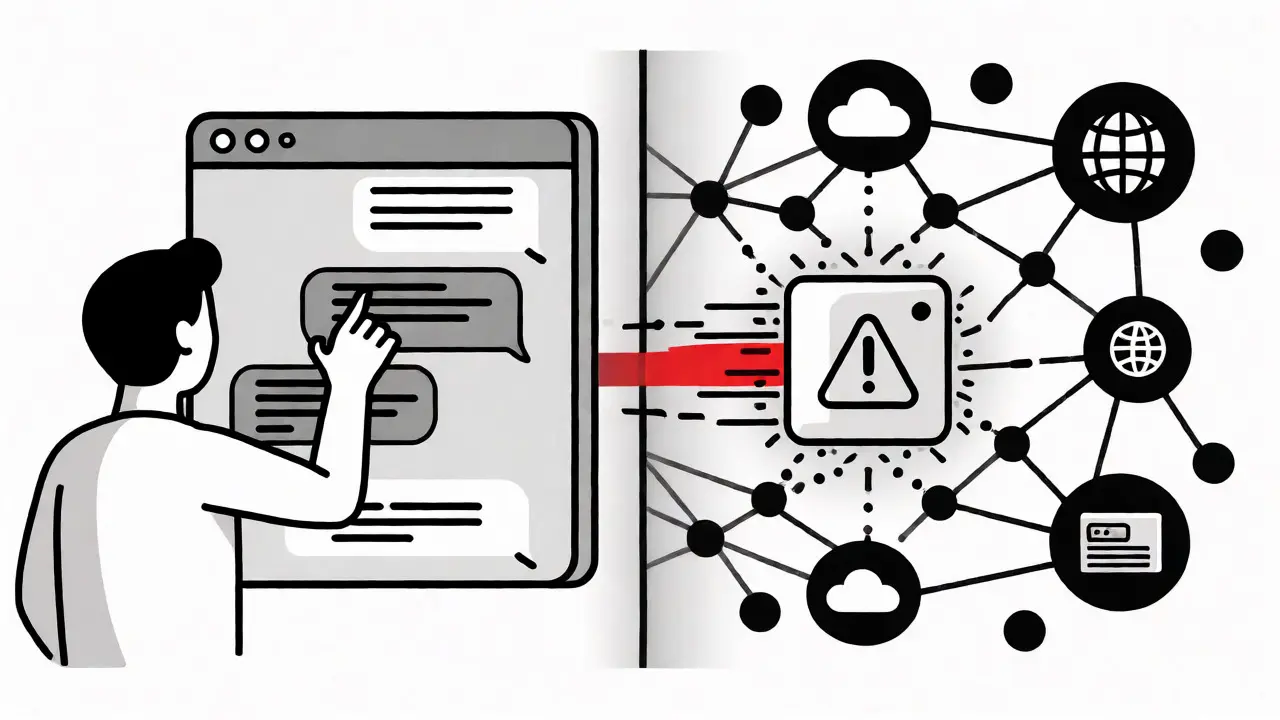
You paste a customer email into a public AI chatbot to summarize it. Simple task, right? But that single click might have just shipped personal data from the EU to a server in California or China, potentially violating GDPR the European Union's General Data Protection Regulation, which governs how personal data is collected and processed. If you are handling Generative AI artificial intelligence systems capable of creating new content based on training data, you are walking a regulatory tightrope.
The core issue isn't just about using AI; it's about where that AI lives and who can see your data while it works. As of late 2025, regulators are no longer guessing. They are fining companies billions for getting this wrong. Meta paid €1.2 billion in 2024 for improper data transfers. Replika got hit with a €5 million fine for transparency failures. The message is clear: if your generative AI moves data across borders without proper safeguards, you are exposed.
| Risk Factor | Description | Regulatory Impact |
|---|---|---|
| Opaque Supply Chains | AI vendors often use multiple subprocessors (cloud providers, model hosts) in different countries. | High risk of unauthorized access by foreign governments. |
| Employee Shadow IT | Staff pasting sensitive data into public tools without knowing data routing paths. | Unintended violations of Article 44 GDPR. |
| Legal Conflicts | US CLOUD Act vs. EU GDPR requirements for data sovereignty. | Inability to guarantee equivalent protection levels. |
Why Generative AI Breaks Traditional Transfer Rules
Traditional software usually processes data in one place. Generative AI doesn't work that way. When you send a prompt to a large language model (LLM), your data might travel through an API gateway, get stored temporarily in a cache, be processed by a model hosted on AWS in Virginia, and then return via a CDN in Frankfurt. Each hop is a potential transfer point under Chapter V of the GDPR.
The problem intensifies because most major AI models are trained on vast datasets scraped from the internet. This means your specific input might influence the model's future outputs, effectively "training" the AI with your personal data. If that model resides in a country without an adequacy decision from the European Commission, you need a legal mechanism to justify that transfer.
Only 16 countries currently hold an adequacy certification, including Japan, Canada, and the UK. The US does not have a blanket adequacy decision following the invalidation of Privacy Shield. While the EU-US Data Privacy Framework (DPF) attempts to bridge this gap, its stability remains a subject of intense legal scrutiny. Relying solely on the DPF is risky if you don't verify that your specific AI vendor is actually certified and compliant.
The Two-Step Legal Test for Every Transfer
Don't make the mistake of thinking a Standard Contractual Clause (SCC) solves everything. The GDPR requires a two-step validation process for every international transfer involving generative AI.
- Lawfulness of Processing: First, do you have a valid legal basis to process the personal data in the first place? Under Articles 6 and 9, this could be consent, contractual necessity, or legitimate interest. For AI, "legitimate interest" is tricky because you must prove the processing is necessary and doesn't override user rights.
- Transfer Mechanism Validity: Second, once you've established you can process the data, you must ensure the cross-border movement itself is protected. This is where SCCs, Binding Corporate Rules (BCRs), or derogations come in.
If you fail step one, the transfer is illegal regardless of the contract. If you pass step one but fail step two, you're still liable. Recent EDPB guidelines emphasize that contractual necessity (Article 6(1)(b)) cannot serve as a standalone basis for complying with third-country authority requests, such as those under the US CLOUD Act. This creates a compliance hurdle: you can't just sign a contract and hope for the best.

Standard Contractual Clauses Are Not Enough
For years, companies relied on Standard Contractual Clauses standardized clauses approved by the European Commission for transferring personal data outside the EEA as a quick fix. But since the Schrems II ruling, SCCs require a supplementary measure known as a Transfer Impact Assessment (TIA).
A TIA forces you to look at the laws of the destination country. Does the US government have surveillance powers that override privacy protections? Does China's state security law allow broad data access? If the answer is yes, standard contracts aren't enough. You need technical measures like encryption, pseudonymization, or differential privacy to supplement the legal contract.
Consider the DeepSeek case in Berlin. Authorities used the Digital Services Act (DSA) alongside GDPR to pressure Apple and Google to delist the app due to concerns over data transfers to China. This shows regulators are expanding their toolkit. It’s not just about data protection anymore; it’s about digital sovereignty.

Practical Steps for Compliance Teams
How do you actually implement this without stalling innovation? Start with these four critical questions before deploying any new AI tool:
- Who is the controller? Is your company deciding how data is used, or is the AI vendor?
- Where does the data go? Map every subprocessor. If the vendor uses Azure OpenAI, where are the servers?
- Is there a legal basis? Do you have explicit consent or a clear contract covering AI processing?
- Are transfers occurring? Does the data leave the EEA? If so, what mechanism covers it?
Update your Records of Processing Activities (ROPAs). Most companies haven't updated theirs to reflect AI usage. Conduct a Data Protection Impact Assessment (DPIA) specifically for high-risk AI applications. This isn't busywork; it's your defense in court.
Also, train your employees. A significant portion of breaches comes from staff pasting PII into public chatbots. Implement an acceptable use policy that bans entering sensitive data into unapproved tools. Provide sanctioned, enterprise-grade alternatives that offer zero-data-retention guarantees.
The Future of Cross-Border AI Regulation
The landscape is shifting fast. The EU AI Act, fully effective by Q3 2026, will layer additional requirements on top of GDPR. High-risk AI systems will need even stricter data governance. We are seeing a convergence of GDPR, the DSA, and the AI Act, creating a complex web of obligations.
Privacy-enhancing technologies (PETs) like homomorphic encryption are gaining traction, allowing computation on encrypted data without decrypting it. While expensive for SMEs, they offer a robust solution for cross-border transfers. Expect more enforcement actions targeting the opacity of AI supply chains. Regulators want visibility into who holds your data and under what jurisdiction.
Ultimately, treating data transfers as a checkbox exercise is dangerous. With fines reaching into the billions and reputational damage looming, proactive compliance is cheaper than reactive litigation. Audit your AI stack today. If you can't trace the path of your data, you can't protect it.
Does using a public AI chatbot violate GDPR?
Not necessarily, but it often does if personal data is involved. Public AI tools typically route data to servers outside the EEA. Without a valid transfer mechanism like Standard Contractual Clauses or an adequacy decision, and without a proper legal basis for processing, this constitutes a violation. Always check if the provider offers an enterprise version with data residency guarantees.
What is a Transfer Impact Assessment (TIA)?
A TIA is a documented analysis required after the Schrems II ruling. It evaluates whether the laws in the destination country provide protection essentially equivalent to the EU. If local surveillance laws undermine privacy, you must implement supplementary technical measures like encryption to proceed with the transfer.
Can I rely on the EU-US Data Privacy Framework?
You can, but only if the specific AI vendor is certified under the framework. Certification is voluntary for companies. Even with certification, ongoing legal challenges mean it carries some risk. Many organizations prefer combining it with SCCs for added security.
Do I need consent for every AI data transfer?
Not always. Consent is one legal basis, but others like 'contractual necessity' or 'legitimate interest' may apply. However, for special categories of data (like health or biometrics), explicit consent is often required. The key is documenting which basis you use and why.
What happens if my AI vendor uses sub-processors?
You remain responsible for all sub-processors. Your contract must flow down GDPR obligations to them. You need transparency on who they are and where they are located. Lack of visibility into sub-processors is a common reason for enforcement actions against AI companies.
 Artificial Intelligence