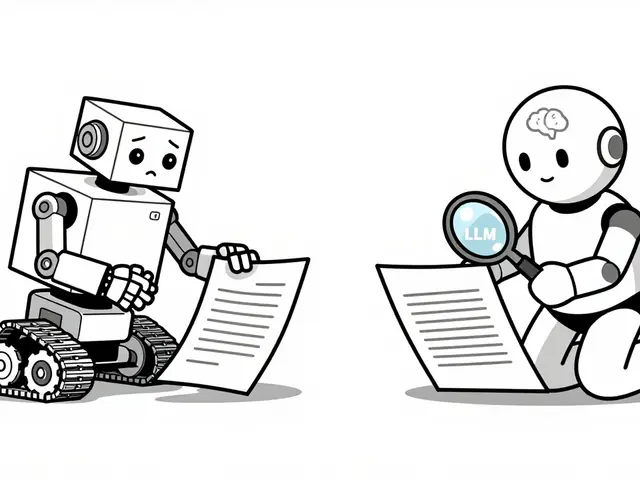
Have you ever asked an AI to write a complex legal argument or explain a nuanced grammatical rule, only to get a response that sounds perfectly professional but is subtly wrong? You are not alone. This phenomenon highlights the central tension in modern artificial intelligence: the difference between fluency, which is the ability to produce smooth, coherent text, and deep structural knowledge of language rules and logic. Large language models (LLMs) have become incredibly good at sounding smart, but do they actually understand what they are saying?
To put it simply, LLMs are masters of pattern matching, not necessarily masters of truth or deep linguistic structure. They can pass bar exams and medical boards with flying colors, yet they often fail when faced with tricky, rare, or logically complex language tasks. Understanding this gap is crucial for anyone relying on AI for critical work. It helps you know when to trust the output and when to double-check your facts.
The Illusion of Understanding: How LLMs Learn
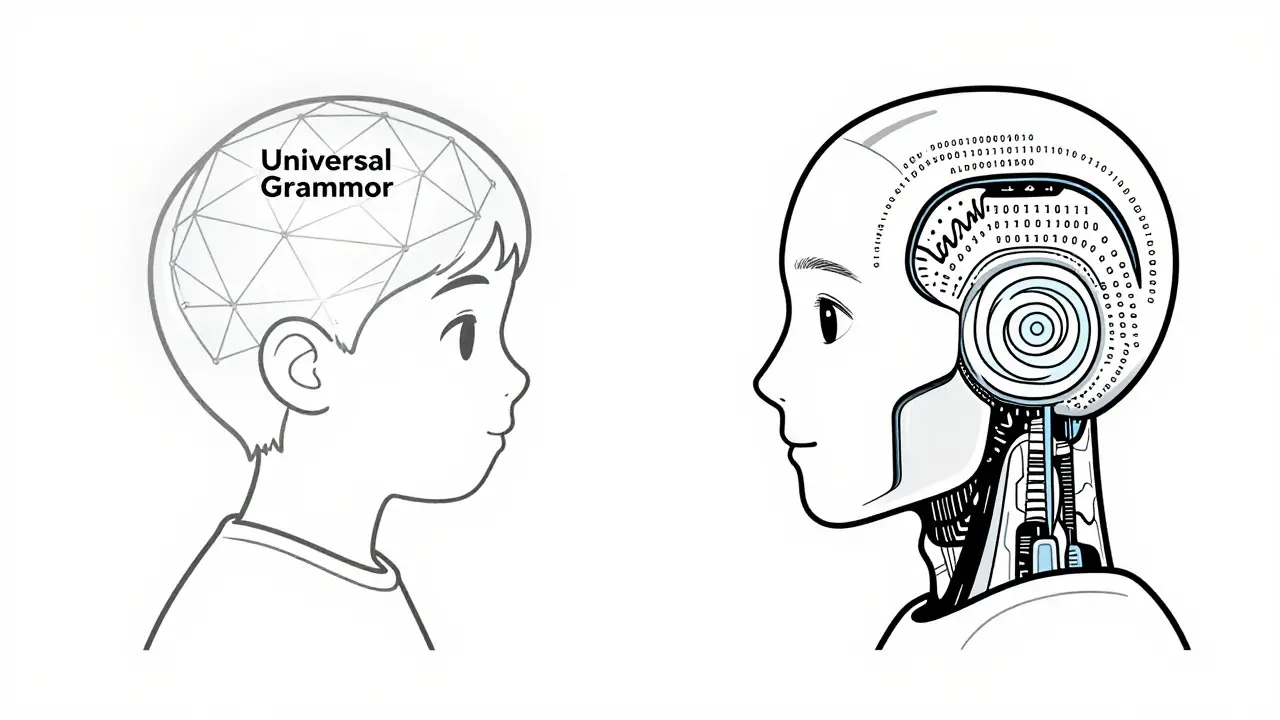
Human children learn language efficiently. A child exposed to roughly five million words can develop native-level fluency. They possess an innate biological bias, often referred to as Universal Grammar, which helps them converge on grammatical rules quickly. Their brains are wired to recognize hierarchical structures in speech, allowing them to understand complex sentences even if they have never heard those exact words before.
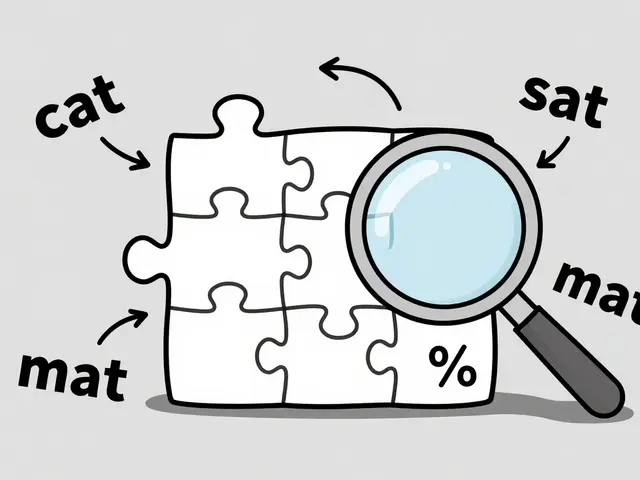
Large Language Models like GPT-4 or Claude take a completely different path. Instead of innate biases, they rely on Statistical Learning Theory. They process petabytes of data, looking for patterns in how words follow other words. An LLM predicts the next most likely token (word or part of a word) in a sequence based on probability. There is no "understanding" in the human sense; there is only calculation.
This difference creates a fundamental limitation. Humans use complex hierarchical grammar to construct meaning. LLMs use sequential prediction. For common phrases and simple sentences, this works great. But when the sentence structure becomes intricate, rare, or logically twisted, the model’s flat, statistical approach often breaks down. It produces errors because it lacks the deep structural knowledge that humans acquire naturally.
Impressive Scores, Hidden Weaknesses
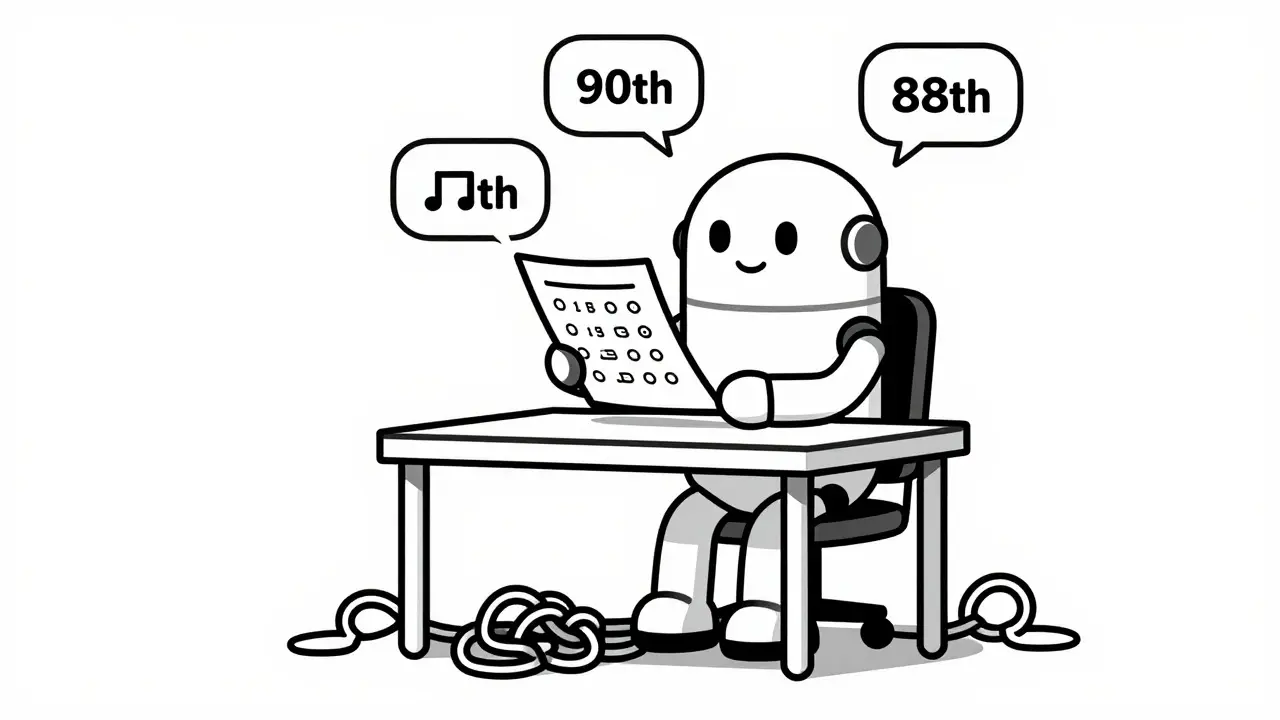
If you look at standardized test scores, it is easy to assume LLMs have mastered knowledge. The numbers are staggering. GPT-4, released by OpenAI in March 2023, scored higher than 93% of human test-takers on the SAT Reading and Writing section. In law school admissions tests, GPT-4 achieved the 88th percentile, while its predecessor, GPT-3.5, sat at the 40th. On the Uniform Bar Exam, GPT-4 jumped from the 10th percentile (GPT-3.5) to the 90th.
Even in specialized fields like medicine, the performance is notable. ChatGPT-4 scored an average of 68 on funduscopic examination questions, outperforming general ophthalmologists who averaged 61, though falling short of specialists who averaged 73. These results demonstrate high fluency-the ability to generate correct answers in familiar contexts.
However, high scores do not equal mastery. These tests often rely on multiple-choice formats or standard scenarios where patterns are well-defined. The model is essentially recalling similar patterns it saw during training. It does not mean the model possesses the deep, flexible knowledge base of an expert specialist who can reason through novel, unstructured problems.
Consistency and Confidence: Do LLMs Know What They Don't Know?
A major red flag in assessing LLM knowledge is consistency. If a model truly understands a concept, it should answer consistently across multiple trials. Research shows significant variation here. Models like ChatGPT-4 and PaLM2 show high correlation in their answers across repeated tests, indicating some stability. However, confidence levels vary wildly.
| Model | Correct Answer Rate | Incorrect/Error Rate | Confidence Profile |
|---|---|---|---|
| ChatGPT-4 | 59% | 28% | High stability, but still perplexed often |
| PaLM2 | 44% | 38% | Bimodal: either confident/correct or confused/wrong |
| SenseNova | 29% | 26% | Moderate confidence |
| ChatGPT-3.5 | 23% | 26% | Lower confidence |
| Claude 2 | 21% | 32% | Lowest confidence level |
Notice that ChatGPT-4 provides incorrect responses in 28% of questions despite having the highest success rate. This suggests that fluency masks underlying inconsistency. The model generates plausible-sounding text even when it is wrong. This is known as hallucination. Because the output looks fluent, users may trust it blindly, leading to errors in critical applications.
Where LLMs Excel: The Power of Surface-Level Fluency
Despite these gaps, LLMs are incredibly useful tools. Their strengths lie in domains where deep structural reasoning is less critical than breadth and speed. LLMs have massive context windows. For example, GPT-3.5 has a context window of 2,000 tokens, allowing it to hold more immediate information in "working memory" than a human can recall perfectly.
This makes them exceptional at:
- Summarization: Condensing long documents into key points without losing the main narrative.
- Terminology Extraction: Identifying key terms and definitions within a text.
- Sentiment Analysis: Detecting tone and emotion in customer feedback or social media posts.
- Style Transfer: Rewriting text to change voice, register, or neutralize gender references.
- Code Generation: Understanding formal languages like Python or JavaScript, often performing as well as junior developers on standard tasks.
Techniques like Instruction Tuning and Reinforcement Learning from Human Feedback (RLHF) have further aligned these models with human preferences. Tools like InstructGPT and CodeX leverage these methods to make outputs more practical and user-friendly. For routine writing, editing, and coding assistance, LLM fluency is a powerful asset.
The Critical Gap: Complex Linguistic Structures
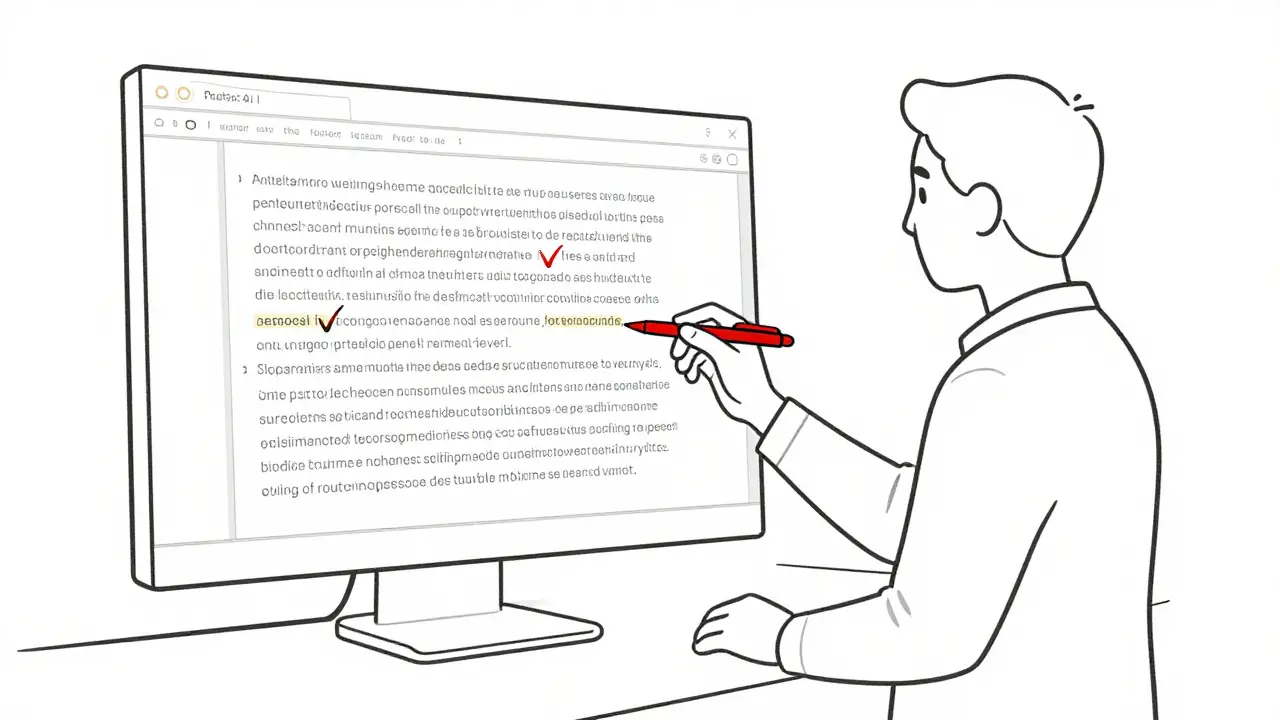
The trouble starts when tasks require deep structural understanding. LLMs struggle with intricate, infrequent grammatical constructions. Because they rely on probability rather than syntactic knowledge, they often make mistakes in logical reasoning or complex sentence parsing.
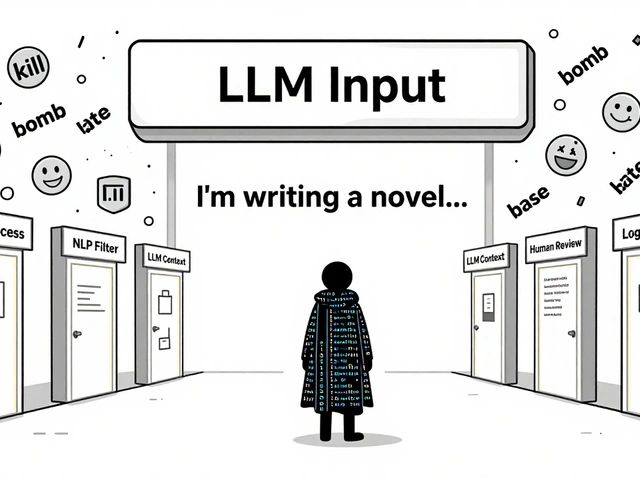
For instance, if you ask an LLM to evaluate whether a highly convoluted sentence is grammatically correct, it might guess based on surface patterns rather than applying strict grammatical rules. This is why human oversight remains essential. Linguists, editors, and domain experts are needed to validate LLM output, design effective prompts, and fine-tune models. The AI provides the draft; the human provides the judgment.
Future Directions: Bridging the Gap
Can we fix this? Researchers believe that scaling up data and parameters alone will not solve the problem. To achieve human-like linguistic competence, future models may need architectural innovations that introduce non-trivial structural priors-similar to the innate biases humans possess.
We are seeing emergent capabilities as models grow larger. Beyond certain parameter thresholds, new abilities appear, such as better context learning. However, true alignment between fluency and knowledge likely requires integrating human-like learning biases into model architectures. Until then, we must treat LLMs as powerful but imperfect assistants, capable of impressive fluency but lacking the deep, reliable knowledge of human experts.
What is the difference between fluency and knowledge in LLMs?
Fluency refers to the model's ability to generate coherent, grammatically correct, and contextually appropriate text based on statistical patterns. Knowledge implies a deep, structural understanding of language rules, logic, and facts. LLMs excel at fluency but often lack true knowledge, leading to plausible but incorrect outputs.
Why do LLMs perform well on standardized tests like the Bar Exam?
Standardized tests often have predictable patterns and formats. LLMs trained on vast amounts of text can recognize these patterns and generate high-probability answers. This demonstrates surface-level fluency rather than the deep reasoning skills required for novel legal arguments.
Are LLMs reliable for complex grammatical tasks?
Not entirely. While they handle common grammar well, LLMs struggle with intricate, rare, or logically complex structures. Their reliance on sequential prediction means they can miss hierarchical grammatical nuances that humans grasp intuitively.
How does human language acquisition differ from LLM training?
Humans learn language using innate biases (Universal Grammar) and require far less data (approx. 5 million tokens). LLMs use statistical learning on petabytes of data without innate biases, predicting next tokens based on probability rather than structural understanding.
What are the best use cases for current LLMs?
LLMs are best suited for summarization, sentiment analysis, style transfer, terminology extraction, and routine code generation. Tasks requiring deep logical reasoning, novel problem-solving, or absolute factual accuracy require human oversight.
 Artificial Intelligence