It is easy to feel invincible when an AI assistant writes your entire backend in seconds. You type a prompt, the code appears, and you deploy. But that speed comes with a hidden cost. A July 2025 report from Escape Technologies exposed the Base44 vulnerability, showing how unauthenticated attackers could easily compromise applications built through vibe coding-the practice of generating application code primarily through AI-assisted development where developers provide high-level prompts rather than writing detailed code manually. This isn't a theoretical risk. In early 2026, researchers scanned over 14,600 assets and found more than 2,000 critical vulnerabilities, including exposed secrets and personally identifiable information (PII), in services built this way.
The problem is simple: AI models are trained on public code repositories, which often contain insecure patterns. When you vibe-code, you inherit those flaws at scale. To protect these services, you cannot rely on hope or manual code reviews alone. You need robust runtime protections. Specifically, you need a layered defense strategy combining Web Application Firewalls (WAFs), Runtime Application Self-Protection (RASP), and strict rate limits.
Why Vibe-Coded Apps Need Extra Security Layers
Traditional software development involves a human reading every line of logic. Even then, mistakes happen. With vibe coding, the developer acts more like a product manager than a coder. The AI fills in the gaps. While tools like GitHub Copilot and Amazon CodeWhisperer have matured significantly since 2023, they do not inherently understand security context unless explicitly prompted for it.
According to GreenGeeks' analysis in 2025, AI-generated code frequently contains common vulnerabilities like Cross-site Scripting (XSS) and SQL Injection because the model prioritizes functionality over security hardening. Furthermore, vibe-coded applications often expose numerous API endpoints without proper access controls. Escape Technologies noted that many of the vulnerable hosts lacked authentication entirely, leaving Supabase tokens and other critical keys accessible directly through public endpoints.
This creates a perfect storm. You have rapid deployment, complex logic generated by a black-box model, and a wide attack surface. Standard perimeter defenses are no longer enough. You need protections that operate at different layers of the stack to catch what slips through the cracks.
Web Application Firewalls (WAFs): The First Line of Defense
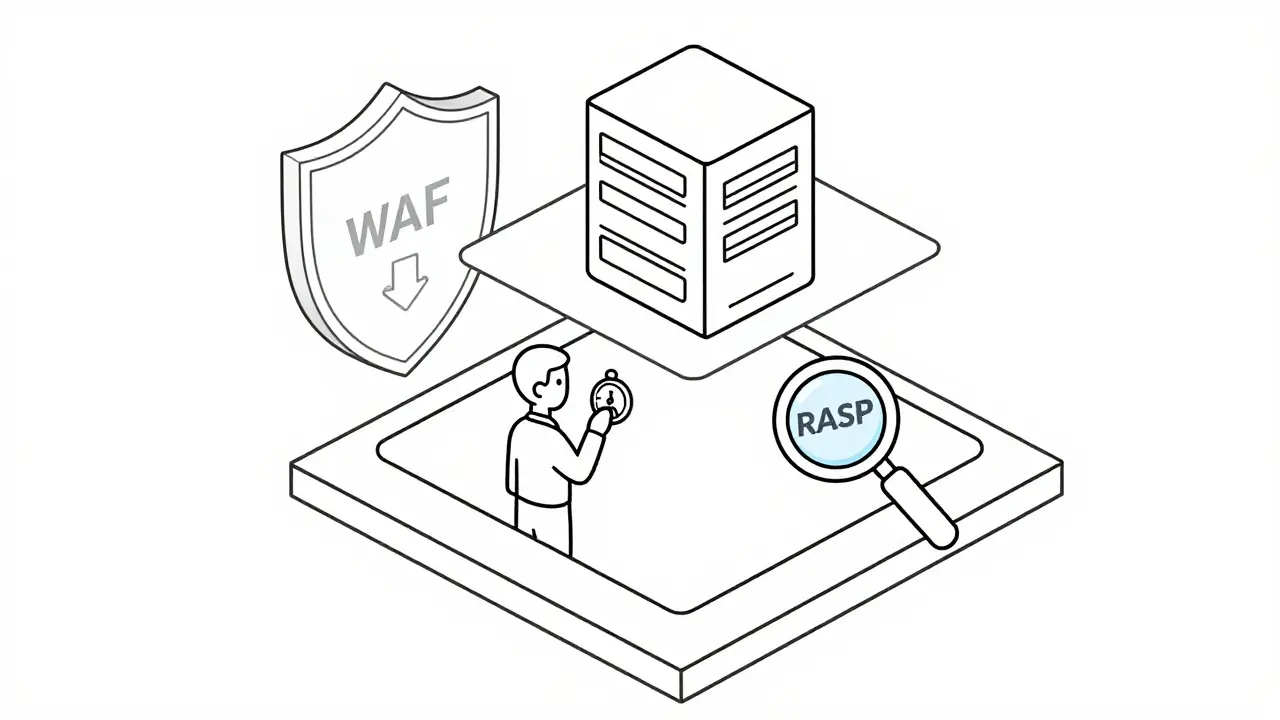
A Web Application Firewall (WAF) is a security control that monitors, filters, and blocks HTTP traffic between a web application and the Internet. Think of it as a bouncer at the door. It checks every request before it reaches your application server. For vibe-coded services, WAFs are essential because they can block known attack patterns even if your AI-generated code has a flaw.
Modern WAFs operate at OSI layer 7. They use rule-based logic, signatures, and behavioral analysis to detect threats. According to Feroot Security's 2025 analysis, effective WAFs block specific vectors such as:
- SQL Injection attempts
- Cross-site Scripting (XSS)
- Cookie poisoning
- Remote File Inclusion (RFI)
- Malicious bot traffic
However, WAFs have limitations. They sit outside your application. They cannot inspect browser-level threats or detect client-side attacks like formjacking. More importantly for vibe-coded apps, they struggle with trusted third-party scripts. If your AI generates code that embeds a malicious script from a compromised CDN, the WAF might let it through because it looks like legitimate traffic.
Blackpoint Cyber documented incidents in 2025 where vibe-coded scripts deployed DCRat malware via fake captchas. Their recommendation? Configure WAF rules to detect unusual query strings or long encoded parameters. Cloud providers are catching up. AWS announced WAF Managed Rules for AI-Generated Code in January 2026, featuring 47 specialized rules targeting common AI code vulnerabilities. Similarly, Cloudflare released its 'AI Code Shield' package in late 2025.
Deploying a cloud-based WAF is quick-typically taking 1 to 4 hours. It requires minimal code changes. But remember: it is only the outer layer. It stops the obvious attacks. It does not stop the clever ones that slip past signature detection.
Runtime Application Self-Protection (RASP): Seeing Inside the Box
If the WAF is the bouncer, Runtime Application Self-Protection (RASP) is a security technology that instruments the application runtime environment to detect and block attacks based on the application's behavior and context. RASP operates from within the application itself. It sees exactly what the code is doing, not just what the network packet looks like.
This distinction is crucial for vibe-coded services. AI-generated code may contain unexpected execution paths. A traditional scanner might miss a logic flaw because it doesn't know the business context. RASP knows the context. It can see if a database query is being constructed unsafely or if a file is being accessed without proper authorization.
Aikido Security specifically recommends using RASP to protect web-facing servers against unknown zero-day vulnerabilities in vibe-coded applications. Solutions like Contrast Security, Imperva RASP, and Microsoft Azure Application Gateway's RASP capabilities provide this deeper inspection.
The trade-off is complexity and performance. Implementing RASP takes longer-usually 3 to 10 days-and adds overhead. Gartner's 2025 Application Security Report notes that RASP typically adds 5-15% overhead to application performance. However, for high-risk APIs handling sensitive data, this cost is justified. RASP catches what the WAF misses: attacks that originate inside the trusted zone or exploit logical flaws rather than syntax errors.
Rate Limiting: Stopping the Brute Force
Vibe-coded applications often expose many API endpoints. Without careful planning, these endpoints become open doors for abuse. Escape Technologies' research revealed that 6,500 hosts and 1,280 API services built with vibe coding techniques frequently lacked proper rate limiting. This allowed attackers to brute-force endpoints or drain resources effortlessly.
Rate limiting is a technique used to control the rate of requests sent or received by a network interface controller or network service. It is not just about stopping Distributed Denial of Service (DDoS) attacks. It is about preventing credential stuffing, scraping, and resource exhaustion.
Effective rate limiting for vibe-coded services requires nuance. You cannot simply apply a global limit. You need endpoint-specific thresholds. Here is a practical baseline:
- Public endpoints: 100 requests per minute per IP address.
- Authenticated endpoints: 1,000 requests per minute per user account.
- Search/Query endpoints: Lower limits, as these are computationally expensive.
Use sliding windows rather than fixed intervals. Fixed intervals create "burst" opportunities where attackers can send maximum traffic right after the window resets. Sliding windows smooth out these bursts.
Cloudflare's API Gateway demonstrates industry best practices here. It allows customizable rate limiting policies ranging from 1 to 10,000 requests per minute depending on endpoint criticality. AWS API Gateway charges $0.90 per million requests for advanced rate limiting configurations beyond basic tiers. Configuration typically takes 4 to 8 hours. It sits between WAF and RASP in terms of complexity but addresses specific volumetric attack vectors that neither WAF nor RASP handles efficiently on their own.
Comparing Protection Mechanisms
| Feature | Web Application Firewall (WAF) | Runtime Application Self-Protection (RASP) | Rate Limiting |
|---|---|---|---|
| Deployment Time | 1-4 hours | 3-10 days | 4-8 hours |
| Protection Layer | Perimeter (Network) | Internal (Application Runtime) | API Gateway / Middleware |
| Detects Zero-Days? | Limited (Behavioral rules help) | Yes (Context-aware) | No (Volumetric only) |
| Performance Overhead | Low | Moderate (5-15%) | Low |
| Best For | Known attack patterns (SQLi, XSS) | Logic flaws, internal threats | Brute force, resource draining |
As NIST Special Publication 800-53 Revision 5 suggests, organizations should deploy all three in a layered defense strategy. WAF is the outer layer. Rate limiting is the middle layer for API protection. RASP is the innermost layer for runtime integrity. This approach addresses the critical finding that most vibe-coded vulnerabilities are exposed without authentication.
Implementation Checklist for Developers
Implementing these protections requires specific attention to detail. You cannot just turn them on and walk away. Here is what you need to do:
- Customize WAF Rules: Do not rely solely on default rules. Enable protections for OWASP Top 10 vulnerabilities. Customize rules to account for unusual patterns in AI-generated code, such as longer parameter strings or unconventional endpoint structures.
- Tune Rate Limits Carefully: Test your limits against legitimate traffic patterns. AI-assisted interactions might generate higher-than-expected traffic. Use safe live validation to verify that exposed tokens are tested against non-destructive requests first.
- Integrate RASP Early: If possible, integrate RASP during the development phase, not just in production. This helps identify logical flaws before they reach users.
- Monitor and Update: Organizations typically invest 20-40 hours for initial configuration. Plan for ongoing maintenance of 4-8 hours monthly for rule updates and exception handling.
- Enforce MFA and Least Privilege: Technical controls are not enough. Blackpoint Cyber emphasizes configuring conditional access policies and enforcing Multi-Factor Authentication (MFA). SiteGuarding stresses separation between development, testing, and production environments.
Check Point researchers warn that many organizations "fail the security vibe check" by treating AI-generated code as inherently secure. Do not make this mistake. Subject your vibe-coded services to the same rigorous security testing as human-written code.
Market Trends and Future Outlook
The market for protecting AI-generated code is growing rapidly. Gartner's 2025 Market Guide reports that the WAF market reached $2.8 billion, driven partly by demand from organizations adopting AI-assisted development. New product categories are emerging. Escape Technologies introduced the 'Visage Surface scanner' integrated into Attack Surface Management platforms specifically for identifying vulnerabilities in AI-generated code.
Compliance requirements are also evolving. PCI DSS already requires WAFs or equivalent measures for public-facing web applications. NIST is developing Special Publication 1800-34, expected in Q3 2026, which will address security controls for AI-assisted development environments specifically. By 2027, Forrester predicts that 65% of enterprise security budgets for application security will include specific allocations for protecting AI-generated code, up from just 18% in 2025.
In December 2025, the OWASP Foundation released its first Top 10 Security Risks for AI-Generated Code. Misconfigured runtime protections ranked as the #3 risk. This confirms that the industry recognizes the unique challenges posed by vibe coding. Your security posture must evolve to match the speed of your development.
What is vibe coding and why is it risky?
Vibe coding is the practice of generating application code primarily through AI assistants using high-level prompts. It is risky because AI models may inherit insecure patterns from training data, leading to vulnerabilities like exposed secrets, SQL injection, and misconfigured APIs that lack proper authentication.
How does RASP differ from a WAF?
A WAF sits at the network perimeter and filters incoming traffic based on known attack signatures. RASP operates inside the application runtime, monitoring behavior and context. RASP can detect logic flaws and zero-day attacks that bypass perimeter defenses, but it adds more implementation complexity and performance overhead.
Do I really need rate limiting for my API?
Yes, especially for vibe-coded services. Research shows many AI-generated APIs lack proper access controls. Rate limiting prevents brute-force attacks, credential stuffing, and resource exhaustion. It should be configured with endpoint-specific thresholds and sliding windows for effectiveness.
What are the recommended rate limit settings?
A good baseline is 100 requests per minute for public endpoints and 1,000 requests per minute for authenticated endpoints. Always use sliding windows instead of fixed intervals to prevent burst attacks. Adjust these values based on your specific application's normal traffic patterns.
How much time does it take to implement these protections?
Initial configuration typically takes 20-40 hours total. WAF deployment is fastest (1-4 hours), followed by rate limiting (4-8 hours), and RASP integration (3-10 days). Ongoing maintenance requires about 4-8 hours monthly for rule updates and exception handling.
 Artificial Intelligence