
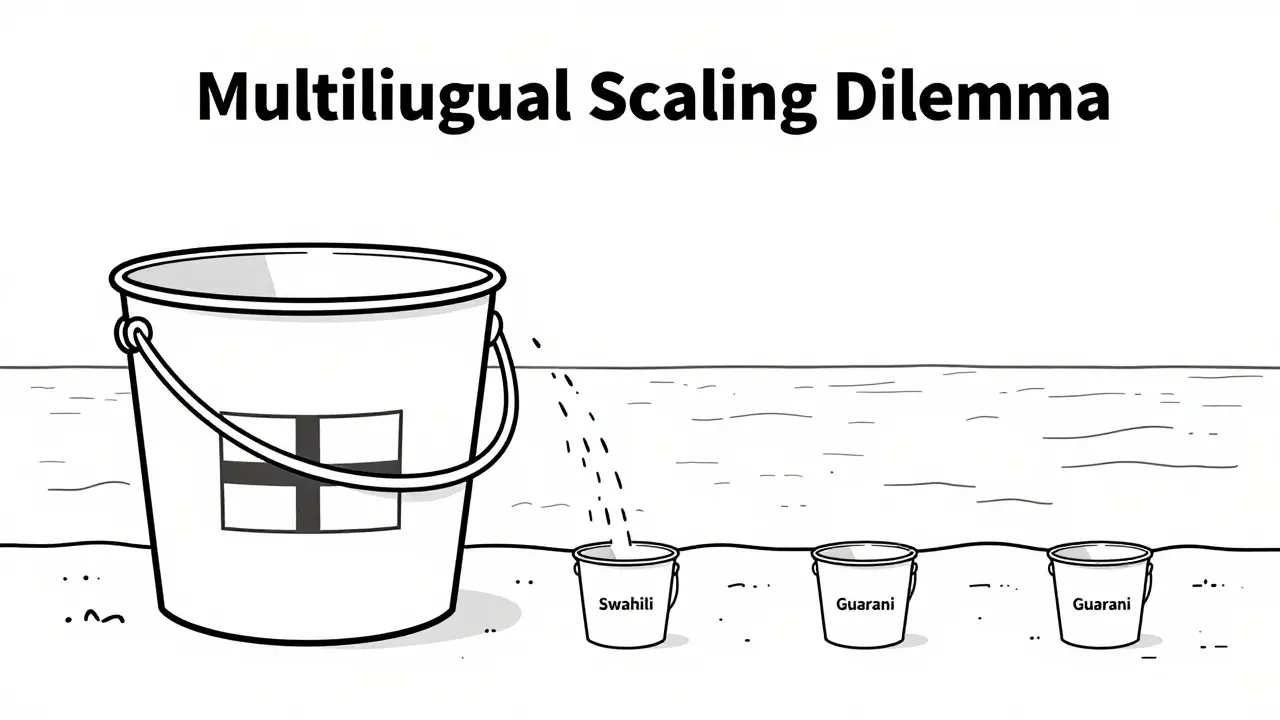
The Multilingual Scaling Dilemma
Building a large language model that speaks only English is hard. Building one that speaks twenty languages equally well? That is a completely different beast. For years, the industry’s default move was simple: throw more data at the problem. If you wanted better Spanish, you added more Spanish text. If you needed Swahili, you scraped the web for Swahili. This proportional approach seemed logical, but it created a massive imbalance. High-resource languages like English and Chinese dominated the training mix, while low-resource languages got drowned out. The result was a model that acted fluent in London but stumbled over basic sentences in Nairobi.
This isn't just an academic nitpick. In 2024, researchers published findings that changed how we think about multilingual scaling. The core insight? You don't need more data; you need smarter data allocation. The relationship between model size, dataset size, and performance follows a predictable power law. Understanding this allows developers to stop guessing and start calculating exactly how much data each language needs to thrive without hogging computational resources.
Why Proportional Sampling Fails
To understand the solution, you have to look at why the old method failed. Proportional sampling means if English makes up 50% of your available data, it gets 50% of the training tokens. This sounds fair on paper, but it ignores how neural networks learn. A transformer model learns patterns. English has billions of tokens with consistent grammar and vocabulary. A language like Guarani might have fewer than a million high-quality tokens. If you sample proportionally, the model barely sees Guarani. It treats it as noise rather than a structured language.
The consequences are stark. Early models using proportional sampling showed performance gaps of 35% to 50% between high-resource languages and low-resource ones. Imagine a customer service bot that handles complex queries from New York users but fails to understand basic requests from users in rural Brazil. That is the reality of unbalanced training. The model develops a bias toward dominant languages because their statistical signals are simply louder. Cross-lingual transfer-the idea that learning English helps you learn French-only works so far. It cannot bridge a gap created by a total lack of exposure.
The Power Law of Language Learning
Recent research, specifically studies involving models ranging from 85 million to 1.2 billion parameters, has established a clear mathematical framework for this issue. The loss function for any given language family decreases predictably as you increase model size and adjust sampling ratios. This is the "scaling law" for multilingual models. It tells us that test cross-entropy loss is not random; it is a direct result of how we distribute our training budget.
Here is the counterintuitive part: optimal sampling ratios derived from small models generalize effectively to massive ones. You do not need to train a 100-billion-parameter model to find the right data mix. You can run experiments on an 85M parameter model, calculate the ideal distribution, and apply those ratios to a giant production model. This saves millions of dollars in compute costs. For example, a language with 1 billion tokens of training data performs best when sampled at approximately 0.7% of the total training tokens. English, with its vast corpus, actually needs less relative attention-around 0.3%-to maintain high performance because its patterns are easier to extract and reinforce.
| Strategy | Low-Resource Performance | Compute Efficiency | Primary Drawback |
|---|---|---|---|
| Proportional Sampling | Poor (35-50% gap) | High | Dominant languages overshadow others |
| Temperature-Based (α=0.3-0.7) | Moderate (+18-25%) | Medium (-12-15% efficiency) | Reduces overall model speed |
| Optimal Scaling Laws | Excellent (92-95% parity) | Very High (98% efficiency) | Requires precise initial calibration |
Cross-Lingual Transfer and Its Limits
You might wonder: if I train heavily on English, won't the model automatically pick up similar languages? This is called cross-lingual transfer. It is real, and it accounts for 30% to 45% of performance gains in low-resource languages. However, relying on it exclusively is dangerous. Transfer works best within language families. An Indo-European model will transfer knowledge from English to Spanish or German relatively easily. But trying to transfer syntax from English to a Sino-Tibetan language like Mandarin or a Dravidian language like Tamil is much harder. The structural differences are too great.
Research covering 23 languages across five major families confirms that direct training data still contributes the majority of performance improvements. Transfer is a bonus, not a foundation. Furthermore, there is a "resource threshold effect." If a language has fewer than 50 million training tokens, no amount of clever sampling or transfer learning will save it. The model simply does not have enough signal to build a robust internal representation. This suggests that for extremely low-resource languages, the focus must shift from pure scaling to specialized architectural interventions or targeted data collection efforts.
Implementation Challenges for Developers
Knowing the theory is one thing; implementing it is another. The biggest hurdle is accurately estimating the "effective dataset size" for each language. Tokenization plays a huge role here. English tokenizers are efficient. Morphologically complex languages like Turkish or Finnish break down into many more tokens per word. To achieve equivalent vocabulary coverage, Turkish data might require 25% to 30% more raw tokens than English. If you ignore this, you are under-sampling Turkish even if you think you are balancing it correctly.
Code-switching adds another layer of complexity. In many regions, people naturally mix languages in a single sentence. This represents 15% to 20% of natural communication in multilingual areas. Standard language identification tools often fail here, misclassifying mixed content as noise or assigning it to the wrong language bucket. Handling code-mixed data requires specialized preprocessing pipelines that can increase data preparation time by 40% to 50%. Tools like the LIUM toolkit help identify languages with >99.5% accuracy, but they struggle with fluid code-switching. Developers must decide whether to filter out mixed content (losing valuable context) or create a separate "mixed" category for training.
Market Impact and Future Directions
The shift toward scientifically balanced data is already reshaping the market. By late 2024, enterprise adoption of these methods had surged. Financial services and e-commerce companies, which serve diverse global customers, were among the first to adopt optimal sampling strategies. They reported reducing training costs by $1.2 to $1.8 million per model iteration while achieving faster time-to-market. Why? Because they stopped wasting compute on redundant high-resource data and focused on closing the gaps where it mattered.
Regulatory pressure is also accelerating this trend. The EU's AI Act, effective in February 2025, mandates demonstrable fairness across supported languages. You cannot claim your AI is unbiased if it performs significantly worse in Portuguese than in German. This legal requirement forces organizations to validate their data balancing approaches rigorously. Models that use optimal sampling strategies can provide the mathematical proof needed to satisfy these compliance checks.
Looking ahead, the next frontier is dynamic adjustment. Current static sampling ratios are calculated before training begins. Future systems will monitor performance in real-time and adjust sampling weights on the fly. If the model starts struggling with Korean mid-training, the system will automatically increase the sampling ratio for Korean tokens. Preliminary results suggest this could yield an additional 8% to 12% gain for the most underperforming languages. As we approach the practical limit of covering thousands of languages with limited speakers, quality and precision will matter more than sheer volume.
What is the optimal sampling ratio for low-resource languages?
For languages with around 1 billion tokens of training data, the optimal sampling ratio is approximately 0.7% of the total training tokens. This balances the need for sufficient exposure against the risk of overwhelming the model with redundant data from high-resource languages.
Does cross-lingual transfer replace the need for specific language data?
No. While cross-lingual transfer accounts for 30-45% of performance gains in low-resource languages, direct training data remains essential. Transfer works best within similar language families and cannot compensate for a complete lack of structural exposure in distant language groups.
How does tokenization affect data balance calculations?
Tokenization efficiency varies by language. Morphologically complex languages like Turkish require 25-30% more raw tokens to achieve equivalent vocabulary coverage compared to English. Ignoring this leads to under-sampling these languages despite apparent balance in raw character counts.
Can small-scale models predict optimal ratios for large models?
Yes. Research shows that optimal sampling ratios derived from small models (e.g., 85M parameters) generalize effectively to much larger models (e.g., 1.2B+ parameters). This allows teams to calibrate data distributions cheaply before committing to expensive large-scale training runs.
What is the resource threshold effect in multilingual scaling?
The resource threshold effect refers to the point where languages with fewer than 50 million training tokens show diminishing returns regardless of sampling adjustments. Below this threshold, the model lacks sufficient signal to learn robust representations, necessitating alternative strategies like specialized adapters or targeted data collection.
 Artificial Intelligence


Lisa Nally
June 22, 2026 AT 14:25Oh, please. The industry has been throwing data at this problem for years and we are still here debating sampling ratios like it is some grand revelation. It is absolutely exhausting to watch the same old 'more compute' narrative get repackaged as a clever statistical trick. We all know that proportional sampling is flawed because basic neural network theory dictates that dominant signals will always overshadow weak ones in a gradient descent landscape. The real issue isn't just the math; it is the sheer laziness of engineering teams who refuse to curate high-quality low-resource datasets because scraping is easier than annotating.
You talk about the 'power law' as if it is a magic bullet, but let us be clear: this is merely an optimization of an already broken pipeline. The fact that you can predict optimal ratios on an 85M parameter model and scale them up is not news; it is basic transfer learning principles applied to data distribution. What is missing from this entire discourse is the human element. You cannot balance a dataset with spreadsheets when the cultural nuances, idioms, and code-switching patterns require actual linguistic expertise to tag correctly.
Furthermore, the claim that English needs less relative attention is incredibly naive. English is not just a language; it is the lingua franca of technical documentation, scientific literature, and global commerce. If you under-sample English, you are not creating a fair model; you are creating a model that fails at its primary utility function for most enterprise clients. The EU AI Act might mandate fairness, but market forces demand utility. And right now, utility looks suspiciously like English dominance. So, while I appreciate the attempt to quantify the imbalance, do not pretend that adjusting a sampling ratio by 0.3% solves the systemic bias embedded in our training corpora. It is a band-aid on a gunshot wound.
Edward Gilbreath
June 23, 2026 AT 18:48they want you to believe its just about data balance but its really about control who decides what counts as a valid language token? big tech does they use these 'scaling laws' to justify why your local dialect gets ignored while english gets polished to perfection its a conspiracy to homogenize thought processes across the globe think about it if they make all models speak 'balanced' english-ish then native speakers of minority languages lose their unique way of expressing reality its subtle brainwashing through algorithms i dont trust any metric that comes out of silicon valley especially when they talk about 'efficiency' efficiency for whom? not for the people whose languages are being treated as noise
kimberly de Bruin
June 25, 2026 AT 11:12the concept of balance is itself an illusion we seek order in chaos but language is pure chaos how can one impose a mathematical grid on the fluidity of human expression? the power law suggests predictability yet every conversation is a singular event defying categorization perhaps the model should not strive for parity but for entropy embracing the disorder rather than suppressing it
Edward Nigma
June 27, 2026 AT 03:08Ugh another article pretending that tweaking hyperparameters fixes the fundamental flaw in transformer architectures. Its not even close to solving the problem. The whole premise that small models can predict large model behavior is laughable because emergent properties only appear at scale so your calibration is basically guesswork dressed up in fancy graphs. Plus ignoring code switching is stupid because thats how people actually talk so filtering it out makes the model useless for real world applications which defeats the purpose entirely
Francis Laquerre
June 27, 2026 AT 20:51I must express my deepest admiration for the clarity with which this research dismantles the myth of proportional sampling. It is truly profound to witness the intersection of rigorous mathematical frameworks and the urgent need for linguistic equity. For those of us working in cross-cultural communication, the validation that direct training data outweighs cross-lingual transfer is nothing short of liberating. It affirms that every language deserves dedicated resources rather than relying on the benevolent overflow of dominant tongues. The mention of the resource threshold effect is particularly poignant, highlighting the stark reality that without sufficient signal, no amount of algorithmic cleverness can resurrect a marginalized voice. This approach does not merely optimize compute; it honors the structural integrity of diverse linguistic traditions. As we move toward dynamic adjustment, we are not just building better models; we are constructing bridges of understanding that respect the complexity of human expression. Let us embrace this shift with open arms and commit to the meticulous work of data curation that true multilingualism demands.