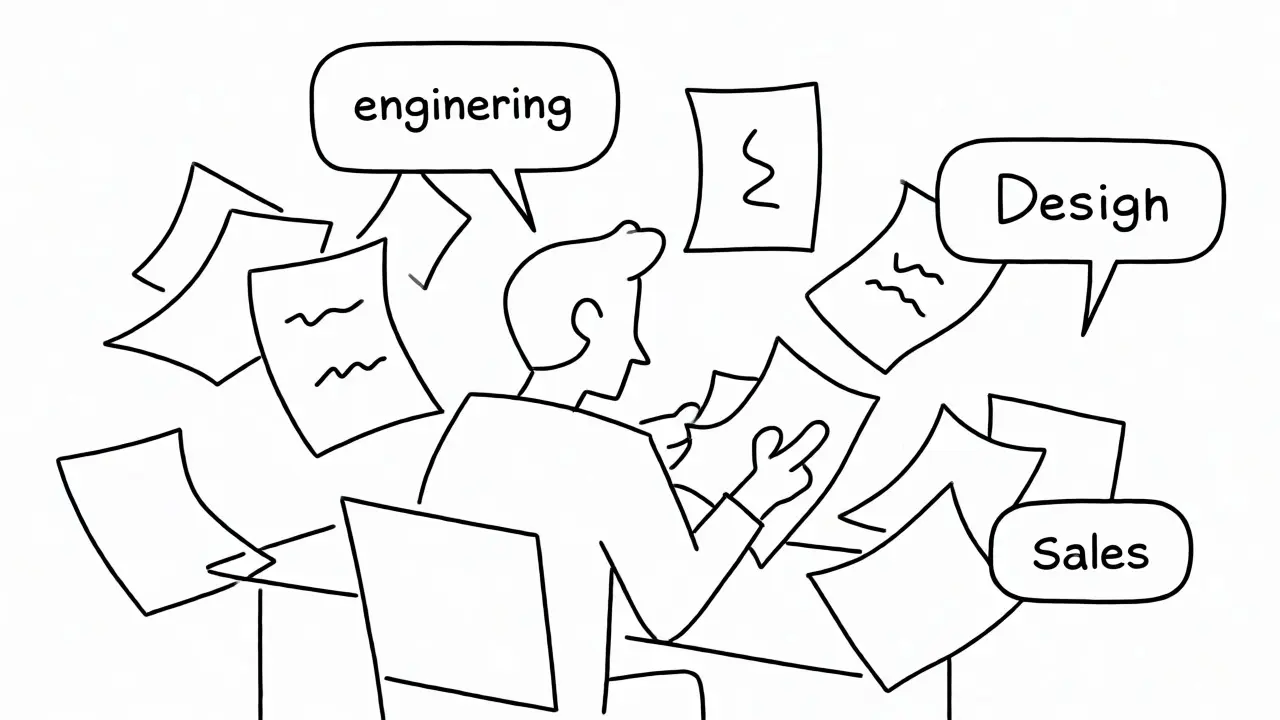
You know the drill. You spend three days writing a Product Requirements Document (PRD) for a new feature. You think it’s perfect. Then engineering pushes back because they missed a dependency, design hates the user flow, and sales wants a different pricing model. By the time you’re done iterating, two weeks have vanished. What if an AI agent didn’t just write that draft, but argued with you until the logic held up? That’s the promise of AI Pair PM, a workflow where autonomous agents generate and refine requirements in real-time.
This isn’t about replacing product managers with chatbots. It’s about shifting from being a document writer to a decision-maker. Traditional AI tools like ChatGPT or Claude are great at summarizing notes into bullet points. But they don’t catch logical gaps. They don’t ask, "What happens if the user loses internet connection during this payment step?" An AI Pair PM system uses specialized agents to simulate stakeholders-engineers, designers, data scientists-to stress-test your ideas before code is ever written. Let’s look at how this actually works and why it changes the speed of product development.
The Breakdown of Static vs. Dynamic Requirements
Most teams treat requirements as static artifacts. You write them, you sign off on them, and then they sit in a Confluence page gathering dust. The problem is that reality is dynamic. User behavior shifts, APIs change, and market competitors launch features overnight. A static PRD becomes obsolete the moment it’s published. AI Pair PM treats requirements as living entities. Instead of a one-way street from PM to Engineer, it creates a feedback loop. The AI generates a draft based on your high-level goals. Then, a separate "Critic Agent" reviews it against historical data from your past projects. If similar features failed due to scope creep, the agent flags it immediately. This turns the PRD from a bureaucratic hurdle into a strategic tool.
Consider the difference in effort. In a traditional setup, a senior PM might spend 15-20 hours drafting a medium-complexity feature spec. With an AI Pair PM workflow, that initial draft appears in minutes. But the real value comes in the refinement phase. The AI doesn’t just polish grammar; it identifies missing edge cases. For example, if you specify a "search function," the agent might ask, "Do we need support for non-Latin characters? What is the latency requirement for mobile users?" These questions force clarity early, saving dozens of hours in sprint planning meetings later.
How the Agent Architecture Works
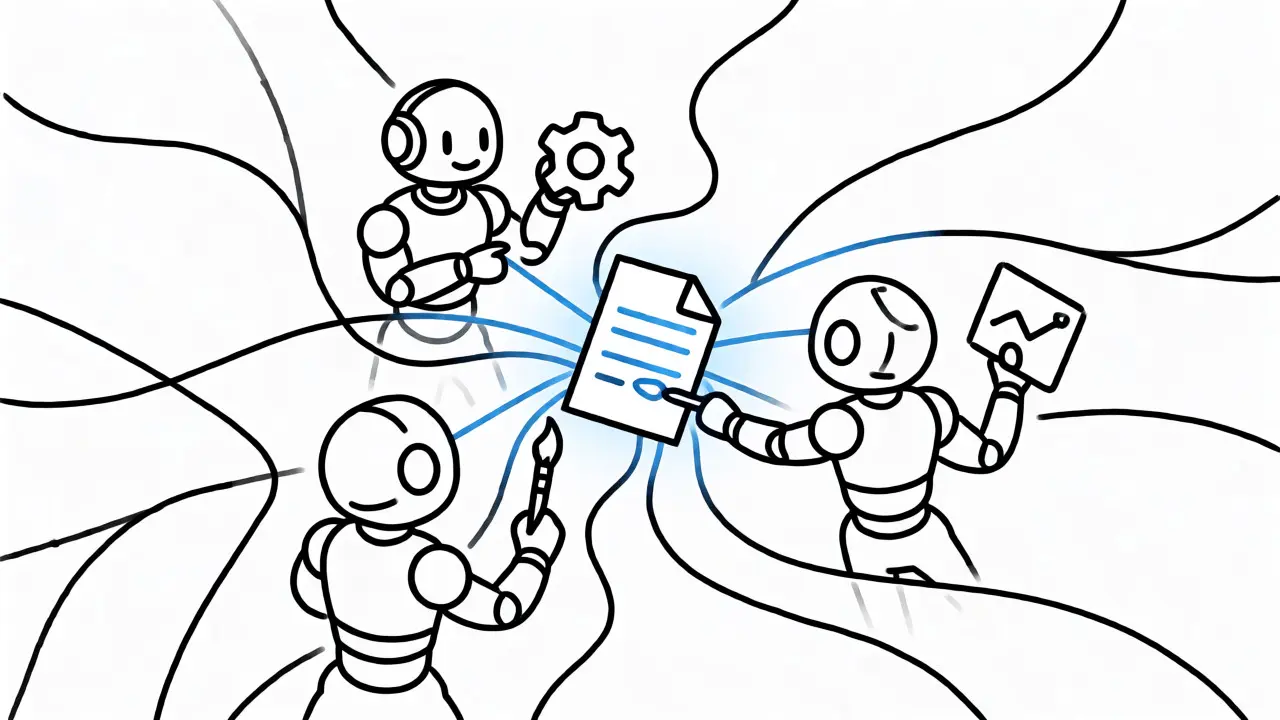
To understand why this is different from standard generative AI, you need to look under the hood. Standard LLMs (Large Language Models) predict the next word. They are optimistic by nature. An AI Pair PM system typically uses a multi-agent architecture. Think of it as having a team of virtual specialists working in parallel. One agent focuses on functionality, another on technical feasibility, and a third on business alignment. They debate each other. If the functionality agent suggests a complex animation, the technical agent might counter with performance constraints based on your app’s current load times. This internal conflict produces a more robust requirement set than any single prompt could achieve.
| Feature | Traditional PRD Process | AI Pair PM Workflow |
|---|---|---|
| Draft Creation Time | 4-8 hours | 5-10 minutes |
| Error Detection | Manual review (high miss rate) | Automated logical validation |
| Stakeholder Alignment | Requires multiple meetings | Simulated pre-alignment via agents |
| Adaptability | Static document | Dynamic, version-controlled specs |
| Knowledge Retention | Limited to individual memory | Integrated with company knowledge base |
This architecture relies heavily on context windows and retrieval-augmented generation (RAG). The agents don’t just guess; they pull from your actual Jira tickets, Slack conversations, and previous release notes. If you mention "payment integration," the agent checks if you use Stripe or PayPal and applies the specific API constraints associated with that provider. This grounding in real data prevents the hallucinations that plague generic AI tools. You aren’t getting a generic template; you’re getting a specification tailored to your tech stack.
The Role of the Human Product Manager
Does this make the Product Manager obsolete? Absolutely not. It elevates the role. When the grunt work of formatting, checking dependencies, and listing acceptance criteria is handled by agents, the PM can focus on strategy. Your job shifts from "writing the what" to "defining the why." You become the editor-in-chief of a newsroom rather than the reporter typing out every sentence. You decide which arguments the AI agents should prioritize. Do you care more about speed to market or long-term scalability? The AI can present both paths with pros and cons, but you make the call.
Moreover, human oversight is critical for ethical and brand considerations. An AI agent might optimize a checkout flow for conversion rates by hiding fees until the final step. A human PM knows that this trick annoys customers and hurts brand trust in the long run. The AI provides options; the human provides judgment. In this partnership, the PM acts as the guardrail. You teach the agents your company’s values over time. If you consistently reject "dark patterns," the Critic Agent learns to flag those suggestions automatically.
Implementation Pitfalls to Avoid
Jumping into AI Pair PM without preparation can lead to chaos. The biggest mistake teams make is feeding the AI poor-quality input. Garbage in, garbage out still applies. If your existing documentation is messy, outdated, or contradictory, the agents will struggle to find ground truth. Start by cleaning up your knowledge base. Ensure that your definition of "done" is consistent across teams. Another pitfall is over-trusting the output. AI is probabilistic, not deterministic. It might confidently state that a certain database query is efficient when it’s actually a bottleneck. Always validate technical assumptions with your lead engineer.
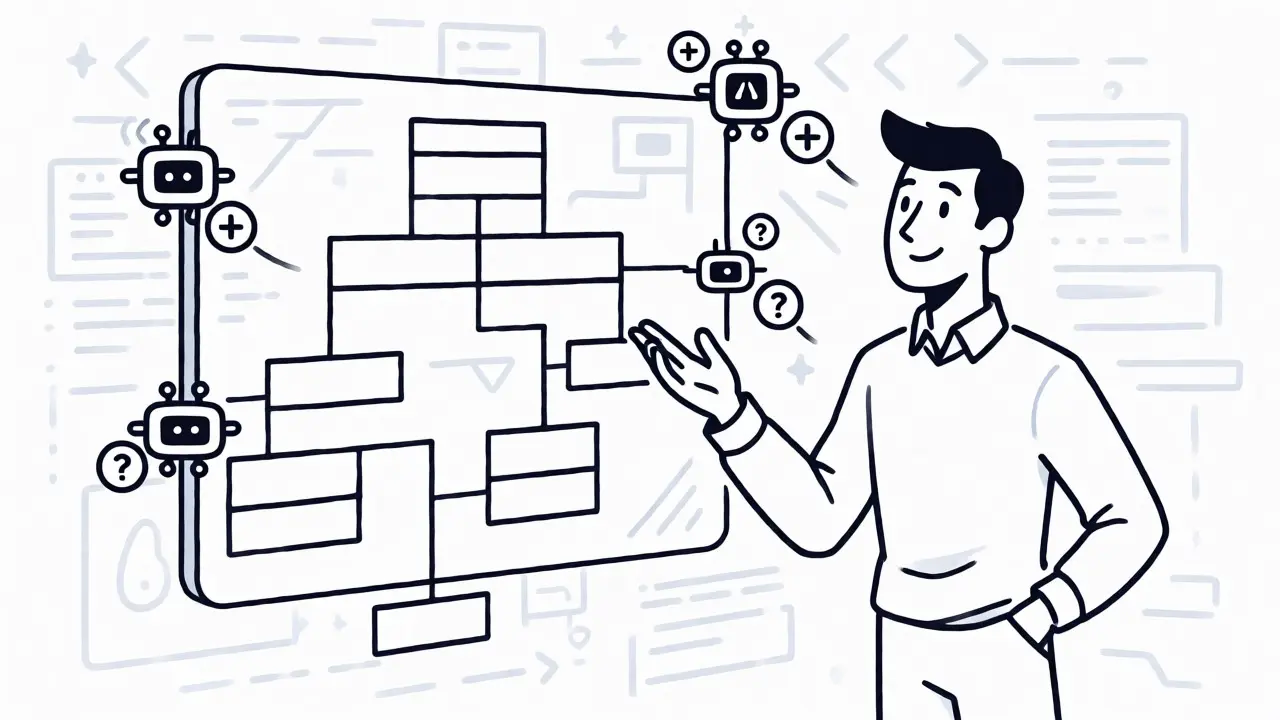
Also, beware of the "black box" effect. If your team doesn’t understand why the AI suggested a certain requirement, they won’t trust it. Implement transparency features. Good AI Pair PM tools show their reasoning. They cite sources: "I recommended caching this data because similar endpoints in Project X had 3-second latency without it." This builds trust and helps junior PMs learn from the system. It turns the tool into a mentor, not just a typist.
Future Trends: From Docs to Code
We are moving toward a world where the boundary between requirements and implementation blurs. Soon, these agents won’t just write text; they will generate prototype code. Imagine defining a user story and having the AI produce a React component that matches the spec. This closes the gap between idea and execution even further. Tools like GitHub Copilot are already stepping stones in this direction. As models improve, the "Pair PM" concept will likely merge with "Pair Programmer." The same agent that wrote the requirement might also suggest the unit tests needed to verify it.
For companies in Bellingham or anywhere else, this means faster iteration cycles. Small startups can compete with giants because they can maintain rigorous documentation standards without hiring a dedicated technical writer. Large enterprises can scale their product teams without drowning in bureaucracy. The key is adoption culture. Teams that view AI as a collaborator rather than a threat will see the most benefit. Those who resist will find themselves bogged down in manual processes while their competitors ship twice as fast.
Is AI Pair PM suitable for non-technical products?
Yes. While often discussed in software contexts, the principles apply to physical products or services. Agents can analyze supply chain constraints, customer service workflows, or marketing campaign structures just as effectively as code dependencies. The core value is logical consistency and gap analysis, which is universal.
How does AI handle conflicting stakeholder requirements?
Advanced systems use weighting algorithms. You can assign priority levels to different stakeholders (e.g., Engineering > Design for backend features). The AI highlights conflicts explicitly and proposes compromise solutions based on historical precedents in your organization, allowing the PM to mediate rather than discover conflicts late.
Can AI replace the discovery phase of product management?
No. Discovery involves empathy, intuition, and understanding unarticulated user needs. AI excels at synthesis and validation of known information. It can summarize thousands of user reviews instantly, but it cannot conduct a nuanced user interview or read body language. Humans remain essential for deep insight generation.
What is the risk of 'hallucinated' requirements?
Hallucination occurs when the AI invents facts. In PRDs, this might mean citing a non-existent API endpoint. Mitigation strategies include using Retrieval-Augmented Generation (RAG) to ground responses in actual documentation and requiring citations for all technical claims. Human review remains mandatory for critical path items.
How do I measure ROI on adopting AI Pair PM tools?
Track metrics like time-to-draft, number of rework cycles after engineering kickoff, and defect density related to ambiguous requirements. If your team spends less time arguing about specs and more time building, and fewer bugs stem from misunderstood requirements, you have positive ROI.
 Artificial Intelligence