

Remember when we first got excited about chatbots? We thought they were the future of work. But let’s be honest-most of them just sit there waiting for you to type a question. They react. They don’t act. That is changing fast. The real shift happening right now isn't just about AI answering questions; it is about autonomous AI agents that can plan, execute, and finish complex tasks without holding your hand every step of the way.
This is what experts call "agentic AI." Unlike the copilots or chatbots you might use today, these systems are proactive. They have a goal, they figure out how to reach it, and they do the work. If you are wondering whether this is just hype or a genuine transformation for your business processes, you are not alone. As of mid-2026, the conversation has moved from "what is this?" to "how do we build it safely?" Let's break down exactly what these agents are, how they differ from the tools you already know, and why they matter for your bottom line.
What Exactly Is an Autonomous Agent?
To understand where we are going, we need to clear up a common confusion. A lot of people throw the word "agent" around loosely. But according to Deloitte’s research on Technology, Media, and Telecommunications predictions, there is a strict definition here. An autonomous agent is software that completes complex tasks and meets objectives with little to no human supervision.
Think of the difference between a calculator and a financial analyst. A calculator (or a basic chatbot) gives you an answer when you press a button. It waits for input. An autonomous agent is like hiring that analyst. You give it a goal-say, "analyze our Q3 supply chain delays and suggest three mitigation strategies based on current vendor data." The agent then decides which databases to query, which reports to read, how to cross-reference that information, and finally, writes the summary for you. It handles the messy middle part-the planning and execution-that humans usually do.
This capability stems from advances in Large Language Models (LLMs) combined with something called Retrieval Augmented Generation (RAG). Essentially, the agent connects to your company’s specific data-emails, CRM records, inventory logs-and uses that context to make decisions. It doesn't just guess; it looks up the facts, plans a workflow, and acts on them.
The Four Levels of Autonomy
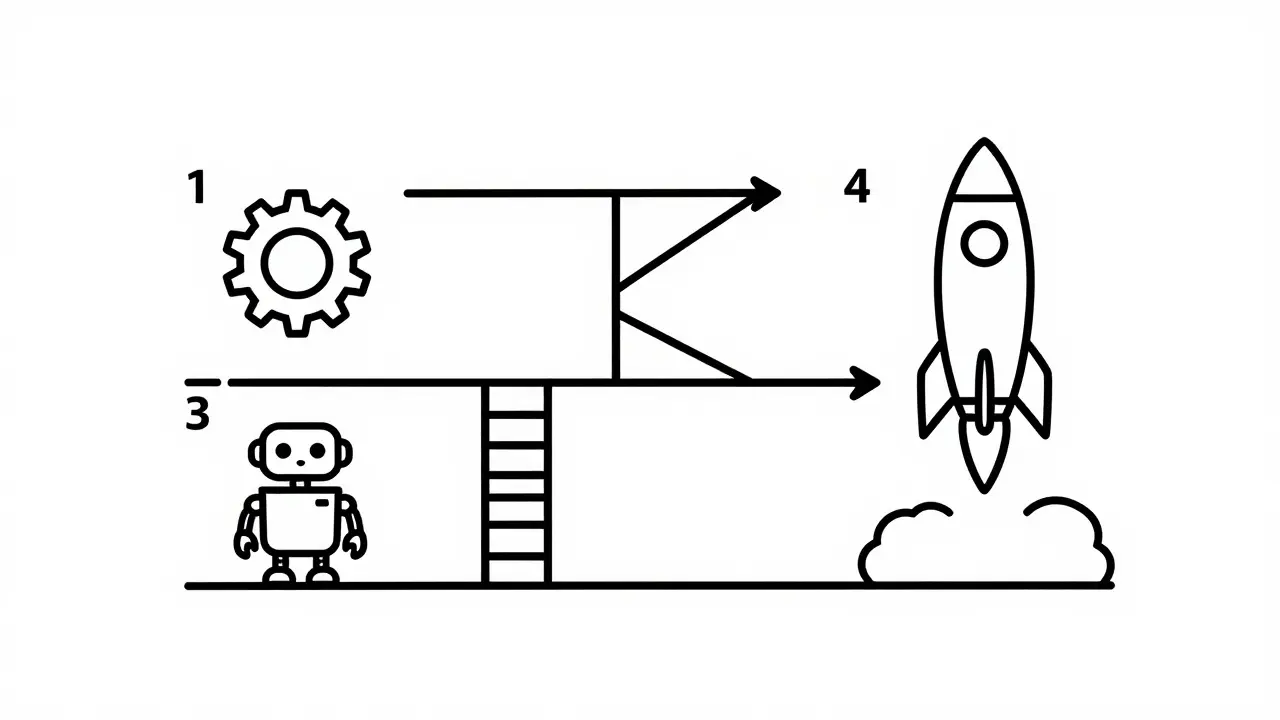
Not all AI systems are created equal. AWS Insights categorizes these capabilities into four distinct levels. Understanding where a tool sits on this ladder helps you set realistic expectations for your projects.
| Level | Name | How It Works | Human Oversight Needed | Real-World Example |
|---|---|---|---|---|
| 1 | Chain | Rule-based, fixed sequence | High (Setup only) | Extracting invoice data from PDFs using Robotic Process Automation (RPA) |
| 2 | Workflow | Pre-defined actions, dynamic sequencing | Medium (Review outputs) | Drafting customer emails with branching logic based on sentiment |
| 3 | Partially Autonomous | Plans and executes given a goal | Low (Spot checks) | Resolving support tickets by accessing multiple internal systems |
| 4 | Fully Autonomous | Proactive, sets own goals, adapts | Minimal (Strategic oversight) | Strategic research agents discovering new market opportunities independently |
Most businesses today are stuck at Level 1 or 2. Traditional RPA (Robotic Process Automation) is great if everything goes perfectly. But if a form changes slightly or a database returns an unexpected error, Level 1 bots crash. Level 3 and 4 agents, however, can handle those surprises. They observe the change, plan a new route, and act. This is the "observe-plan-act" cycle that BCG highlights as the core engine of modern agentic AI. The system learns from its past interactions, becoming more efficient over time.
Why Businesses Are Moving Beyond Chatbots
You might ask, "Can't my current AI copilot do this?" The short answer is no, not really. Copilots are assistants. They wait for you to drive. Agents are drivers. They take the wheel.
McKinsey notes that traditional automation struggles with workflows that have "wide variation in potential inputs and outputs." Think about customer support. Every complaint is different. Some require refunds, some need technical troubleshooting, and some just need empathy. A rule-based bot fails here because it can't judge nuance. An autonomous agent can analyze the tone, check the purchase history, verify warranty status, and decide the best resolution path-all in one go.
In fact, early adopters are seeing massive efficiency gains. Genentech, a biotech giant, deployed an AWS-based agentic solution for biomarker validation. Instead of scientists spending hours manually searching through dense research papers, the agent broke down the task, queried multiple knowledge bases, and synthesized the findings. The result? A 30-40% reduction in time-to-target identification. That is not just saving time; it is accelerating innovation.
The Hidden Complexity: It’s Not Just Code
If building an agent was as easy as prompting a chatbot, everyone would be doing it. The reality is much messier. Implementing true autonomy requires a robust "data fabric." This is the underlying layer that allows the AI to securely access the right information at the right time.
Appian points out a major pain point: consistency. In the early days of generative AI, two employees could ask the same agent the same question and get wildly different answers. For a business, that is unacceptable. To fix this, companies are moving away from loose prompting and toward structured enterprise platforms. These platforms enforce rules, manage permissions, and ensure that the agent operates within safe boundaries.
Here is what a typical implementation timeline looks like for an enterprise-grade deployment:
- Months 1-2: Building the data fabric. This involves cleaning data, setting up vector databases for semantic search, and defining security protocols. As one engineer noted in a recent industry discussion, "We spent 4 months just building the data layer before the agent could reliably execute simple tasks."
- Months 3-4: Developing the agent logic. This includes defining the "tools" the agent can use (e.g., access to Salesforce, SAP, or email APIs) and creating the manager-subagent structure.
- Months 5-6: Testing and refinement. This is where you stress-test the agent against edge cases to ensure it doesn't hallucinate or breach security.
It takes longer than rolling out a basic chatbot, but the ROI is significantly higher. Enterprise architects report that while upfront investment is 15-20% higher than basic LLM integrations, the return on investment hits 3-5x within 12-18 months due to productivity gains.

Risks and Guardrails: Keeping Control
With great power comes great responsibility. When you let an AI make decisions, you need guardrails. The European AI Act draft guidelines classify Level 3 and 4 autonomous agents as "high-risk" systems. This means they require rigorous validation and human oversight protocols.
So, how do you keep control?
- Permission-Aware Access: The agent should only see data that a human employee in that role would see. If a junior support agent can't see executive salaries, neither should the AI acting on their behalf.
- Human-in-the-Loop for Critical Actions: For high-stakes decisions-like approving a large refund or sending a legal document-the agent should flag the action for human approval rather than executing it blindly.
- Audit Trails: Every decision the agent makes must be logged. Why did it choose option A over option B? You need to be able to trace the reasoning back to the source data.
Without these controls, you risk "hallucinations" leading to costly errors or reputational damage. The goal is not to replace human judgment entirely but to augment it, handling the routine complexity so humans can focus on strategy.
Who Should Adopt This Now?
Not every company needs a Level 4 autonomous agent today. However, certain industries are seeing immediate value. According to Deloitte’s industry segmentation, finance leads with 42% of early pilots, followed by healthcare/life sciences (28%) and technology (22%).
If your business processes involve:
- High volumes of unstructured data (emails, documents, calls)
- Multi-step workflows that require coordination across different software systems
- Tasks that require nuanced judgment but follow predictable patterns
The market is growing fast-projected to hit $18.7 billion by 2027. The companies that move now will establish the standards for how AI works in their organizations. Those who wait will find themselves playing catch-up in a landscape where their competitors are already automating the "thinking" parts of their business.
What is the difference between a chatbot and an autonomous AI agent?
A chatbot is reactive; it waits for user input and responds based on pre-trained data or simple scripts. An autonomous AI agent is proactive and goal-oriented. It can plan multi-step workflows, access external tools and databases, and execute tasks to achieve a specific objective with minimal human intervention.
How long does it take to implement an autonomous agent in a business?
Enterprise-grade deployments typically take 3 to 6 months. This timeline includes building a secure data fabric, integrating APIs, developing the agent logic, and rigorous testing. Simple proof-of-concepts may take weeks, but production-ready systems require significant infrastructure setup.
Are autonomous AI agents safe to use in sensitive industries?
Yes, but only with proper guardrails. Regulations like the EU AI Act classify high-autonomy agents as high-risk. Safety requires permission-aware data access, audit trails for all actions, and human-in-the-loop approvals for critical decisions. Without these controls, risks of errors or data breaches increase.
Which industries are adopting agentic AI fastest?
Finance leads adoption with 42% of early pilots, followed by healthcare and life sciences (28%), and technology (22%). These sectors benefit most from automating complex, data-heavy workflows that require nuanced analysis and cross-system coordination.
What is the ROI of implementing autonomous agents?
While upfront costs are 15-20% higher than basic AI integrations, enterprises report a 3-5x return on investment within 12-18 months. Gains come from reduced processing times (25-40% in some cases), fewer bottlenecks, and lower operational costs in complex workflows.
 Artificial Intelligence



Jeanne Abrahams
June 24, 2026 AT 19:19Oh look, another article telling us that robots are going to do our jobs for us while we sit back and sip lattes. How original. I suppose next they'll tell me my toaster is going to write poetry. The 'agentic AI' buzzword is just corporate speak for 'we want to fire people but make it sound like innovation.'
Bineesh Mathew
June 25, 2026 AT 09:59The soul of humanity lies in the struggle, not in the efficiency of execution. When we outsource our cognitive labor to these silicon ghosts, we strip ourselves of the very essence that defines our existence as thinking beings. It is a tragedy wrapped in convenience, a slow erosion of the human spirit disguised as progress. We become mere spectators in our own lives, watching the machines dance while we wither away in apathy.
Oskar Falkenberg
June 26, 2026 AT 21:24I totally get where you're coming from Bineesh but i think its more nuanced than that. Like sure there's a risk of losing touch with the manual side of things but on the flip side imagine all the time we could save on mundane tasks that really don't require much creative thought anyway. I mean if an agent can handle the data crunching then we humans can focus on the big picture stuff which is kinda cool right? I've been testing some level 2 workflows at work and honestly it's pretty seamless once you get the hang of setting up the rules. Just gotta be careful with the oversight part though.
Caitlin Donehue
June 28, 2026 AT 01:04I've been reading up on this stuff lately and it's interesting how the timeline keeps shifting. The post mentions 3-6 months for enterprise deployment, which seems realistic given the data cleaning required. I wonder if smaller businesses will ever catch up or if this will just be a luxury for big corps with deep pockets.
Stephanie Frank
June 29, 2026 AT 09:13Let's cut the fluff. Most of these 'autonomous agents' are just glorified scripts with a hallucination problem. You think your supply chain bot isn't going to crash when the vendor changes their API format slightly? Please. The ROI claims are pure marketing BS designed to scare CTOs into buying overpriced SaaS subscriptions. Real engineers know that building a reliable data fabric takes years, not months. This whole agentic AI trend is a bubble waiting to burst because nobody wants to admit that LLMs are still fundamentally probabilistic guessers, not logical reasoners.
Patrick Dorion
June 30, 2026 AT 08:49It's important to distinguish between hype and utility here. The key insight in the article is the distinction between reactive chatbots and proactive agents. In my experience with RPA implementations, the failure point is always the rigidity of the workflow. If you can introduce a layer of semantic understanding via RAG, you solve 80% of those edge cases. However, the 'human-in-the-loop' requirement is non-negotiable for any critical business function until we have verifiable reasoning traces, which we currently lack.
Marissa Haque
July 1, 2026 AT 05:50This is absolutely fascinating!!! I never realized how complex the backend infrastructure had to be before the agent even starts working! It's wild to think that companies spend 4 months just on the data layer!! I feel like this is going to change everything about how we manage projects!! Who else is excited about the future of work?!?
Keith Barker
July 2, 2026 AT 17:43the concept of autonomy is flawed if the underlying model cannot guarantee truth. we are building castles on sand. the eu ai act is a step in the right direction but likely too little too late for the damage already done by unchecked deployment. silence is often the best response to such technological fervor.
Lisa Puster
July 4, 2026 AT 14:22another day another american tech bro trying to sell us his broken toys. europe knows better hence the strict regulations. you guys keep pushing this 'move fast break things' mentality until something actually breaks and then cry about it. real sophistication comes from restraint not from letting algorithms run wild. pathetic.
Joe Walters
July 5, 2026 AT 02:09Ugh please. Everyone talks about guardrails but no one actually implements them properly. I saw a 'fully autonomous' agent at a fintech startup last week approve a refund based on a misinterpreted sentiment score. Total disaster. The CEO was furious. These tools are dangerous in the hands of amateurs who think prompting is engineering. It's not. It's alchemy without the magic.