
Generative AI isn’t coming - it’s already here. By Q3 2025, 55% of organizations were using it in at least one function, and 22% had rolled it out across multiple teams. This isn’t a tool you can ignore. It’s reshaping how decisions are made, how work gets done, and who leads the way. But here’s the truth most leaders miss: generative AI doesn’t replace leadership - it demands better leadership.
What Generative AI Actually Does for Leaders
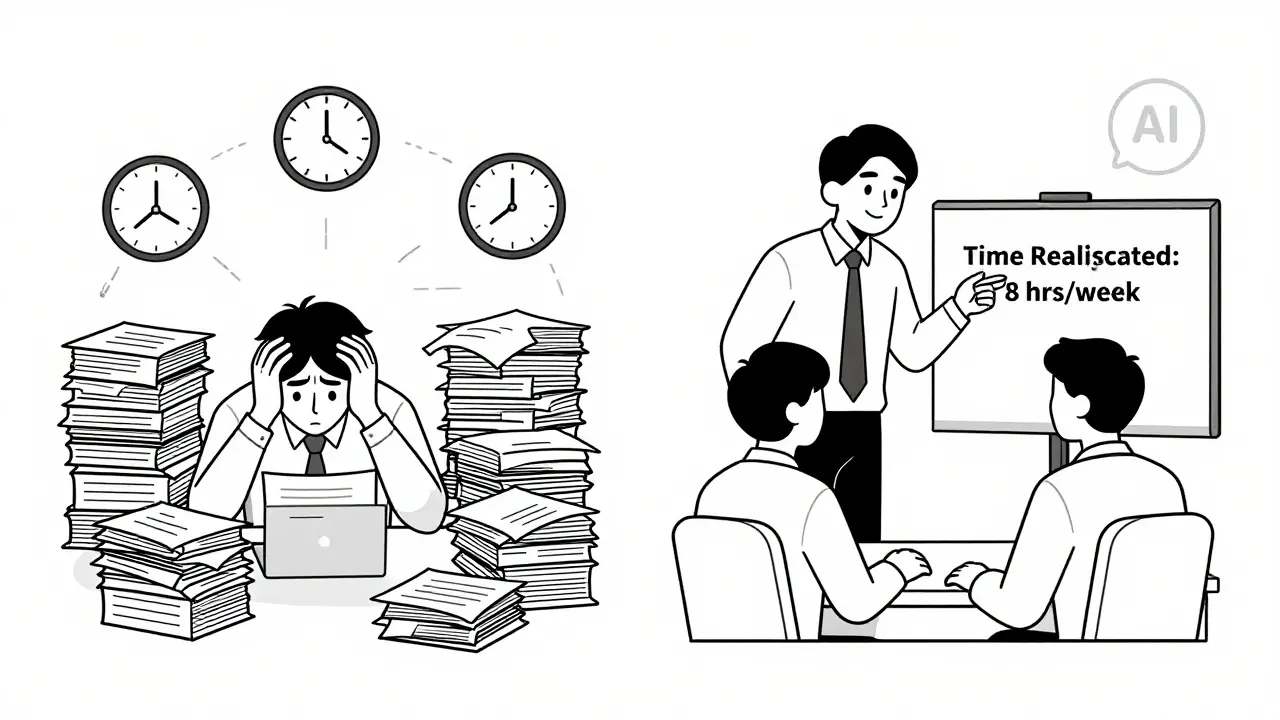
Think of generative AI as a tireless assistant that writes reports, summarizes meetings, drafts emails, and even generates scenario forecasts. But its real power? It frees up time. Leaders who use it well aren’t just getting more done - they’re doing different things. IBM’s leadership team found that managers who used AI for administrative tasks gained an average of 8-12 hours per week. That’s not a bonus. That’s a redesign opportunity.
Yet most leaders don’t know what to do with that time. A manager at Siemens said it plainly: "I saved eight hours a week, but my team just filled it with more meetings." That’s the trap. Without intention, AI doesn’t transform leadership - it just adds noise.
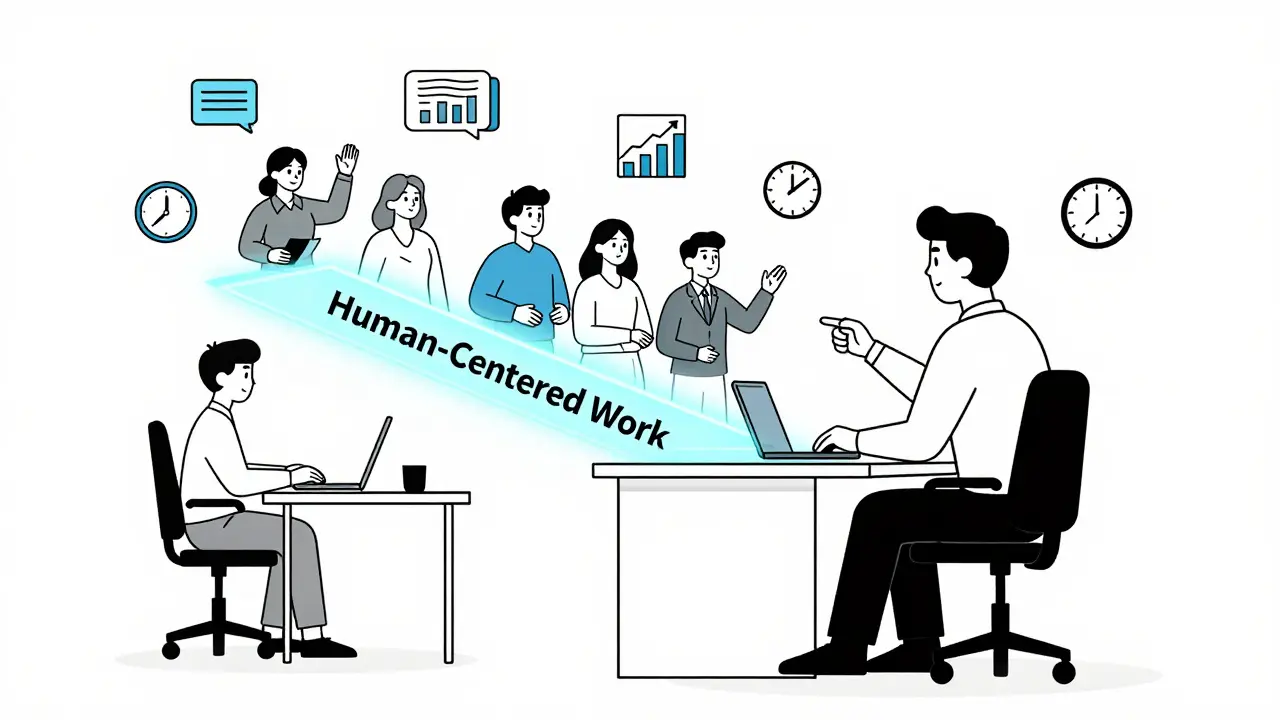
The real value lies in redirecting that saved time toward human-centered work: coaching, building trust, resolving conflict, and thinking strategically. McKinsey’s data shows that leaders who consciously shift focus to these areas see 37% higher team engagement. That’s not luck. It’s strategy.
Three Pillars of AI-Ready Leadership
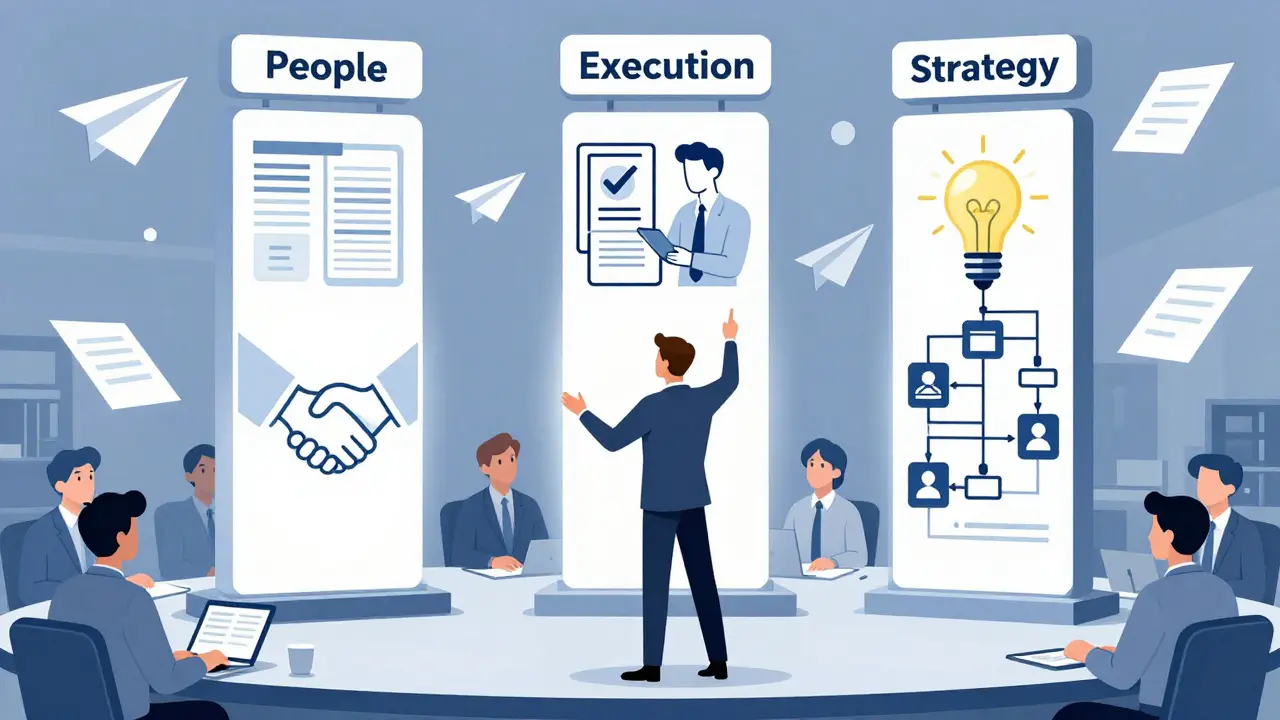
IBM’s framework for leading in the age of generative AI breaks it down into three pillars: people, execution, and strategy. Most companies focus on execution - cutting costs, speeding up reports. But the winners are the ones who lead with people first.
- People: This is where leadership becomes irreplaceable. Generative AI can’t give feedback with empathy. It can’t read the room during a tense meeting. It can’t build psychological safety. Leaders who model authenticity, courage, and inclusion are the ones their teams trust - especially when AI changes how work gets done.
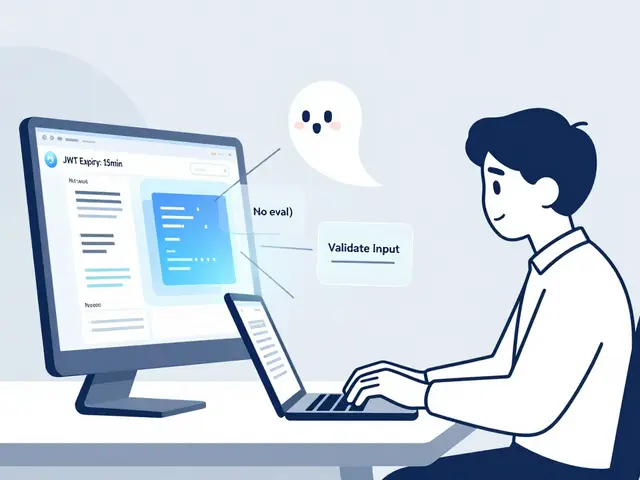
- Execution: Use AI to automate the repetitive. Drafting weekly summaries? Let AI handle it. Sorting through customer feedback? Use AI to tag themes. But always add human validation. High-performing organizations require human review of AI outputs 87% of the time - far above the 29% of average performers.
- Strategy: Don’t just use AI to do the same thing faster. Redesign workflows. Ask: "What if we rebuilt this process from scratch with AI as a core partner?" Companies that redesign at least 30% of their core workflows see 2.3x higher leadership effectiveness scores by 2026.
How to Start - Without Overwhelming Your Team
You don’t need a full AI transformation plan on day one. Start small. Here’s how:
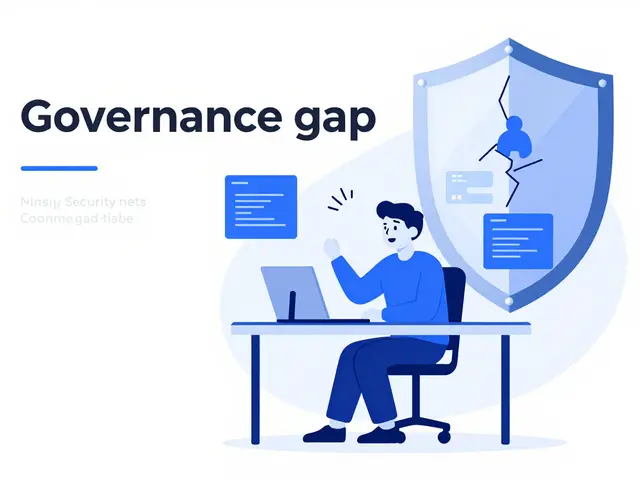
- Build your AI team within 30 days. Bring together HR, IT, operations, and frontline managers. Don’t leave this to tech alone. The people who use AI daily need a voice in how it’s governed.
- Define guardrails, not bans. MIT Sloan’s research found companies with clear AI policies outperform those that ban it by 3.2x in productivity. Instead of "Don’t use AI," try: "Use AI to draft customer responses, but always review tone and accuracy before sending."
- Pick one high-impact, low-risk use case. Focus on something with clear metrics: reducing meeting prep time, summarizing call transcripts, or automating routine reports. Aim for at least a 20% efficiency gain. Paradise Solutions recommends choosing use cases that can be implemented in under 120 days.
- Train, don’t announce. A 4-hour module like IBM’s "Leading in the Age of Gen AI" works because it’s practical. Show managers how to use AI in difficult conversations - not just how to click buttons. Frontline managers need 8-12 weeks of hands-on practice. Executives need less time, but more cultural clarity.
What Happens When You Get It Wrong
Not every rollout goes well. One director at a major retail chain shared on Blind: "We rushed AI into performance reviews. Employees thought we were replacing them. Anxiety spiked 30% in six weeks."
That’s the cost of poor change management. Generative AI isn’t just a tech upgrade - it’s a cultural shift. If your team thinks AI will replace them, they’ll resist it. If they think it’s a shortcut for managers to monitor them more closely, they’ll distrust it.
USAA’s approach is telling. Instead of rolling out customer-facing AI chatbots, they focused entirely on internal tools to reduce case resolution time. Result? A 27% drop in average handling time - without a single customer interaction being automated. They proved value internally first. That built trust. That built adoption.
The Data Doesn’t Lie - But It Doesn’t Tell the Whole Story
McKinsey says 63% of companies use cloud-based AI platforms. Microsoft, Google, and Amazon control 81% of the enterprise infrastructure market. The EU AI Act requires documentation for high-risk systems. The U.S. follows NIST guidelines. All of this matters.
But here’s what the data doesn’t say: Who’s leading the change? The organizations that thrive aren’t the ones with the most advanced models. They’re the ones with leaders who ask: "How do we use this to make our people better?"
Marvin Boakye, CHRO at Cummins, put it simply: "When you’re a leader, a significant amount of your time is spent on the development of your teams." That’s not going away. It’s becoming more important than ever.
What to Watch in 2026
By the end of 2025, 61% of Fortune 500 companies had formal AI governance frameworks. That’s up from 29% earlier in the year. By 2026, McKinsey predicts organizations with AI-integrated leadership development will see 2.3x higher leadership effectiveness scores.
Two trends will define success:
- Time reallocation becomes a KPI. Leaders who track how they use AI-saved time - and measure outcomes like team morale, innovation ideas, or retention - will outperform those who don’t.
- Human validation becomes non-negotiable. If your team isn’t reviewing, questioning, or refining AI outputs, you’re not leading - you’re delegating.
And remember: the goal isn’t to make AI smarter. It’s to make leaders wiser.
What’s the biggest mistake leaders make when adopting generative AI?
The biggest mistake is treating AI as a productivity hack instead of a leadership opportunity. Many leaders use AI to do more tasks faster, but they don’t redirect the saved time toward human-centered activities like coaching, strategic thinking, or team development. Without that shift, AI just adds pressure, not value.
Should I ban generative AI tools in my organization?
No. MIT Sloan’s 2025 research found companies with clear AI governance policies outperformed those with outright bans by 3.2x in productivity. Banning tools drives usage underground and kills transparency. Instead, create simple, clear guidelines: what’s allowed, what needs review, and how to report issues.
How do I know if my team is using AI effectively?
Look for two signs: First, are they asking questions about the output? High-quality AI use involves human judgment - not blind acceptance. Second, are they using saved time for higher-value work? If managers are just doing more emails, they’re not leveraging AI. If they’re having one-on-ones, mentoring, or refining strategy, they are.
Do I need to hire AI specialists to lead this?
Not necessarily. You need leaders who understand people, not just algorithms. The most successful AI initiatives are led by HR, operations, or frontline managers who know the day-to-day work. Tech teams can support, but leadership must own the change. Focus on training your existing leaders to use AI wisely - not on hiring experts to replace them.
What’s the fastest way to get started with generative AI?
Start with one low-risk, high-visibility task: automate weekly status reports or meeting summaries. Use a tool your team already has - like Microsoft Copilot or Google Gemini. Set a 30-day goal: "By the end of the month, we’ll save at least 5 hours per manager per week." Then, ask: "What did you do with that time?" The answer will tell you more than any dashboard.
Is generative AI creating more jobs or eliminating them?
The data shows both. Russell Reynolds’ 2025 survey found 64% of executives expect AI to create new jobs, while only 32% believe it will reduce headcount. The key is transformation, not replacement. AI is shifting roles - not removing them. For example, customer service reps are becoming AI trainers and quality auditors. The job changes, but the human element becomes more critical.
 Artificial Intelligence

Aimee Quenneville
February 19, 2026 AT 04:46Cynthia Lamont
February 20, 2026 AT 11:33Kirk Doherty
February 20, 2026 AT 14:53Dmitriy Fedoseff
February 22, 2026 AT 02:23Meghan O'Connor
February 22, 2026 AT 07:48Morgan ODonnell
February 22, 2026 AT 20:06Liam Hesmondhalgh
February 23, 2026 AT 12:48