
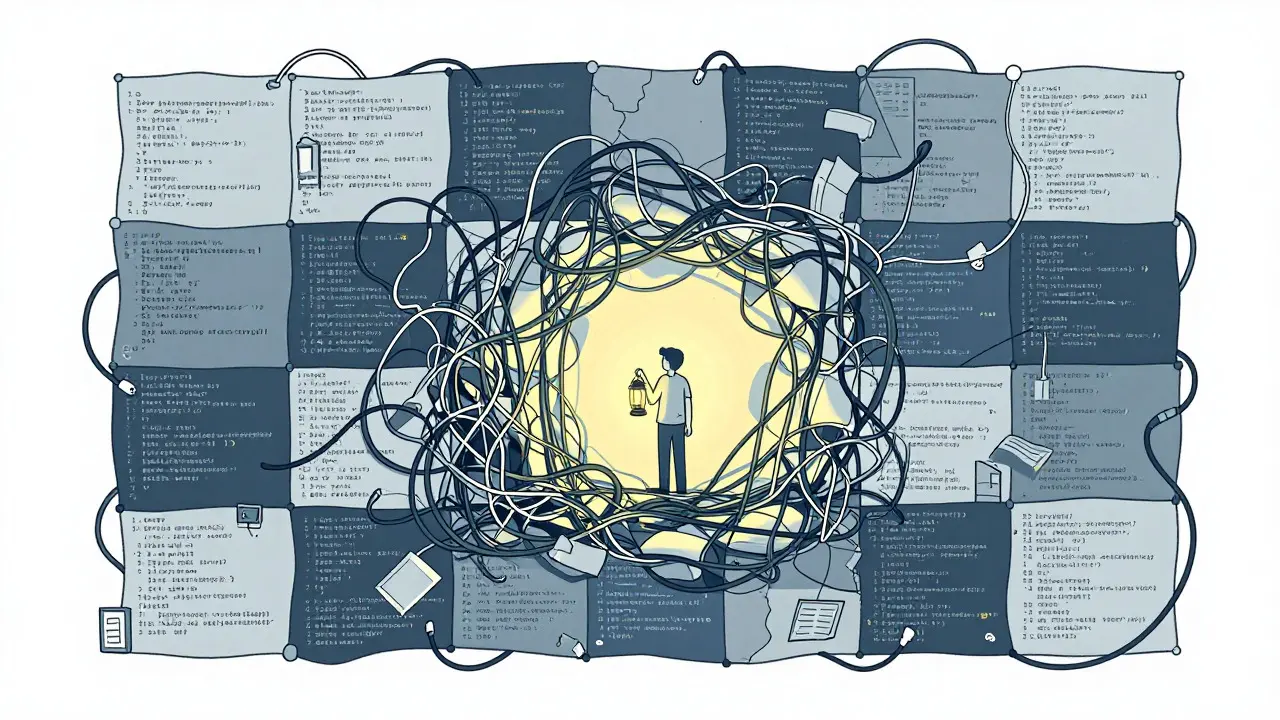
Imagine your dev team moving fast, but the codebase looks like a patchwork quilt from five different eras. That's where a Vibe Coding Center of Excellence comes in. It’s not just about enforcing rules; it’s about creating a shared language and toolkit that lets developers flow. In 2026, with AI assistants writing half our boilerplate, the "vibe" is shifting from individual style to collective intelligence. This guide breaks down how to build a CoE that actually gets adopted, rather than one that becomes another bureaucratic hurdle.
The Core Problem: Why Traditional Governance Fails Now
Most legacy Centers of Excellence fail because they focus on enforcement instead of enablement. Forrester data shows that CoEs focused solely on policing code fail 83% of the time. Developers hate being told what to do without being given the tools to do it well. A modern Vibe Coding CoE flips this script. It acts as an enablement hub, providing reusable assets, templates, and AI-assisted validation rather than just red pens. The goal isn't to slow down innovation; it's to remove the friction that causes context switching and technical debt.
Drafting the Charter: Defining Scope and Decision Rights
Your charter is the social contract between the CoE and the dev teams. If it’s too broad, you’ll get resistance. If it’s too narrow, you won’t matter. A strong charter takes 4-8 weeks to finalize and must clearly define three things:
- Scope: Are you covering all languages or just core enterprise stacks? Start with the top 2-3 technologies used by 70% of your developers.
- Decision Rights: Gartner analysts recommend pushing 70-80% of technical decisions to the teams. The CoE should only retain authority over architectural patterns, security-critical choices, and cross-team integration standards.
- Success Metrics: Don't just measure "compliance." Measure reduction in production incidents, onboarding time, and deployment frequency.
Keep the charter living document. Review it quarterly with stakeholder feedback to ensure it still reflects the reality of your engineering culture.
Staffing the Team: Who Actually Belongs in the Room?
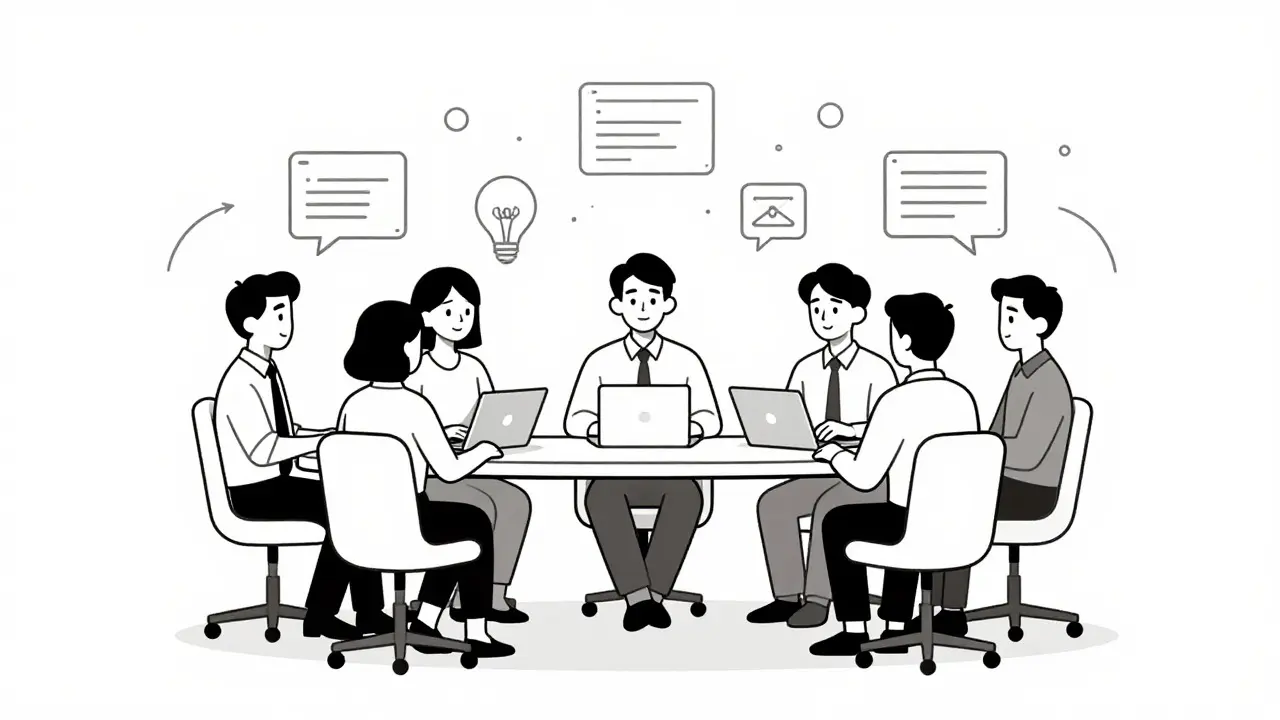
You don't need a massive army. For organizations with 100+ developers, a core team of 5-7 full-time equivalents is the sweet spot. But who are these people? They aren't just senior engineers. They are translators.
| Role | Primary Focus | Key Skill Set |
|---|---|---|
| CoE Director | Strategy & Stakeholder Management | Change management, executive communication |
| Principal Architect | Technical Standards & Patterns | System design, 10+ years domain expertise |
| DevEx Engineer | Tooling & Developer Experience | CI/CD pipelines, internal tooling, UX for devs |
| AI Integration Lead | Prompt Engineering & Model Governance | LLM fine-tuning, RAG pipelines, AI ethics |
| Community Manager | Adoption & Education | Workshops, documentation, community building |
Notice the inclusion of an AI Integration Lead. By 2026, 45% of new CoEs incorporate AI tools for standard enforcement. You need someone who understands how to configure Lint rules for AI-generated code and manage prompt libraries. Also, hire for empathy. 87% of CoE directors cite communication skills as critical. If your team can't explain *why* a pattern matters, no one will follow it.
Setting Realistic Goals: From Onboarding to Innovation
Goals should be phased. Don't try to boil the ocean in month one. Here is a realistic 12-month roadmap based on industry benchmarks:
- Months 1-3 (Foundation): Establish the charter, select the core tech stack, and integrate with existing CI/CD pipelines. Target: 90% of new projects using the standard Git branching strategy.
- Months 4-6 (Enablement): Launch the first set of reusable components and AI-assisted code review bots. Target: Reduce average onboarding time from 6 weeks to 10 days.
- Months 7-12 (Optimization): Measure impact. Aim for a 35-45% acceleration in time-to-market for standardized features and a 40% reduction in coding-standard-related production incidents.
Track defect density (< 0.5 per KLOC) and build success rates (>95%) as leading indicators. If these numbers improve, you're on the right track. If they stay flat, check if your standards are actually helpful or just annoying.
The Role of AI in the Modern CoE
This is where "Vibe Coding" really shines. Traditional CoEs relied on humans to review code for style consistency. That doesn't scale. In 2026, 70% of CoEs use AI to validate compliance. Your CoE should maintain a central library of "Golden Prompts" and custom Linters that understand your specific architecture. When a developer uses Copilot or Cursor, the AI should nudge them toward your preferred patterns automatically. This reduces cognitive load. Instead of memorizing 50 style guides, developers just write code, and the AI handles the formatting and basic structural checks. The CoE's job shifts from checking every line to curating the AI's behavior.
Avoiding Common Pitfalls
Even with the best plan, CoEs stumble. Here are the traps to avoid:
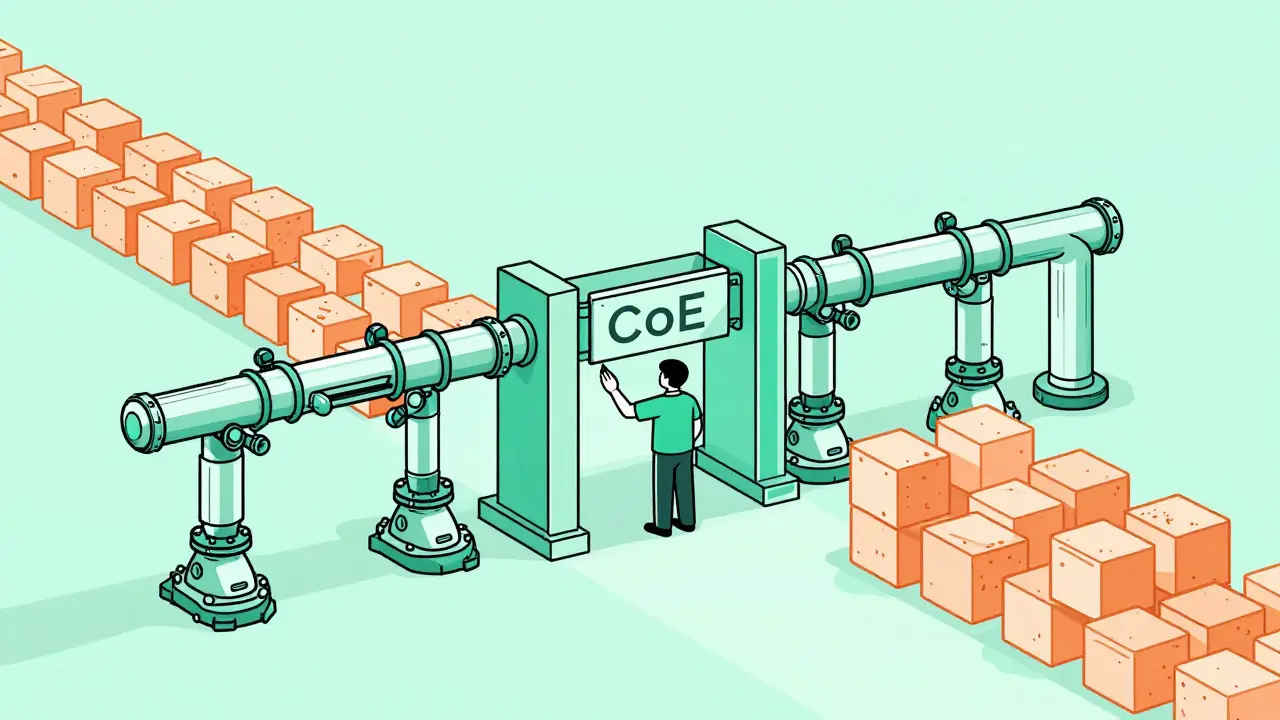
- The Bottleneck Effect: If every PR needs CoE approval, you've created a queue. Use automated gates for simple checks and human review only for architectural changes.
- One-Size-Fits-All: Allow 20-30% customization within your standards. Teams working on experimental AI models shouldn't have to follow the same rigid structure as a banking backend.
- Lack of Executive Sponsorship: This is the #1 failure factor. Without a VP or CTO actively championing the CoE, budget cuts will hit first. Secure a formal mandate early.
Measuring Success: Beyond Vanity Metrics
How do you know it's working? Look at business outcomes, not just code quality scores. Organizations with mature CoEs report 20-30% cost savings on subsequent projects due to reuse. More importantly, watch developer sentiment. Stack Overflow surveys show that 68% of developers rate CoEs positively when they provide tangible tools, versus only 29% when it's just governance. Run quarterly pulse surveys. If developers feel empowered rather than policed, you're winning.
Frequently Asked Questions
What is the minimum team size for a Vibe Coding CoE?
For organizations with 100+ developers, a core team of 5-7 full-time equivalents is recommended. Smaller companies can start with 2-3 part-time contributors focusing on key areas like API standards and CI/CD integration.
How does a CoE handle AI-generated code?
Modern CoEs use AI-assisted linters and custom prompt libraries to enforce standards on AI-generated code. The goal is to automate compliance checks so that human reviewers can focus on logic and architecture rather than syntax or style.
Should the CoE own the technology stack?
No. The CoE should recommend and standardize patterns, but decision rights for specific project technologies should remain with the development teams. The CoE retains authority only over cross-cutting concerns like security, observability, and integration protocols.
How long does it take to see ROI from a CoE?
Initial benefits like reduced onboarding time appear within 3-6 months. Significant cost savings and time-to-market improvements typically materialize after 12 months of consistent adoption and asset reuse.
What is the difference between a CoE and a Platform Team?
A Platform Team builds and maintains internal infrastructure (like Kubernetes clusters or identity services). A CoE defines the standards, patterns, and educational resources for how that infrastructure should be used. They often collaborate closely, with the Platform Team providing the tools and the CoE providing the guidance.
 Artificial Intelligence



Tamara Miller
August 22, 2026 AT 07:18Oh, wonderful. Another one of those "thought leadership" pieces that sounds like it was written by a committee of people who have never actually shipped code in the last decade.
You say the CoE is an "enablement hub," but let's be honest for a moment; it is just a polite way of saying there is now a middle management layer between you and your IDE.
I have seen this movie before. You start with good intentions, a nice charter, and a few shiny AI tools. Then, six months later, the "AI Integration Lead" is spending more time arguing about prompt syntax than fixing actual bugs.
The statistic about 83% failure rates? That is not a warning; that is a prophecy.
Developers do not want to be "empowered" by a group of five people who sit in glass offices and decide what colors our buttons should be. We want to write code.
If you are going to build this thing, at least make sure the "Community Manager" knows how to use a terminal so they do not waste our time with Jira tickets about font sizes.
But I suppose we cannot trust developers to self-regulate anymore. No, we need a "Golden Prompt" library. How very modern.
Just don't come crying to me when the adoption rate hits zero because nobody wants to read another PDF on architectural patterns.
It is all very well until the first production outage happens because the "standardized Git branching strategy" broke the deploy pipeline.
Then we will see if your "executive sponsorship" is strong enough to cover the cost of the fix.
For now, I am just here to watch the circus.
Please, do try to keep the "vibe" positive while you dismantle our autonomy.
Or maybe just leave us alone. That would be easier.
Savara Gunn
August 23, 2026 AT 15:23I think the point about starting with the top 2-3 technologies is really key here.
We tried to standardize everything at once last year and it fell apart pretty quickly.
Focusing on where most of the devs actually spend their time makes a lot more sense.
Also, the idea of using AI to handle the basic style checks instead of humans doing line-by-line reviews is something we are just starting to explore.
It takes a lot of the friction out of code review for simple changes.
Thanks for sharing this roadmap, it gives us a good framework to talk to our stakeholders.
Anthony Miller
August 25, 2026 AT 00:19Let us be clear about the fundamental flaw in this entire premise which is that you are assuming developer sentiment is a valid metric for engineering success which it is not because sentiment is subjective and volatile and therefore useless as a KPI
The real issue is that you are conflating enablement with bureaucracy
A Center of Excellence is by definition a center of excellence not a center of comfort
If your developers are complaining about standards then they are either incompetent or lazy and both conditions require correction not accommodation
The mention of an AI Integration Lead is particularly telling because it suggests that you do not trust your senior engineers to manage the output of these probabilistic machines themselves
Why would you need a dedicated headcount to curate prompts when a competent principal engineer can do it in an afternoon
This is bloat
This is pure organizational bloat disguised as innovation
And do not get me started on the "Vibe Coding" terminology which is nothing more than a marketing term designed to make technical debt sound like a lifestyle choice
You are not building a culture you are building a compliance department with a nicer logo
Get rid of the Community Manager role immediately because community does not need managing it needs leading and leadership requires authority not empathy workshops
The only metric that matters is throughput and defect density and if your CoE does not improve those two numbers within two quarters then it is a cost center and should be dissolved
Stop hiding behind quarterly pulse surveys and measure the code
Measure the code and stop measuring the feelings
michelle veluz
August 26, 2026 AT 03:50Wait wait wait... hold on a second!!
Did you guys notice that the "AI Integration Lead" role is basically a new way for Big Tech to spy on us??
Think about it! They want to control the "Golden Prompts"?? Who decides what is a good prompt?? The government? The corporations?
It is all connected! The whole "Center of Excellence" thing is just a front for centralizing control over our digital lives!!
I mean, look at the stats. 83% failure rate. That is not a coincidence, that is a sign from the universe that this system is rigged against the common coder!!
They want us to stop thinking for ourselves and just follow the "standardized Git branching strategy" like sheep!!
My uncle works in banking and he says the backend is already full of backdoors planted by foreign entities during the last migration.
So now we add AI on top of that? Dangerous!! Very dangerous!!
We need to protect our local data! Do not trust the cloud! Do not trust the "CoE Director" who is probably just a corporate shill trying to cut budgets!
Stay vigilant everyone! The vibe is shifting, but not in a good way! It is shifting towards total surveillance!
Wake up sheeple!
Jacob Baby Official
August 26, 2026 AT 15:56Actually, this whole concept is fundamentally flawed because it assumes that a "Center of Excellence" can exist independently of the product team which is a myth perpetuated by consultants who charge by the hour
The real problem is not governance it is the lack of product-market fit
Why are we even talking about code style when we should be talking about why our churn rate is up 15%
The AI part is also overhyped because LLMs are still terrible at understanding context beyond a single file
So the idea that they can enforce architectural patterns is laughable
You are building a house of cards on sand
And the worst part is the staffing model
Five to seven people is too many for a team of 100
That is a 5-7% overhead just for "standards"
In my experience the best CoEs are just one person who writes a wiki page and leaves
Everything else is theater
Great post though, very insightful, thanks for wasting my time with such a detailed breakdown of a solution to a problem that doesn't exist.
john randall
August 27, 2026 AT 05:06Interesting take on the AI integration.
We are seeing similar trends in our org.
The shift from human review to automated gates seems inevitable.
Good points on the pitfalls too.
Especially the bottleneck effect.
We hit that last year.
Now we use auto-merge for minor fixes.
Works well.
Thanks for the summary.
Jeff Falcon
August 27, 2026 AT 07:38I really liked the section on the charter being a living document, because honestly, in my experience, most charters end up gathering dust in a shared drive after the first quarter, and nobody remembers who approved them in the first place, which leads to a lot of confusion down the line when someone tries to implement a new pattern that wasn't explicitly covered in the original scope, so having that quarterly review cadence is crucial, especially when you are dealing with rapid changes in the AI tooling landscape where what worked last month might be obsolete next month, and it is not just about the tech, it is about the people, because if the team feels like the rules are static and unchangeable, they will find ways to bypass them, which defeats the whole purpose of the CoE, so the social contract aspect is really the most important part, more than any of the technical standards or the specific metrics you track, because ultimately, adoption is a human behavior, not a technical one, and if you do not treat it as such, you will fail, regardless of how good your linters are or how sophisticated your prompt libraries become, and that is something that a lot of these guides miss, focusing too much on the "what" and not enough on the "how" of change management, which is a hard skill to hire for, but an essential one for this role, and I think that is why the Community Manager role is so critical, even if it sounds a bit fluffy on paper, because they are the ones bridging the gap between the technical reality and the cultural perception of the team, and without that bridge, you just have two groups of people talking past each other, which is the fastest way to kill momentum, so yeah, definitely agree with the phased approach, better to start small and expand than to boil the ocean, as they say, and hopefully, this guide helps others avoid the same mistakes we made, which were mostly about underestimating the communication effort required to sustain a CoE over time, rather than the initial setup, which is usually the easy part, compared to keeping the energy high and the relevance sharp, especially in a fast-moving industry where attention spans are short and priorities shift constantly, so stay flexible, stay empathetic, and remember that the goal is flow, not friction, and if you lose sight of that, you have lost the plot entirely, but overall, solid advice, thanks for putting it together, it gave me a lot to chew on for our next planning cycle, and I am going to share it with my director, who has been asking for a rationale on why we need to invest more in DevEx, so this should help make that case, and who knows, maybe we will actually get some traction this time around, fingers crossed, but we have learned to be cautiously optimistic, given the history of these initiatives in our company, which tends to swing between extreme chaos and extreme rigidity, rarely hitting the sweet spot in the middle, but that is a story for another day, and for now, let us just hope that this Vibe Coding approach brings a little more harmony to our codebase, and a little less headache to our daily work, because that is really all we want, is to do our jobs well, without getting in each other's way, and if a CoE can help with that, then it is worth the effort, provided that it stays focused on enablement, and not enforcement, which is a fine line to walk, but a necessary one, in my opinion, and one that requires constant vigilance and adjustment, but hey, that is life, right, so let us keep moving forward, one commit at a time, and maybe, just maybe, we will actually get somewhere this time, and that is a hopeful thought to end on, thank you again for the post, it was quite comprehensive, and I appreciate the effort that went into it, and I hope it resonates with others in the community as well, because we all need a bit of guidance in this ever-changing landscape, and a bit of reassurance that we are not alone in our struggles, and a bit of inspiration to keep pushing forward, despite the odds, and despite the noise, and despite the endless meetings, and despite the broken pipelines, and despite the confusing requirements, and despite the changing tools, and despite the shifting priorities, and despite the budget cuts, and despite the layoffs, and despite the uncertainty, we keep going, because we love what we do, and we believe in the power of software to change the world, and that belief is what drives us, day after day, week after week, month after month, year after year, and it is what keeps us coming back to the keyboard, ready to build, ready to create, ready to innovate, and ready to solve problems, big and small, simple and complex, known and unknown, and that is the true spirit of coding, and that is the true vibe, and that is what we should all be striving for, every single day, in every project, in every interaction, and in every line of code we write, so let us raise a glass to that, metaphorically speaking, and let us continue to push the boundaries of what is possible, together, as a community, as a team, as a family, and as fellow travelers on this incredible journey, and may the force be with us, always, and everywhere, and in every corner of the digital realm, and beyond.