
Imagine cutting your coding time by half, only to spend an entire afternoon hunting for a single, invisible bug that a machine introduced. That is the current reality of Code Generation is the process where artificial intelligence systems, trained on massive repositories of existing code, translate natural language descriptions into functional programming code. We've moved past simple autocomplete; we are now in an era where AI can draft entire functions, suggest architectural patterns, and write boilerplate in seconds.
But here is the catch: while these tools make us feel like superpowers on a Tuesday, they can lead to catastrophic security holes by Wednesday if we aren't careful. The promise of 55% faster task completion is real, but it comes with a hidden tax in the form of increased code review time and a new kind of "cognitive load." If you're using these tools, you're no longer just a coder-you're an editor and a security auditor.
The Productivity Jump: Where the Wins Actually Happen
For most developers, the biggest win isn't in solving complex algorithms; it's in deleting the boring parts of the job. GitHub Copilot, which launched in June 2022 and is powered by OpenAI Codex, has become the gold standard for this. According to a GitHub study, users finished tasks 55% faster. Why? Because AI is incredible at the "grunt work."
You'll see the most immediate gains in these areas:
- Boilerplate Generation: Writing CRUD operations or setting up basic UI components in React or Vue.
- API Integration: Instead of digging through outdated documentation, you can ask for a specific implementation example of a library.
- Unit Test Drafting: Generating the initial 80% of a test suite, which you then refine with specific edge cases.
- Language Translation: Converting a logic block from Python to TypeScript with surprising accuracy.
This shifts the developer's role. You spend less time recalling the exact syntax for a map function and more time thinking about how the data should flow through your system. It reduces the friction between having an idea and seeing it run on screen.
The Heavy Hitters: Comparing Today's Code LLMs
Not all models are built the same. Some are proprietary black boxes designed for seamless enterprise integration, while others are open-source giants that you can tweak and host on your own hardware. Depending on whether you value privacy, cost, or raw power, your choice will change.
| Model/Tool | Access Type | Key Strength | HumanEval (Pass@1) | Best For |
|---|---|---|---|---|
| GitHub Copilot | Proprietary/Paid | IDE Integration | ~52.9% | General purpose enterprise dev |
| CodeLlama-70B | Open-Source | Customization | ~53.2% | Self-hosting & fine-tuning |
| Amazon CodeWhisperer | Proprietary | AWS Ecosystem | ~47.6% | AWS cloud infrastructure projects |
| Gemini Code Assist | Proprietary | Google Cloud/Context | High | Deep Google Cloud integration |
If you're an individual developer, a $10/month subscription for a managed service is usually the best trade-off. However, for companies handling extremely sensitive data, a model like CodeLlama-which Meta released with variants from 7B to 70B parameters-allows you to keep your code entirely on-premises, provided you have the GPU power (at least 16GB VRAM for the smaller versions).
The Invisible Wall: Where LLMs Fail
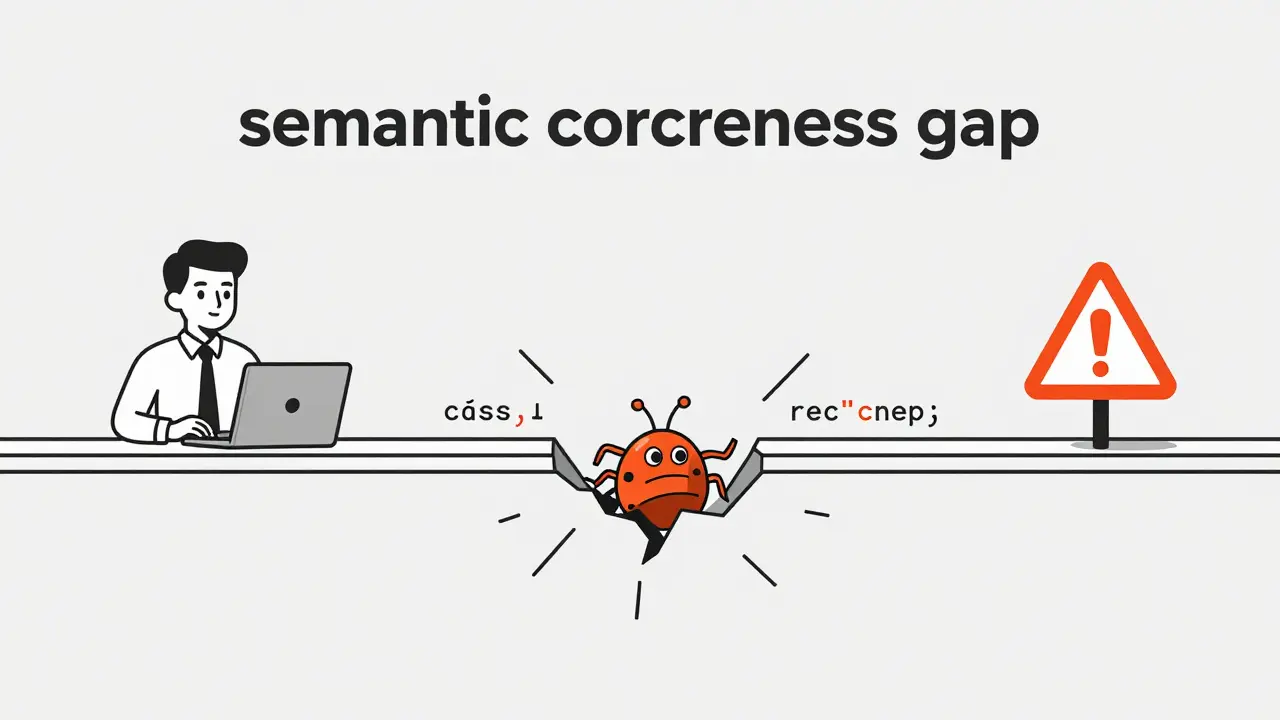
If LLMs are so fast, why hasn't every senior engineer been replaced? Because there is a massive gap between "code that looks correct" and "code that is correct." This is what experts call the semantic correctness gap. A model might generate a function that passes a basic unit test but fails catastrophically when it hits a rare edge case or a race condition in a multi-threaded environment.
The limits are most apparent in these critical areas:
- Security-Critical Code: Research has shown that nearly 40% of LLM-generated authentication systems contain security flaws. One developer on Hacker News even documented a case where a model introduced a SQL injection vulnerability that slipped past basic scans.
- Complex State Management: LLMs struggle with long-range dependencies. They might forget a variable's state if the logic spans across multiple files or very long functions.
- Cryptographic Functions: A 2024 study found that major LLMs failed to correctly implement over 37% of cryptographic functions. Using AI for encryption is a recipe for disaster.
- Concurrency: Handling deadlocks and async/await patterns in complex systems is still a human-centric task.
Essentially, LLMs act like a very eager junior developer. They are incredibly fast and know a little bit about everything, but they lack the wisdom to know when they are guessing. They don't understand the code; they are predicting the next most likely token based on a trillion examples.
The "AI Tax": New Challenges for Developers
There is a paradoxical trend happening in software houses: as coding speed increases, the time spent on code review is skyrocketing. An MIT study found that while junior developers were 55% faster, they produced significantly more vulnerabilities than seniors coding manually. This means the "time saved" in writing is often spent in the review phase.
We are seeing a shift in the required skill set. To survive in this environment, you need to move from being a "writer" to being a "reviewer." This involves:
- Advanced Debugging: You need to be able to spot subtle logical errors that look syntactically perfect.
- Prompt Engineering: Learning how to guide the model through "least-to-most prompting" to break complex problems into smaller, manageable chunks.
- Rigorous Testing: Since you can't trust the generator, your test suite must be more robust than ever before.
If you rely too heavily on the AI, you risk "automation bias," where you assume the code is correct because it looks professional. This is where the most dangerous bugs are born.
Staying Safe: A Practical Checklist for AI Coding
You don't have to stop using these tools, but you should change how you use them. Treat every line of AI-generated code as a suggestion, not a fact.
- Never copy-paste security logic: Any code involving passwords, tokens, or encryption must be written or vetted by a human expert.
- Verify API versions: LLMs frequently "hallucinate" API methods that don't exist or belong to an older version of a library.
- Use Execution Feedback: If your tool supports it, use a "self-debugging" loop where the AI sees the error message and tries to fix it. This can improve correctness by nearly 30%.
- Isolate AI code: Keep AI-generated blocks small and modular. It's much easier to audit a 10-line function than a 200-line class.
Do LLMs replace the need to learn how to code?
Actually, the opposite is true. Because LLMs can introduce subtle, high-impact bugs, you need a deeper understanding of the language to audit the output. Relying on AI without knowing the fundamentals makes you unable to identify when the model is hallucinating or introducing a security flaw.
Which is better: GitHub Copilot or an open-source model like CodeLlama?
It depends on your priority. Copilot offers the best user experience and IDE integration for a monthly fee. CodeLlama is better for those who need total data privacy (self-hosting) or want to fine-tune the model on their own proprietary codebase.
How do I stop the AI from making security mistakes?
You can't stop the model from making mistakes, but you can stop them from reaching production. Use static analysis tools (SAST), implement mandatory peer reviews for AI-generated code, and never use AI to implement authentication or encryption from scratch.
What is the "semantic correctness gap"?
This refers to code that is syntactically correct (it runs without crashing) but logically wrong (it doesn't actually solve the problem correctly or fails on specific edge cases). It's the most dangerous kind of error because it's harder to detect than a syntax error.
Can AI help with complex architectural decisions?
LLMs are great at suggesting patterns (like "use a Factory pattern here"), but they lack the context of your specific business needs, long-term maintenance costs, and organizational constraints. They are better for implementation than for high-level system design.
What's Next for AI Coding?
We are moving toward "Agentic" workflows. Tools like Copilot Workspace are attempting to move from generating a single snippet to managing a whole project. Instead of writing a function, the AI will plan a feature, create the files, write the tests, and then present the final PR for your review.
The future isn't about the AI writing the code; it's about the AI managing the boilerplate while the human manages the intent, the security, and the edge cases. The developers who thrive will be those who treat AI as a high-speed assistant that requires constant, skeptical supervision.
 Artificial Intelligence





Rahul U.
April 22, 2026 AT 13:23The point about the semantic correctness gap is so spot on! 🎯 It's definitely a double-edged sword where the speed is tempting but the risk is real. I've noticed this a lot when handling complex data types in TypeScript. ✨
E Jones
April 22, 2026 AT 13:49Oh, please! You're all just dancing to the tune of the silicon overlords who want to feast on our cognitive autonomy while they secretly harvest our keystrokes to build a digital panopticon that'll eventually make the very concept of a 'developer' a quaint relic of a pre-algorithmic dark age where humans actually thought for themselves instead of being mere biological conduits for a black-box oracle designed by shadow corporations to erode the fabric of human intellect and replace it with a sterile, predictable, and utterly soulless sequence of tokens! 👁️
David Smith
April 23, 2026 AT 13:32Absolutely ridiculous that we're even debating this. The sheer audacity of suggesting a junior can just 'review' AI code is a joke. It's a disaster waiting to happen and honestly, it's morally bankrupt to push these tools on people who don't understand the underlying architecture just to hit a deadline. Pure chaos.
James Boggs
April 24, 2026 AT 09:54I concur. The focus on modularity is essential.
selma souza
April 25, 2026 AT 07:08It is profoundly disappointing to observe the lack of linguistic rigor in these discussions. The term 'automation bias' is used correctly here, yet the broader industry continues to ignore the fundamental requirement of precision in both code and prose. One does not simply 'prompt' their way to excellence without a foundational mastery of the craft.
Frank Piccolo
April 27, 2026 AT 05:16Typical. Everyone's acting like this is some revolutionary shift when it's basically just a fancy grep on steroids. Real American engineering was built on grit and knowing the metal, not asking a chatbot to write a React component because you're too lazy to read the docs. This 'productivity jump' is just a fancy word for mediocrity scaling at an industrial pace.
Lissa Veldhuis
April 28, 2026 AT 23:15lol imagine thinking you can just 'audit' code when the AI is basically hallucinating a whole new reality for you honey... it's a total trainwreck and you're all just sipping the kool-aid while your codebase turns into a spaghetti monster of invisible bugs and ghost logic that only a wizard could fix
Barbara & Greg
April 30, 2026 AT 23:05We must reflect upon the ontological shift occurring here. When the act of creation is outsourced to a probabilistic machine, the developer ceases to be an artisan and becomes a mere curator of artifacts. There is a distinct ethical imperative to maintain the sanctity of human intellect over the convenience of algorithmic efficiency, lest we lose the very essence of critical thinking in our pursuit of a faster sprint cycle.
Addison Smart
May 2, 2026 AT 01:15I can see where everyone is coming from, and while the concerns about security and the 'AI tax' are certainly valid and deserve a seat at the table, I believe we can find a middle ground where we embrace the efficiency of these tools without abandoning our professional standards. It's all about fostering a culture of mutual skepticism and rigorous peer review, ensuring that we don't let the technology dictate our standards, but rather use the technology to elevate the baseline of what we consider 'acceptable' code through constant iteration and open communication across different levels of seniority in the team.