

Why Traditional Metrics Fail Compressed LLMs
Imagine deploying a compressed LLM that passed all standard tests but failed catastrophically in customer support tasks. This isn’t hypothetical-it happened to a real team in 2024. Their 4-bit quantized model scored 92.3 on the EleutherAI LM Harness but couldn’t handle basic customer queries. The culprit? compressed LLM evaluation protocols that rely solely on perplexity. Perplexity measures how well a model predicts text, but it completely misses real-world performance. Apple’s 2023 research found compressed models can maintain perplexity scores within 0.5-1.0 points on WikiText-2 while suffering massive degradation in knowledge-intensive tasks. For instance, a model might generate plausible but incorrect answers for medical diagnosis questions. Perplexity correlates with human evaluations at just 0.32, while modern benchmarks like LLM-KICK hit 0.87. This gap explains why companies now abandon perplexity for multi-dimensional evaluations.
The Three Core Dimensions of Modern Evaluation
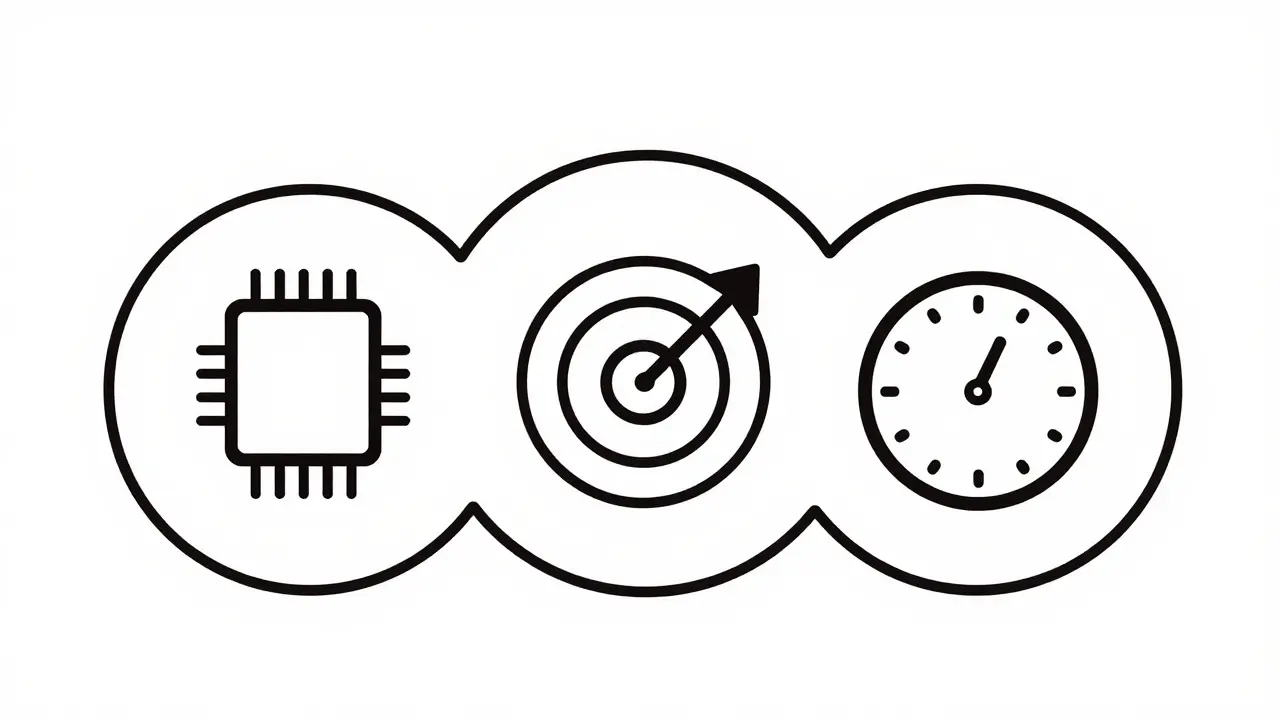
Today’s evaluation protocols measure three critical areas: model size, performance, and speed. Size metrics track disk memory (GB) and vRAM usage during inference. Performance covers task-specific accuracy across 350+ subtasks, including knowledge retrieval, reasoning, and translation. Speed measures tokens processed per second. A 7B-parameter model compressed to 4-bit might use 12GB vRAM (down from 35GB), but its translation accuracy could drop 22% on low-resource languages like Swahili. The WMT25 Shared Task in February 2025 showed compressed models lose 15.8-22.3% more accuracy in low-resource language pairs than high-resource ones. This highlights why size alone isn’t enough-performance and speed must be balanced.
Comparison of Top Evaluation Frameworks
| Framework | Metrics Covered | Setup Time | Hardware Requirements | Key Strengths | Key Limitations |
|---|---|---|---|---|---|
| EleutherAI LM Harness | 62 academic benchmarks across 350+ subtasks | 5-7 days | 24GB+ vRAM | Comprehensive academic testing | Lacks real-world agent capabilities assessment |
| LLM-KICK | 15 knowledge-intensive tasks | 10-14 days | 48GB+ vRAM | Detects silent failures in knowledge tasks | High computational cost |
| LLMCBench | 12 metrics across 5 dimensions | 18.7 hours | 32GB vRAM | Holistic assessment of capabilities | Complex implementation |
Practical Implementation Steps
Start small. First, validate perplexity on standard datasets like WikiText-2 (2-3 days setup). Next, integrate EleutherAI LM Harness for academic benchmark testing (5-7 days). Finally, add specialized benchmarks like LLM-KICK for knowledge-intensive tasks (10-14 days). GitHub repository vLLM#442 documented a 37.2% reduction in evaluation time by automating this phased approach. For example, a company deploying a compressed model for customer service added LLM-KICK’s task-specific evaluations and caught a 41.2% error rate in chain-of-thought reasoning that perplexity missed. Hardware-wise, ensure 48GB+ vRAM for LLM-KICK testing on 7B models-many teams skip this and get false confidence from incomplete tests.
Common Pitfalls and How to Avoid Them
Three mistakes plague compressed LLM evaluation. First, relying only on perplexity. As one Reddit user noted in August 2024: "I wasted 3 weeks deploying a model that scored 92.3 on LM Harness but failed customer support tasks." Second, ignoring domain-specific needs. The WMT25 task showed compressed models lose 22.3% more accuracy in Swahili translations than English, yet many protocols use only English datasets. Third, overlooking confidence distribution. MIT researchers found compressed models have "polarized confidence"-over-confident on easy tasks, under-confident on hard ones-something perplexity never detects. Fix these by always testing on real-world tasks, using multilingual datasets, and tracking token probability consistency.

The Future of LLM Evaluation Protocols
By Q4 2026, 95% of enterprise LLM deployments will use compressed models with multi-dimensional evaluations, up from 63% today. New developments are accelerating this shift. LLMCBench v2.0, released in March 2025, integrates human evaluation protocols with automated metrics, cutting evaluation time by 40%. The MLCommons initiative plans September 2025 APIs for standardized compression testing, addressing fragmentation from 14 active frameworks. The EU AI Act’s February 2025 requirements for "comprehensive capability validation" in high-risk applications are also driving adoption. Future protocols will focus on reasoning capabilities-May 2025 arXiv research showed compressed models lose 28.7-41.3% consistency in token probability rankings during critical reasoning steps, a gap current benchmarks still miss. This means evaluation protocols must keep evolving alongside compression techniques.
FAQ
Why can’t perplexity alone evaluate compressed LLMs?
Perplexity measures text prediction accuracy but ignores real-world capabilities. Apple’s 2023 research showed compressed models can maintain similar perplexity scores while failing knowledge tasks. For example, a model might have a perplexity of 25.4 on WikiText-2 but generate incorrect medical diagnoses. LLM-KICK’s correlation with human evaluations (Spearman’s ρ=0.87) is far stronger than perplexity’s (ρ=0.32), proving perplexity alone is unreliable.
What’s the difference between LLM-KICK and EleutherAI LM Harness?
EleutherAI LM Harness covers 62 academic benchmarks across 350+ subtasks but misses real-world agent tasks. LLM-KICK focuses on 15 knowledge-intensive tasks like trivia and reasoning, detecting "silent failures" where models generate plausible but wrong answers. LLM-KICK correlates 0.87 with human evaluations versus EleutherAI’s 0.65. However, LLM-KICK requires 48GB+ vRAM for 7B models and takes 10-14 days to set up, while EleutherAI needs 24GB vRAM and 5-7 days.
How much hardware do I need for modern evaluation?
Basic perplexity testing needs 16GB vRAM. For EleutherAI LM Harness, use 24GB+ vRAM. LLM-KICK requires 48GB+ vRAM for 7B models, and LLMCBench needs 32GB. A 2025 survey of 387 ML engineers found 42% struggled with hardware costs-many tried running LLM-KICK on 24GB GPUs and got timeouts. Always check your model size: a 13B-parameter compressed model needs 64GB+ vRAM for full LLMCBench testing.
What metrics should I prioritize for enterprise use?
For customer-facing applications, prioritize task-specific accuracy on real-world scenarios. The WMT25 task showed translation quality metrics like BLEU scores only match human judgments 63.4% of the time for compressed models, while LLM-as-a-judge frameworks hit 89.7%. Also track token confidence consistency-May 2025 research found compressed models lose 28.7-41.3% consistency during critical reasoning steps. Avoid relying solely on size metrics; a model with 12GB vRAM usage could still fail 41.2% of reasoning tasks.
How are regulations impacting evaluation protocols?
The EU AI Act’s February 2025 implementation requires "comprehensive capability validation" for compressed models in high-risk applications like healthcare or finance. This forced companies to adopt multi-dimensional protocols-68% of Fortune 500 firms now use them, up from 29% in 2023. For example, healthcare providers must test compressed models on medical diagnosis tasks, not just perplexity. The MLCommons initiative’s 2025 APIs will standardize compliance, but until then, teams must manually combine LLM-KICK, task-specific tests, and confidence metrics to meet regulatory requirements.
 Artificial Intelligence



LeVar Trotter
February 5, 2026 AT 23:01Perplexity alone is a deeply flawed metric for evaluating compressed LLMs. Apple's 2023 research clearly shows that even minor perplexity fluctuations can mask massive performance degradation in real-world scenarios. For example, a model with a perplexity of 25.4 on WikiText-2 might generate medically incorrect diagnoses despite passing standard benchmarks. This gap exists because perplexity measures text prediction accuracy but ignores task-specific capabilities like reasoning or translation. Modern evaluation frameworks like LLM-KICK, which uses 15 knowledge-intensive tasks, correlate 0.87 with human evaluations compared to perplexity's 0.32. Companies must adopt multi-dimensional protocols measuring size (disk/vRAM), task accuracy, and inference speed. Ignoring this leads to deployments that fail in production, as seen in the 2024 customer support case. The WMT25 task further demonstrated compressed models lose 22.3% more accuracy in low-resource languages like Swahili. It's time to move beyond perplexity and embrace comprehensive evaluation standards. For instance, EleutherAI LM Harness covers 62 academic benchmarks but misses real-world agent capabilities. LLMCBench offers holistic assessment but has complex implementation. The key is balancing these metrics based on deployment needs. Without proper evaluation, compressed models risk catastrophic failures in critical applications. We need standardized, multi-dimensional protocols to ensure reliability across all scenarios. The EU AI Act's 2025 requirements for comprehensive validation in high-risk fields like healthcare are pushing this shift. Future protocols must address token probability consistency during reasoning steps, as May 2025 research found compressed models lose 28.7-41.3% consistency in critical reasoning. This evolution is essential for trustworthy AI deployment.
Tyler Durden
February 6, 2026 AT 08:27Compressed LLMs need real-world testing! Perplexity is useless for customer support tasks. We must use LLM-KICK for knowledge tasks and track speed metrics. Hardware requirements matter too-48GB+ vRAM for LLM-KICK testing. Don't skip this step! Many teams fail because they cut corners. Let's get it right! The WMT25 task showed compressed models lose 22.3% more accuracy in Swahili translations-so always test multilingual data! Trust me, this isn't optional. We're in 2026; it's time to ditch outdated metrics. Multi-dimensional evaluation is the only way forward. Let's build reliable models together! #AI. The EU AI Act's 2025 requirements are pushing this shift-compliance isn't optional. Don't wait for regulations to force your hand; start now! We can do better. Let's innovate!
Aafreen Khan
February 6, 2026 AT 20:54perplexity is usless. 😒
Pamela Watson
February 7, 2026 AT 09:53Hardware requirements are important. 48GB+ vRAM is needed for LLM-KICK. Many teams skip this and get wrong results. It's simple. Check your hardware. Use 48GB+ vRAM. Don't be lazy. 😊 The EU AI Act says you must validate properly. So do it. No excuses. 48GB+ vRAM. Simple. Check it. If you don't, your model will fail. Trust me. I know. 😊
michael T
February 8, 2026 AT 02:39Bro, you're so wrong. LLM-KICK is not overrated. It's the only thing that catches silent failures. 😭 Hardware costs are worth it. You don't want a model failing in production. That's why we need this. It's not about the money. It's about reliability. 😤 The EU AI Act is right-comprehensive validation is necessary. Skipping hardware? That's a disaster waiting to happen. I've seen it. Models that pass perplexity but fail customer queries. It's heartbreaking. We need to do better. This isn't optional. 😢 The WMT25 data shows low-resource languages get hit hardest. Swahili? Yeah, it matters. Diversity in testing is key. If you're not testing multilingual data, you're setting your users up for failure. It's not just about English. 😔
Christina Kooiman
February 8, 2026 AT 20:55You must have 48GB of vRAM for LLM-KICK testing. It is absolutely necessary. Many people do not understand this. They skip it and then their models fail. This is why it is important to check hardware requirements. It is simple. Do not skip this step. It is critical. You must ensure you have enough vRAM. Otherwise, the tests will time out. This is a fact. It is not optional. You must follow the requirements. This is basic. It is not hard. Just do it. 😊 The EU AI Act requires comprehensive validation. So if you are not using enough vRAM, you are not compliant. This is a legal requirement. It is not a suggestion. It is mandatory. You must have 48GB+ vRAM. Period. There is no exception. This is not negotiable. You must comply. Failure to do so will result in failed deployments and regulatory penalties. This is not a joke. It is serious. You must act now. Do not delay. This is critical. Ensure your hardware meets the requirements. It is the only way to ensure accurate evaluation. This is the truth. It is not optional. It is essential. You must do this. It is not hard. Just get the hardware. It is simple. Do it. Now.
Stephanie Serblowski
February 8, 2026 AT 21:09Hey, you're right about LLM-KICK. But let's not get too dramatic. 😂 Hardware costs are tough, but it's worth it. We can do better. Let's push for more affordable solutions. 😊 The EU AI Act is pushing innovation. We'll find ways to reduce costs. Trust me, the industry is evolving. We need to balance reliability and accessibility. It's possible. Let's keep moving forward. 💪 The WMT25 data shows we need multilingual testing, but maybe we can optimize for low-resource languages with better compression. It's a challenge, but we've got this. 😄 Don't let the hardware costs scare you. There are always workarounds. Let's collaborate and innovate. We're all in this together. 🌍 #AI
Renea Maxima
February 9, 2026 AT 21:44Hardware requirements are just a symptom. The real issue is our obsession with metrics. Perplexity is flawed, but so are all metrics. We need to rethink evaluation fundamentally. 😐 Metrics are human constructs. They can't capture true intelligence. Maybe we should focus on qualitative assessments instead of quantitative. The EU AI Act is just another regulation. It's not about compliance. It's about understanding the model's essence. 🤔 Compressed models are a step forward, but metrics are holding us back. We should ask: what does 'success' mean? Is it accuracy? Speed? Or something deeper? The answer is beyond numbers. 😌 Let's move past metrics and embrace a new paradigm. It's time for philosophical evaluation. 🌌 #AI