You built a chatbot. It works. But who checks if it’s leaking your customer data or hallucinating compliance rules? Most teams treat Generative AI as just another software feature. That’s a mistake. Unlike traditional apps, GenAI introduces risks that standard firewalls can’t see-like prompt injection attacks or training data poisoning. If you’re running GenAI in production by late 2026, you need more than good vibes; you need a control framework. The big players are NIST, ISO, and SOC 2. They aren’t interchangeable. Choosing the wrong one wastes months of engineering time. Here is how to pick the right shield for your specific AI workload.
NIST Leads with Specificity
If you want a blueprint designed specifically for AI, look at NIST. Their AI Risk Management Framework (AI RMF), released in early 2023, isn’t just a suggestion-it’s becoming the de facto standard for U.S. enterprises. Why? Because it breaks AI risk down into four actionable functions: Govern, Map, Measure, and Manage. This structure forces you to ask hard questions about accountability before you even deploy a model.
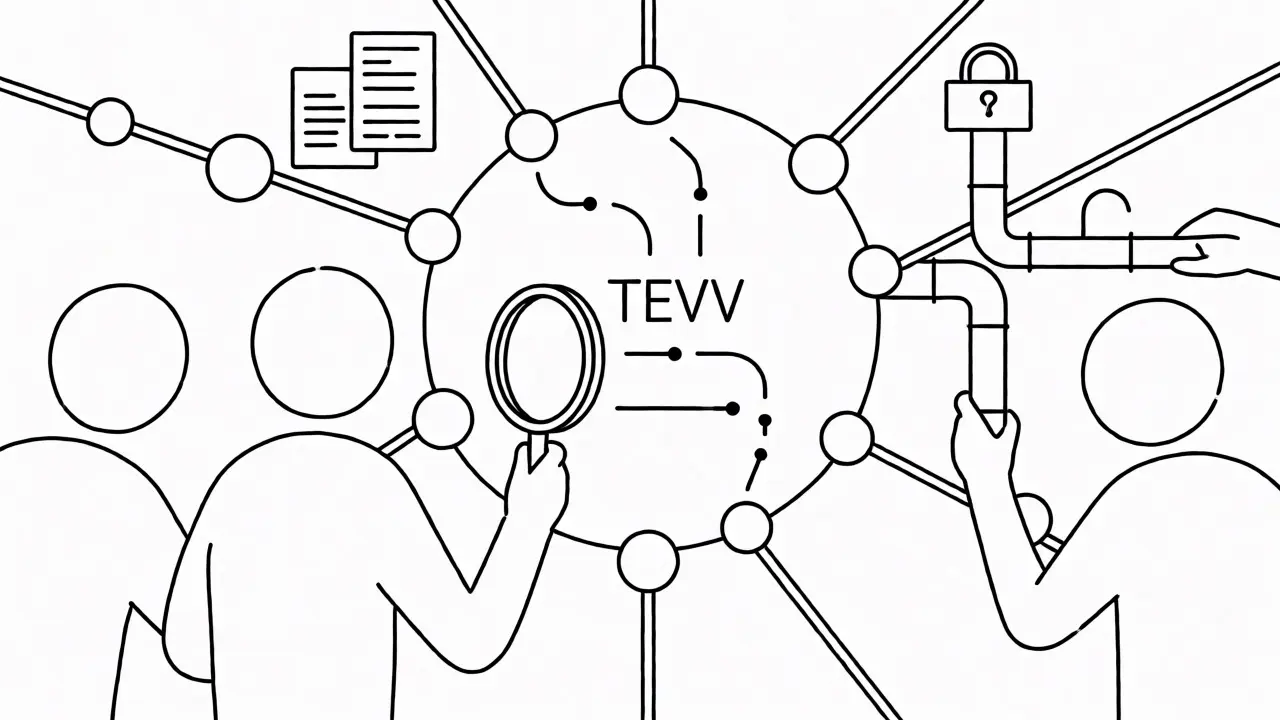
The real game-changer came in July 2024 with the release of NIST-AI-600-1, the Generative AI Profile. This document identifies 12 unique risks that don’t exist in traditional software. Think about information integrity: a standard app either works or crashes. A GenAI model might confidently state a falsehood. NIST demands pre-deployment testing through robust TEVV (Test, Evaluation, Validation, and Verification) processes. You can’t just ship it and hope for the best.
Looking ahead, NIST is preparing COSAIS (Control Overlays for Securing AI Systems). Scheduled for public draft in fiscal year 2026, this will adapt existing federal cybersecurity standards (SP 800-53) to address AI vulnerabilities directly. It covers five areas, including generative applications like chatbots and image generators. If you work with government contracts, aligning with NIST now saves you from scrambling later when regulations tighten.
ISO Provides Global Structure
ISO/IEC 27001:2022 remains the gold standard for international information security management systems (ISMS). But here’s the catch: it wasn’t written for AI. It’s a broad framework. To use it for GenAI, you have to customize it heavily. Many organizations struggle with this mapping. A January 2026 survey found that 68% of security professionals faced significant challenges adapting existing ISO controls for generative AI workloads.
The main friction points are content provenance and data leakage prevention. ISO requires you to protect confidentiality, but it doesn’t tell you how to stop a large language model from inadvertently revealing sensitive training data in its output. You end up building custom controls on top of the ISO framework. However, if your company operates globally, especially in the European Union, ISO carries weight. It complements the EU AI Act, making it essential for cross-border compliance.
There is also ISO/IEC 42001, published in December 2023. This is an AI management system standard. It focuses more on governance and lifecycle management than specific technical cybersecurity controls. While useful for overall AI strategy, it lacks the granular security details needed to prevent immediate threats like prompt injection. Use it for governance, not for your firewall rules.
SOC 2 Focuses on Trust
SOC 2, developed by the AICPA, is all about trustworthiness. It evaluates service organizations based on five trust criteria: security, availability, processing integrity, confidentiality, and privacy. For SaaS companies offering AI features, SOC 2 reports are often mandatory for sales deals. Customers want proof that their data is safe with you.
But SOC 2 has a blind spot: it lacks AI-specific guidance. There is no standard checklist for "Is this LLM secure?" Auditors rely on general security principles. This creates confusion. One CISO noted recently that they were essentially building a hybrid framework because SOC 2 didn’t explicitly cover AI risks. You have to interpret the controls yourself. Did your AI vendor undergo a penetration test for adversarial attacks? SOC 2 might not say.
The American Institute of CPAs knows this gap exists. They are collaborating with NIST to develop SOC 2 extensions for AI-specific controls, with a draft expected in Q3 2026. Until then, treat SOC 2 as a baseline for operational hygiene, not a comprehensive AI security guarantee. It proves you have basic security practices, but it doesn’t prove your AI model won’t hallucinate sensitive info.
Comparing the Big Three
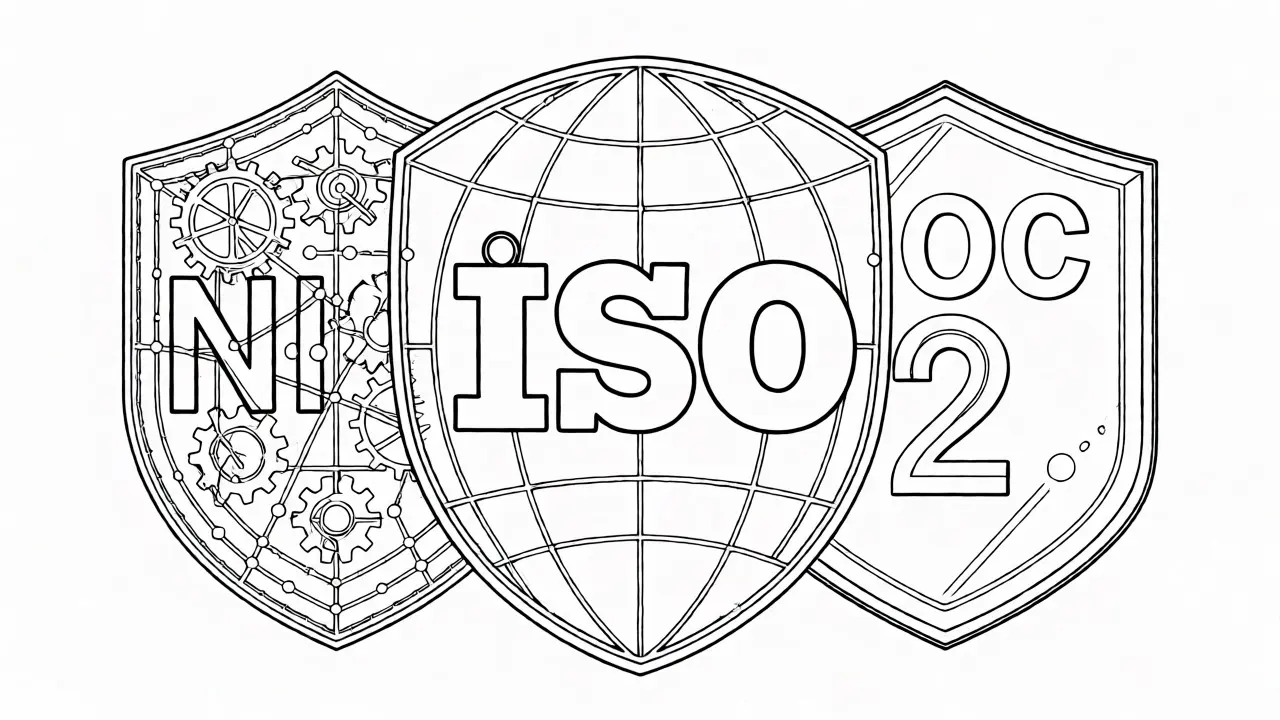
How do these frameworks stack up against each other? Let’s break it down. NIST wins on specificity for GenAI. ISO wins on global recognition. SOC 2 wins on commercial trust signals for B2B services. None are legally binding in the U.S. yet, but adoption trends are shifting fast. By 2027, Gartner predicts 60% of large enterprises will adopt NIST derivatives, up from 25% in 2025.
| Feature | NIST AI RMF & GenAI Profile | ISO/IEC 27001:2022 | SOC 2 Type II |
|---|---|---|---|
| Primary Focus | AI-specific risk management and technical controls | Information Security Management System (ISMS) | Service organization trust and operational controls |
| GenAI Specificity | High (identifies 12 unique risks) | Low (requires heavy customization) | Very Low (general security interpretation) |
| Best For | U.S. enterprises, regulated industries, complex AI stacks | Global operations, EU compliance, mature ISMS | B2B SaaS vendors, customer trust verification |
| Implementation Effort | Moderate-High (specialized knowledge required) | High (mapping AI risks to broad controls) | Moderate (standard audit process) |
| Regulatory Alignment | Strong (aligns with U.S. Executive Orders) | Strong (aligns with EU AI Act) | Weak (voluntary market standard) |
Practical Implementation Steps
So, how do you actually implement this? Start small. Don’t try to boil the ocean. Initial assessment against the NIST AI RMF typically takes 6-12 weeks. Larger enterprises might need 3-6 months for full rollout. You need specific skills: AI security specialists, data governance experts, and compliance pros. These roles aren’t cheap; AI security specialists average $185,000 annually in the U.S. as of early 2026.
Focus on three critical areas first:
- Data Provenance: Track where your training data comes from. Can you prove it wasn’t scraped from copyrighted sources without permission? Implement metadata tracking across all AI-interacting systems.
- Pre-Deployment Testing: Run red-team exercises. Try to break your model. Ask it questions designed to trigger prompt injections. Does it leak system prompts? Does it ignore safety guardrails?
- Third-Party Risk: If you use APIs from OpenAI, Anthropic, or others, assess their security posture. NIST’s Govern function specifically addresses third-party AI risk management. Don’t assume your vendor’s SOC 2 report covers AI-specific threats.
Tools can help. Platforms like Robust Intelligence and WhyLabs offer pre-built mappings to NIST controls. They automate some of the monitoring, which helps with the "Measure" function of the AI RMF. Remember, the goal isn’t just compliance; it’s resilience. Mayo Clinic successfully used NIST’s pre-deployment testing requirements to catch a potential HIPAA violation in their clinical note assistant before it went live. That’s the kind of win you’re aiming for.
Future Trends and Regulatory Pressure
The landscape is moving fast. In January 2026, California proposed Senate Bill 1047, requiring generative AI developers to implement NIST AI RMF controls. While not law yet, it signals intent. Federal contractors may soon face mandatory NIST framework adoption. If you sell to the government, get ready.
Internationally, the EU AI Office recommended aligning with NIST frameworks for high-risk AI systems in early 2026. This suggests a trend toward harmonization. Instead of conflicting standards, we might see a convergence around NIST’s technical depth and ISO’s procedural rigor. SOC 2 will likely evolve too, with AI-specific extensions arriving in late 2026.
Don’t wait for regulation to force your hand. Adopting these standards now builds customer trust and reduces breach risk. The cost of implementation ($50k-$500k depending on size) pales in comparison to the cost of a data breach involving proprietary AI models. Start with NIST for your technical controls, layer ISO for global structure, and use SOC 2 to close sales deals. It’s not about picking one; it’s about using them together.
Which framework should I start with for a startup?
Start with NIST AI RMF. It provides the most direct guidance for generative AI risks without the heavy administrative overhead of ISO certification. You can implement key controls from the Govern and Measure functions quickly. Add SOC 2 later when you need to prove trust to enterprise customers.
Is ISO 27001 enough for AI security?
No, not on its own. ISO 27001 is excellent for general information security but lacks specific controls for AI phenomena like model drift, prompt injection, and training data poisoning. You must extend your ISO controls with AI-specific measures, often borrowing from NIST guidelines, to adequately protect generative AI systems.
What is COSAIS?
COSAIS stands for Control Overlays for Securing AI Systems. It is an upcoming NIST initiative scheduled for draft release in fiscal year 2026. It adapts existing federal cybersecurity standards (SP 800-53) to address unique AI vulnerabilities, providing specific technical controls for securing AI models, data, and infrastructure.
Do I need SOC 2 if I use NIST?
It depends on your business model. If you are a B2B SaaS provider, SOC 2 is often commercially necessary to close deals, regardless of your internal security framework. NIST guides your internal security practices, while SOC 2 validates those practices for external stakeholders. Many companies maintain both.
How long does NIST AI RMF implementation take?
Initial assessment typically takes 6-12 weeks. Full implementation varies by organization size. Small businesses might complete core controls in a few months, while large enterprises with complex AI ecosystems may require 3-6 months or longer to fully integrate the framework into their development lifecycle.
 Artificial Intelligence