
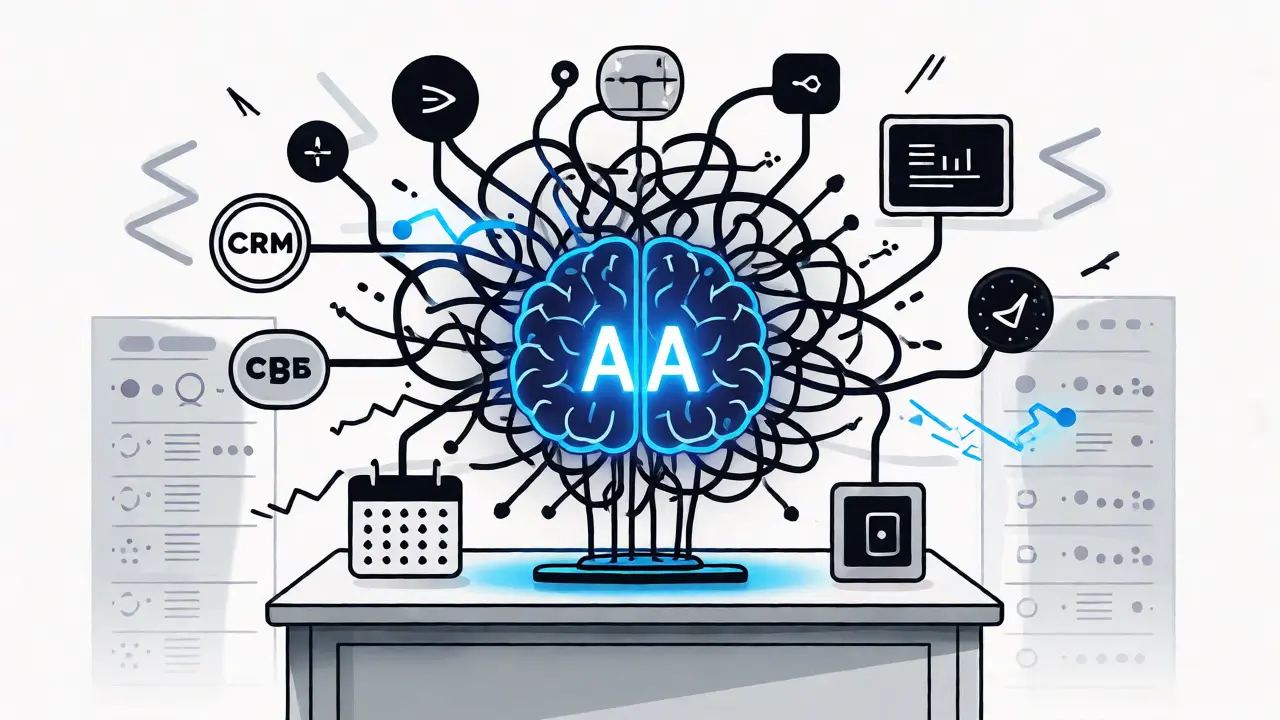
Imagine you have built a brilliant AI agent that can draft emails, query databases, and schedule meetings. It works perfectly in your local development environment. But the moment you try to plug it into your company’s legacy CRM or connect it to a third-party financial tool, everything breaks. You spend weeks writing custom glue code, debugging authentication errors, and praying the context window doesn’t overflow. This isn’t just an annoyance; it’s a systemic bottleneck. As of mid-2025, 68% of enterprises struggled with integrating AI tools from different vendors because there was no common language for them to speak. That chaos is finally ending.
The solution isn’t better prompts or bigger models-it’s standardization. We are witnessing the birth of the "protocol era" of AI, where interoperability standards like the Model Context Protocol (MCP) act as the universal translator between Large Language Models (LLMs) and the external world. If you’re building or managing generative AI systems today, understanding these standards-specifically around APIs, data formats, and LLMOps-is no longer optional. It’s the difference between a fragile prototype and a scalable enterprise product.
Why We Need Universal Protocols Now
Before we look at the tech, let’s talk about why this matters so much right now. For years, every AI provider offered their own proprietary way to connect tools. OpenAI had its Assistant API, Google had Vertex AI Tools, and Anthropic had its own experimental setups. These silos meant that if you switched models, you often had to rewrite your entire integration layer. This fragmentation created massive compliance headaches. According to Prompts.ai, organizations without standardized interfaces faced 37% higher compliance costs when trying to meet regulatory frameworks like the EU AI Act.
The pressure to fix this came from two directions. First, technical debt: maintaining dozens of custom integrations became unsustainable. Second, regulation: the European Union’s AI Act, with provisions effective in August 2025, demanded transparency and risk management that ad-hoc connections couldn’t easily provide. Enter the Model Context Protocol (MCP), finalized in March 2025. Initially introduced by Anthropic, MCP has rapidly become the de facto standard, supported by OpenAI, Microsoft, and LangChain. It solves the fundamental problem of how AI agents request capabilities from external tools securely and consistently.
Inside the Model Context Protocol (MCP)
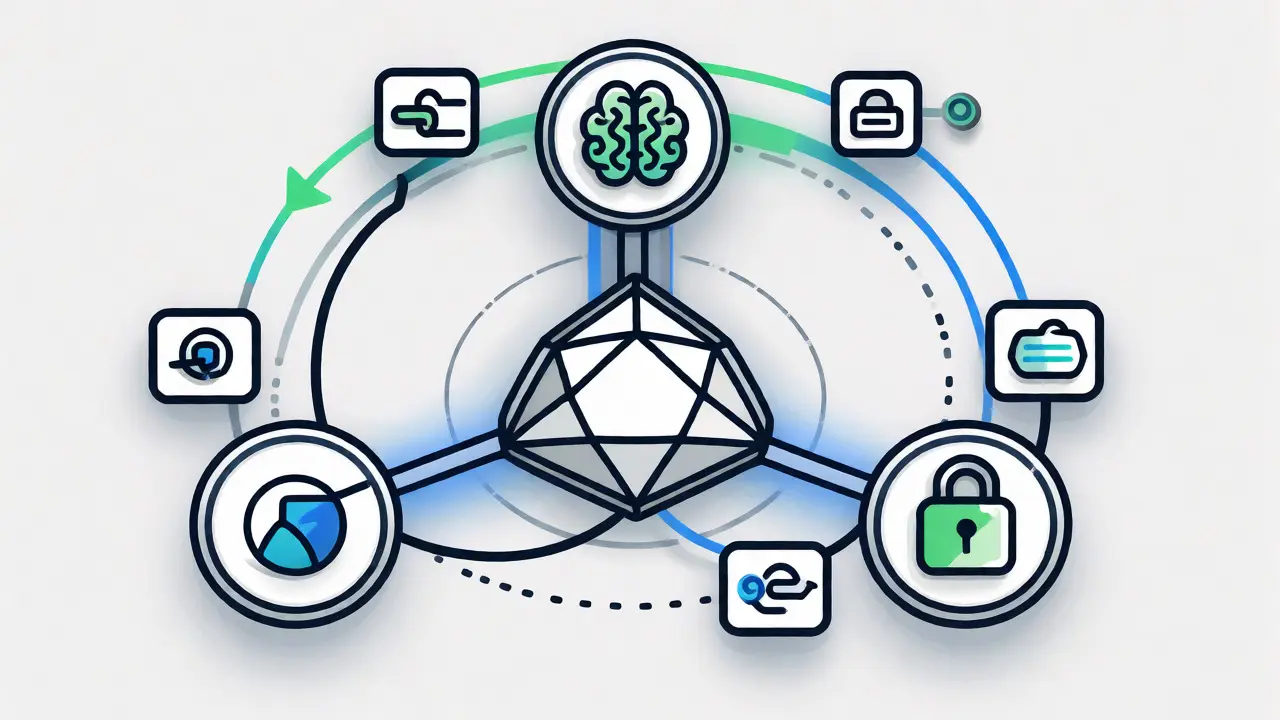
MCP isn’t just another API wrapper; it’s a comprehensive specification designed to handle the messy reality of AI interactions. When Anthropic released version 1.0, they addressed four critical pain points that plagued earlier attempts at AI-tool integration.
- OAuth 2.1 Authorization: Security was a major vulnerability in pre-2025 AI integrations, with NIST noting issues in 42% of cases. MCP mandates OAuth 2.1 for HTTP-based transports, ensuring that agents only access what they’re authorized to see.
- Streamable HTTP Transport: The old HTTP+SSE (Server-Sent Events) setup was clunky and slow. MCP replaced it with a bidirectional streaming protocol that reduces latency by 58%, according to Anthropic’s internal benchmarks.
- JSON-RPC Batching: Complex workflows often require multiple tool calls. Instead of waiting for one response before sending the next, MCP allows clients to batch requests, cutting latency by up to 47% in multi-step tasks.
- Tool Annotations: This is the metadata layer. MCP requires rich descriptions of tool behavior using standardized schemas. With 27 mandatory fields, these annotations help AI agents understand not just what a tool does, but how it behaves, reducing hallucinations and incorrect usage.
These features make MCP significantly more robust than its predecessors. Compared to the earlier WebLLM standard, MCP shows a 41% higher success rate in complex workflows involving five or more simultaneous tools. That’s a game-changer for agents that need to coordinate across sales, support, and engineering platforms simultaneously.
The Role of LLMOps in Standardized Ecosystems
Standards don’t exist in a vacuum. They rely on operational practices known as LLMOps (Large Language Model Operations). Just as DevOps automated software deployment, LLMOps automates the lifecycle of AI models and their integrations. Without LLMOps, adopting a standard like MCP is just swapping one set of problems for another.
Effective LLMOps for interoperability focuses on three areas: monitoring, testing, and governance. Because MCP standardizes error handling and context management, you can build unified dashboards that track performance across all connected tools, regardless of the vendor. Early adopters report that automated testing frameworks compatible with MCP reduced QA cycles by 40-65%. This efficiency is critical when you’re dealing with the rapid iteration cycles typical of generative AI projects.
Governance is another pillar. The NIST AI Risk Management Framework (RMF) provides assessment criteria that align well with MCP’s structure. By leveraging MCP’s standardized logs and metadata, organizations can prove compliance with regulations like the EU AI Act more easily. You’re no longer manually auditing each integration; you’re verifying conformance to a known standard.
Comparing Integration Approaches
To understand where MCP fits, it helps to compare it against the alternatives. Most companies fall into one of three buckets: proprietary vendor SDKs, custom point-to-point integrations, or open standards like MCP.
| Feature | Proprietary SDKs (e.g., Vertex AI) | Custom Point-to-Point | Open Standards (MCP) |
|---|---|---|---|
| Integration Time per Tool | Medium (Vendor-specific docs) | High (Manual coding/debugging) | Low (Standardized interfaces) |
| Vendor Lock-in | High | None | Low (Multi-vendor support) |
| Compliance Overhead | Medium | High (Hard to audit) | Low (Built-in logging/security) |
| Market Adoption (New Projects) | 12% | 7% | 78% |
The data tells a clear story. While proprietary SDKs still hold ground in specific ecosystems, new enterprise projects are overwhelmingly choosing open standards. Gartner’s Magic Quadrant for AI Integration Platforms places MCP in the leader quadrant, driven by its ability to bridge the gap between diverse models like Claude, GPT-5, and Llama 3.

Implementation Challenges and Realities
Adopting MCP isn’t instant magic. It requires engineering effort and a shift in mindset. A survey by Bradley Arns found that 63% of organizations needed 2-3 months of dedicated engineering work to achieve full compliance, with average costs hitting $187,500 USD.
Common pitfalls include context leakage and strict token limits. MCP enforces rigorous context window management, which caught some developers off guard. One user on HackerNews noted that strict context rules caused 28% of initial implementation failures until they adjusted their prompt engineering practices. Additionally, specialized industries face extra hurdles. Healthcare integrations require HIPAA-specific extensions (MCP-HC), while financial services need PCI-DSS modules, adding 18-22% overhead to transactions.
However, the long-term payoff is significant. Companies that successfully navigate the learning curve report integration times dropping from three weeks to four days. Reliability in production jumps to over 99%, and manual intervention in business processes falls by nearly half. The key is treating interoperability as a core architectural decision, not an afterthought.
The Future: Regulatory Convergence and Global Standards
We are moving toward a world where AI interoperability is legally mandated. China’s national generative AI standards, announced in April 2025, already include alignment requirements for cross-border services. The EU AI Office plans to reference MCP in its Code of Practice, potentially making compliance mandatory for high-risk applications. IDC predicts that by 2027, 95% of enterprise AI deployments will require MCP or equivalent standards to meet global regulations.
This convergence creates both opportunity and risk. On one hand, a unified standard simplifies global expansion. On the other, critics like Professor Timnit Gebru warn that relying on a single protocol could centralize control among a few large tech firms. To mitigate this, the MCP Consortium is developing open governance mechanisms to ensure neutrality. The upcoming MCP 1.1 release, featuring quantum-resistant encryption, signals that the standard is evolving to meet future security threats, further cementing its role as the backbone of the AI economy.
What is the Model Context Protocol (MCP)?
MCP is an open standard developed by Anthropic and adopted by major AI providers like OpenAI and Microsoft. It defines how AI models interact with external tools and data sources, providing a universal interface for authentication, data exchange, and error handling.
Why is MCP important for LLMOps?
MCP standardizes the interaction layer, allowing LLMOps teams to monitor, test, and secure AI integrations uniformly. This reduces the complexity of managing multiple vendor-specific APIs and simplifies compliance with regulations like the EU AI Act.
How long does it take to implement MCP?
For developers with REST API experience, proficiency takes about 17.5 hours. However, full organizational compliance typically requires 2-3 months of dedicated engineering effort, depending on the number of existing tools and legacy systems involved.
Does MCP replace proprietary AI APIs?
Not entirely. MCP acts as a middleware or abstraction layer. Proprietary APIs still handle model inference, but MCP standardizes how those models call external tools. This allows you to switch underlying models without rewriting your tool integrations.
Are there industry-specific versions of MCP?
Yes. Specialized extensions exist for regulated industries. For example, MCP-HC adds HIPAA compliance features for healthcare, while financial services implementations include PCI-DSS modules to handle sensitive payment data securely.
 Artificial Intelligence


Art HND
September 10, 2026 AT 17:05Standardization is just corporate speak for lock-in disguised as progress. The EU AI Act pressure is artificial.
Dave Gibbeson
September 10, 2026 AT 22:28You're missing the forest for the trees here! Look at the data: 68% of enterprises are struggling right now because they have no common language. We need this standard to stop wasting weeks on glue code.
The OAuth 2.1 mandate alone solves so many security headaches that NIST flagged in 42% of cases. This isn't about lock-in, it's about survival in a fragmented market. If you aren't adopting MCP, you're actively choosing technical debt over efficiency.
Think about the latency reduction from streamable HTTP transport. That's real value for production systems. Stop being contrarian for the sake of it and look at the actual engineering benefits. This is the future of interoperability.
Sabrina Newland
September 11, 2026 AT 02:44omg yes!! 🤯 finally someone said it... i was so confused by all the diffrent APIs last year 😵💫 its like trying to talk to people who dont share a langauge lol
the part about context leakage scared me tbh but then i read about the strict token limits and thought okay maybe thats good? 🤔 idk feels like we need rules to keep things sane ✨
also prof gebru has a point tho about centralization 🌍 but if its open governance maybe its ok?? 🙏 im just happy my dev team stopped crying over auth errors 💻❤️
Elizabeth Brooks
September 11, 2026 AT 17:20Great post Elizabeth agrees with most points but want to add that healthcare integrations are way harder than listed here due to HIPAA specific extensions adding significant overhead. The article mentions 18-22% extra cost which is accurate but often underestimated in budgeting phases. Also LLMOps monitoring needs to be vendor agnostic to really work well with MCP standards otherwise you end up with siloed dashboards again.
Mark Harvey
September 12, 2026 AT 14:47love seeing these kinds of deep dives mark harvey thinks this is exactly what teams need to hear before starting their next project integration time dropping from three weeks to four days is huge for morale and velocity keep pushing this message everyone can do this
Deb Kortyna, MBA
September 14, 2026 AT 09:03It is absolutely imperative that we recognize the gravity of this shift. The transition from proprietary silos to open standards represents a fundamental restructuring of enterprise architecture. One cannot simply ignore the regulatory convergence driven by the EU AI Act; it is not merely a suggestion, but an impending legal reality. To suggest otherwise is to invite catastrophic compliance failures. The financial implications alone warrant immediate strategic attention.
Brandon Olvera
September 14, 2026 AT 12:14US tech should lead this not rely on foreign regulations to force our hand
alex kobri
September 15, 2026 AT 17:51interesting perspective on the philosophical underpinnings of protocol design alex kobri wonders if we are losing agency when we let algorithms dictate interaction norms or if standardization actually frees us from trivial decisions allowing focus on higher level creativity the balance between control and convenience is delicate here
Zach Loescher
September 16, 2026 AT 08:20zach loescher appreciates the balanced view presented especially regarding implementation challenges the mention of hackernews user experiences adds credibility showing real world friction points rather than just theoretical benefits neutral stance but finds the quantum resistant encryption roadmap promising for long term viability