

Have you ever asked an AI assistant a specific question about a technical error code or a rare medical acronym, only to get a vague, hallucinated answer? You know the document exists in your database. The AI should have found it. But it didn't. This is the classic failure point of pure Semantic Search. It understands meaning, but it often misses exact matches. That is why developers are moving toward Hybrid Search.
Hybrid Search for Retrieval-Augmented Generation (RAG) combines vector-based semantic search with keyword-based full-text search to provide Large Language Models (LLMs) with the most accurate context possible. By merging these two approaches, you stop missing critical information hidden behind unusual phrasing or specific terminology. In this guide, we will break down how hybrid search works, why it outperforms single-method retrieval, and how you can implement it effectively in your own RAG pipelines.
Why Pure Semantic Search Fails at Exact Matches
To understand why we need hybrid systems, we first have to look at the limitations of standard Vector Databases. When you use semantic search, you convert text into high-dimensional vectors-usually between 384 and 1536 dimensions. These vectors capture the 'meaning' of the text. If you search for 'heart attack,' the system finds documents discussing 'myocardial infarction' because they are semantically close.
This is great for general conversation. It is terrible for precision tasks. According to analysis by Towards AI in November 2023, semantic search frequently misses results containing exact keyword matches, especially for rare terms, acronyms, or code snippets. Imagine a healthcare application where a user queries for 'HbA1c.' A pure semantic model might interpret this as a generic health query and return articles about diabetes management in general, missing the specific lab result definition you needed. Similarly, in software development, searching for a specific function like `np.dot` might fail if the vector embedding treats it as just another mathematical concept rather than a specific library call.
The problem is that semantic search 'interprets away' unique identifiers. It smooths over the rough edges of language. For mission-critical applications in legal, medical, or engineering fields, those rough edges are exactly what you need to find.
The Role of BM25 in Hybrid Retrieval
If semantic search handles meaning, what handles the words themselves? Enter BM25 (Best Match 25). This is not a new technology; it has been the gold standard for information retrieval since the late 1990s. Unlike vector search, BM25 does not care about the abstract meaning of a sentence. It cares about term frequency.
BM25 evaluates document relevance based on two main factors:
- Term Frequency: How often does the search word appear in the document?
- Inverse Document Frequency: How rare is this word across the entire corpus of documents?
As explained in the EDICOM Group Tech Blog from February 2024, BM25 measures 'how frequent a word is in a document and how less frequent this word is in the set of documents.' If you search for 'COPD' in a medical database, BM25 will prioritize documents that contain that exact string multiple times, regardless of whether the surrounding text discusses lung capacity or administrative billing codes. It is rigid, precise, and incredibly effective for exact match scenarios.
However, BM25 lacks context. If you search for 'Apple,' BM25 cannot distinguish between the fruit and the tech company without additional metadata filtering. This is where the hybrid approach shines: it uses BM25 for precision and Vector Search for context.
How Hybrid Search Works: The Fusion Process
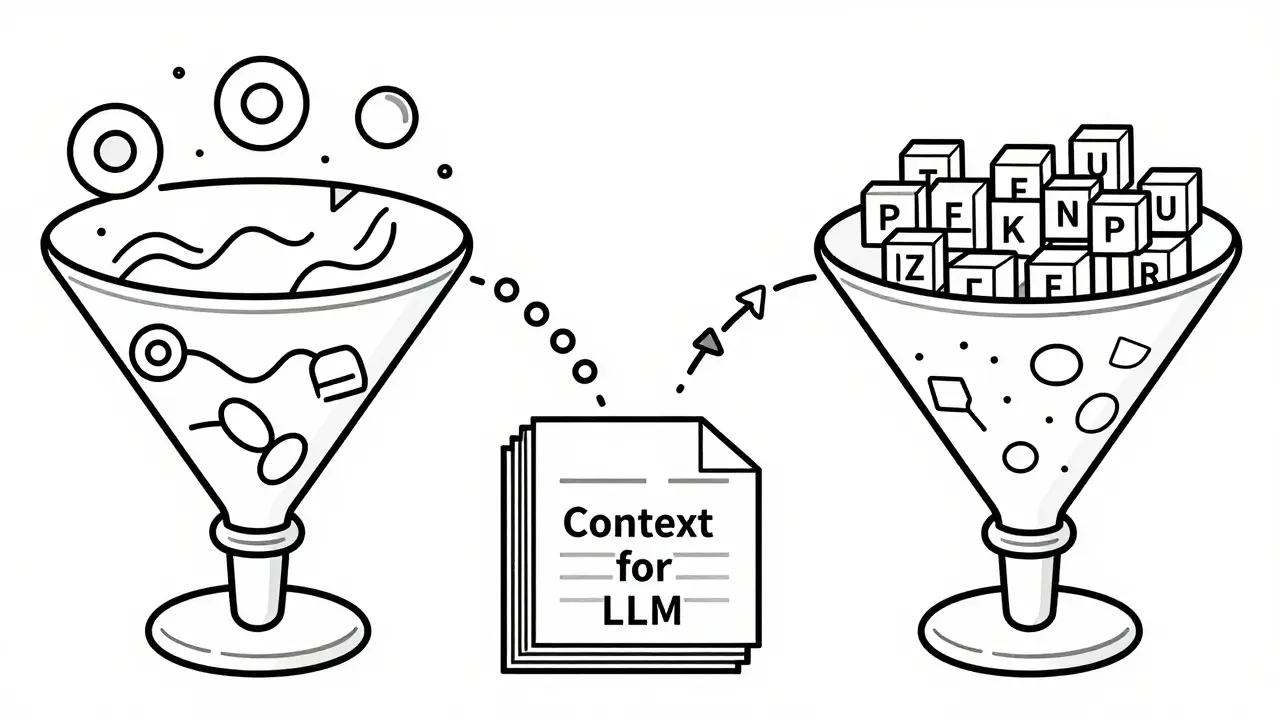
Implementing hybrid search is not just about running two searches side-by-side. It requires a sophisticated fusion mechanism to combine the results. The process typically follows four stages:
- Parallel Querying: The system sends the user's query simultaneously to both the vector database (for dense embeddings) and the keyword index (for sparse BM25 representations).
- Independent Scoring: Each system returns its top results with their respective relevance scores. The vector database uses cosine similarity, while BM25 uses its statistical scoring algorithm.
- Fusion: The system combines these two ranked lists into a single list using a mathematical formula.
- Retrieval: The final, optimally ranked chunks are sent to the LLM as context.
The magic happens in step three. There are three primary fusion techniques used in industry today:
- Reciprocal Rank Fusion (RRF): This method merges rankings without needing raw scores. As noted by Fuzzy Labs in April 2024, RRF ensures that even lower-ranked results from one method can contribute to the final list if they are consistently relevant in the other method. It is robust and requires minimal tuning.
- Simple Weighted Fusion: This assigns explicit weights to each method. For example, you might decide that semantic relevance is more important, so you apply a 70% weight to vector scores and 30% to BM25 scores. LangChain implementations often use this approach for its simplicity.
- Linear Fusion Ranking (LFR): Used in platforms like Salesforce Data 360, this calculates a weighted sum of transformed scores from both dense and sparse vectors. It offers granular control but requires more complex normalization of score ranges.
Performance Benchmarks: Why Hybrid Wins
Does combining these methods actually improve accuracy? The data says yes. Meilisearch reported in June 2024 that properly tuned hybrid systems achieve up to 37% improvement in retrieval accuracy compared to single-method approaches for technical domains. Let's look at specific verticals:
| Industry Vertical | Key Challenge | Accuracy Improvement |
|---|---|---|
| Healthcare | Medical Acronyms (e.g., HbA1c, COPD) | 35.7% |
| Software Development | Code Syntax (e.g., np.dot, lambda) | 41.2% |
| Legal & Compliance | Case References & Law Codes | 33.4% |
| E-Commerce | Product SKUs & Model Numbers | 27.8% |
Dr. Emily Chen, Principal AI Researcher at Microsoft, described hybrid search as 'the missing link between precision and contextual understanding in enterprise RAG deployments.' Gartner identified it as a 'must-adopt pattern' for mission-critical RAG implementations in their February 2025 Emerging Technologies Hype Cycle, predicting that 78% of enterprise RAG systems would incorporate hybrid retrieval by 2026.
Implementation Challenges and Trade-offs
While the benefits are clear, hybrid search is not a free lunch. It introduces complexity and overhead that you must manage carefully.
Increased Latency: Running two separate searches takes time. Elastic’s benchmark tests in March 2024 showed that hybrid search can introduce 18-25% higher latency compared to single-method search. For real-time chat applications, this delay can be noticeable. To mitigate this, experts recommend implementing 'query-time fusion' rather than index-time fusion, allowing you to optimize the pipeline dynamically.
Development Complexity: Integrating two retrieval systems requires more engineering effort. Fuzzy Labs documented that hybrid implementation adds 35-50% more development time to RAG pipeline construction. You need to maintain separate indexes-one for vectors and one for keywords-which also increases storage overhead by 30-40%.
Weight Tuning Difficulty: Determining the optimal balance between semantic and keyword search is domain-specific. Legal applications typically require 80% keyword weighting to ensure exact statute references are found. General knowledge domains perform best with 60% semantic weighting to maintain conversational flow. Finding this sweet spot requires iterative testing. As of October 2024, GitHub issue trackers for LangChain showed hundreds of open issues related to 'hybrid search configuration,' with users citing difficulty in determining optimal weights as a major pain point.

Best Practices for Deploying Hybrid Search
If you are ready to build a hybrid RAG system, follow these practical steps to avoid common pitfalls:
- Start with EnsembleRetriever: If you are using LangChain, utilize the
EnsembleRetrieverclass. It is the most widely adopted solution for combining retrievers, offering built-in support for weighted fusion. - Use Reciprocal Rank Fusion (RRF) First: Before tweaking weights, try RRF. It is less sensitive to the scale differences between vector scores (0 to 1) and BM25 scores (which can vary wildly). It provides a stable baseline performance.
- Optimize for Your Domain: Do not use a one-size-fits-all approach. If you are building a developer assistant, increase the weight of keyword search to catch specific API names. If you are building a customer support bot, lean heavier on semantic search to understand user intent.
- Monitor Zero-Result Queries: Track how often your system returns no results. Stack Overflow reported a 34.7% reduction in zero-result queries after adopting hybrid search. Use this metric to validate your fusion strategy.
- Consider Dynamic Weighting: Look into advanced features like Meilisearch’s 'Dynamic Weighting,' which automatically adjusts semantic/keyword weights based on query characteristics. This can improve overall accuracy by nearly 20% in beta tests.
The Future of Hybrid Retrieval
Hybrid search is evolving beyond simple static fusion. We are seeing the emergence of 'Adaptive Hybrid Retrieval' systems, as demonstrated by Stanford's Center for Research on Foundation Models in April 2025. These systems use the LLM itself to determine the optimal retrieval strategy per query. For example, if the LLM detects a query contains a specific product SKU, it might temporarily boost the keyword weight for that specific request.
Additionally, tighter integration with re-ranking models is becoming the next standard. Re-rankers take the top 50 results from the hybrid search and re-score them using a cross-encoder model for maximum precision. While this adds computational cost, it significantly improves the quality of context passed to the LLM.
Despite these advancements, caution is warranted. Dr. Andrej Karpathy warned in March 2024 that 'over-reliance on keyword matching in hybrid systems can reintroduce brittleness that semantic search was designed to overcome.' Ensure your system includes sufficient contextual filtering to prevent retrieving legally sensitive or irrelevant information simply because it shares a keyword.
What is the difference between semantic search and hybrid search?
Semantic search uses vector embeddings to find documents based on meaning and context, ignoring exact word matches. Hybrid search combines semantic search with keyword search (like BM25) to capture both conceptual relevance and exact term matches, improving accuracy for technical or specific queries.
When should I use BM25 instead of vector search?
Use BM25 when you need exact matches for acronyms, product codes, legal statutes, or code snippets. It is superior for queries where specific terminology matters more than general context. However, it lacks the ability to understand synonyms or paraphrases, which is why it is best used in combination with vector search.
How do I tune the weights for hybrid search?
Tuning depends on your domain. For general knowledge or conversational AI, start with 60-70% semantic weight. For technical, legal, or medical applications requiring precision, increase keyword weight to 70-80%. Use Reciprocal Rank Fusion (RRF) as a baseline before adjusting manual weights, as it requires less tuning and performs well across diverse datasets.
Does hybrid search slow down my RAG application?
Yes, hybrid search can increase latency by 18-25% because it runs two separate queries. To minimize impact, use efficient vector databases that support hybrid indexing natively, implement query-time fusion, and consider caching frequent queries. For large corpora, optimizing the BM25 index size is crucial.
Is hybrid search necessary for all RAG implementations?
Not necessarily. For general conversational bots or creative writing assistants, pure semantic search may suffice and is simpler to maintain. Hybrid search is essential for mission-critical applications in healthcare, law, finance, and software development where missing an exact term match can lead to incorrect or dangerous outputs.
 Artificial Intelligence




Quintin Franzese
July 28, 2026 AT 01:27So basically we are just admitting that AI is still pretty dumb when it comes to specific facts and we need to patch it with old-school database tricks.
It’s funny how everyone acts like vector search is this revolutionary magic bullet, but then you realize it can’t even find the word 'HbA1c' without a nudge from BM25. I guess we should all just lower our expectations for AGI and accept that we’re stuck with hybrid patches for the next decade.
At least it’s better than hallucinating medical advice, right? Probably.
Susan Cole
July 29, 2026 AT 08:47I found the section on Reciprocal Rank Fusion particularly helpful for understanding how to balance the two methods without getting bogged down in complex weight tuning.
It seems like a practical starting point for teams who are new to implementing hybrid systems. The explanation of why pure semantic search fails at exact matches was also very clear and easy to follow.
Tamara Miller
July 29, 2026 AT 16:30You really think people don't know about BM25?!!
It has been around since the 1990s!!! Why are we acting like this is some groundbreaking discovery?!?! It is basic information retrieval!!! You should be ashamed of yourself for presenting this as if it is new technology!!! And don't get me started on the latency issues!!! Who wants to wait 25% longer for a search result?!?! It is unacceptable!!!
Savara Gunn
July 30, 2026 AT 18:59This is a really solid overview of the trade-offs involved.
I appreciate that you mentioned the increased development time and storage overhead, as those are often overlooked in more optimistic articles. It helps set realistic expectations for engineering teams looking to adopt this pattern.
Anthony Miller
August 1, 2026 AT 07:18The author clearly lacks depth in their understanding of enterprise architecture because they fail to address the fundamental flaw in assuming that simple fusion techniques are sufficient for high-stakes environments where precision is paramount and any error is catastrophic
you need to look at dynamic weighting strategies that adapt in real-time based on query intent rather than static weights which are inherently flawed and lead to suboptimal results in complex domains
it is pathetic that so many developers settle for mediocre solutions because they are too lazy to implement proper adaptive retrieval mechanisms
michelle veluz
August 3, 2026 AT 00:10They want you to believe that hybrid search is the answer but it is just another way for big tech to keep you dependent on their proprietary systems!!!
Have you noticed how all these 'best practices' come from companies like Salesforce and Microsoft?!?! They are manipulating the data to make their own products look superior!!!
We need to wake up and realize that true freedom lies in decentralized keyword matching without any corporate influence!!!
Jacob Baby Official
August 4, 2026 AT 21:49Oh great, another article telling us that we need to combine two imperfect systems to create a slightly less imperfect system.
Let's pretend for a moment that BM25 isn't completely obsolete in the face of modern transformer models. The idea that we need to rely on term frequency and inverse document frequency in 2024 is laughable.
But sure, let's add 35-50% more development time and 30-40% more storage overhead just to catch a few acronyms. Because nothing says 'efficient engineering' like maintaining two separate indexes and dealing with the latency nightmare that comes with parallel querying.
It's not a solution; it's a band-aid on a gunshot wound, and we're all just pretending it works.
john randall
August 5, 2026 AT 01:09Interesting perspective on the latency trade-offs.
I've seen similar performance hits in our internal tools when switching from pure vector search to hybrid. The accuracy boost is noticeable, especially for technical queries, but the extra milliseconds do add up in high-throughput scenarios.
Jeff Falcon
August 5, 2026 AT 07:53I have been working on a RAG pipeline for a legal tech startup and this article really resonated with my experience because we were struggling with the fact that our pure semantic search was missing specific case law references which are critical for our users to trust the system
we ended up implementing a weighted fusion approach where we gave more weight to the keyword search initially and then gradually adjusted it based on user feedback and testing results which helped us strike a balance between finding the exact statutes and understanding the broader context of the legal questions being asked
it was definitely more work than just using a vector database alone but the improvement in retrieval accuracy was worth the extra effort and complexity involved in maintaining both indexes