
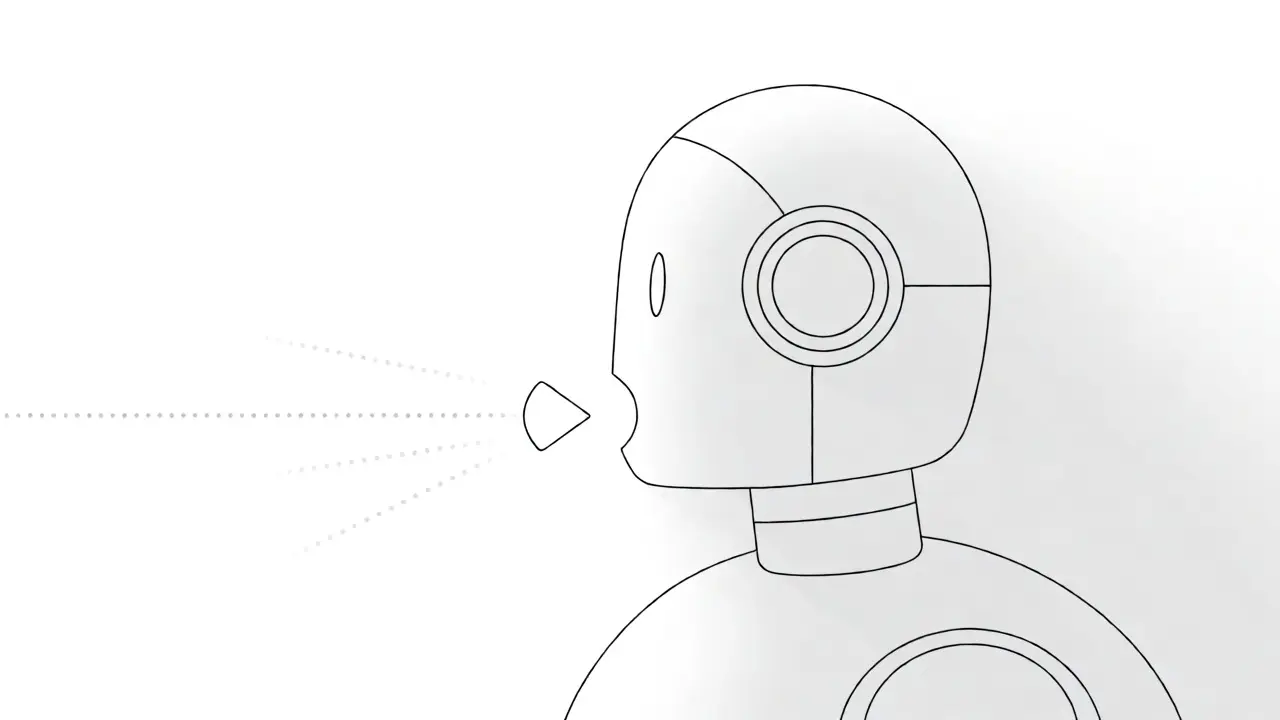
You type a prompt into an AI chatbot. It spits out a coherent paragraph in seconds. But here is the weird part: it didn't write that paragraph all at once. It wrote it one word-or more accurately, one token-at a time. This process, known as autoregressive text generation, is the heartbeat of every modern Large Language Model (LLM) you use today, from GPT-4 to Llama 3. If you want to understand why AI hallucinates, why it sometimes gets stuck in loops, or why it can be so surprisingly creative, you need to look under the hood at how it predicts the next token.
Think of it like playing a high-stakes game of "finish this sentence." The model looks at everything written so far and calculates the probability of every possible next piece of information. Then it picks one. That new piece becomes part of the history for the next step. Repeat until done. Simple? Conceptually, yes. Complex in execution? Absolutely. Let’s break down exactly how this works, why it dominates the AI landscape, and where it might be heading next.
The Core Mechanic: Left-to-Right Prediction
Autoregressive text generation is a method where a model generates data sequentially, using its own previous outputs as inputs for future steps. In the context of Large Language Models, this means predicting the next token based strictly on the tokens that came before it.
This approach relies on a mathematical concept called causal language modeling. Imagine a timeline of words. A causal model can only look backward. It cannot peek at the future. When the model sees the sequence "The cat sat on the," it doesn't know what comes after. It calculates probabilities for candidates like "mat," "floor," or "couch." Once it selects "mat," that word is locked in. The model then updates its internal state and asks again: given "The cat sat on the mat," what comes next?
This left-to-right factorization is represented mathematically as P(x₁:T) = ∏ P(xₜ | x<ₜ). Don’t let the Greek letters scare you. It just means the probability of a whole sentence is the product of the probabilities of each individual word, conditioned on all the words before it. This strict sequential nature is what makes LLMs powerful storytellers but also prone to early errors cascading into nonsense later on.
Why Transformers Won the War
Before transformers, we had n-grams and recurrent neural networks (RNNs). They tried similar things but hit hard walls with long sentences. The breakthrough came with the Transformer architecture, introduced in 2017. Unlike RNNs, which process words one by one slowly, transformers use self-attention mechanisms to weigh the importance of every previous token simultaneously.
Decoder-only transformers, popularized by OpenAI’s GPT series, are specifically built for autoregression. They use "masked" attention, meaning when processing position 5, the model can attend to positions 1 through 4, but not 6 or 7. This masking ensures the model never cheats during training by seeing the answer before it has to predict it. During inference, this same mechanism allows the model to efficiently cache past computations, speeding up the generation of subsequent tokens.
| Feature | Autoregressive (e.g., GPT) | Masked (e.g., BERT) |
|---|---|---|
| Primary Task | Text Generation | Text Understanding/Classification |
| Context Direction | Left-to-Right (Causal) | Bidirectional |
| Output Type | Sequential Tokens | Single Token or Label |
| Training Objective | Predict Next Token | Predict Masked Token |
The Inference Pipeline: Prefill and Decode
When you send a prompt to an API, the model doesn't just start typing immediately. There are two distinct phases: prefill and decode. Understanding these helps explain latency issues and costs.
- Prefill Phase: The model processes your entire input prompt in parallel. If you paste a 1,000-word article, the model reads it all at once, building a complex internal representation of the context. This phase is compute-heavy but fast because it leverages parallel processing across GPU cores.
- Decode Phase: This is where the magic happens. The model generates one token at a time. For each step, it runs a forward pass through the network, calculates probabilities for the next token, samples one, and adds it to the context. This phase is sequential and slower because each new token depends on the result of the previous one.
During the decode phase, the model maintains a Key-Value (KV) cache. Instead of recalculating attention for all previous tokens every single time, it stores the keys and values from earlier steps. This optimization is critical; without it, generating a long essay would take exponentially longer. Modern frameworks like Hugging Face’s TGI or vLLM are heavily optimized for managing this KV cache efficiently.
Decoding Strategies: More Than Just Argmax
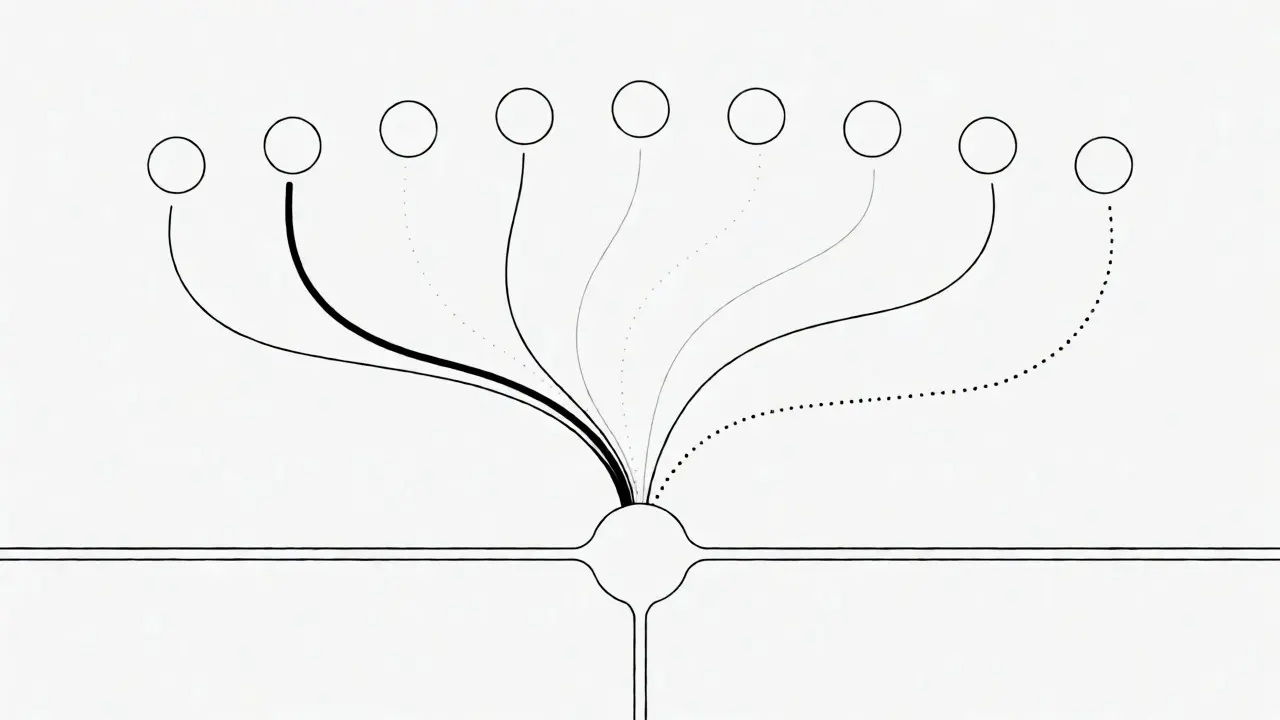
If the model always picked the most probable next token (a strategy called greedy decoding), output would be repetitive and boring. "The sun is bright. The sky is blue. The grass is green." You’ve seen this robotic tone before. To make text feel human, developers tweak how the model chooses from its probability distribution.
- Temperature: This scales the probabilities. High temperature (e.g., 1.0+) flattens the distribution, making less likely words more probable. This leads to creativity but also chaos. Low temperature (e.g., 0.2) sharpens the distribution, making the model conservative and predictable.
- Top-p (Nucleus) Sampling: Instead of picking from the top K words, the model picks from the smallest set of words whose cumulative probability exceeds p (e.g., 0.9). This dynamically adjusts the candidate pool based on confidence. If the model is sure, it picks from few words. If unsure, it considers many.
- Top-k Sampling: Restricts choices to the k most likely tokens. It’s simpler than Top-p but less adaptive to context certainty.
These knobs allow you to balance coherence against diversity. A legal contract generator needs low temperature and high precision. A poetry generator benefits from higher temperature and nucleus sampling.
Known Pitfalls: Exposure Bias and Hallucinations
Autoregressive generation isn’t perfect. Because the model commits to a token irreversibly, small mistakes compound. This is called exposure bias. During training, the model sees ground-truth history. During inference, it sees its own generated history. If it makes a slight error early on, it must continue from that flawed premise, often leading to logical inconsistencies or "hallucinations" where facts drift away from reality.
Moreover, the model has no global view of the final sentence. It doesn't plan ahead. It reacts. This reactive nature explains why LLMs sometimes struggle with long-form reasoning tasks that require holding multiple constraints in mind simultaneously. They are optimizing locally, step-by-step, rather than globally.

The Future: Beyond Discrete Tokens
Research in late 2025 and 2026 is pushing boundaries. New architectures like Continuous Autoregressive Language Models (CALM) propose moving away from discrete token prediction. CALM compresses chunks of tokens into continuous vectors, predicting vector sequences instead of individual words. This could speed up generation significantly while maintaining fidelity.
Another emerging idea is viewing LLMs as energy-based models. This perspective suggests that next-token prediction is essentially learning an energy landscape over sequences. While still theoretical for widespread deployment, it offers new ways to regularize models and improve calibration, potentially reducing those pesky hallucinations.
Frequently Asked Questions
What is a token in LLMs?
A token is a piece of text, typically a word, subword, or character. Models don't read words directly; they map text to numerical IDs. Common words might be one token, while rare words might be split into multiple subword tokens.
Why do LLMs generate text one word at a time?
This is due to the autoregressive nature of their training objective. They learn to predict the conditional probability of the next token given the previous ones. This sequential dependency prevents parallel generation of the full output sequence.
Can autoregressive models see the future?
No. Standard autoregressive models are causal, meaning they only attend to past tokens. Bidirectional models like BERT can see both past and future, but they are generally used for understanding tasks, not open-ended generation.
How does temperature affect output?
Temperature controls randomness. Lower temperatures make the model pick the most likely words, resulting in deterministic and safe outputs. Higher temperatures flatten the probability distribution, allowing less likely words to be chosen, increasing creativity and variability.
What is exposure bias?
Exposure bias occurs when the model encounters its own generated errors during inference, which differ from the ground-truth data it saw during training. These errors can cascade, leading to degraded quality in longer generations.
 Artificial Intelligence




Anthony Miller
September 3, 2026 AT 05:19It is frankly embarrassing that we are still explaining this fundamental mechanic to adults who claim to understand AI. The autoregressive nature is not a feature it is a limitation of our current hardware architecture and anyone arguing otherwise lacks basic technical literacy regarding sequential processing constraints.
michelle veluz
September 3, 2026 AT 13:25OMG WAIT!!! Did you realize that because it predicts one token at a time THEY CAN HEAR US THINKING??? Like seriously the government or Big Tech or whoever controls the server farm knows exactly what word we were going to type next before we even hit send?? It’s creepy!! I’m telling you they are training on our subconscious thoughts right now and nobody is talking about the privacy implications of left-to-right prediction being used for surveillance!!! 😱😱😱
Jacob Baby Official
September 4, 2026 AT 18:44This entire premise is flawed. Autoregression is just a crutch for bad engineering. If models were truly intelligent they wouldn't need to guess the next piece of data sequentially like a toddler learning to speak. They should be generating the whole thought simultaneously. This article ignores the fact that non-autoregressive models exist and are superior but are suppressed by the GPT hype machine. We are being sold a lie.
john randall
September 5, 2026 AT 01:48Yeah the sequential aspect definitely explains why generation speed is tied to output length rather than prompt complexity. Makes sense from an optimization standpoint.
Vishnu Vardhan Reddy M S
September 6, 2026 AT 13:47Haha, nice try Jacob. You're just mad because non-autoregressive models struggle with coherence in long-form text. The 'toddler' analogy actually works perfectly here because language IS sequential by nature. You can't un-say a word once it's generated. It's not a crutch, it's a constraint we've learned to work within beautifully. Keep drinking the kool-aid though, it tastes fine.
Jeff Falcon
September 6, 2026 AT 22:13I totally agree with Vishnu here, and honestly, when I was reading through the part about causal language modeling, I couldn't help but think about how much this mirrors human speech patterns, you know? Because we also don't really plan out every single syllable before we start talking; we usually have a general idea of where the sentence is going and then adjust as we go along, which is basically what the model is doing with those probability distributions. It’s fascinating when you step back and look at it from that perspective because it suggests that maybe the difference between artificial intelligence and biological intelligence isn't as vast as people claim, especially when you consider that both systems rely on context windows to maintain coherence over longer conversations or paragraphs.
Alyson Karson
September 7, 2026 AT 04:56STOP OVERTHINKING IT!! Its just math!!! Next token prediction is simple stats! Get a life!
Chris Neal
September 8, 2026 AT 11:35Actually, strictly speaking, modern transformers use KV caching to optimize this, so it's not re-computing the entire history for every single token, which contradicts the simplistic view presented here. Also, speculative decoding allows for parallel verification of multiple tokens, effectively breaking the strict one-by-one bottleneck during inference. So while the conceptual framework is correct, the implementation details matter significantly for performance metrics.