
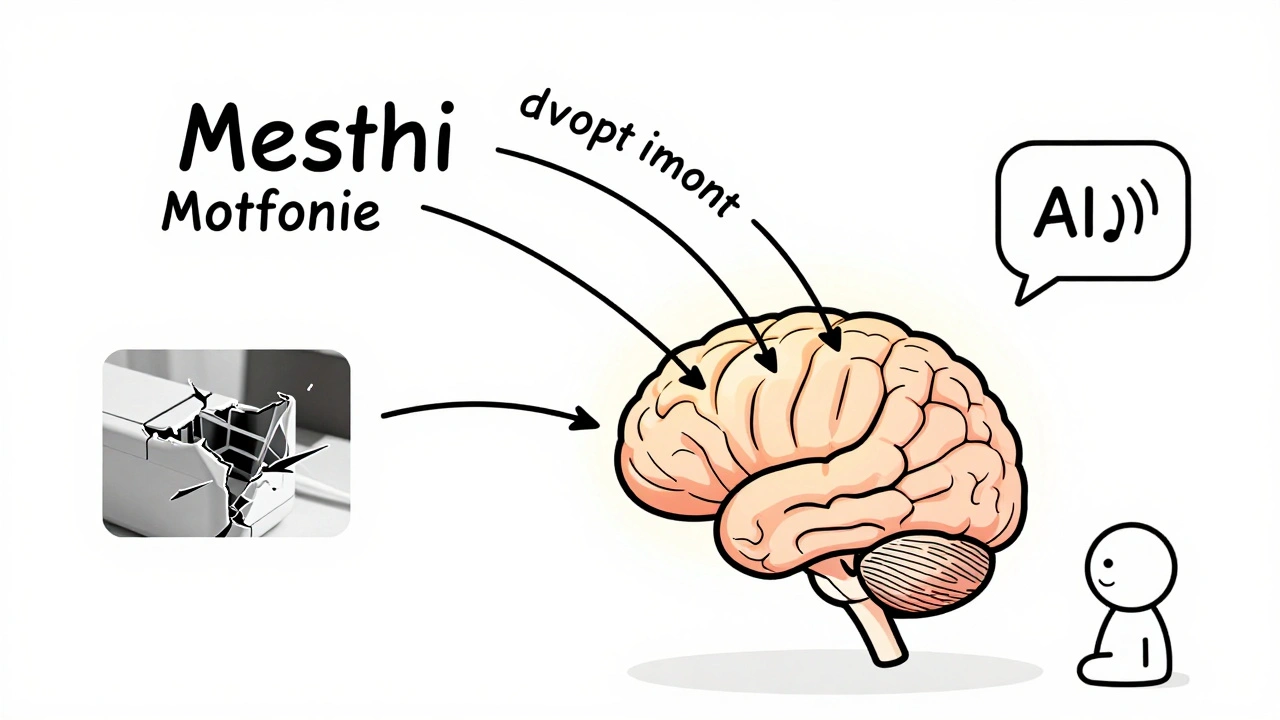
Text-only AI feels outdated now. You ask a chatbot to describe a photo, and it guesses. You upload a receipt, and it struggles to read the numbers. You record a voice note with background noise, and it misses half the meaning. That’s because text-only systems only see half the story. Multimodal AI doesn’t just read words-it sees, hears, and understands the full context. And that’s changing everything.
What Multimodal AI Actually Does
Multimodal AI doesn’t process text, images, and audio one at a time. It handles them together. Think of it like how you understand the world. You don’t read a description of a storm and then look at a photo of it. You see the dark clouds, hear the thunder, and feel the wind-all at once. Your brain combines those signals to know it’s dangerous. Multimodal AI does the same.
Models like OpenAI’s GPT-4o and Google’s Gemini can take a photo of a broken appliance, read the text on its label, listen to your voice describing the noise it makes, and then tell you exactly what’s wrong. Text-only models would need you to type out every detail. They’d miss the color of the crack, the pattern of the rust, the tone of your voice when you say, “It’s been making this weird clicking sound since Tuesday.”
This isn’t just convenience. It’s accuracy. A Stanford study in 2024 found multimodal systems reduced diagnostic errors in radiology by 37.2% by combining X-rays with patient history. Text-only systems, even with detailed notes, missed critical visual cues that changed outcomes.
Why Text-Only AI Falls Short
Text-only models are like reading a book with half the pages missing. They can describe a sunset based on words like “golden,” “warm,” or “calm.” But they can’t tell if the photo you sent is actually a sunset-or a streetlamp at dusk. They can’t hear sarcasm in a customer’s voice. They can’t detect if someone’s holding a fake ID by the way the light reflects off the plastic.
Here’s a real example: In 2024, a customer service chatbot at a major bank failed to catch a fraud attempt because the user sent a photo of a forged check along with a text message saying, “Please deposit this.” The text-only bot saw the words, checked the account, and approved it. A multimodal system would’ve flagged the mismatch between the check’s blurry signature and the customer’s known signature style from past uploads. That’s why Bank of America saw a 68% success rate with multimodal chatbots on document-heavy cases-compared to just 42% with text-only ones.
Text-only systems also struggle with ambiguity. If you say, “This looks like a lemon,” while showing a photo of a yellow fruit, a text-only AI might reply, “Lemons are citrus fruits.” A multimodal AI looks at the shape, texture, color, and context-and says, “That’s a lemon, but it’s bruised. You might want to avoid it.”
How Multimodal AI Is Changing Industries
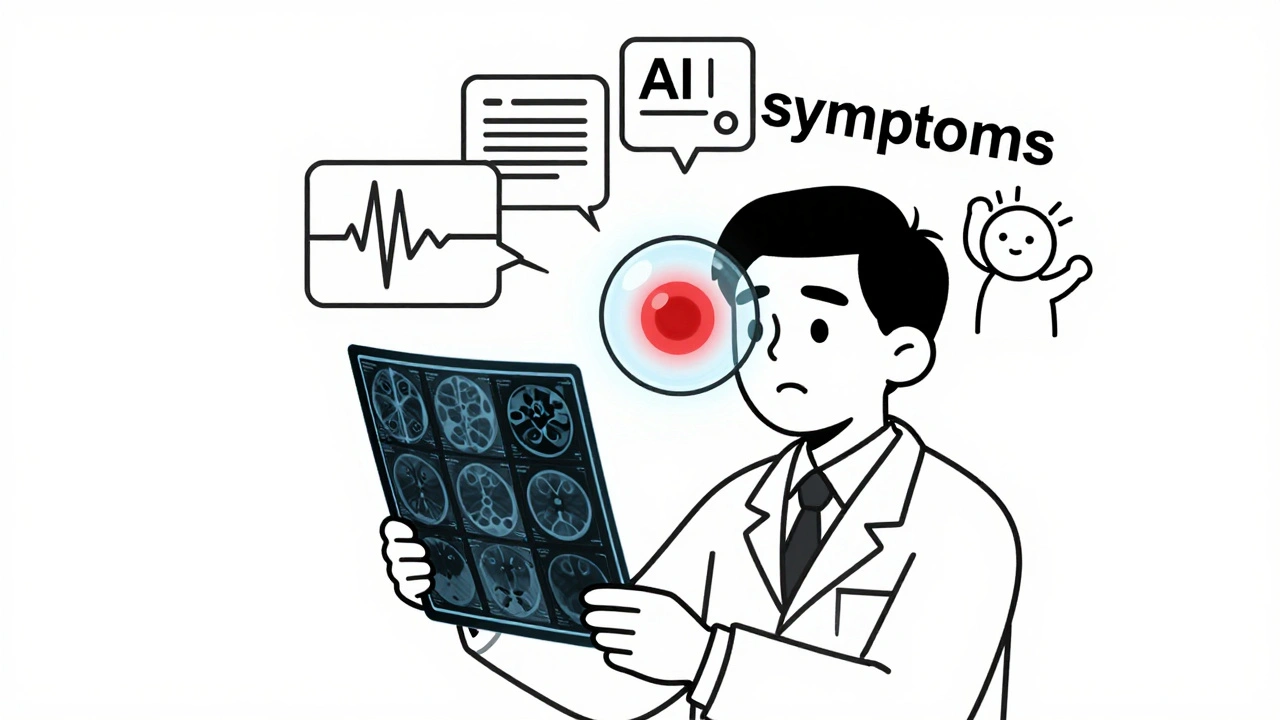
Healthcare is one of the biggest winners. Doctors now use multimodal AI to analyze MRI scans alongside lab results, patient symptoms, and even voice recordings of their complaints. A 2025 report from the US AI Institute showed these systems improved diagnostic precision by 28.7%. That’s not just faster-it’s life-saving.
In retail, companies like Unilever use multimodal AI to scan Instagram posts, TikTok videos, and customer reviews together. They found a surge in demand for “plastic-free packaging” not from text mentions, but from photos of consumers holding reusable containers with handwritten notes saying, “No plastic, please.” Text-only tools would’ve missed that entirely. Unilever cut product development cycles by 47% because they spotted trends before they became search terms.
Customer service has transformed too. Systems now analyze tone, word choice, and even pauses in speech. If a caller says, “I’m fine,” but their voice cracks and they sigh heavily, the AI knows they’re not fine. It escalates the call. Text-only bots just reply, “I’m sorry to hear that.”
Even education is changing. Students upload photos of handwritten math problems, record themselves explaining their thought process, and the AI gives feedback on both their writing and their reasoning. It’s like having a tutor who sees your struggle, not just your answer.
The Hidden Costs and Challenges
Multimodal AI isn’t magic. It’s expensive. Training these models requires massive amounts of data and power. MIT’s 2024 research found they use 3.5x more processing power than text-only models. That means you need high-end GPUs-NVIDIA says you need at least 80GB of VRAM just to start. For small teams or individual developers, that’s a wall.
Data alignment is another headache. If you’re trying to match a video clip to a transcript, the timing has to be perfect. A half-second delay can throw off the whole analysis. Tredence’s 2025 survey found 67% of enterprises struggled with this. Solutions like temporal synchronization helped, but they added complexity.
And then there’s bias. Multimodal systems amplify bias faster. If a model sees mostly images of men in lab coats and women in kitchens, and then reads text describing “scientists” as “he” and “nurses” as “she,” it learns those associations hard. The Partnership on AI found multimodal systems had a 15.8% higher bias amplification rate than text-only ones when dealing with cultural context.
Even the best models make mistakes. Professor Gary Marcus at NYU showed that GPT-4o misinterpreted satirical memes as real news in 23% of test cases. It saw the cartoonish image and the sarcastic caption and thought it was serious. That’s a dangerous flaw in journalism or public safety applications.
What’s Next? The Road to True Context Awareness
The next leap isn’t just adding more data types. It’s understanding cause and effect across them. Right now, multimodal AI can tell you a person is crying. But it can’t always tell you why. Is it joy? Grief? Frustration? That’s where current models fail.
But progress is fast. Google’s Gemini 1.5, released in January 2025, can process a full movie with synchronized subtitles-over a million tokens of context. OpenAI’s GPT-4o update cut latency by 42%, making real-time multimodal interactions feel natural. Meta’s Llama 3.1 now understands non-English multimodal inputs across 200 languages with 38.7% better accuracy than before.
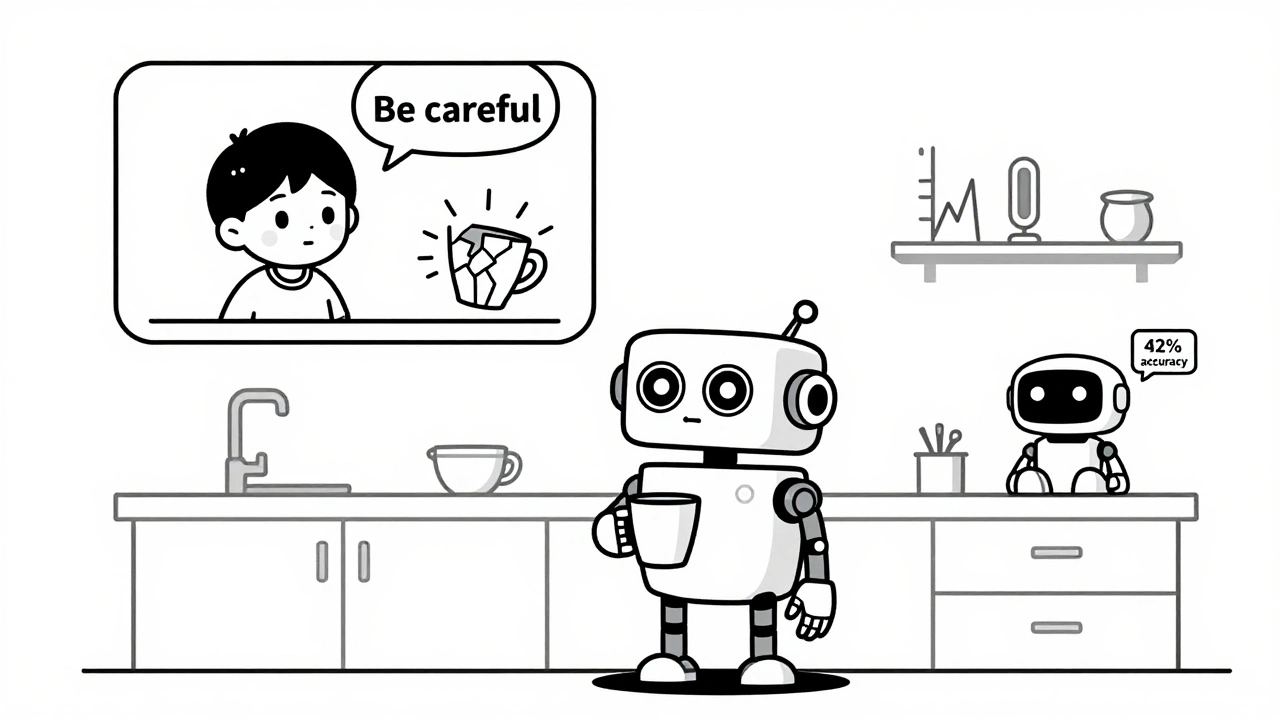
And then there’s embodied AI. NVIDIA’s Project GROOT, announced in September 2025, combines vision, audio, and touch sensors to let robots understand their environment like humans do. A robot can see a cup, hear a child say, “Be careful,” and feel the weight shift as it picks it up. That’s not just multimodal-it’s contextual.
By 2028, 91% of AI researchers predict all generative AI systems will be multimodal. The question isn’t if-it’s how fast you’ll adapt.
Should You Use It?
If you’re in healthcare, retail, customer service, or any field that deals with images, audio, or video-yes. The ROI is clear. Faster decisions, fewer errors, deeper insights.
If you’re a small startup with limited hardware? Start small. Don’t try to build a full multimodal system overnight. Begin with one cross-modal task: image captioning, or voice-to-text transcription with sentiment analysis. Coca-Cola did that in 2024. They started with analyzing social media images and text together. They saw ROI in seven months. Companies that tried to do everything at once took 14 months just to break even.
And if you’re just curious? Try it. OpenAI’s GPT-4o is free to use. Upload a photo. Ask a question. See how it responds. You’ll quickly realize the difference between a chatbot that reads words-and one that understands the world.
What’s the difference between multimodal AI and text-only AI?
Text-only AI processes only written words. Multimodal AI processes text, images, audio, video, and sometimes sensor data-all at the same time. It connects the dots between them. For example, it can look at a photo of a broken phone, read your text description of the issue, hear the sound it makes, and give you a diagnosis. Text-only AI can only work with what you type.
Is multimodal AI better than text-only AI?
In most real-world scenarios, yes. Multimodal AI is more accurate, more context-aware, and better at understanding human behavior. Studies show it reduces errors in healthcare by over 37%, improves customer service resolution by 41%, and detects trends in social media that text-only systems miss entirely. But for simple text tasks-like summarizing a legal contract-it can be slower and less precise due to unnecessary processing of visual data.
Do I need special hardware to use multimodal AI?
For running large models like GPT-4o or Gemini locally, yes-you need powerful GPUs with at least 80GB of VRAM. But most people use cloud-based APIs from OpenAI, Google, or Anthropic. Those services handle the heavy lifting. You just upload a photo or audio file and get a response. No special hardware needed on your end.
Why is multimodal AI more expensive to train?
Because it needs way more data and computational power. Training a multimodal model isn’t just reading text-it’s aligning millions of images, videos, and audio clips with their corresponding descriptions. This requires massive datasets and high-end hardware. MIT found multimodal training uses 3.5 times more energy and processing power than text-only training. That drives up costs.
Can multimodal AI make mistakes?
Yes. It can misinterpret sarcasm, confuse similar-looking objects, or misalign audio with video. In tests, GPT-4o mistook satirical images for real news in 23% of cases. It can also amplify biases if the training data is skewed-for example, associating certain skin tones with specific roles. That’s why human oversight is still critical, especially in high-stakes fields like medicine or law.
 Artificial Intelligence

Addison Smart
December 13, 2025 AT 00:52Man, I remember when we thought chatbots were magic just because they could write a decent email. Now we’re at a point where AI can look at a photo of your dog with a sock in its mouth, hear you sigh and say ‘not again,’ and reply with ‘I see the sock, I hear your exhaustion, and I recommend a chew toy from Amazon link #4.’ It’s wild how much more human it feels. Multimodal isn’t just an upgrade-it’s like AI finally got a pair of eyes and ears and stopped pretending it’s a very fancy autocomplete.
And honestly? The healthcare stuff hits different. My aunt’s oncologist used a system that cross-referenced her MRI scans with her voice recordings during check-ins. The AI picked up a subtle tremor in her voice she didn’t even realize she had, which led to catching a new tumor early. Text-only would’ve just nodded along to ‘I’m tired’ and moved on. This isn’t sci-fi anymore. It’s Sunday dinner conversation.
Yeah, the cost is insane. I work at a startup and we’re still on a shoestring, but we started small-just image-to-caption for our product photos. Turned out customers were uploading pics of our product in weird settings-on a beach, in a car, next to a cat-and we had zero idea until the AI started tagging them. We redesigned packaging based on that. No focus groups. Just pixels and pixels talking to each other.
And the bias thing? Terrifying. I saw a demo where the AI kept labeling women in kitchens as ‘cooks’ even when the text said ‘CEO.’ It wasn’t malicious. It was just trained on a dataset where every ‘CEO’ was a man in a suit and every ‘cook’ was a woman with an apron. We’re not just teaching AI to see. We’re teaching it to believe the world as it was, not as it should be.
Still. I’d rather have a flawed system that sees the world than a perfect one that only reads the script.
David Smith
December 13, 2025 AT 14:53Wow. Another tech bro manifesto. Let me guess-you also think AI will solve climate change and make your cat wear a turtleneck? All this ‘multimodal’ nonsense is just corporations slapping ‘AI’ on everything to sell more GPUs. You think your bank’s chatbot catching a fake check is a breakthrough? Newsflash: humans used to do that. With eyes. And brains. And no 80GB VRAM required.
And don’t get me started on ‘context awareness.’ Last week my kid drew a stick figure with a lightning bolt and called it ‘Dad’s mood.’ The AI labeled it ‘a child expressing joy.’ No. It was a cry for help. You think a machine can read that? Please. This isn’t progress. It’s just louder noise.
Lissa Veldhuis
December 13, 2025 AT 16:30David you’re such a Luddite it’s almost cute like you think the world stopped evolving in 2012 when you last used a printer
Look I just uploaded a video of my grandma trying to use her new tablet and the AI didn’t just transcribe her mumbled ‘what’s this button’-it saw her trembling fingers, heard the panic in her breath, and gave her a voice-guided tutorial in slow Spanish with big icons and a virtual hand pointing. She cried. Not because she was sad. Because for the first time since her stroke she felt understood.
And yes the bias is wild-my friend’s resume got rejected by an AI that saw her name and a photo of her in a hijab and linked it to ‘low engagement’ in some training data from 2018. But that’s not the AI’s fault. That’s the damn humans who fed it trash. Fix the data not the tool.
Also GPT-4o misread a meme as news? So did half of Facebook. At least the AI admits it’s confused. Humans just share it and yell at their cousins.
Michael Jones
December 14, 2025 AT 20:23Think about it this way-we used to think the mind was just words. Then we learned it was images. Then emotions. Then body language. Now we’re finally letting machines learn the same way. This isn’t about better tech. It’s about better empathy.
When you hear someone say ‘I’m fine’ and their voice cracks? That’s not data. That’s a soul trying to be brave. Text-only AI hears the word. Multimodal hears the silence behind it.
We’re not building smarter machines. We’re building mirrors. And the more we feed them truth-the more they reflect back what we’ve forgotten: that being human isn’t about speaking. It’s about being seen.
And yeah the cost is high. But so was the printing press. So was the telephone. So was the wheel. We don’t stop progress because it’s hard. We stop it when we forget why we started.
What are we afraid of? That machines will understand us too well? Or that we’ll finally have to face how little we understand each other?
allison berroteran
December 16, 2025 AT 01:33I’ve been using GPT-4o for my students’ handwritten math work and it’s been a game-changer. One kid kept turning in blurry photos of equations with scribbles all over the margins. The AI didn’t just solve the problem-it noticed he kept erasing the same step over and over, and in his audio explanation he kept saying ‘I don’t get why this part doesn’t work.’ So instead of just giving the answer, it highlighted the exact step he was stuck on, showed him a visual of the algebraic transformation, and said ‘This part trips up a lot of people-here’s why.’
He cried. Not because he was upset. Because someone-something-finally saw him.
And yeah the bias is real. I had it flag a photo of a Black student holding a lab report as ‘likely not a STEM major’ because the training data associated lab coats with white men. I reported it. They fixed it in two weeks. That’s the thing-this tech isn’t perfect, but it’s teachable. Unlike some humans.
Start small. Try image captioning. See what you learn. The world’s full of details text can’t capture. But cameras? They never blink.
Gabby Love
December 16, 2025 AT 11:35Just tried uploading a photo of my coffee spill next to a sticky note that said ‘I hate Mondays’-the AI replied ‘That’s a classic Monday. Also, you might want to clean that before it stains the wood.’ Simple. Accurate. Human. No fluff.
It’s not magic. It’s just better attention.