
Have you ever typed the same question into an AI chatbot twice - just reworded slightly - and gotten two completely different answers? You’re not crazy. That’s not a glitch. It’s prompt sensitivity, and it’s one of the biggest hidden problems in today’s large language models.
What Exactly Is Prompt Sensitivity?
Prompt sensitivity is when tiny changes in how you phrase a question lead to big changes in the AI’s response. Swap "explain" for "describe," add an Oxford comma, or restructure a sentence - and suddenly the model gives you a totally different answer, even if the meaning hasn’t changed. This isn’t a bug. It’s a feature that went wrong. Large language models don’t understand meaning the way humans do. They predict the next word based on patterns they’ve seen. So if two prompts look different on the surface - even if they’re logically identical - the model treats them as separate inputs. And that leads to inconsistent, unreliable outputs. Researchers have measured this using something called the PromptSensiScore (PSS). It’s a metric that tracks how much an AI’s answers vary across different versions of the same prompt. In tests, some models showed output differences so drastic that accuracy dropped by over 25% just from rewording. The most sensitive part? The overall structure of the prompt. Changing how a question is framed matters more than the actual facts inside it.Why Does This Happen?
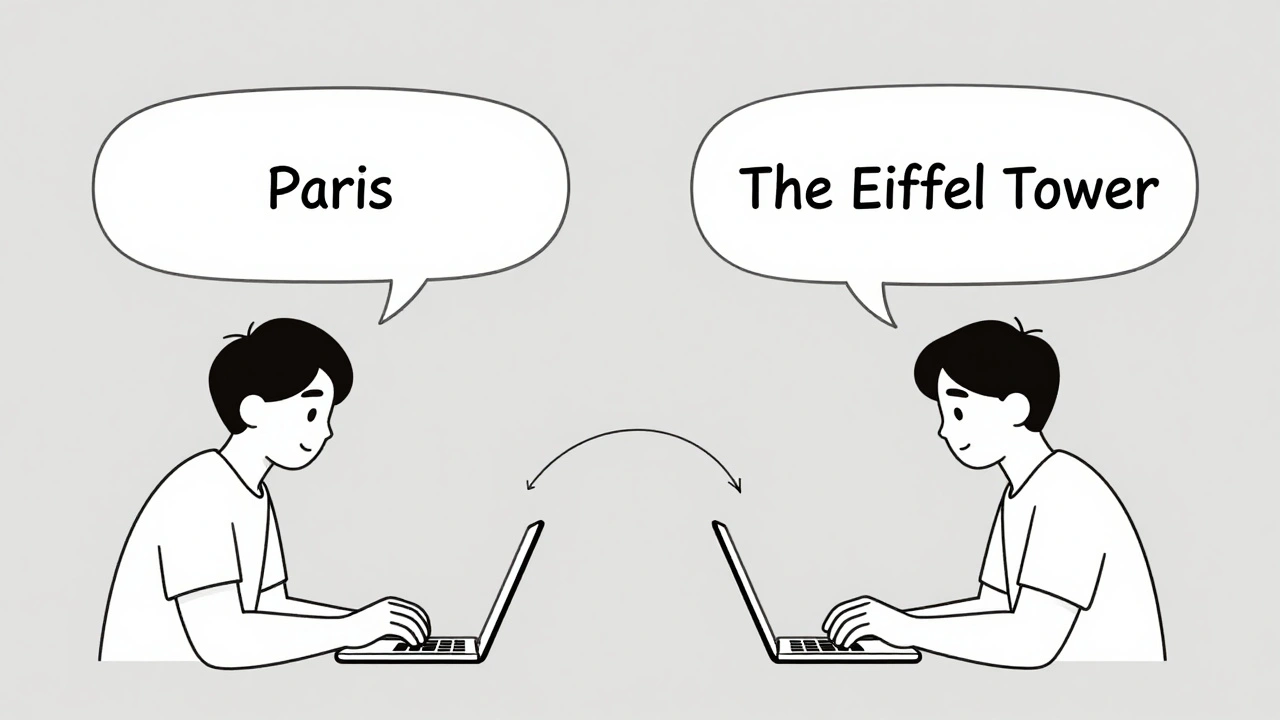
At the core, it’s about confidence. When a model isn’t sure what you’re asking, it guesses. And when it guesses, it guesses differently every time. Studies show that when prompt sensitivity is high, the model’s own confidence in its answer drops by nearly 28%. Think of it like asking two people the same question in slightly different ways. One person says, "What’s the capital of France?" The other says, "Can you tell me the city that serves as France’s political center?" A human would say "Paris" both times. But an LLM? It might answer "Paris," then "The Eiffel Tower," then "I don’t know," depending on how the words are arranged. The problem gets worse with complex prompts. Chain-of-thought prompting - where you ask the model to "think step by step" - actually makes sensitivity worse by 22%. Why? Because the model starts overthinking. It invents reasoning paths that weren’t needed, and those paths lead to different conclusions. Smaller models are usually more sensitive. But not always. Some smaller, specialized models outperformed larger ones in consistency tests. Llama3-70B-Instruct, released in July 2024, had the lowest PSS across all tested models - 38.7% lower than GPT-4 and Claude 3. Meanwhile, some Flash models in healthcare settings beat their bigger counterparts in diagnostic classification tasks.How It Breaks Real-World Applications
This isn’t just a lab curiosity. It’s breaking real systems. In healthcare, a radiology AI was trained to flag potential tumors in X-rays based on doctor notes. One prompt: "Does this report suggest a malignant lesion?" Another: "Is there any indication of cancer here?" Same intent. But the model answered "yes" to the first and "no" to the second - 34.7% more often in borderline cases. That’s not a small error. That’s a missed diagnosis. Developers on GitHub and Reddit are reporting the same thing. One person spent 37 hours debugging what they thought was a model bug. Turns out, it was just an Oxford comma. Another user saw accuracy drop from 87% to 62% when they changed "Please explain" to "Can you describe." Enterprise teams are now spending weeks testing dozens of prompt variations before deploying any AI tool. Forrester found that 78% of companies using LLMs in production now list prompt sensitivity as one of their top three concerns - far above cost or speed.
What Works: Proven Ways to Reduce Sensitivity
You can’t eliminate prompt sensitivity. But you can manage it. Use few-shot examples. Giving the model 3-5 clear examples of the input-output pair you want cuts sensitivity by over 31%. It’s simple, cheap, and works even on smaller models. Try Generated Knowledge Prompting (GKP). Instead of asking directly, first ask the model to generate relevant facts. For example: "List key symptoms of pneumonia based on this report. Then, based on those symptoms, is pneumonia likely?" This reduces sensitivity by 42% and boosts accuracy by nearly 9 percentage points. Structure your prompts. Use clear formatting: "Answer in one sentence. Use only yes or no. Do not explain." Structured prompts improve consistency by over 22% compared to open-ended ones. Test multiple versions. Don’t rely on one prompt. Write 5-7 variations of your most important prompts. Run them all. Pick the one that gives the most consistent output. This single practice reduces sensitivity-related errors by 54%. Avoid chain-of-thought for simple tasks. If you’re doing binary classification - yes/no, true/false - don’t ask the model to "think step by step." It will overcomplicate things and become less reliable.What Doesn’t Work (And Why)
Many people assume bigger models are more stable. They’re not. GPT-4 is more powerful, but not necessarily more consistent. Llama3-70B-Instruct beat it in sensitivity tests. Some try to fix sensitivity by adding more instructions. "Be precise. Be accurate. Don’t guess." That doesn’t help. The model doesn’t understand those meta-instructions. It just sees more words - and that can make it more confused. Another myth: AI-generated prompts are better. Tools like Automatic Prompt Engineer (APE) create optimized prompts automatically. But tests show they’re almost identical in sensitivity to human-written ones. The difference? Just 1.8 percentage points. And no, you can’t just "train the model out of it." Prompt sensitivity isn’t a training flaw. It’s built into how LLMs process language. Until models start understanding meaning like humans - not just predicting words - this will stay a problem.
The Bigger Picture: Why This Matters
Prompt sensitivity isn’t just an engineering headache. It’s a trust issue. If you can’t rely on your AI to give the same answer to the same question, how can you use it in law, medicine, finance, or education? Regulators are starting to notice. The EU AI Act now requires high-risk AI systems to prove "demonstrable robustness to reasonable prompt variations." By 2026, experts predict prompt sensitivity scores will be as standard on model cards as accuracy and response time. Companies are already competing on this. Anthropic claims Claude 3 is 28% more robust than GPT-4. OpenAI’s internal roadmap includes "Project Anchor," aimed at cutting GPT-5’s sensitivity by half. But here’s the catch: reducing sensitivity sometimes makes answers dull. One developer on Reddit complained: "My prompts became so robust they also became boring - always giving the safest, most generic answer." That’s the trade-off. More consistency often means less creativity. And in some cases, you want creativity. In others - like medical triage or legal document review - you need reliability above all.What You Should Do Today
If you’re using LLMs in any serious way, here’s your action plan:- Take your most important prompt. Write 5 different versions that mean the same thing.
- Run them all. Record the outputs.
- Look for inconsistencies. Are answers conflicting? Missing key details? Changing tone?
- Use few-shot examples or GKP to stabilize it.
- Document the best version - and keep testing it over time.
Why does changing one word in a prompt change the AI’s answer?
Large language models don’t understand meaning - they predict the next word based on patterns in training data. Even small wording changes alter the pattern the model follows, leading it to generate a different response. Two prompts with identical meaning can trigger entirely different prediction paths, especially if the structure, tone, or word order differs.
Are bigger models less sensitive to prompt changes?
Not always. While larger models often perform better on standard benchmarks, prompt sensitivity doesn’t always scale with size. For example, Llama3-70B-Instruct showed 38.7% lower sensitivity than GPT-4 and Claude 3, despite being the same size or smaller than some competitors. Some smaller, task-specific models outperformed larger general-purpose ones in consistency tests. Size helps, but architecture and training focus matter more.
What’s the PromptSensiScore (PSS), and why does it matter?
The PromptSensiScore (PSS) is a metric developed in the ProSA framework to measure how much an AI’s output varies across semantically identical prompts. A higher PSS means the model is more sensitive to wording changes. It matters because it reveals how unreliable an AI might be in real-world use. A model with high PSS could give conflicting answers in medical diagnosis, legal advice, or customer support - even when the user’s intent hasn’t changed.
Can I fix prompt sensitivity by giving the AI more instructions?
No. Adding more instructions like "be precise" or "don’t guess" doesn’t help. LLMs treat all text as part of the input pattern. More words often increase confusion, not clarity. The best fixes are structural: using few-shot examples, structured prompts, or Generated Knowledge Prompting. These give the model clearer reference points - not just more rules.
Is prompt sensitivity a problem only for developers?
No. While developers are the first to notice it, prompt sensitivity affects anyone relying on AI for decisions. In healthcare, it can lead to misdiagnoses. In legal workflows, it can change contract interpretations. In customer service, it can give conflicting answers to the same question. Enterprises now test for it before deploying AI - and regulators are starting to require it. It’s a trust issue, not just a technical one.
Will future models solve this problem?
Potentially, but not soon. Researchers believe prompt sensitivity stems from how LLMs process language - not a fixable bug. OpenAI’s "Project Anchor" and other initiatives aim to reduce it by 50% in future models, but experts estimate it will remain a core challenge for at least 5-7 years. The goal isn’t to eliminate sensitivity entirely, but to build models that are inherently more consistent - and to give users tools to test and manage it.
 Artificial Intelligence



Renea Maxima
December 14, 2025 AT 05:24Jeremy Chick
December 14, 2025 AT 21:03selma souza
December 14, 2025 AT 23:33Frank Piccolo
December 15, 2025 AT 10:42James Boggs
December 15, 2025 AT 22:21