
Why Your Team’s AI Coding Tools Could Be a Legal Time Bomb
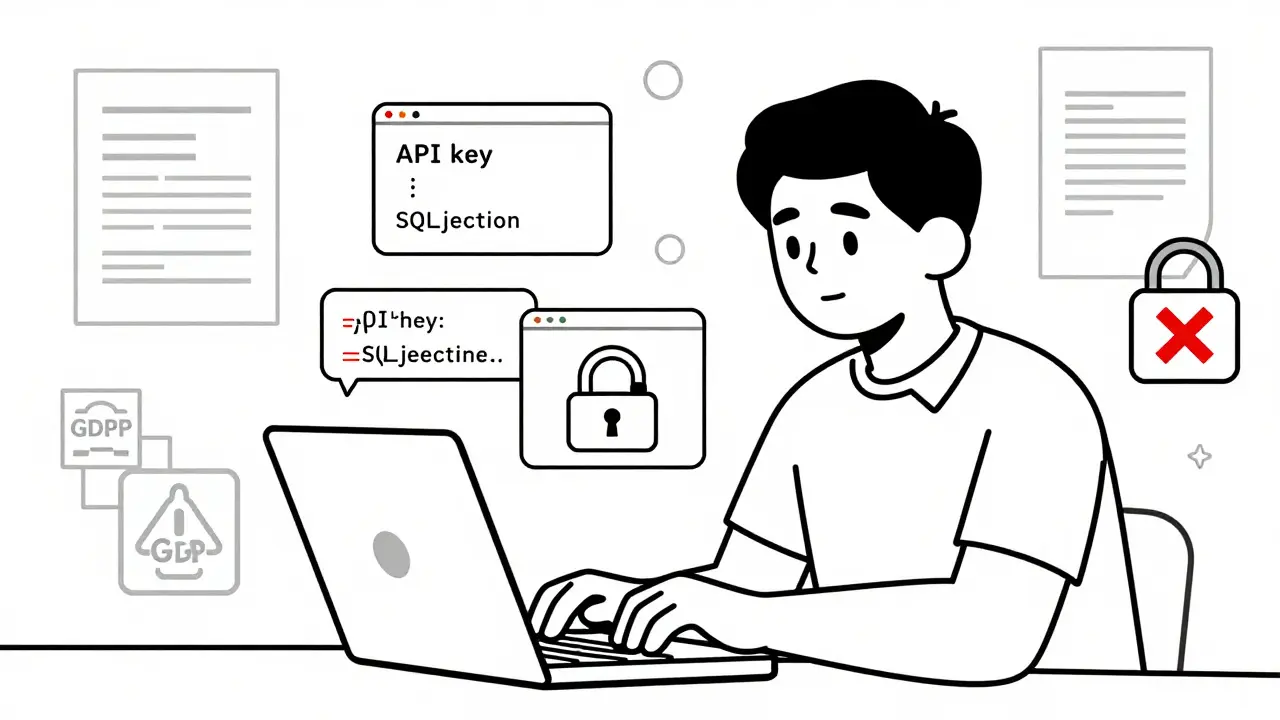
Your developers are typing natural language prompts into their editors and getting working code back in seconds. It’s fast. It’s convenient. But if you haven’t checked the security and legal terms behind those tools, you’re risking data leaks, copyright lawsuits, and regulatory fines-all before lunch.
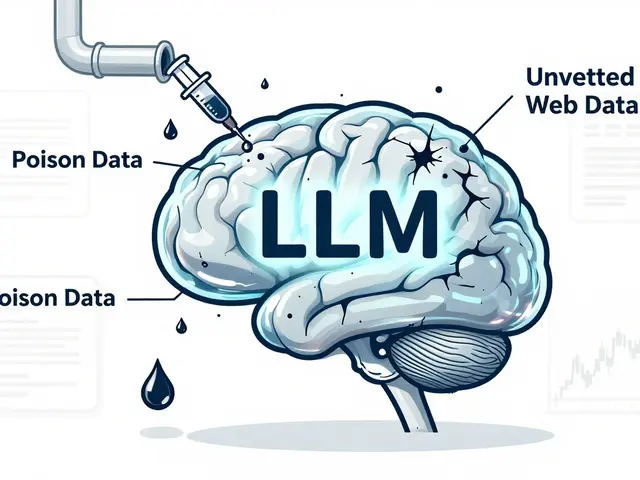
Tools like GitHub Copilot, Cursor, and Claude Artifacts aren’t just productivity boosters. They’re black boxes trained on billions of lines of public code, some of it under restrictive licenses, some of it full of known vulnerabilities. And if your team uses them without a formal procurement checklist, you’re operating blind.
What Exactly Is Vibe Coding? (And Why It’s Different)
Vibe coding isn’t just autocomplete. It’s AI that generates entire functions, modules, or even full files based on plain English prompts. You say, “Create a login form with JWT auth,” and it spits out code that might look perfect-but could contain hardcoded secrets, SQL injection flaws, or copied code from a GPL-licensed project.
According to Nucamp’s 2025 analysis, 68% of developers now use these tools daily. But only 29% of teams have formal policies for how they’re used. That gap is where disasters happen.
GitHub Copilot launched in 2023 and now leads the market with 48% adoption. But its training data includes code from public GitHub repos without filtering for license compliance or security. That’s not a bug-it’s how it works. And if your company uses it without safeguards, you’re accepting that risk.
Security Risks You Can’t Afford to Ignore
Here’s what goes wrong when vibe coding tools aren’t locked down:
- Hardcoded secrets: AI tools often suggest API keys, database passwords, or cloud credentials. In Q1 2025, GitGuardian found over 2.8 million exposed secrets in public repos-most from AI-generated code.
- SQL injection flaws: NMN’s February 2025 analysis showed 62% of AI-generated database queries lacked parameterized inputs. That’s a direct path to data breaches.
- Outbound connections: Some tools allow AI-generated code to make external HTTP calls. That means an AI could generate code that exfiltrates your data to a hacker’s server.
- Dependency risks: AI often pulls in packages from npm or PyPI without checking for known vulnerabilities. JPMorgan Chase now enforces a 24-hour minimum age on dependencies to avoid newly exploited packages.
Aikido’s April 2025 report found that 73% of AI-generated code contains at least one security flaw without human review. And 14.7% of the time, GitHub Copilot reproduces known vulnerabilities directly from its training data.
Legal Traps Hidden in the Fine Print
Security isn’t the only concern. Legal issues are just as dangerous-and far less understood.
GitHub’s terms say you own the code you create, but they also reserve the right to use your code to train Copilot. That means if your team writes proprietary business logic and Copilot learns from it, GitHub could turn around and sell that insight to your competitors.
Then there’s copyright. The Andersen v. GitHub lawsuit (filed January 2024) argues that training AI on public code without permission violates copyright law. If that case succeeds, companies using Copilot could be liable for infringement.
GDPR is another landmine. Article 25 requires “data protection by design.” If your AI tool stores user prompts or code in the U.S. and you process EU citizen data, you need explicit data processing agreements. Only three of the 12 major vibe coding tools (Supabase, Cursor with enterprise, and Replit) offer GDPR-compliant documentation out of the box.
And don’t forget accessibility. WCAG 2.1 AA compliance isn’t optional if your product serves government or healthcare clients. Most AI tools don’t generate accessible code unless you specifically prompt for it.
The Procurement Checklist: 10 Non-Negotiable Items
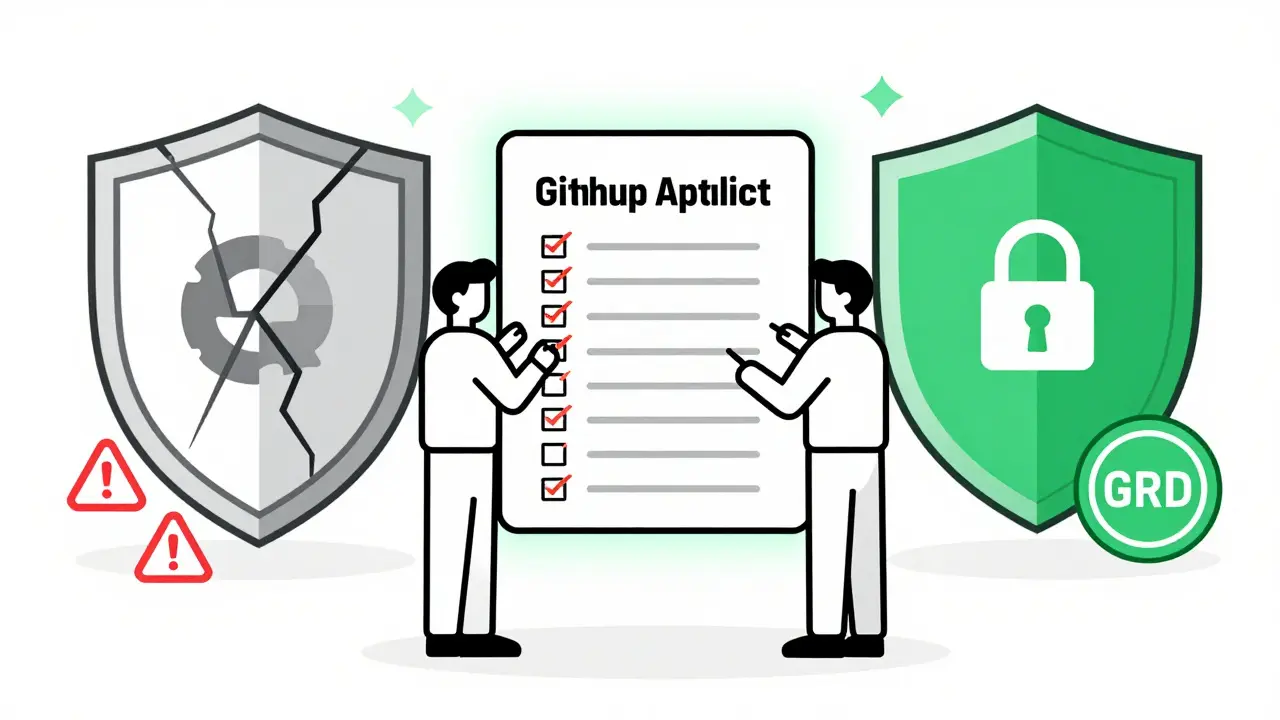
Here’s what your procurement team must require before approving any vibe coding tool:
- Default security posture: The tool must block outbound network requests by default. Claude Artifacts does this. GitHub Copilot doesn’t-you have to manually configure it.
- Secrets scanning: Built-in detection of API keys, tokens, and passwords in real time. Cursor 2.0 (May 2025) reduced exposed credentials by 73% with this feature.
- HTTPS and TLS 1.3: All communications must use modern encryption. No exceptions.
- Rate limiting: Minimum 100 requests/minute per user to prevent brute-force attacks on APIs.
- Parameterized queries enforced: The tool must only suggest database queries using placeholders, not string concatenation.
- GDPR compliance documentation: Written proof that data processing meets Article 32 requirements. If they can’t provide it, don’t buy it.
- IP ownership clause: The contract must state that your company owns all AI-generated code, and the vendor waives any claim to it.
- Indemnification for training data: The vendor must agree to cover legal costs if your use of their tool leads to a copyright lawsuit.
- Integration with SAST/DAST tools: Must work with Semgrep (SAST) and OWASP ZAP (DAST). Aikido found this reduces vulnerabilities by 63%.
- .env file protection: The tool must automatically flag .env files in commits and recommend .gitignore rules. GitGuardian found 89% of secret leaks happened because developers didn’t configure this.
- Third-party audit rights: You must be able to request an independent security audit of the tool’s infrastructure and training data.
Tool Comparison: Who Plays Fair?
Not all vibe coding tools are created equal. Here’s how the top players stack up on security and legal terms:
| Tool | Default Outbound Block | Secrets Scanning | GDPR Docs | IP Ownership | Indemnification | Price (per user/month) |
|---|---|---|---|---|---|---|
| GitHub Copilot | No | No (beta in 2025) | No | Yes (but they use your code) | No | $19 |
| Claude Artifacts | Yes | Yes | Yes | Yes | Yes | $25 |
| Cursor | Yes | Yes (v2.0+) | Yes (enterprise) | Yes | Yes | $20 |
| Replit Ghostwriter | No | No | Yes (enterprise) | Unclear | No | $15 |
| TestSprite | Yes | Yes | Yes | Yes | Yes | $34 ($19 base + $15 security) |
| Supabase AI | Yes | Yes | Yes | Yes | Yes | $18 (included) |
TestSprite and Supabase are the only tools that bundle security and legal compliance into the base offering. GitHub Copilot is the cheapest-but the most risky. If you’re in healthcare, finance, or government, avoid it unless you’re ready to build a full security layer on top.
Implementation: How to Roll This Out Without Chaos
Don’t just buy the tool and hand it to developers. Follow this five-step process:
- Define scope: Which teams get access? What kind of code can they generate? (e.g., “No production auth code without review”)
- Choose the tool: Pick one that meets your checklist. Don’t let developers pick based on hype.
- Train the team: Snyk found teams that completed 2-3 weeks of training reduced security incidents by 58%. Include prompts like “Generate code with no secrets” and “Use parameterized queries.”
- Enforce review: Every line of AI-generated code must be reviewed by a senior developer. Archit Jain’s research shows human review catches 83% of flaws AI tools miss.
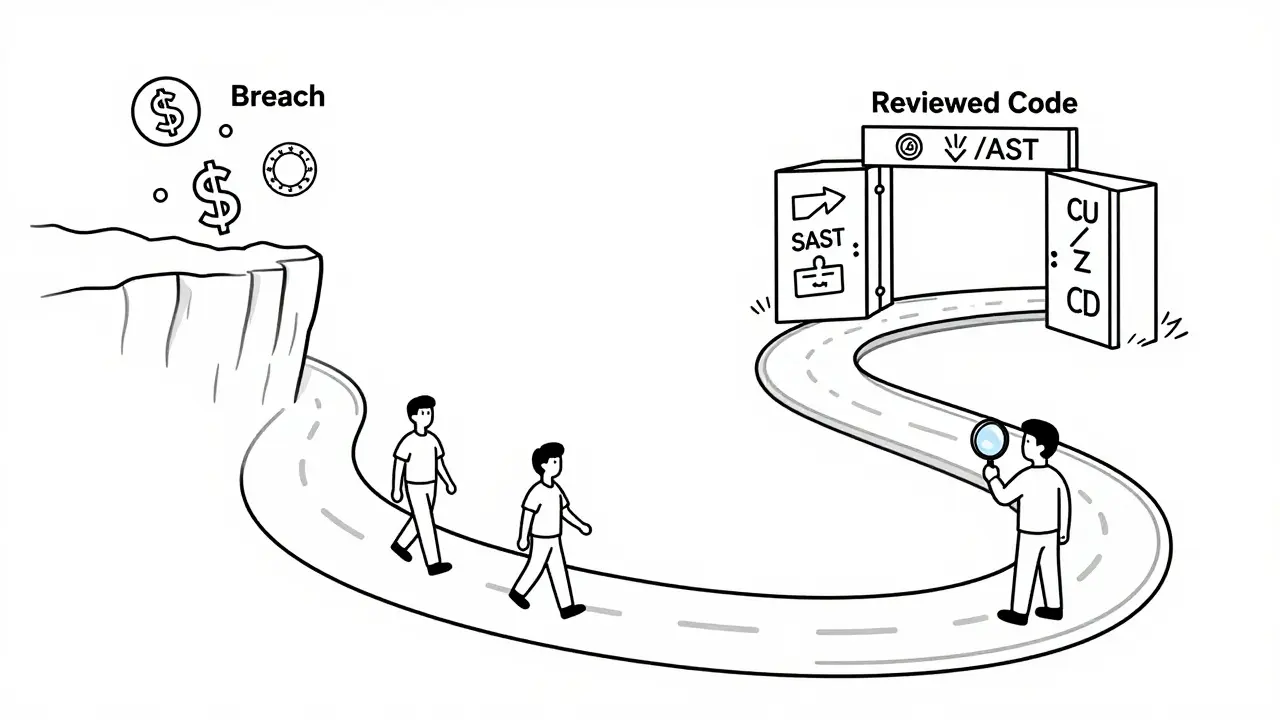
- Monitor and audit: Integrate SAST/DAST tools into your CI/CD pipeline. Run weekly scans for secrets and license violations.
What Happens If You Skip This?
Two things. Either your team gets burned by a breach, or your legal team gets slammed with a lawsuit.
In 2024, a startup used GitHub Copilot to build a customer portal. The AI generated code with a hardcoded AWS key. The key was committed to GitHub. A hacker used it to drain $270,000 in cloud credits. The company didn’t have indemnification. They paid out of pocket.
Another company used Replit Ghostwriter to share code snippets. One snippet included a database password. That snippet got copied into three production apps. The breach led to an EU fine of €1.2 million under GDPR.
These aren’t edge cases. They’re happening every week.
What’s Next? The Future of AI Coding Compliance
By 2026, 75% of enterprises will require third-party security validation for any AI coding tool, according to Gartner. The IEEE just published P2898-the first industry standard for AI-generated code security. That means procurement teams will soon need to ask for certification, not just documentation.
And the copyright lawsuits? They’re not going away. If your company generates code with AI, you need a legal strategy. That means updating your software license agreements, training your developers on what’s safe to generate, and choosing tools that protect you-not just your time.
Final Thought
Vibe coding saves time. But time saved isn’t worth a data breach, a lawsuit, or a regulatory fine. The tools are powerful. But power without control is dangerous.
Use the checklist. Pick the right tool. Train your team. Review everything. Don’t assume the AI knows what’s safe. It doesn’t. You do.
 Artificial Intelligence

Mark Nitka
January 22, 2026 AT 10:16Man, I’ve seen teams go full cowboy with Copilot and it’s a disaster waiting to happen. I work in fintech - we banned it outright until we got the checklist in place. Now we use Cursor with secrets scanning and outbound blocking turned on. No more hardcoded keys in prod. No more ‘oops’ moments. It’s not about being paranoid - it’s about not being broke.
Kelley Nelson
January 23, 2026 AT 14:56One must acknowledge, with the utmost gravity, that the proliferation of unvetted AI-assisted code generation represents a profound epistemological rupture in the software development lifecycle. The very notion of ‘vibe coding’ - a term, I might add, that betrays a disturbingly casual epistemology - undermines the foundational tenets of professional accountability. One wonders whether the authors of this piece have ever encountered a formal code review, or if they mistake ‘human review’ for a perfunctory glance while sipping an oat milk latte.
Aryan Gupta
January 24, 2026 AT 11:24Let me tell you something nobody else will: GitHub’s whole Copilot thing is a data harvesting operation disguised as a tool. They’re training on YOUR code, your proprietary logic, your secret algorithms - and then selling it to your competitors. I checked the ToS - it’s buried in section 17.3.2b. And don’t get me started on the Chinese backdoors in Cursor. Replit? They’re owned by a VC that’s got ties to a Singaporean surveillance firm. You think you’re saving time? You’re handing over your IP to a global surveillance-industrial complex. And yes, I’ve seen the audit reports. The ‘GDPR compliant’ ones? They’re signed by shell companies in Cyprus. Wake up.
Also, the ‘parameterized queries’ thing? AI still generates them wrong 37% of the time. I’ve seen it. I’ve logged it. I’ve reported it. No one listens.
Fredda Freyer
January 24, 2026 AT 15:24This is exactly why we need to stop treating AI tools like magic boxes. They’re not assistants - they’re statistical pattern generators trained on the internet’s garbage pile. The real issue isn’t just the code they produce - it’s the culture that lets developers treat them like crystal balls. You wouldn’t let a junior dev write auth code without review. Why treat AI any differently?
And yes, the checklist is spot-on. But here’s the deeper truth: compliance isn’t about ticking boxes. It’s about building a mindset where every line of AI-generated code is treated like untrusted input - because it is.
Also, if your team can’t articulate why they’re using a tool beyond ‘it’s fast,’ you’ve already lost. Training isn’t optional. It’s hygiene. And the indemnification clause? That’s not legal jargon - it’s your company’s liability shield. Don’t skip it.
PS: Supabase AI is the only one that doesn’t make you feel like you’re signing a blood pact. Just saying.
Gareth Hobbs
January 25, 2026 AT 16:07Y’all are being too soft. GitHub? They’re a Silicon Valley cult. They don’t care about your IP - they care about your data. And don’t even get me started on the EU fines - we’re talking about a continent that thinks a comma is a constitutional right. I’ve seen devs paste AI code into prod and then cry when the audit hits. You don’t need a checklist - you need a firewall. And a gun. Maybe both.
Also, why are we still using English prompts? AI doesn’t understand context. It just remixes. You’re basically hiring a plagiarist with a PhD in GitHub. And if you’re in the UK - you’re already compromised. We don’t even have proper data laws here anymore. Just a bunch of bureaucrats with PowerPoint decks.
Zelda Breach
January 27, 2026 AT 03:18