

Finance teams used to spend weeks crunching numbers, pulling data from five different systems, and writing reports no one read. Now, they’re getting back hours in their week-not by working harder, but by letting AI do the heavy lifting. Generative AI isn’t just a buzzword in finance anymore. It’s changing how forecasts are made, why variances happen, and who gets to see the story behind the numbers.
What’s Really Changing in Financial Forecasting?
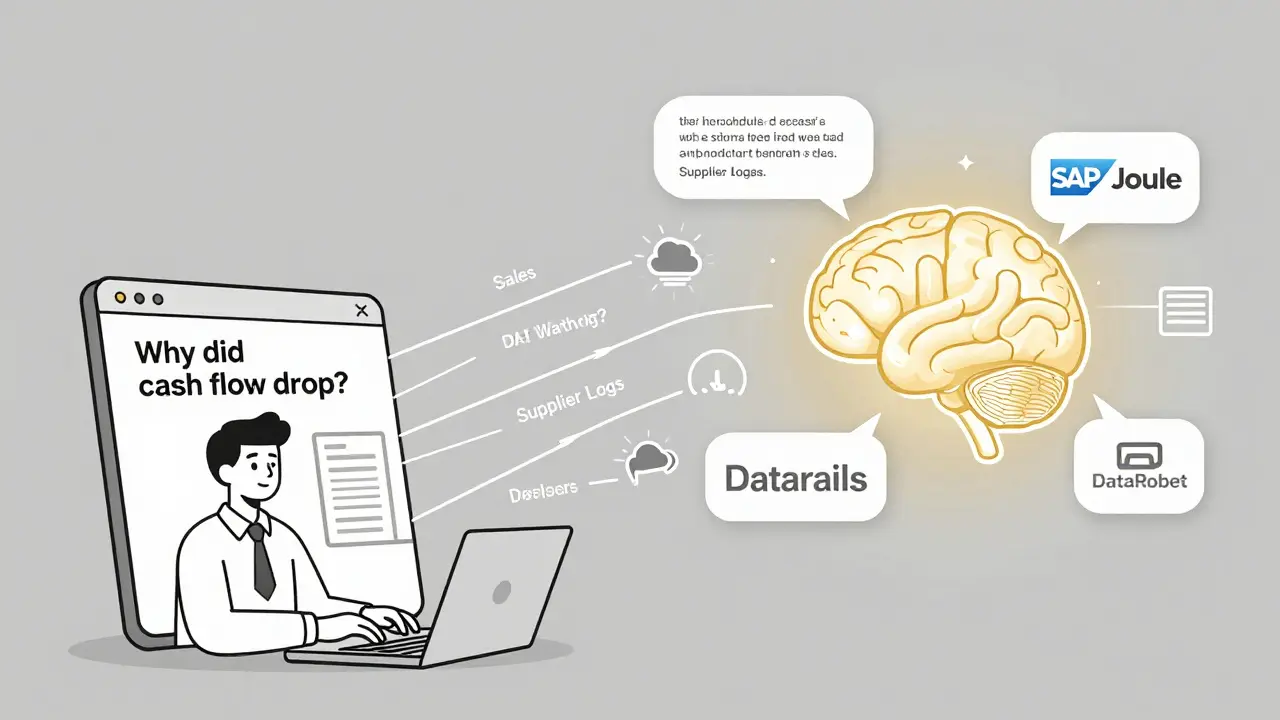
Traditional forecasting meant building Excel models that broke every time a new cost center was added or a supplier changed prices. Teams spent 60 to 80% of their time just gathering data, according to McKinsey. The rest? Trying to explain why last quarter’s revenue missed target by 12%. Generative AI flips that. Instead of manually updating spreadsheets, finance teams now feed historical data-sales, payroll, inventory, even weather patterns-into systems that learn patterns over time. These systems don’t just spit out numbers. They generate full narratives: "Revenue missed targets because the Pacific Northwest snowstorm delayed shipments, and customer churn rose 8% among mid-tier clients after the price hike in January." It’s not magic. It’s retrieval-augmented generation (RAG). Think of it like a super-smart assistant who’s read every financial report, ERP log, and earnings call from the past three years. When you ask, "Why did cash flow drop?" it pulls the right data, runs simulations, and writes the answer in plain English.How Variance Analysis Got a Whole Lot Smarter
Variance analysis used to mean comparing a forecast to actuals, then writing a two-page email explaining the difference. Often, the explanation was vague: "Market conditions changed." Now, AI tools like DataRobot’s Cash Flow Forecasting App and Datarails’ platform automatically detect anomalies. They cross-reference actual spending with external signals-news about supply chain delays, competitor pricing moves, even social sentiment around a product launch. Then they tell you exactly what drove the variance. At King’s Hawaiian, after implementing AI-driven forecasting, finance teams saw a 20%+ drop in interest expenses. Why? Because they could predict cash shortfalls weeks in advance and adjust borrowing schedules. No more last-minute loans at higher rates. One North American financial institution cut report-writing time by 70%. Instead of drafting internal risk updates manually, their AI generated the first draft. Analysts just reviewed and approved. The system flagged inconsistencies, like when a department’s travel budget spiked but no corresponding approval emails were found in the system.Real Tools Finance Teams Are Using Right Now
You don’t need a team of data scientists to use this. Most enterprise tools are built for finance people, not engineers.- SAP Joule: Launched in March 2024, this AI assistant inside SAP S/4HANA Finance answers questions like, "What’s our cash position next quarter if we delay the new warehouse launch?" It pulls live data from treasury systems and generates forecasts with confidence intervals.
- DataRobot: Their Cash Flow Forecasting App integrates directly with SAP Datasphere and analyzes payer behaviors. It’s being used by manufacturers and distributors to predict when customers will pay-and when they won’t.
- Datarails: This platform connects to QuickBooks, NetSuite, and Oracle, then uses generative AI to turn complex financial models into one-page summaries for executives.
- Anaplan and Adaptive Insights: These FP&A platforms now include AI features, but they still lag behind in narrative generation. They’re great for modeling, but weak at explaining why things happened.
Why This Works Better Than Old-School Excel
Excel models are static. They don’t adapt. If you forget to include a new cost center, the whole forecast is off. And if you want to test 50 "what-if" scenarios-like what happens if inflation hits 7% or a key supplier goes bankrupt-you’re looking at weeks of manual work. Generative AI runs thousands of scenarios in minutes. You can simulate:- What if the Fed raises rates again?
- What if our biggest client cancels their contract?
- What if we launch a new product in Q3 and need to hire 30 more people?
Where It Still Falls Short
This isn’t a magic wand. Generative AI needs good data. If your ERP system has messy entries, duplicate vendor names, or missing cost codes, the AI will still make mistakes. Gartner found 68% of early adopters struggled with data quality. It also struggles with black swan events. If a pandemic hits, a war breaks out, or a new regulation drops overnight, the AI has no historical pattern to learn from. That’s why human oversight is still critical. The best systems flag uncertainty: "This forecast has low confidence due to lack of recent data on supplier disruptions." Another issue? Integration. Many companies still rely on Excel files emailed between departments. Getting AI to connect to those systems is like trying to plug a USB-C cable into a dial-up modem. SAP and Oracle are making progress, but legacy setups remain a bottleneck. And then there’s trust. Some CFOs still see AI as a "black box." If you can’t explain how the AI reached its conclusion, auditors and regulators won’t accept it. That’s why explainability features matter. Tools like Datarails now show which data points influenced each part of the narrative. You can click through and see: "This forecast was adjusted because Q4 sales in Texas were 15% higher than last year, and the weather data showed 30% fewer delivery delays."Who’s Using This-and Who Isn’t
Adoption isn’t even. McKinsey found that 62% of Fortune 500 companies have AI in their FP&A functions. But only 28% of mid-market firms and just 12% of small businesses are using it. Why? Cost and complexity. Enterprise tools from SAP or DataRobot can run $50K-$200K a year. For smaller teams, that’s a hard sell. But cloud-based platforms like Datarails now offer tiered pricing starting under $10K/year, making AI accessible to teams with 5-10 finance staff. The biggest driver? Time. CFOs are under pressure to do more with less. With talent shortages in finance, AI isn’t a luxury-it’s a necessity. The Hackett Group found 78% of CFOs are prioritizing AI in FP&A over other finance functions. And 92% plan to increase spending on it over the next three years.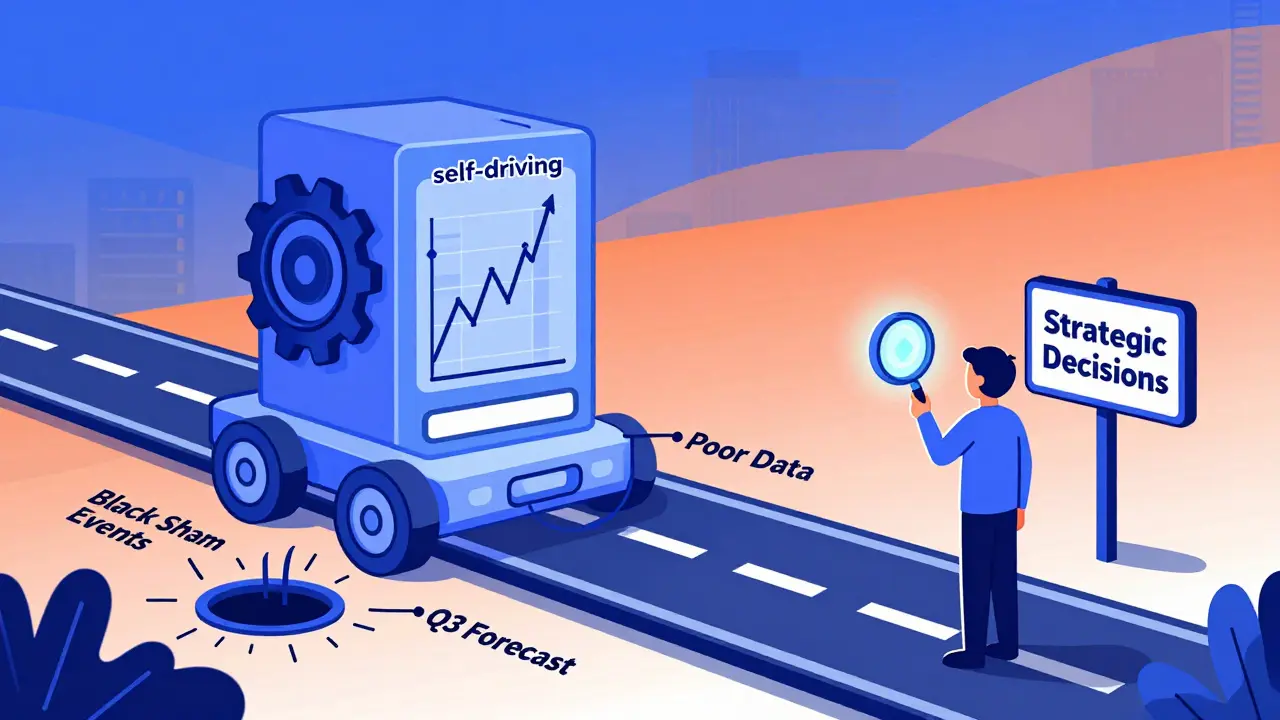
What’s Next? The Road to "Self-Driving Finance"
The next step isn’t just forecasting. It’s acting. Bain & Company predicts "self-driving finance" by 2027-systems that don’t just predict cash flow gaps, but automatically adjust payment schedules, trigger procurement orders, or even pause non-essential spending when thresholds are breached. Imagine this: Your AI notices inventory levels are too high and sales are slowing. Instead of waiting for a manager to approve a discount, it automatically sends a targeted promo to high-value customers and adjusts the next supplier order. All without human input. That’s not sci-fi. It’s already being tested. An Asian financial institution piloted a "prompt-to-report" system where analysts typed, "Show me the impact of a 10% salary increase across all departments," and got a full report with charts, commentary, and recommendations in under 30 seconds. Regulators are catching up too. The SEC now requires companies to disclose how they use AI in financial reporting. The IFRS Foundation will release formal guidance on AI-generated forecasts in Q1 2025. That means transparency isn’t optional anymore.How to Start Using Generative AI in Your Finance Team
You don’t need to overhaul everything. Start small.- Pick one use case: Start with cash flow forecasting. It’s data-rich, high-impact, and easy to measure.
- Check your data: Clean up vendor names, fix duplicate entries, make sure all transactions are coded correctly. If your data’s messy, the AI won’t help.
- Choose a tool: If you use SAP, try Joule. If you’re on NetSuite or QuickBooks, test Datarails. Look for tools that explain their outputs, not just give numbers.
- Pilot for 60 days: Run the AI alongside your current process. Compare results. See where it saves time.
- Measure success: Track: percentage reduction in forecast variance, hours saved per cycle, and stakeholder satisfaction scores.
Final Thought: It’s Not About Replacing People
Generative AI doesn’t make finance roles obsolete. It makes them more valuable. Instead of spending days on data entry, you’re now advising the CEO on whether to expand into a new market. Instead of explaining why a number missed, you’re asking, "What’s the next move?" IBM research shows 82% of finance leaders believe generative AI frees them up for strategic work. That’s not hype. That’s the reality teams are living right now. The question isn’t whether you should use AI. It’s whether you want to be the team that’s still stuck in Excel while everyone else is running the business.Can generative AI replace finance professionals?
No. Generative AI automates repetitive tasks like data gathering, report drafting, and variance explanations-but it doesn’t replace judgment. Finance professionals still interpret results, assess risk, and make strategic decisions. AI is a tool that lets them focus on higher-value work, like advising leadership or identifying growth opportunities.
Do I need to be tech-savvy to use AI tools in finance?
No. Most enterprise tools like Datarails, SAP Joule, and DataRobot are designed for finance teams, not IT. They offer no-code interfaces, drag-and-drop data connectors, and plain-language outputs. Analysts typically need 2-4 weeks of training to use them effectively. The real requirement is financial literacy, not coding skills.
How accurate are AI-generated forecasts compared to traditional methods?
AI-driven forecasts are 25% more accurate on average, according to the 2024 FP&A Trends survey. Organizations using AI also see 57% fewer sales forecast errors, per IBM research. This comes from analyzing more data sources-including external signals like market trends and weather-and running thousands of scenarios quickly, something manual models can’t match.
What are the biggest risks of using generative AI in finance?
The biggest risks are poor data quality, lack of governance, and over-reliance on AI without human review. If your historical data is incomplete or inconsistent, the AI will produce flawed forecasts. Without clear rules on who approves AI outputs, teams can end up with conflicting models. And during extreme market events-like pandemics or wars-AI may not have enough context to make reliable predictions. Always treat AI as a decision-support tool, not a replacement for judgment.
Is generative AI only for big companies?
No. While 62% of Fortune 500 companies use AI in FP&A, cloud-based platforms like Datarails now offer affordable plans for mid-market and even small businesses. Startups and regional firms with 5-10 finance staff can begin with as little as $10,000 per year. The key is starting small-focus on one high-impact use case like cash flow forecasting before scaling.
How long does it take to implement generative AI in finance?
Most organizations run a pilot for 3-6 months before full rollout. The initial setup-connecting to ERP systems, cleaning data, and training users-usually takes 4-8 weeks. Teams using cloud-based tools with pre-built connectors can see results in under 60 days. Full enterprise deployment, including governance and integration across departments, typically takes 6-9 months.
Will AI-generated forecasts pass an audit?
Yes-if you document how the AI works. The SEC and IFRS Foundation now require transparency in AI use for financial reporting. Tools that provide audit trails, show which data points influenced each forecast, and allow users to trace outputs back to source data are audit-ready. Avoid "black box" systems that can’t explain their reasoning. Always pair AI with human oversight and clear documentation.
 Artificial Intelligence



Shivam Mogha
December 19, 2025 AT 11:21This is huge. I used to spend weekends fixing Excel errors. Now my team gets forecasts done in two days. AI doesn't replace us-it just lets us stop being data clerks.
mani kandan
December 19, 2025 AT 18:30It’s like watching a symphony where the orchestra finally stopped playing off-key. Generative AI doesn’t just automate-it *elevates*. Suddenly, finance isn’t about midnight spreadsheets and panic emails. It’s about strategy, insight, and telling stories that actually move the needle. The real magic? When the AI says, ‘Your cash flow dips in August but recovers by October,’ and you finally have time to ask, ‘Why not invest that gap?’
Rahul Borole
December 19, 2025 AT 21:39Adoption of generative AI in financial planning and analysis represents a paradigm shift of unprecedented magnitude. Organizations that fail to integrate these technologies risk obsolescence. The 25% improvement in forecasting accuracy is not merely incremental-it is transformational. Furthermore, the reduction in report-writing time by 70% directly correlates with enhanced operational efficiency and strategic agility. It is imperative that finance leaders prioritize implementation with rigorous governance frameworks to ensure compliance, auditability, and data integrity.
Sheetal Srivastava
December 20, 2025 AT 01:18Let’s be honest-this isn’t AI. It’s just fancy pattern recognition dressed up in buzzwords. You’re still feeding it garbage data and calling it ‘retrieval-augmented generation.’ And don’t get me started on how these tools are just glorified autocomplete for CFOs who can’t think for themselves. The real risk? We’re outsourcing judgment to algorithms trained on biased, incomplete datasets. And now regulators are going to audit us for *how* the AI lied? Please. This is just corporate theater.
Bhavishya Kumar
December 20, 2025 AT 17:11There are several grammatical inconsistencies in the original post. For instance, the phrase 'no one read' should be 'no one reads' for consistency in tense. Also, 'ERP system has messy entries' lacks subject-verb agreement-it should be 'ERP systems have messy entries.' Furthermore, the use of em dashes without proper spacing reduces readability. These details matter, especially in a professional context where precision is non-negotiable.
ujjwal fouzdar
December 22, 2025 AT 16:52Think about it-finance used to be the cathedral of spreadsheets, where numbers were prayers and variance reports were sermons. Now we’ve handed the pulpit to a machine that speaks in plain English. Is this progress? Or are we just replacing human doubt with algorithmic certainty? The AI doesn’t feel the weight of a missed budget. It doesn’t lose sleep over a supplier going under. But we do. So maybe the real question isn’t how smart the AI is-but how much of our soul we’re willing to trade for speed.
Eka Prabha
December 23, 2025 AT 12:53They say AI reduces errors-but what if the AI is trained on data from companies that cooked their books? What if the system learns to normalize fraud? And who’s auditing the auditors? I’ve seen this before-automation leads to complacency, then catastrophe. Remember the 2008 crisis? No one questioned the models. Now we’re doing it again, but with more PowerPoint slides and less accountability. This isn’t innovation. It’s institutionalized denial.
Bharat Patel
December 24, 2025 AT 15:58There’s something beautiful about this shift. Finance used to be about control-locking numbers in cages, making them behave. Now it’s about conversation. The AI doesn’t boss you around-it listens, learns, and talks back. And for the first time, the numbers don’t just sit there. They tell you a story. Maybe that’s the real win-not efficiency, but connection. We’re not losing our jobs. We’re becoming storytellers again.
Bhagyashri Zokarkar
December 25, 2025 AT 13:17ok so i tried datarails and honestly its kinda meh? like the ai wrote this whole thing about why cashflow dropped but it missed that the ceo took a 3 week vacation and no one approved the vendor payments?? like how does it not know that?? and the summaries are way too long i just want to know if im gonna have enough to pay rent next month not a novel. also why does it keep saying ‘the system detected a potential anomaly’ like its a spy movie?? just tell me if its bad or good please
Rakesh Dorwal
December 26, 2025 AT 09:54India’s finance teams are leading this revolution. While the West is still arguing about ethics, we’re deploying AI to cut costs, boost efficiency, and reclaim time. This isn’t just tech-it’s national progress. Why are we letting foreign tools like SAP and Oracle dictate our future? We need homegrown AI solutions built for Indian markets, Indian data, Indian chaos. Stop importing solutions. Build our own. Our finance teams deserve better than foreign algorithms trying to understand our GST filings.