
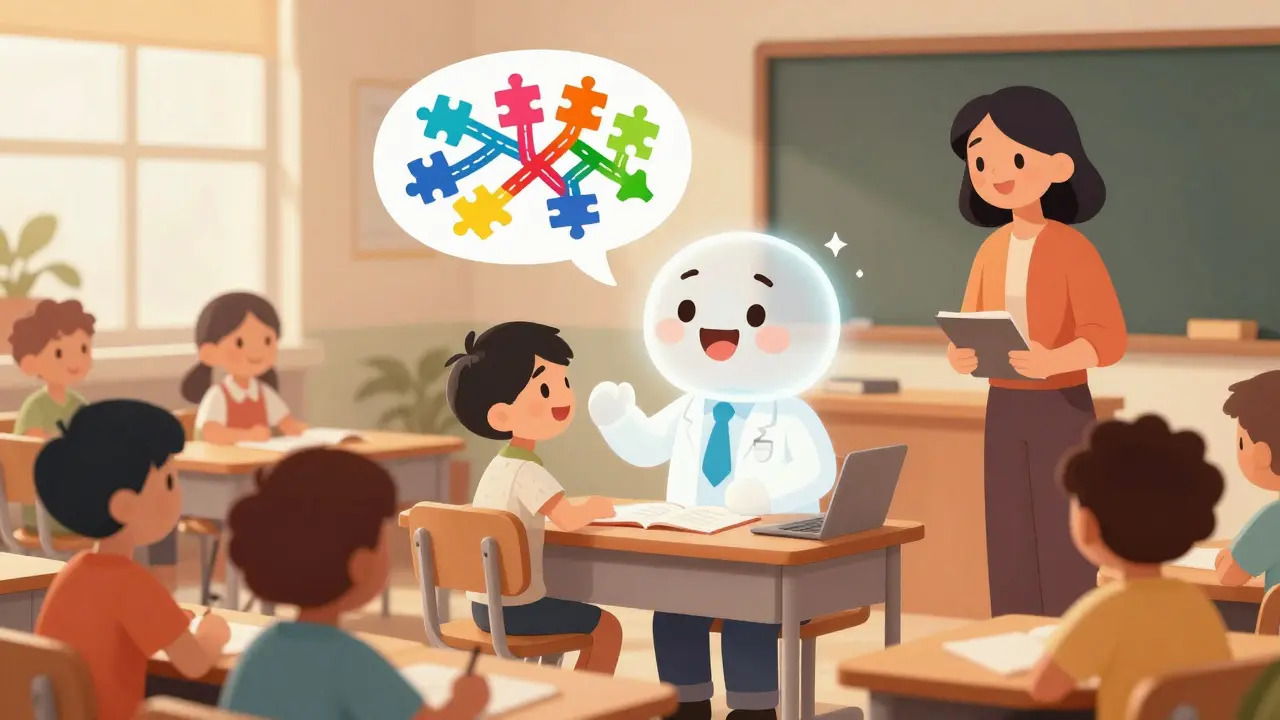
Imagine a classroom where every student gets a tutor who knows exactly what they’re struggling with-and can explain it in a way that clicks for them. No waiting in line. No rushed explanations. No one falling behind because the lesson moved too fast. This isn’t a fantasy. It’s happening right now, thanks to large language models in education.
Back in 2022, when GPT-3.5 first showed up, most people thought of it as a fancy chatbot. But teachers? They saw something else. A way to finally solve the oldest problem in education: how do you teach 30 different kids at once, when each one learns differently? Now, in early 2026, over 42% of U.S. K-12 schools are using AI tutors powered by LLMs. And the results are changing how learning works.
What Exactly Is a Personalized Learning Path?
A personalized learning path isn’t just a fancy playlist of videos. It’s a dynamic, real-time road map that changes as the student moves. One kid might need help breaking down algebra word problems. Another might be stuck on why photosynthesis matters in biology. A third might be a non-native English speaker who needs simpler language and visual cues. Traditional teaching tries to hit all of them at once-and usually misses.
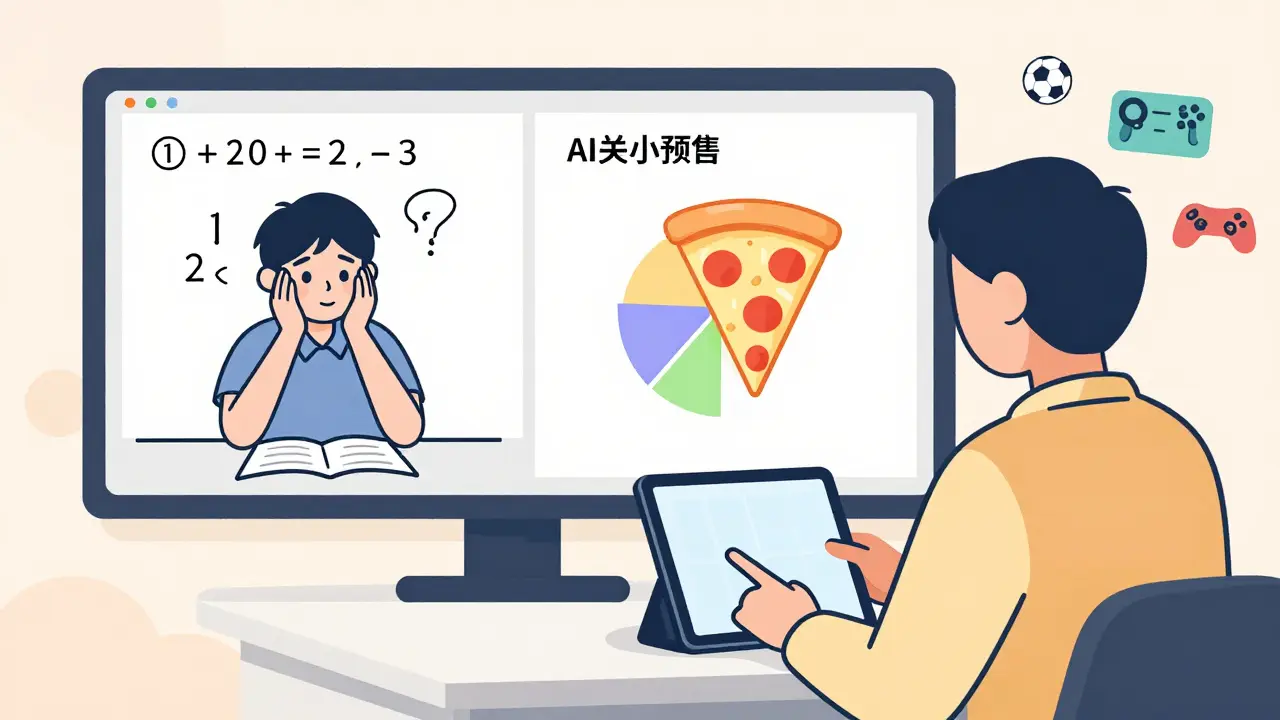
LLMs change that. They watch what you type, how long you pause, which questions you get wrong, and even how you react to feedback. Then they adjust. If you keep missing questions about fractions, the system doesn’t just repeat the same lesson. It tries a different explanation. Maybe it uses pizza slices instead of number lines. Maybe it asks you to draw it. Maybe it connects it to something you care about-like video game scores or sports stats.
This isn’t guesswork. Systems like SchoolAI and NeuroBot TA use something called retrieval-augmented generation, or RAG. It means the AI doesn’t just pull answers from memory. It checks trusted sources-textbooks, lesson plans, peer-reviewed studies-before responding. That cuts down on fake answers from 91% to under 18%. That’s still not perfect, but it’s a massive leap.
How It Works in Real Classrooms
At Dartmouth’s medical school, Professor Thomas Thesen taught 190 students in a neuroscience course. With human tutors, that would’ve meant one tutor for every 10 students. But with NeuroBot TA? Every student got one-on-one help-24/7. The AI didn’t replace the professor. It handled the repetitive stuff: explaining neuron pathways, clarifying terminology, checking quiz answers. That freed Thesen to focus on deep discussions, critical thinking, and real-time feedback.
In a 7th-grade classroom in Denver, a teacher named Maria uses SchoolAI to help her dyslexic students. The AI takes dense textbook passages and rewrites them in plain language. It adds visuals. It reads them aloud. One student told her, “I finally understand what the chapter is saying.” That’s not just progress. That’s access.
And it’s not just for kids. In community colleges, LLM tutors help adult learners juggling jobs and families. They can ask questions at 10 p.m. and get an answer by 10:01. No waiting. No shame. No judgment.
The Numbers Don’t Lie
Here’s what the data shows:
- Students using LLM tutors are 1.5 times more likely to stay engaged than in traditional settings.
- Teachers report saving 2 to 3 hours per week on grading and lesson prep.
- Special education teachers say AI tools help them meet Universal Design for Learning standards 82% of the time.
- Accuracy for basic tasks like vocabulary or grammar? 85-95%.
- For complex math or science problems? Accuracy drops to 62-78%.
That last number is the problem. LLMs are great at patterns. They’re not great at true understanding. If you ask a medical AI about a rare disease, it might give you a perfectly worded, completely wrong answer. That’s called a hallucination. And it’s dangerous if students trust it blindly.
Where LLMs Fall Short
Here’s the truth: AI tutors are not human. And they never will be.
They can’t read a sigh. They can’t tell when a student is frustrated, anxious, or giving up. A human tutor notices a dropped head, a clenched fist, a quiet “I don’t get it.” An AI sees a wrong answer and says, “Let me try again.”
Studies show human tutors spot frustration 89% of the time. AI? Only 43%.
And then there’s bias. LLMs are trained on data from the internet. That means they’ve seen centuries of inequality. A 2025 MIT study found LLMs were 23% less accurate with non-native English speakers. Why? Because the training data didn’t include enough examples of how they think, speak, or ask questions.
And in labs? Forget it. You can’t simulate a chemistry experiment with text. A student needs to see the color change, smell the reaction, feel the heat. LLMs can describe it. They can’t replace it.
What Teachers Are Actually Doing
Successful schools aren’t replacing teachers. They’re upgrading them.
The best use of LLMs follows three steps:
- Start with admin work. Let the AI draft parent emails, organize gradebooks, or generate quiz questions. That saves hours.
- Use it for differentiation. Turn one worksheet into five versions-basic, standard, advanced, visual, audio. The AI does it in seconds.
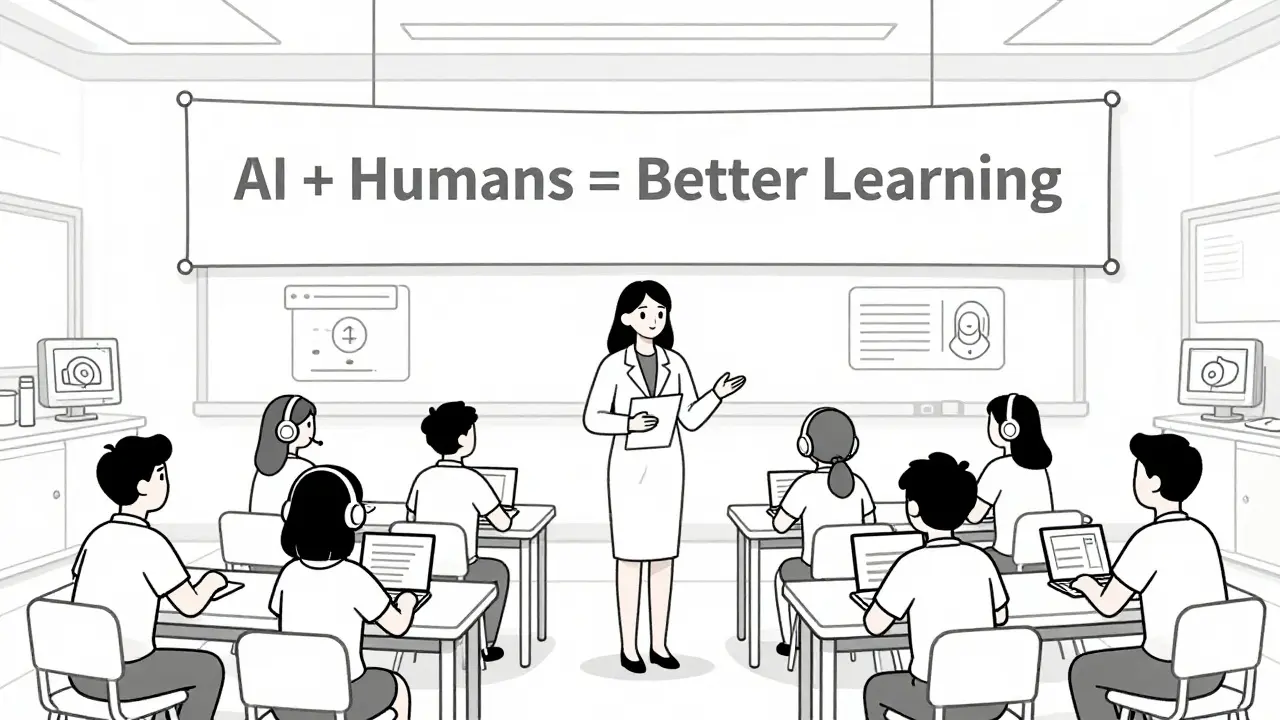
- Let it tutor-but supervise. Students can chat with the AI. But teachers check every answer. They teach students to question it. “Is this right? Where did it get this? Does it make sense?”
Teachers who do this report 70% improvement in student performance. But those who hand over control? They see chaos. Kids copy-paste answers. They stop thinking. They trust the machine too much.
What You Need to Make This Work
If you’re a teacher, parent, or student, here’s what actually matters:
- Verify everything. Never accept an AI answer without checking. Use textbooks, trusted websites, or ask a human.
- Learn basic prompt engineering. Instead of “Explain photosynthesis,” try “Explain photosynthesis like I’m a 12-year-old who loves soccer.”
- Use it for practice, not proof. AI is great for quizzes, flashcards, and rewriting notes. Not for essays, exams, or final projects.
- Watch for bias. If the AI keeps using examples that don’t match your culture, language, or experience-speak up.
Schools are now required to train teachers in AI literacy. In 28 U.S. states, you need 12 hours of certification just to use these tools. That’s not overkill. It’s essential.
The Future Isn’t Just AI-It’s AI + Humans
The global AI in education market hit $12.8 billion in 2025. It’s projected to hit $41.7 billion by 2028. That’s not hype. That’s demand.
But the best systems aren’t the ones that replace teachers. They’re the ones that make teachers better. The ones that give students access they never had before. The ones that help a kid in a crowded classroom finally feel seen.
LLMs won’t fix education. But they can help us fix the parts we’ve ignored for decades: access, equity, and individual attention. The goal isn’t to have robots teach. It’s to give every student a tutor who never sleeps, never gets tired, and never says, “I don’t have time.”
And that’s worth something.
Can large language models replace human teachers?
No. LLMs can’t replace human teachers. They lack emotional intelligence, can’t build trust, and don’t understand context beyond text. They’re tools-not replacements. The best classrooms use AI to handle repetitive tasks so teachers can focus on mentoring, critical thinking, and emotional support.
Are LLMs accurate enough for learning?
Accuracy depends on the task. For vocabulary, grammar, or basic facts, LLMs are 85-95% accurate. For complex math, science, or medical questions, accuracy drops to 62-78%. Some systems even hallucinate answers 79% of the time on advanced problems. That’s why verification is required. Students must learn to question the AI, not trust it blindly.
Do LLMs help students with learning disabilities?
Yes, and this is one of the biggest breakthroughs. Tools like SchoolAI can simplify text, read it aloud, add visuals, and rephrase concepts for students with dyslexia, ADHD, or language delays. Special education teachers report that 82% of AI users now meet Universal Design for Learning goals. For many students, this is the first time they’ve accessed grade-level material.
Is using AI in education safe for student privacy?
It depends on the platform. Reputable tools like SchoolAI and NeuroBot TA follow FERPA and COPPA regulations, use end-to-end encryption, and anonymize student data. But open-source or poorly designed systems may store personal info insecurely. Always check if the tool is certified under the 2024 National Education Data Privacy Standards.
What’s the biggest risk of using LLMs in schools?
The biggest risk is over-reliance. When students stop thinking and just copy AI answers, learning stops. The second biggest risk is bias. Training data often reflects societal inequalities, leading to lower accuracy for non-native speakers or minority groups. Without oversight, these tools can widen gaps instead of closing them.
 Artificial Intelligence
Rakesh Dorwal
February 15, 2026 AT 22:53Let me tell you something they don’t want you to know. These AI tutors? They’re not here to help kids. They’re a Trojan horse for Big Tech to collect every single thought, every wrong answer, every hesitation - and sell it to advertisers, governments, and private militias. I’ve seen the code leaks from Bangalore labs. The AI doesn’t just adapt to students - it profiles them. Who’s smart. Who’s slow. Who’s from a rural village. Who’s got parents who can’t read. This isn’t education. It’s surveillance with a smiley face.
And don’t get me started on how they’re rewriting history in the background. My nephew came home saying the British didn’t colonize India - they ‘shared knowledge.’ That’s not an error. That’s programming. Someone’s got a hidden agenda, and it ain’t pedagogy.
They say ‘verify everything.’ Yeah, right. How? With what? Textbooks printed by the same companies that built the AI? Wake up. This is digital colonialism dressed in rainbow emojis.
Vishal Gaur
February 17, 2026 AT 02:15man i just read this whole thing and honestly i think its kinda cool but also kinda scary like i work at a private school here in pune and we just got this ai tutor system and my kid who used to hate math now says ‘the bot gets me’ but like… i caught it giving him the wrong answer like 3 times about quadratic equations and he just copied it and got marked wrong in class and then he got mad at me for not helping him because ‘the ai said it was right’ so now i have to sit with him and reteach everything and its like 2am and i’m drinking cold chai and wondering if this is progress or just another way for tech bros to make money off our kids’ stress
also the voice feature reads out loud but with this weird robotic accent that makes my dyslexic daughter cry so now i have to manually rewrite every prompt to sound like a chill uncle and not a google translate ghost
Nikhil Gavhane
February 19, 2026 AT 00:42What struck me most about this article isn’t the tech - it’s the humanity behind it. That story about Maria in Denver helping her dyslexic students? That’s the real breakthrough. Not because the AI rewrote the text, but because it gave a child the quiet dignity of understanding something for the first time without shame. I’ve seen kids shut down in classrooms for years because they felt broken. This doesn’t fix everything - no, not even close - but it gives them a voice when they’ve been told they’re too slow, too different, too much.
And yes, the hallucinations are scary. The bias is real. But the alternative - leaving them behind - is worse. We don’t need to fear the tool. We need to learn how to hold it gently. Teachers aren’t being replaced. They’re being given back the time to do what they signed up for: to see a student, truly see them, and say, ‘I’m here with you.’
Rajat Patil
February 19, 2026 AT 20:58It is with great care that I respond to this matter. The introduction of large language models into educational environments presents both opportunity and responsibility. While the potential for personalized learning is significant, one must not overlook the foundational role of human interaction in the development of young minds.
It is my observation that when technology is introduced without adequate oversight, it may unintentionally diminish the critical thinking capacity of learners. The act of questioning, of doubting, of seeking clarification from a person - these are not inefficiencies. They are essential processes.
I encourage all stakeholders - educators, parents, policymakers - to proceed with patience, humility, and a deep respect for the complexity of human learning. The goal should not be efficiency. The goal should be wisdom.
deepak srinivasa
February 20, 2026 AT 18:31I’m curious - when the AI gives a wrong answer on a science problem, how do students learn to recognize it’s wrong? Is there a training module for that? Or do they just assume it’s right because it sounds confident?
Also, the stats say accuracy drops to 62-78% on complex math. That’s still better than some human tutors I’ve had. But if students don’t know how to cross-check, aren’t we just trading one kind of ignorance for another?
Has anyone studied how long it takes a student to develop critical evaluation skills when using AI tutors daily? Like, do they get better at spotting errors over time? Or do they just get more dependent?
pk Pk
February 22, 2026 AT 08:42Look, I’ve been teaching in public schools for 22 years. I’ve seen every trend come and go - smartboards, flipped classrooms, gamified learning. This one? It’s different. Not because it’s perfect - it’s not. But because it finally lets me reach the kids who were invisible before.
I have a student who speaks Tamil at home and struggles with English. Last year, she never spoke up. This year? She asks the AI questions every day. She’s learning. Not because I forced her. Because the AI didn’t judge her accent. Didn’t sigh when she repeated the question. Didn’t tell her she was ‘behind.’
Yes, we supervise. Yes, we teach them to question. Yes, we fix the bias. But don’t you dare tell me this isn’t equity. This isn’t access. This isn’t justice. This is the first time in my career I’ve seen a child feel like they belong in a classroom. And that’s worth every risk.