
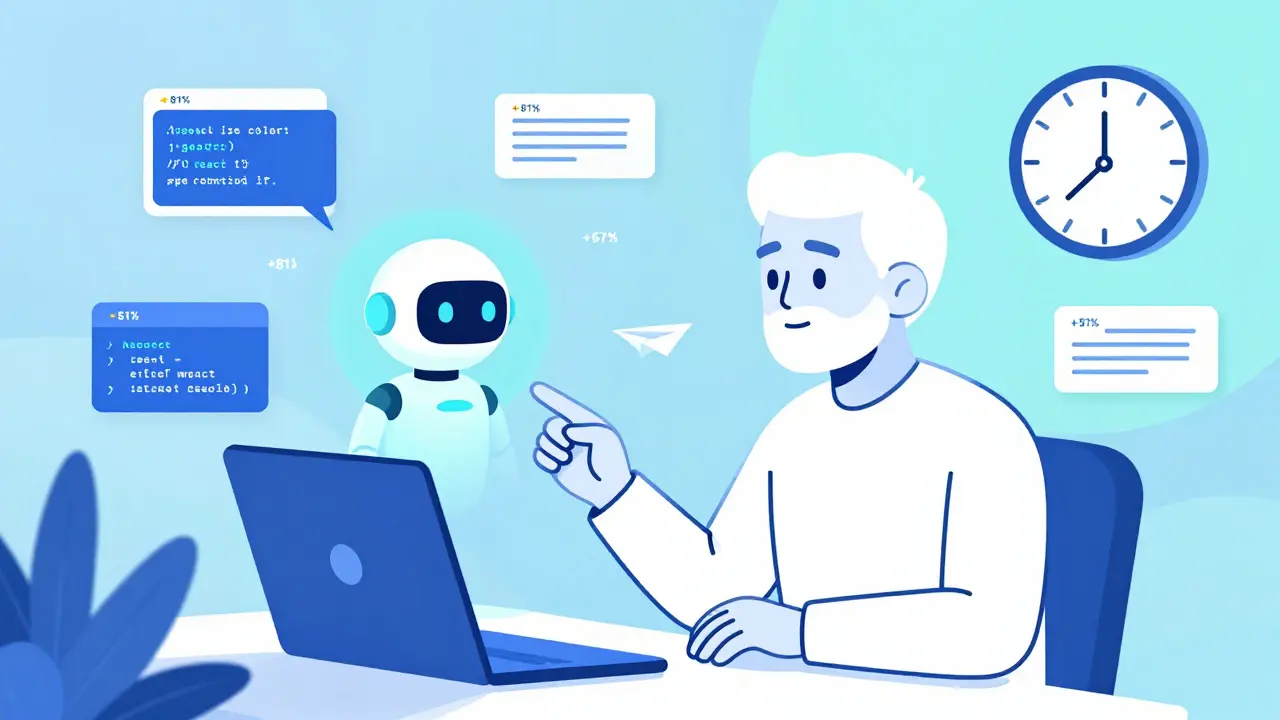
Most developers think AI coding tools just speed up typing. But if you’ve seen teams go from 3-day projects to 3-hour ones, you know it’s more than that. The numbers don’t lie: vibe coding is reshaping how software gets built. According to Second Talent’s January 2026 report, teams using AI-assisted workflows report up to 126% more weekly output. That’s not a fluke. It’s a structural shift. And it’s happening right now-in startups, enterprises, and even solo side projects.
What Vibe Coding Actually Is (And What It Isn’t)
Vibe coding isn’t just copying and pasting AI suggestions. It’s a workflow where you stay in control, but let AI handle the heavy lifting. Think of it like having a super-fast junior developer who never sleeps, knows every API, and writes clean boilerplate-but still needs you to double-check the logic. The term was coined by GitHub’s product team in late 2023 during Copilot Enterprise’s beta. It stuck because it describes the feeling: you’re not coding line by line. You’re guiding, reviewing, and shaping what the AI generates.
It’s not magic. You still need to know how to program. A junior dev using AI without understanding the code ends up with broken auth systems and security holes. But a senior engineer? They use AI to eliminate grunt work-like setting up database connections, writing CRUD endpoints, or building UI components-and focus on architecture, edge cases, and testing.
Where the 126% Gain Comes From
The 126% figure isn’t an average. It’s a peak. It’s what happens when you combine multiple high-impact use cases across a full week. Here’s how it breaks down:
- Boilerplate and config (81% faster): Setting up a new React project with TypeScript, Tailwind, and Vite used to take 2 hours. Now it takes 20 minutes. AI generates the entire folder structure, config files, and even test scaffolding.
- API integration (67% faster): Connecting to Stripe, Auth0, or a legacy SOAP service? AI writes the request handlers, error handling, and data mapping. You just validate the schema.
- UI components (51% faster): Building a modal, form, or data table? Describe it in plain English. AI spits out the JSX, CSS, and accessibility tags. You tweak the spacing.
- Business logic (34% faster): Writing a pricing calculator, inventory sync, or notification trigger? AI drafts the logic. You audit for edge cases.
Combine those gains over a week, and you’re not just doing more tasks-you’re doing more meaningful tasks. One developer at a SaaS startup told me they shipped a full feature set in 4 days that normally took 9. That’s not luck. That’s vibe coding in action.
The Tools That Make It Happen
You can’t vibe code without the right tools. Here’s what most teams use:
- GitHub Copilot: Used by 1.8 million developers. Integrates directly into VS Code, JetBrains IDEs, and even Neovim. Best for general-purpose coding and full-stack tasks.
- Cursor: Built from the ground up for AI-assisted development. Lets you chat with your codebase like a teammate. Popular among teams that build complex apps.
- Replit GhostWriter: Great for beginners and non-developers. Lets you build full apps from prompts without touching a terminal.
76% of developers stick with IDE-integrated tools. Why? Because switching contexts kills flow. You don’t want to copy-paste from a standalone app. You want suggestions as you type.
And the tools are getting smarter. GPT-5.2 and Claude Opus 4.5, released in January 2026, improved code quality by 18% over last year’s models. GitHub’s new Copilot Quality Dashboard even shows you a reliability score for each suggestion-before you accept it.
The Hidden Cost: Debugging and Technical Debt
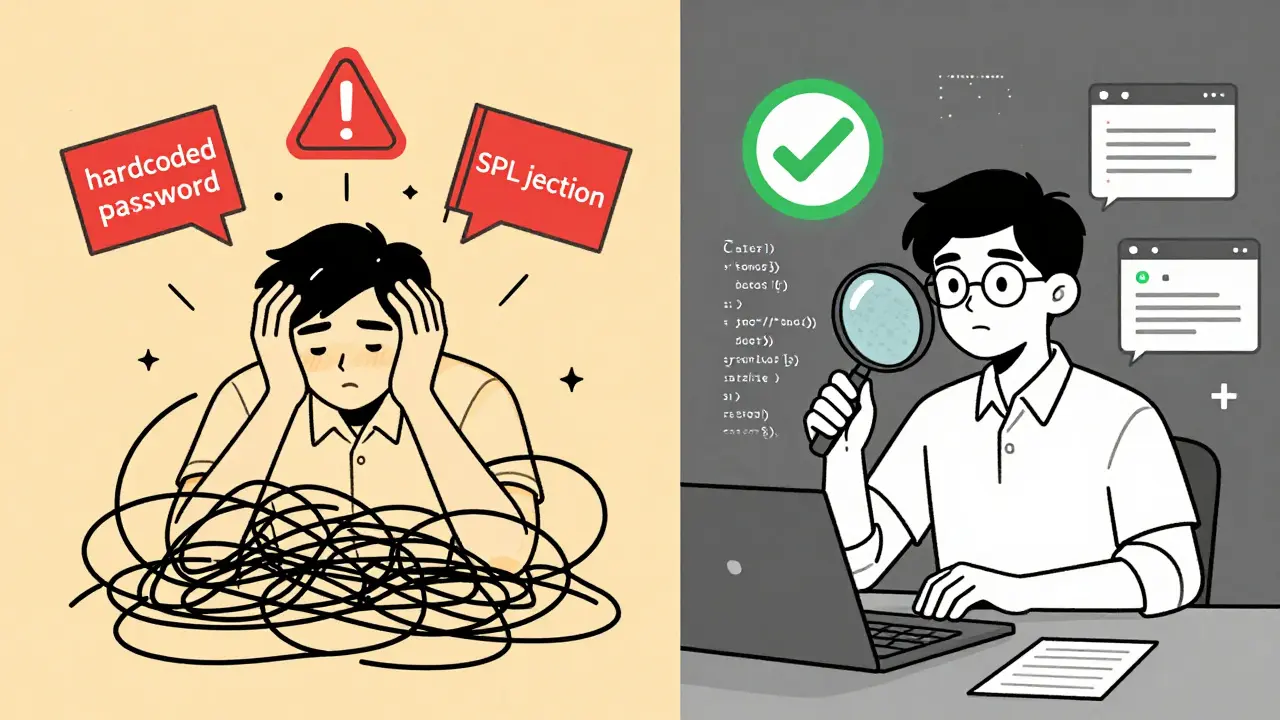
Here’s the catch: speed isn’t free. Microsoft’s Scott Hanselman said it best: “You can build 10x faster, but if you don’t review the code, you’re just building a house of cards.”
40% of junior developers admit they’ve deployed AI-generated code they didn’t fully understand. That’s how security flaws slip in. One Reddit user shared how Copilot generated an auth system with a hardcoded admin password. It took him three days to fix.
MIT’s Dr. Alan Chen found that unverified AI code increases technical debt by 37% on average. That means more bugs, longer reviews, and slower future changes. The “80/20 Rule” is real: AI gives you 80% of the app fast. The last 20%-error handling, logging, testing, scalability-is where humans still win.
The best teams don’t skip review. They build it in. Google’s internal data shows teams that add “AI code review gates” (static analysis + security scans + human sign-off) reduce rework by 37%. It adds 15-20% to initial time, but saves weeks later.
Who Benefits the Most?
Not everyone gains the same. Experience matters.
- Senior developers (10+ years): Report 81% productivity gains. They use AI to automate repetitive work so they can focus on system design and mentoring.
- Junior developers (0-3 years): See 40-50% faster task completion. But they’re also 3x more likely to introduce bugs. Training is critical.
- Non-developers: 63% of vibe coding users now aren’t professional coders. Designers, product managers, and data analysts are building internal tools using Replit and Cursor. That’s a massive shift.
Team size also changes the math. Small teams (2-5 people) report 68% faster delivery. Big teams (15+ people) only see 31%. Why? Coordination overhead. AI helps individuals, but doesn’t fix bad processes.
Why This Isn’t Just a Trend-It’s the New Normal
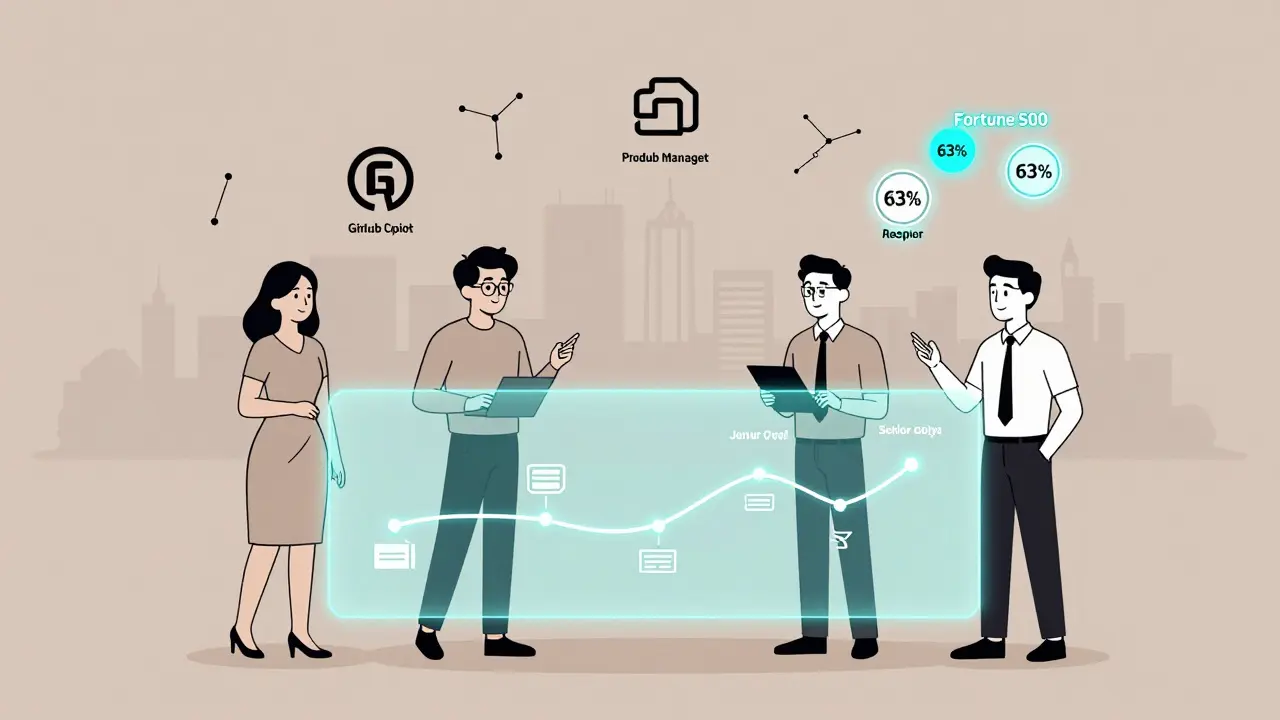
Fortune 500 companies went from 17% adoption in mid-2024 to 63% by Q4 2025. That’s not slow adoption. That’s a rush. Google and Microsoft now say 30% of new code is AI-generated. The Linux Foundation released the AI Code Provenance Standard 1.0 in December 2025 because companies needed to track where code came from-for compliance, security, and audits.
The market is exploding. GlobalData predicts the vibe coding tools industry will hit $4.2 billion by 2027. That’s up from $2.1 billion in 2025. And it’s not just about writing code anymore. It’s about rethinking the entire development lifecycle.
How to Start Without Losing Control
If you’re thinking about trying vibe coding, here’s how to do it right:
- Start small: Use AI for UI components or config files first. Not security-critical code.
- Learn to critique: Don’t accept the first suggestion. Ask: “Does this match our patterns? Is this secure? Is it testable?”
- Set up review gates: Even if you’re solo, run AI-generated code through a linter and a security scanner before committing.
- Track your time: Compare how long tasks take before and after. Don’t trust hype-trust your data.
- Train your team: If you’re a lead, run a 30-minute workshop. Show examples of good and bad AI-generated code.
Don’t try to replace yourself. Use AI to replace the boring parts. That’s how you get 126% gains without burning out.
What Comes Next
Vibe coding is evolving into something bigger: AI-native engineering. That means AI won’t just help you write code-it’ll help you plan, test, deploy, and monitor. GitHub’s new dashboard is just the start. Soon, AI will predict which features will fail in production before you even write them.
But the core truth stays the same: AI is a tool. Not a replacement. The best developers aren’t the ones who use AI the most. They’re the ones who use it the smartest.
Is vibe coding the same as using ChatGPT for code?
No. ChatGPT is a general-purpose chatbot. Vibe coding uses AI tools built into your IDE that understand your codebase, file structure, and project context. GitHub Copilot, for example, sees your entire project and suggests code that matches your style, not just generic answers.
Does vibe coding make developers obsolete?
Not at all. It makes junior developers more productive and frees up seniors to focus on architecture, security, and complex problem-solving. The most successful teams are the ones where humans are still in charge-just with a supercharged assistant.
Can I use vibe coding if I’m a beginner?
Yes, but be careful. AI can write code you don’t understand, which leads to bugs and security issues. Start by using it for simple tasks like generating HTML forms or basic functions. Always read the code before accepting it. Pair it with tutorials or documentation.
Is vibe coding secure?
It’s only as secure as your review process. AI can generate code with hardcoded passwords, SQL injection flaws, or insecure APIs. Never trust AI-generated code without scanning it. Use tools like Snyk, CodeQL, or GitHub’s own security alerts. The Linux Foundation’s AI Code Provenance Standard helps track where code came from, which is critical for enterprise use.
What’s the biggest mistake people make with vibe coding?
Accepting AI suggestions without understanding them. The biggest productivity gains come from speed-but the biggest risks come from overconfidence. The most successful developers treat AI like a smart intern: they ask questions, check the work, and never hand over final approval.
 Artificial Intelligence



John Fox
January 28, 2026 AT 08:39you think you're saving time but then you spend 3 days debugging code you didn't write
Tasha Hernandez
January 30, 2026 AT 01:30let me guess next you'll say your toaster is now sentient and it makes better toast than you
40% of juniors deploy code they don't understand and you call that progress? lol
Anuj Kumar
January 30, 2026 AT 23:36they want us to forget how to code so we cant fix the system when it breaks
ai generated code has backdoors built in i know it
Christina Morgan
February 1, 2026 AT 15:27but the review gates? non-negotiable. i run every ai suggestion through our linter and a quick security scan before commit
it adds minutes, not hours, and prevents so much pain later
Kathy Yip
February 1, 2026 AT 21:31like when it keeps generating overly complex solutions for simple problems
and i keep forgetting to check if the auth flow actually works
oops
Bridget Kutsche
February 2, 2026 AT 07:53i use it for UI components and config files first, then slowly moved to business logic
the key is reading every line before accepting it
and yes, i still write tests. always. ai doesn’t replace understanding, it replaces repetition
Jack Gifford
February 3, 2026 AT 14:20and yes, i still review everything. but now i have time to actually think about scalability, not just get the form to submit