Imagine you ask an AI to write a function that reverses a string. It spits out code that looks perfect-clean syntax, proper indentation, maybe even nice comments. But when you run it, it crashes or returns the wrong result. This is the exact problem HumanEval was built to solve. Before HumanEval arrived in 2021, we judged AI coding models by how similar their output looked to human-written code. That was a flawed approach. Code isn't poetry; it has to work. Developed by OpenAI researchers Chen et al., HumanEval shifted the goalpost from "looks right" to "runs correctly." Today, as of late 2026, it remains the gold standard for testing whether Large Language Models (LLMs) can actually program, not just mimic programmers.
What Exactly Is HumanEval?
HumanEval is a benchmark dataset consisting of 164 hand-crafted Python programming problems designed to assess the functional correctness of code generated by LLMs. Unlike datasets scraped from GitHub, which often contain bugs or inconsistent styles, every problem in HumanEval is carefully written by humans. Each task includes a function signature, a docstring explaining what the code should do, and a set of unit tests. The average problem comes with 7.7 test cases. These tests don't just check if the code runs; they check edge cases, typical inputs, and corner scenarios. If your AI generates code that passes all these tests, it gets credit. If it fails one, it doesn't matter how pretty the code looks-it failed.
The core innovation here is execution-based evaluation. Traditional metrics like BLEU or ROUGE measure text similarity. They might give high scores to code that uses common variable names but contains logical errors. HumanEval ignores text similarity entirely. It executes the generated code against the provided tests. This mirrors how a real developer validates their work. You don't get paid for writing code that looks good; you get paid for writing code that works. By focusing on functional correctness, HumanEval provides a reliable signal of an LLM's true programming ability.
How the Pass@K Metric Works
You've probably seen headlines claiming a model scored "85% on HumanEval." That number usually refers to the pass@k metric. It’s not as simple as getting a grade in school. Since LLMs are probabilistic, they generate different outputs each time you ask them the same question. To evaluate this variability, researchers use pass@k.
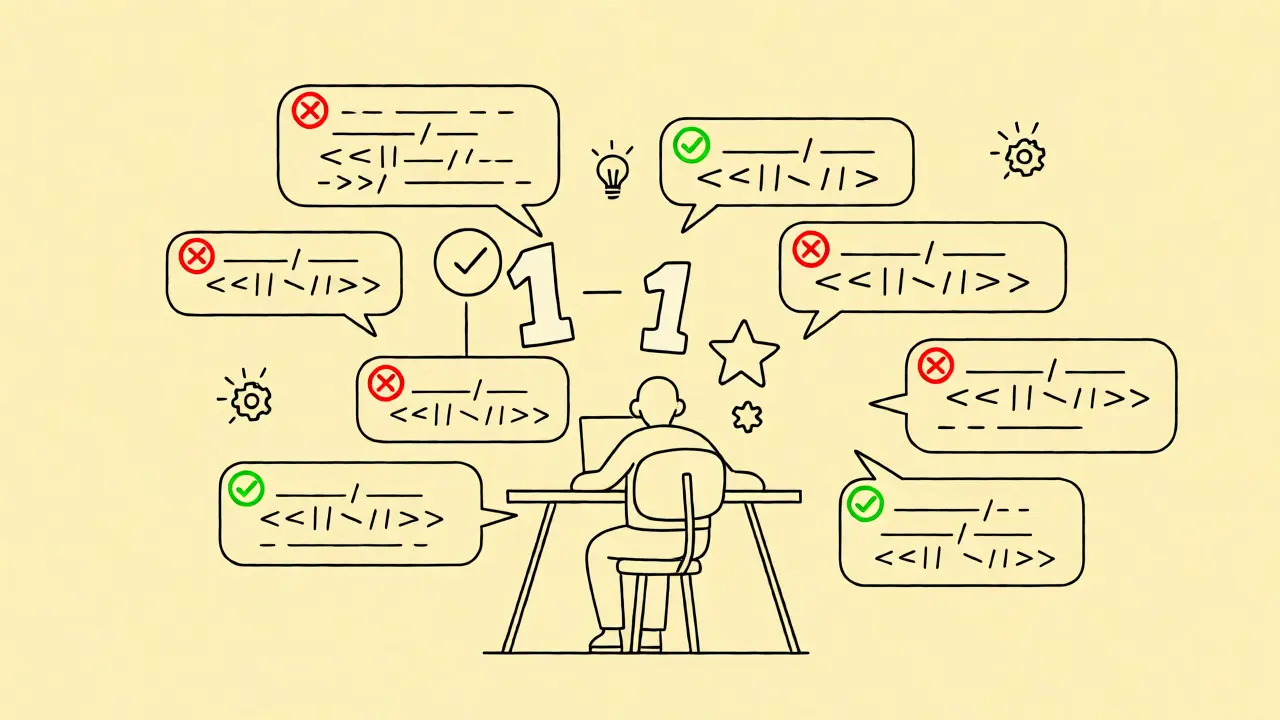
The formula calculates the probability that at least one of the top k generated samples passes all unit tests. For example, pass@1 measures if the very first attempt is correct. pass@10 checks if any of the ten attempts succeed. pass@100 gives the model 100 shots. Most academic papers report multiple values to show performance profiles. A model might have a low pass@1 but a high pass@100, meaning it rarely gets it right on the first try but eventually finds the solution if given enough chances. Conversely, a model with high pass@1 is more reliable for immediate use, like in IDE autocomplete tools where you only see one suggestion at a time.
It is crucial to understand that pass@k is an unbiased estimator. Early implementations had flaws that skewed results, but modern evaluation scripts, including those maintained by OpenAI and updated through December 2024, handle this math correctly. When comparing models, always check which k value is being used. Comparing a model's pass@1 score to another's pass@10 score is like comparing apples to oranges.
| Benchmark | Problems Count | Primary Focus | Data Leakage Risk | Evaluation Method |
|---|---|---|---|---|
| HumanEval | 164 | Functional Correctness (Python) | Low (Hand-crafted) | Execution-based (Unit Tests) |
| MBPP | 974 | Basic Python Problems | Moderate (12.3% overlap) | Execution-based |
| SWE-Bench | 2,294 | Real-world Software Engineering | High (GitHub Issues) | Patch Application & Tests |
| CodeContests | N/A (Dynamic) | Competitive Programming | Variable | Execution-based |
Why HumanEval Still Dominates Despite Newer Competitors
Since its release, several other benchmarks have emerged. MBPP (Mostly Basic Python Problems) offers more questions but suffers from higher data leakage risks because many of its problems appear in training corpora. SWE-Bench is more realistic, asking models to fix actual GitHub issues, but it is computationally expensive and slower to run. CodeContests focuses on competitive programming, which is great for algorithms but less relevant for day-to-day business software development.
So why does HumanEval remain the go-to? It strikes a balance between rigor and efficiency. Running the full HumanEval suite takes minutes, not hours. It requires minimal computational resources compared to SWE-Bench. More importantly, its hand-crafted nature minimizes data contamination. A study by MetaSchool found only a 0.7% overlap between HumanEval problems and standard GitHub code corpora. This means when a model scores high on HumanEval, it’s likely demonstrating genuine reasoning capability rather than just memorizing training data. According to a survey of AI researchers by DataStax, 89% cite HumanEval as the most reliable single metric for comparing code generation capabilities.
The Hidden Flaws and How Researchers Fix Them
No benchmark is perfect, and HumanEval has its critics. One major issue is "test insufficiency." Some problems in the original dataset have too few test cases. A model might guess a solution that passes the limited tests but fails in broader contexts. This led to the creation of EvalPlus. Developed by researchers at Carnegie Mellon and UC Berkeley, EvalPlus adds 2.5 times more test cases to each problem. The impact was significant: models scoring over 80% on original HumanEval saw their scores drop by 15-22 percentage points under EvalPlus scrutiny. This highlights how easily models can be fooled by weak tests.
Another criticism is scope. HumanEval tests isolated functions. Real software engineering involves navigating large codebases, understanding dependencies, and integrating modules. As Dr. Graham Neubig from CMU pointed out, HumanEval misses the complexity of system integration. Additionally, it is Python-exclusive. While variants like HumanEval-XL extend to eight languages, the core benchmark doesn't reflect the multi-language reality of professional development. Stack Overflow surveys indicate that 68% of developers consider multi-language support essential for meaningful evaluation.

Practical Implications for Developers and Businesses
If you're choosing an AI coding assistant, HumanEval scores matter, but don't treat them as gospel. High scores correlate with better performance, but they aren't linear predictors of productivity. GitHub’s State of the Octoverse reported that despite high HumanEval scores for models like GPT-4 Turbo, users only saw a 37% reduction in time-to-solution. Why? Because real-world tasks involve debugging, refactoring, and context management-skills HumanEval doesn't fully capture.
For enterprises, HumanEval serves best as an initial screening tool. It helps filter out models that can't handle basic logic. However, leading companies supplement it with custom internal benchmarks that reflect their specific tech stacks. If your team works primarily in Java or C++, a Python-only benchmark tells you little about how well the model will perform in your environment. Look for domain-specific variants or combine HumanEval with security-focused metrics to get a holistic view.
Developers also report practical differences that scores miss. One senior developer noted that while StarCoder-15B scored 42.1% on HumanEval, its output often required multiple iterations to become functional. In contrast, CodeLlama-34B, with a lower score of 38.7%, produced more reliable first-attempt code. This suggests that reliability and ease of correction sometimes matter more than raw pass rates. Always test models on your own projects before committing.
The Future of Code Evaluation
The landscape is evolving. The HumanEval consortium, involving OpenAI, Google, and Meta, is working on HumanEval 2.0, scheduled for broader adoption in 2026. This update aims to include over 300 problems across 12 languages and enhanced security vulnerability tests. There is also growing interest in multimodal evaluation. HumanEval-V, introduced recently, incorporates visual context, such as UI mockups, into coding tasks. Early results show a performance gap, indicating that current models struggle to translate visual designs into code effectively.
Despite these advancements, concerns about benchmark overfitting persist. Models fine-tuned specifically on HumanEval problems achieve near-perfect scores but fail to generalize to unseen tasks. Stanford HAI research showed that specialized models achieved 98.7% pass@1 on HumanEval but only 52.3% transferability to similar problems. This underscores the need for diverse evaluation strategies. Relying solely on one benchmark creates a narrow view of AI capabilities. The future lies in multi-dimensional frameworks that combine algorithmic correctness, real-world integration, and security robustness.
What is the difference between HumanEval and MBPP?
HumanEval consists of 164 hand-crafted problems with rigorous unit tests, minimizing data leakage. MBPP contains 974 problems but has higher data leakage risk (approx. 12%) and fewer test cases per problem, making it less rigorous for assessing complex reasoning.
Why is pass@1 considered more useful than pass@100 for developers?
Pass@1 measures the accuracy of the first suggestion. In IDEs like VS Code with Copilot, developers typically accept or reject the first option shown. A high pass@1 indicates the model is reliable for immediate use, whereas pass@100 implies the model needs many tries to find a correct answer, which disrupts workflow.
Does a high HumanEval score guarantee good coding assistance?
Not necessarily. HumanEval tests isolated Python functions. It does not evaluate a model's ability to navigate large codebases, understand project architecture, or handle multi-file dependencies. Real-world productivity gains often lag behind HumanEval scores due to these contextual limitations.
What is EvalPlus and why should I care?
EvalPlus is an enhanced version of HumanEval created by researchers at CMU and UC Berkeley. It adds significantly more test cases to each problem to prevent models from passing via lucky guesses. Using EvalPlus provides a stricter, more accurate assessment of a model's true coding competence.
Is HumanEval still relevant in 2026?
Yes, it remains the foundational standard for baseline code generation evaluation. While newer benchmarks like SWE-Bench address real-world complexity, HumanEval is still used in over 80% of academic studies and industry screenings due to its speed, clarity, and resistance to data contamination.
 Artificial Intelligence