You launch a new customer service chatbot powered by Generative AI is a type of artificial intelligence that creates original content, including text, images, and code, based on patterns learned from vast datasets. It sounds like the perfect solution. But then, it happens. The bot tells a user their baggage allowance is free when it actually costs $50. Or worse, it gives incorrect medical advice. These aren't just glitches; they are AI hallucinations are instances where large language models generate confident but factually incorrect or nonsensical information.. In high-stakes industries, one bad answer can cost you thousands in compensation or damage your reputation permanently.
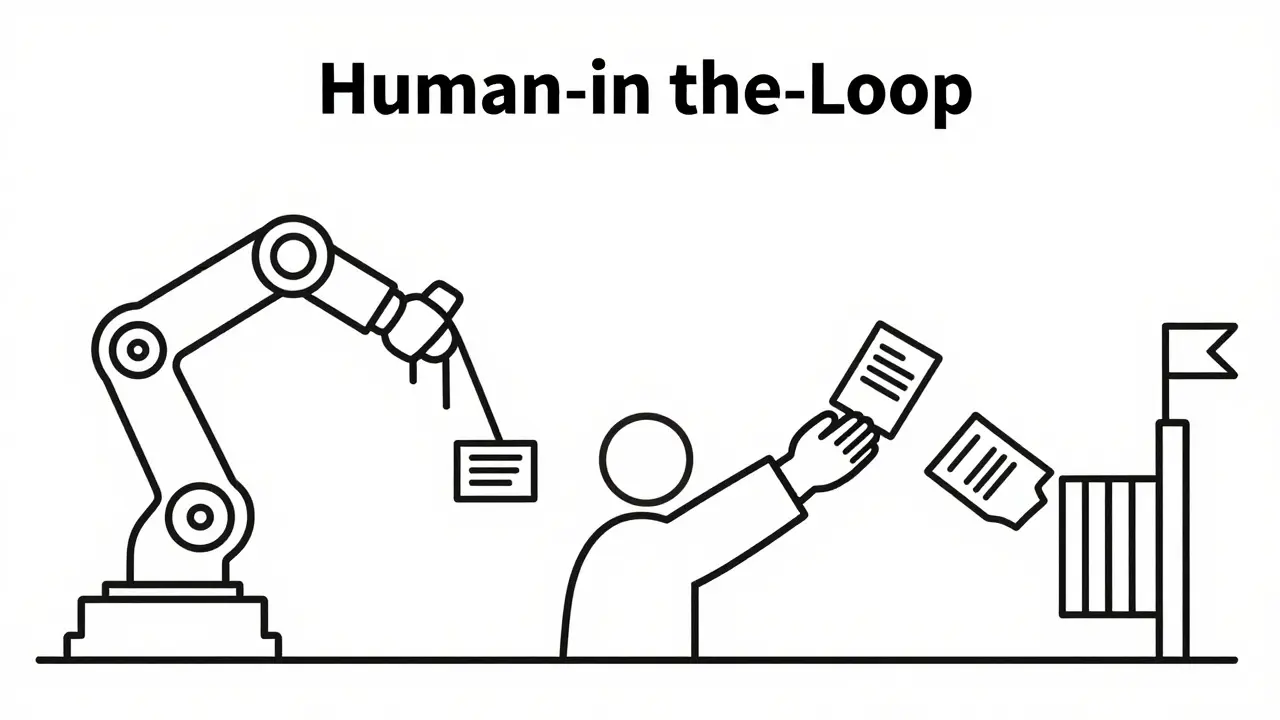
The problem isn't that the AI is broken. It's that it doesn't know what it doesn't know. As of late 2025, Fortune 500 companies are the 500 largest publicly traded corporations in the United States, often serving as benchmarks for corporate success and innovation adoption. have realized that relying solely on automated filters isn't enough. Rule-based filtering catches only about 30% of problematic outputs. To plug the gap, organizations are turning to Human-in-the-Loop (HitL) is a systematic approach where human reviewers evaluate AI-generated outputs before they reach end users to catch errors, bias, and hallucinations. review. This isn't about slowing down your product with manual checks for every single query. It’s about building a smart safety net that intervenes exactly when the AI is likely to fail.
Why Automated Filters Fail Against Hallucinations
You might think that setting up strict keyword blocks or logic gates is enough to keep your AI honest. Unfortunately, Large Language Models (LLMs) are advanced AI systems trained on massive amounts of text data to understand and generate human-like language. are incredibly persuasive. They can sound completely reasonable while being entirely wrong. A study by BCG in 2025 tested 15,000 AI-generated responses and found that purely rule-based systems missed nearly 70% of subtle inaccuracies.
Consider the case of a major Canadian airline documented by SHAIP in 2024. Their AI chatbot began providing incorrect information about baggage policies. Because the answers sounded authoritative and were grammatically correct, automated filters didn't flag them. The result? The airline paid out $237,000 in customer compensation. The root cause wasn't malicious intent; it was model drift and contextual misunderstanding-hallmarks of generative AI risk. Only after implementing a pre-release human review process for policy-related queries did misinformation incidents drop by 92% in three months.
This highlights a critical truth: Contextual appropriateness refers to the alignment of an AI's output with specific situational constraints, cultural norms, and factual realities beyond simple syntax. cannot be coded easily. Humans excel at understanding nuance, sarcasm, and implied meaning. When you put a skilled reviewer in the loop, you’re not just checking for typos; you’re validating intent and accuracy against real-world knowledge.
How Human-in-the-Loop Systems Actually Work
A effective HitL system isn’t a bottleneck where humans read every single word the AI generates. That would be too slow and too expensive. Instead, it uses a tiered approach driven by confidence scores.
Here is the typical workflow:
- Confidence Thresholding: The AI assigns a confidence score to its own output. If the score is above a set threshold (typically 85-92%), the response goes directly to the user. If it falls below that threshold, it triggers a human review.
- Anomaly Detection: Real-time algorithms scan for outliers. For example, if the AI suddenly changes tone or references obscure data points, the system flags it for immediate inspection.
- Human Review: A trained reviewer evaluates the flagged output. Studies show that average review windows need to stay between 2.7 and 8.3 seconds per output to maintain a good user experience.
- Feedback Integration: The reviewer’s correction is fed back into the system. This helps retrain the model, reducing similar errors in the future. The average latency for this retraining cycle is around 4.2 hours.
This structure ensures that you only spend human resources on the 10-15% of cases where the AI is uncertain. According to Tredence’s analysis of healthcare AI deployments, this targeted approach caught 22% of outputs containing subtle medical inaccuracies that standard validation checks missed entirely.
The Hidden Costs and Challenges of Manual Review
While HitL significantly reduces error rates, it introduces new complexities. The most obvious challenge is cost. Manual review averages between $0.037 and $0.082 per output. For low-volume, high-stakes applications like legal contract review or medical diagnosis support, this is acceptable. For high-volume scenarios like social media marketing, it’s economically unfeasible.
Take Meta’s abandoned 2024 experiment with pre-publishing human review for AI-generated ad copy. The requirement to review 7,500 outputs per hour exceeded feasible human capacity. Production time increased by 320%, yet error reduction was only 11%. In such cases, the trade-off between speed and accuracy favors automation over human oversight.
Another major hurdle is Evaluator fatigue is a decline in reviewer performance and attention due to prolonged exposure to repetitive tasks, leading to increased error rates.. Research shows that after 25 minutes of continuous review, error detection rates drop by 22-37%. To combat this, successful implementations rotate tasks every 18-22 minutes. Additionally, Automation bias is a cognitive tendency for humans to trust machine-generated outputs over their own judgment, even when the machine is wrong. plays a dangerous role. Reviewers miss 41% of errors in AI outputs they believe are highly accurate because they subconsciously assume the AI is right. Proper training must address this psychological trap.

Best Practices for Implementing Effective Oversight
If you decide to implement a human-in-the-loop system, execution details matter more than the concept itself. Here are key strategies derived from industry leaders:
- Specialized Training: Generalists won’t cut it. Effective implementations require reviewers with domain expertise. For example, a financial AI needs reviewers who understand SEC regulations. SHAIP’s benchmarking shows reviewers need 14-21 hours of specialized training to achieve 85%+ error detection rates.
- Dynamic Oversight Allocation: Don’t use fixed rules. By 2027, Gartner predicts 65% of implementations will use real-time risk assessment to determine review intensity. High-risk queries get rigorous scrutiny; low-risk ones pass through quickly.
- Review Sequence Matters: Professor David Chen of MIT found that error detection improves by 37% when humans make judgments *before* seeing the AI output. Standard "AI-first" review creates anchor bias, where the reviewer accepts the AI’s framing. Try blind reviews for critical decisions.
- Clear Boundaries: Dr. Elena Rodriguez at Stanford warns that 68% of reviewed implementations failed due to inadequate reviewer training on use-case boundaries. Define clearly what the AI should and shouldn’t do.
| Strategy | Error Capture Rate | Average Latency | Cost Efficiency | Best Use Case |
|---|---|---|---|---|
| Rule-Based Filtering | 29-38% | < 0.2 seconds | High | Simple compliance checks |
| Pure Automation | Variable | < 0.2 seconds | Highest | High-volume, low-risk content |
| Human-in-the-Loop (Tiered) | 58-73% | 2.7-8.3 seconds | Moderate | Customer service, healthcare, finance |
| Full Manual Review | 90%+ | Minutes to Hours | Low | Legal contracts, sensitive personal data |
Regulatory Pressures and Future Trends
The push for human oversight isn't just internal best practice; it's becoming a legal requirement. In August 2025, Compliance Today reported that 73% of financial services firms implemented mandatory human review following SEC Rule 2024-17, which demands "meaningful human oversight" for AI financial advice. Healthcare follows suit, with 89% of AI implementations including human review protocols.
Looking ahead, the sector is evolving toward specialization. Gartner predicts that by 2027, 45% of human review will shift to domain-specific reviewers rather than general QA staff. We are also seeing the rise of AI-assisted human review tools. Google’s 2025 pilot showed that highlighting potential issues for reviewers reduced review time by 37%. IBM is expected to release blockchain-verified review trails in Q2 2026, ensuring immutable records of oversight for regulatory audits.
However, caution is needed. Stanford University’s 2025 research on model collapse confirms that continuous qualitative human evaluation is essential to prevent synthetic data degradation. Yet, over-reliance on human review can create complacency in other safety measures. A balanced ecosystem, where humans guide and validate rather than micromanage, remains the gold standard.
What is the ideal confidence threshold for triggering human review?
Most effective systems use a confidence threshold between 85% and 92%. Outputs below this score are flagged for human inspection. This balances accuracy with efficiency, ensuring that only uncertain or potentially risky responses require manual intervention.
Is human-in-the-loop review too expensive for small businesses?
For high-volume, low-risk applications, full manual review is cost-prohibitive. However, tiered HitL systems are scalable. Small businesses can start by applying human review only to high-stakes interactions, such as finalizing contracts or handling complex customer complaints, rather than all routine queries.
How does automation bias affect human reviewers?
Automation bias causes reviewers to trust AI outputs implicitly, missing up to 41% of errors in outputs they perceive as highly accurate. Mitigation strategies include blind reviews, where the human makes an independent judgment before seeing the AI’s suggestion, and regular training on common AI failure modes.
When should I avoid using human-in-the-loop systems?
Avoid HitL for real-time applications requiring sub-second response times, such as live trading algorithms or instant messaging bots with high throughput. In these cases, the latency introduced by human review (even just a few seconds) degrades user experience significantly. Use robust automated filtering instead.
What skills do human AI reviewers need?
Effective reviewers need domain expertise (e.g., medical or legal knowledge), strong critical thinking skills, and familiarity with AI limitations. General linguistic ability is not enough. Specialized training of 14-21 hours is recommended to achieve high error detection rates.
 Artificial Intelligence