You built a Retrieval-Augmented Generation (RAG) system. It works great on your laptop with three documents. Then you push it to production, and suddenly users are staring at spinning wheels for five seconds before getting an answer. That gap between "it works" and "it feels fast" is where most RAG projects die. Latency isn't just a metric; it's the difference between a helpful assistant and a frustrating chatbot.
Here is the hard truth: adding retrieval to a Large Language Model (LLM) adds weight. According to Adaline Labs' 2024 analysis, embedding and vector search operations alone add 200-500ms to every request. If you aren't managing this aggressively, your complex queries will average 2-5 seconds. For voice applications, that’s fatal. Vonage’s research shows natural conversation breaks down if total latency exceeds 1.5 seconds. So, how do you keep your RAG pipeline snappy without sacrificing accuracy? Let’s break down the specific levers you can pull.
The Anatomy of Latency in RAG
Before you optimize, you need to know where the time goes. A typical production RAG pipeline isn't just one call; it's a chain. You have query embedding, vector search, context assembly, prompt construction, and finally, LLM generation. Each step has its own cost.
Network round trips are silent killers. Ragie.ai’s Architect’s Guide notes that each hop to a data store adds 20-50ms. If you’re hitting a vector database, a keyword index, and a relational database simultaneously, those milliseconds stack up fast. For instance, MongoDB-based vector databases might add ~300ms just for semantic search. Context assembly-the process of stitching retrieved chunks into a prompt-often hides 100-300ms of latency that developers forget to measure. In fact, Adaline Labs found this hidden latency accounts for 15-25% of total response time in 60% of systems.
Optimizing the Retrieval Layer
The vector database is usually the biggest bottleneck. You have two main strategies here: choosing the right engine and using approximate search.
Not all vector databases are created equal. Benchmarks from Ragie.ai in May 2025 showed Qdrant delivering 45ms query latency at 95% recall, while Pinecone took 65ms for similar accuracy. If you’re self-hosting, open-source options like Qdrant or Faiss offer zero per-query costs but require $1,200-$2,500 monthly in infrastructure. Commercial solutions like Pinecone charge roughly $0.25 per 1,000 queries. At scale, the math often favors self-hosted engines if you have the DevOps capacity.
| Database | Avg Latency (ms) | Recall Rate | Cost Model |
|---|---|---|---|
| Qdrant | 45 | 95% | Self-hosted ($1.2k-$2.5k/mo) |
| Pinecone | 65 | 95% | $0.25 / 1k queries |
| Weaviate | ~70 | High | Hybrid / Self-hosted |
Beyond the engine choice, use Approximate Nearest Neighbor (ANN) indexes. Algorithms like HNSW (Hierarchical Navigable Small World) and IVFPQ reduce query latency by 60-70%. The trade-off? A tiny drop in precision, typically 2-5%. Dr. Elena Rodriguez from Stanford noted that the accuracy curve flattens beyond 95% recall, meaning aggressive approximation is economically justified for most apps. Don’t chase 99% recall if it doubles your latency.
Smart Routing: Agentic RAG vs. Traditional RAG
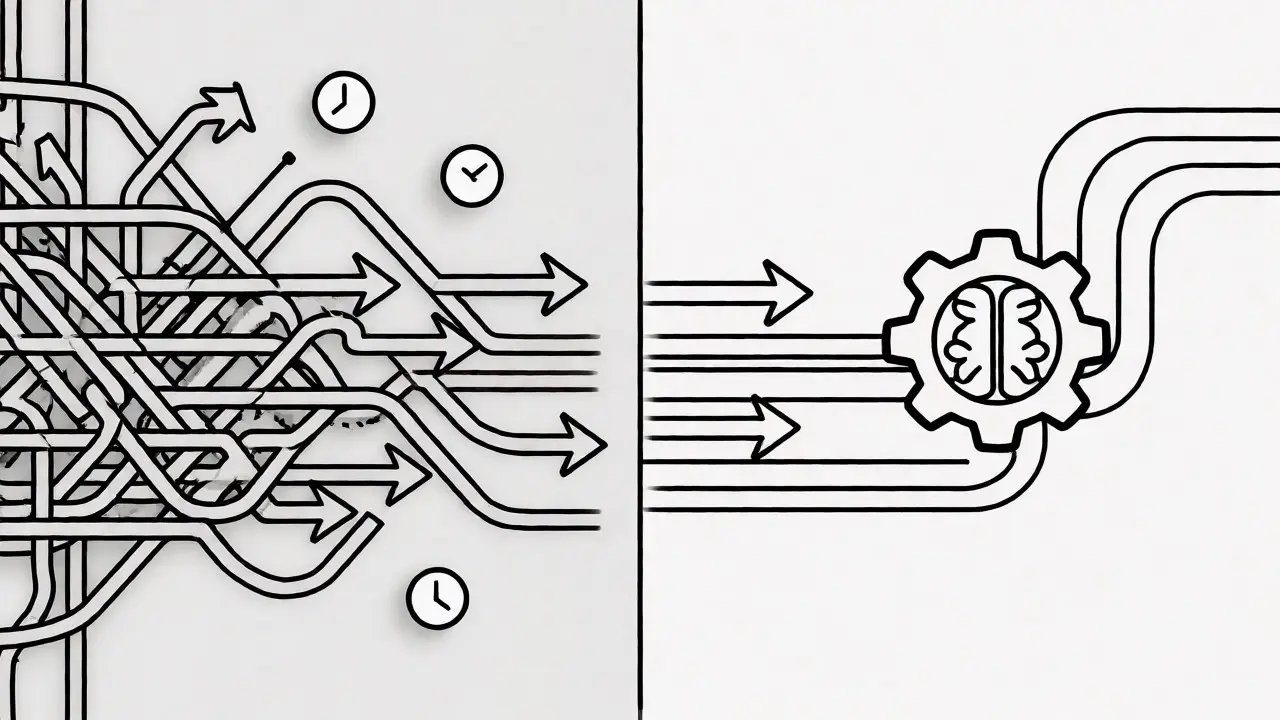
Traditional RAG blindly retrieves information for every single query. Even if a user asks "Hello," the system might hit the vector DB. This adds unnecessary overhead. Enter Agentic RAG. This approach uses a lightweight classifier to decide if retrieval is even needed.
Adaline’s production benchmarks show Agentic RAG reduces latency by 35% (from 2.5s to 1.6s) and cuts costs by 40% because it skips retrieval for 35-40% of queries. Gartner predicts that by 2026, 70% of enterprise implementations will use intent classification to avoid these wasted calls. If your app handles chitchat alongside factual questions, implementing a simple intent router is one of the highest-ROI optimizations you can make.
Accelerating Generation with Streaming and Batching
Once you have your context, the LLM needs to generate the answer. Standard requests wait for the entire response before sending anything back to the user. This leads to a long Time to First Token (TTFT).
Streaming changes the game. By sending tokens as they are generated, you reduce TTFT from 2000ms to 200-500ms. For voice apps using Eleven Labs TTS, this drops time-to-first-audio to 150-200ms. Users perceive speed based on when the first word appears, not when the last one finishes. LangChain v0.3.0 added native support for this, cutting average latency by 25% in tests.
For backend efficiency, look at batching. Nilesh Bhandarwar, a Senior Software Engineer at Microsoft, states that asynchronous batched inference is non-negotiable at scale. Leveraging GPU parallelism to process multiple prompts in one forward pass reduces average latency per request by 30-40%. If you’re running high-throughput services, batching is essential.
Infrastructure and Connection Management
Software logic isn't the only culprit. Poor connection management creates jitter. Artech Digital’s monitoring report highlights that connection pooling cuts database/API overhead by 80-90%, saving 50-100ms per request. Without pooling, your system spends valuable time just establishing TCP handshakes.
Also, watch out for hidden bugs. A widely reported issue in LangChain v0.2.11 caused 500-800ms of extra latency due to inefficient pooling. Always check library changelogs. On the infrastructure side, AWS SageMaker RAG Studio now includes auto-optimization tools that handle pooling and batching, reducing setup time from weeks to hours.
Monitoring: You Can’t Fix What You Can’t See
How do you know which part of your pipeline is slow? Distributed tracing. Maria Chen, Chief Architect at Artech Digital, says OpenTelemetry is the single most effective practice, identifying 70% of bottlenecks within 24 hours. Tools like Datadog (rated 4.3/5 on G2) provide comprehensive tracing but can cost $2,500+/month. Open-source stacks like Prometheus and Grafana hold 28% market share and are cheaper, though they require more manual setup.
Set up alerts for p95 and p99 latencies, not just averages. Averages hide spikes. During traffic peaks, unoptimized connections can cause unpredictable 2-8 second delays, as noted by ML Ops practitioners on HackerNews. Monitoring should track both latency and retrieval quality. Over-optimizing for speed can degrade results; AWS warns that 20% faster searches might sacrifice 8-12% precision.
Key Takeaways for Production Success
- Measure First: Establish baselines under load. Expect 1-2 weeks of dedicated monitoring.
- Use Intent Classification: Skip retrieval for simple queries to save 35%+ latency.
- Stream Responses: Reduce perceived wait time by showing tokens immediately.
- Pool Connections: Save 50-100ms per request by reusing database connections.
- Approximate Search: Use HNSW/IVFPQ to cut search time by 60-70% with minimal accuracy loss.
What is a good target latency for production RAG?
For text-based chatbots, aim for sub-2-second total response time. For voice applications, you must stay under 1.5 seconds to maintain natural conversation flow. Complex analytical queries may tolerate up to 3-5 seconds, but user satisfaction drops significantly after 2 seconds.
Does using a commercial vector database guarantee lower latency?
Not necessarily. While Pinecone offers consistent sub-100ms latency, open-source alternatives like Qdrant can be faster (45ms in some benchmarks) if properly tuned and hosted on optimized hardware. Commercial solutions often win on ease of maintenance rather than raw speed.
How much does latency optimization impact accuracy?
There is a trade-off. Using approximate nearest neighbor (ANN) algorithms can reduce precision by 2-5%. However, research suggests the accuracy curve flattens beyond 95% recall, so slight losses are often acceptable for significant speed gains. Always monitor retrieval quality metrics alongside latency.
What tools help monitor RAG pipeline latency?
OpenTelemetry is the standard for distributed tracing. Popular monitoring platforms include Datadog, New Relic, and open-source solutions like Prometheus combined with Grafana. These tools help identify bottlenecks in embedding, retrieval, and generation stages.
Is Agentic RAG worth the complexity?
Yes, if your application handles diverse query types. Agentic RAG reduces latency by ~35% and costs by ~40% by skipping retrieval for queries that don't need external knowledge. The added complexity of intent classification pays off in high-volume production environments.
 Artificial Intelligence