
You’ve probably been there. You ask an Large Language Model (LLM) to write a complex business report, and it gives you something that looks right but falls apart when you check the facts. Or maybe you try to debug code with AI, and it fixes one bug while introducing two new ones. The problem isn’t always the model itself; often, it’s how we’re asking it to work. We treat these powerful tools like magic wands, expecting them to solve multi-step problems in a single breath. But real intelligence-and reliable AI output-usually requires breaking things down.
This is where prompt chaining comes in. It’s not just a buzzword from the latest tech conference; it’s a practical methodology for making generative AI behave more predictably. Instead of throwing a massive, complicated request at the model and hoping for the best, you break the task into smaller, sequential steps. The output of one step becomes the input for the next. Think of it like assembling furniture: you don’t just throw all the parts and screws into a pile and hope they form a chair. You follow instructions, step by step. According to a 2024 IBM study, this approach can reduce factual errors by over 67% compared to using a single, monolithic prompt. That’s a huge leap in reliability for anyone relying on AI for serious work.
What Exactly Is Prompt Chaining?
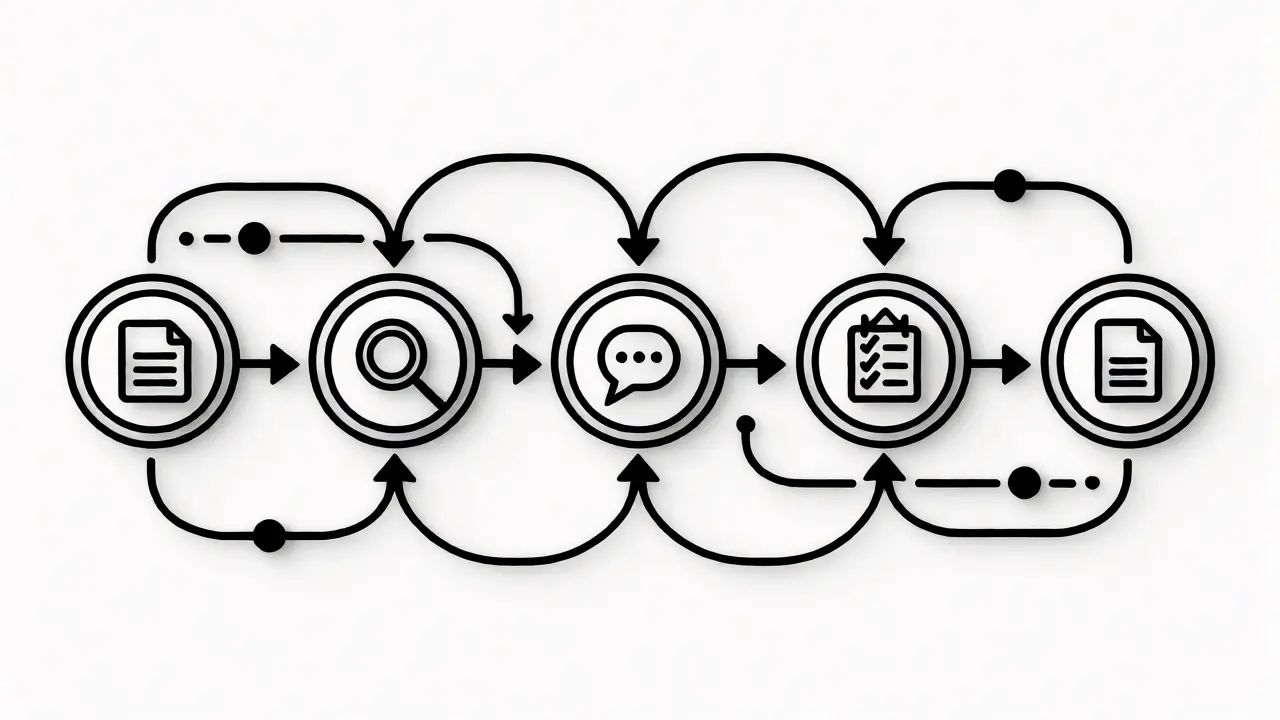
At its core, prompt chaining is a technique where the output from one prompt serves as the input for the next. It transforms a linear conversation into a structured workflow. If you’ve ever used a recipe app that tells you to "preheat oven" before "mixing batter," you understand the logic. In AI terms, you might first ask the model to extract key data points from a document, then use those extracted points to generate a summary, and finally use that summary to draft an email. Each step has a clear, narrow job.
This method emerged around 2022 as models like GPT-3 became capable enough to handle context but still struggled with complex reasoning. Researchers at OpenAI, Google AI, and Anthropic helped refine these techniques, realizing that LLMs perform better when focused on one sub-task at a time. By September 2026, prompt chaining has become a standard part of advanced prompt engineering frameworks. Platforms like AWS SageMaker and Jotform AI have built-in features specifically designed to manage these sequences, recognizing that users need more control than a simple chat interface provides.
Why Single Prompts Fail Complex Tasks
When you ask an AI to do too much at once, you risk what experts call "context drift." The model tries to hold too many variables in its working memory simultaneously. For example, if you ask an AI to "analyze this sales data, identify trends, suggest three marketing strategies, and write a slide deck outline," it might hallucinate a trend that doesn’t exist because it’s trying to force a narrative to fit the requested output format.
Prompt chaining mitigates this by isolating each cognitive load. A 2024 benchmark by Promptitude.io showed that chained prompts improved accuracy by 52.7% across 1,200 test cases. Why? Because each step acts as a verification point. If Step 1 extracts the wrong date, you catch it before Step 2 builds a whole argument on that error. It’s the difference between building a house on a shaky foundation versus checking the level after every brick.
The Five Core Patterns of Prompt Chaining
Not all chains look the same. Depending on your goal, you’ll use different structural patterns. Here are the five most common types documented in technical guides:
- Instructional Chaining: This is the most straightforward type. You give explicit step-by-step directions. Example: "Step 1: List all customer complaints. Step 2: Categorize them by theme. Step 3: Propose a solution for the top category."
- Iterative Refinement: Here, the output of one prompt improves the previous one. You might ask the AI to write a draft, then critique it, then rewrite it based on the critique. This mimics human editing processes.
- Contextual Layering: You add background information incrementally. First, define the persona. Second, provide the constraints. Third, ask for the output. This ensures the model has all necessary context without overwhelming it initially.
- Comparative Analysis: You evaluate multiple options sequentially. Generate Option A, then Option B, then compare them side-by-side in a final step. This reduces bias toward the first answer generated.
- Conditional Branching: This uses if-then logic. If the sentiment analysis returns "negative," go to the apology template. If "positive," go to the thank-you note template. This adds dynamic decision-making to your chain.
Real-World Impact: Case Studies and Metrics
Theoretical benefits are nice, but do they hold up in production? Let’s look at some concrete examples. Telnyx, a communications platform, reported a 58% reduction in ticket escalation rates in their customer support automation after implementing chained prompts. By separating intent recognition from response generation, their system stopped sending generic answers to complex queries.
In legal tech, a user on Reddit shared a story about analyzing contracts. Using a seven-step chain, they reduced document analysis errors by 71%. The chain involved extracting clauses, summarizing risks, cross-referencing against a checklist, and drafting a memo. Without the chain, the AI would occasionally miss critical liability clauses buried in long paragraphs.
However, it’s not a silver bullet. Dr. Emily Bowen, Chief AI Officer at Telnyx, noted that while chaining reduces hallucinations by 61.2%, it requires careful design. If your first step is flawed, the error propagates. One misinterpreted instruction in Step 1 can ruin Steps 2 through 5. This is why validation steps are crucial.
How to Build Your First Prompt Chain
Ready to try it? Don’t start with a ten-step monster. Begin small. AWS recommends starting with 3-5 step chains for simple workflows. Here’s a practical framework to get you started:
- Deconstruct the Task: Break your main goal into logical sub-tasks. What does the AI need to know first? What should it do next?
- Draft Individual Prompts: Write a clear, specific prompt for each sub-task. Avoid vague language. Instead of "Summarize this," try "Extract the three main arguments from this text."
- Define Input/Output Formats: Decide how data passes between steps. Use JSON or XML tags to keep structure clean. For example, ask the model to output results in a specific format so the next prompt can parse it easily.
- Add Validation Checks: Insert a step that verifies the previous output. "Does this summary accurately reflect the original text? Yes/No. If No, list discrepancies."
- Test and Iterate: Run the chain. Where did it fail? Did Step 2 misunderstand Step 1? Adjust the wording and repeat.
Keep in mind that chaining increases processing time. Expect about a 38% increase in latency compared to single prompts because the system waits for each step to complete. For real-time applications, this might be a dealbreaker. For batch processing or deep analysis, it’s worth the wait.

Common Pitfalls and How to Avoid Them
Even experienced developers run into trouble with chaining. The biggest issue is "error propagation." As Professor Emily M. Bender warned, chaining can create a false sense of reliability. If an early step contains a subtle inaccuracy, subsequent steps will build upon that falsehood confidently. To combat this, include self-correction prompts. Ask the model to review its own work before proceeding.
Another challenge is context window limits. While modern models like GPT-4 and Claude 3 have large contexts, maintaining coherence over very long chains (more than 7-8 steps) can lead to drift. Google’s research suggests keeping chains concise. If your task requires dozens of steps, consider grouping them into modular sub-chains rather than one endless sequence.
Debugging is also harder. When a single-prompt fails, you know where to look. With a chain, you have to trace back through multiple outputs to find the source of the error. Tools like LangChain or custom logging scripts can help visualize the flow of data between steps.
| Feature | Single Prompt | Prompt Chaining |
|---|---|---|
| Accuracy on Complex Tasks | ~52% | ~85% |
| Processing Time | Fast | +38% Slower |
| Development Effort | Low | Moderate-High |
| Hallucination Rate | Higher | Reduced by ~60% |
| Best For | Simple Q&A, Creative Brainstorming | Data Analysis, Coding, Structured Reports |
The Future of Chained Workflows
We’re moving toward smarter, automated chaining. Microsoft’s Copilot Studio and Google’s Gemini are integrating features that allow AI to dynamically adjust the chain based on intermediate results. Imagine an AI that realizes Step 3 failed and automatically re-runs Step 2 with different parameters. This "adaptive chaining" could further reduce error rates by another 20-30%.
For now, though, manual design remains king. The market for prompt engineering is growing rapidly, projected to reach billions in value. Whether you’re a developer building apps or a marketer creating content, understanding how to guide AI through sequential steps is becoming a fundamental skill. It’s less about finding the perfect magic phrase and more about designing a robust process.
Is prompt chaining only for developers?
No. While developers use code-based frameworks like LangChain, business analysts can use low-code interfaces in platforms like Zapier or Make.com to string together AI actions. The logic remains the same: break the task down and pass results forward.
Does prompt chaining cost more money?
Generally, yes. Since you are making multiple API calls instead of one, you pay for tokens in each step. However, because the output is more accurate, you save money on manual corrections and retries. Many companies find the total cost of ownership is lower due to increased efficiency.
How many steps should a prompt chain have?
There is no hard limit, but complexity grows exponentially. Most experts recommend keeping individual chains to 3-7 steps. If you need more, consider breaking the workflow into separate modules or using an agent framework that manages state more efficiently.
Can I use prompt chaining with any AI model?
Yes, prompt chaining works with virtually all major LLMs, including OpenAI’s GPT-4, Anthropic’s Claude, and Meta’s Llama 3. The principle is independent of the specific model architecture, though larger context windows make managing longer chains easier.
What is the biggest mistake people make when starting?
The biggest mistake is failing to define strict output formats between steps. If Step 1 outputs free-form text and Step 2 expects JSON, the chain breaks. Always specify exactly how data should be formatted for handoff.
 Artificial Intelligence