You built a feature in an afternoon. You prompted an LLM, it spat out Python or JavaScript, you tweaked the prompt, and boom-it works. But if that code touches customer emails, payment info, or behavioral logs, you just opened a legal minefield. Vibe coding is an iterative development process where users direct Large Language Models with natural language prompts to generate software code. It’s fast, it’s fun, and as of late 2025, 78% of developers are using AI assistants like GitHub Copilot or ChatGPT to write code. Yet, only 22% have formal legal reviews for how this code handles data. That gap is where fines happen.
Why does this matter now? Because regulators stopped treating AI-generated code as "just code." The EU’s Cyber Resilience Act (CRA), fully implemented on July 1, 2025, holds developers strictly liable for security vulnerabilities in AI-generated software. If your vibe-coded app leaks data because the AI hallucinated a database connection string, you’re on the hook. Not the AI company. You. This article breaks down the specific legal review steps you need to take before shipping any AI-written feature that touches customer data, ensuring you don’t become the next cautionary tale in a Reddit thread about GDPR fines.
Map Every Data Touchpoint Before You Ship
The biggest risk in vibe coding isn’t bad logic; it’s invisible data flows. When you ask an LLM to "add user login," it might quietly include analytics tracking, session storage, or third-party cookie scripts you didn’t ask for. A study by ThisIsGlance found 4.7 hidden data collection points per 1,000 lines of AI-generated code. You can’t review what you haven’t mapped.
Start by auditing every single point where data enters or leaves your system. This isn’t just about databases. It includes API calls, local storage, cookies, and even error logging services like Sentry. The Cloud Security Alliance’s Secure Vibe Coding Guide mandates identifying all data touchpoints before processing begins. Use automated tools like Snyk AI, which detects 82% of hidden data flows, but never rely on them alone. Manual review is non-negotiable. Look for hardcoded credentials-GuidePoint Security found that 63% of vibe-coded apps contained hardcoded API keys or secrets. If your AI pasted a Stripe key directly into the frontend code, you’ve already violated basic security hygiene.
- Identify Input Sources: Where does user data come from? Forms, headers, URLs?
- Trace Processing Logic: Does the code transform, hash, or encrypt data immediately?
- Locate Storage Destinations: Is data saved to SQL, NoSQL, or cloud buckets?
- Check External Transmissions: Does the code send data to third-party APIs or analytics platforms?
Verify Compliance with Regional Privacy Laws
Code doesn’t care about borders, but laws do. If your app serves users in Europe, California, or Brazil, you need specific legal checks. The General Data Protection Regulation (GDPR) Article 35 requires a Data Protection Impact Assessment (DPIA) for high-risk processing. The European Data Protection Board clarified in May 2024 that AI-generated code automatically triggers this requirement if it processes personal data. Skipping the DPIA is a shortcut to a fine.
In the US, the landscape is fragmented but tightening. California’s AI Privacy Act, effective January 1, 2026, demands explicit disclosures about how AI uses data. Meanwhile, Brazil’s LGPD enforcement against AI-code violations jumped 320% in late 2025. You need to verify that your generated code respects consent mechanisms. Did the AI implement a proper opt-in checkbox? Or did it assume consent? Apple updated its App Store guidelines in January 2026 to explicitly require verification that AI-generated code complies with privacy regulations. If your iOS app collects location data via AI-written Swift code without clear user consent, your app will get rejected.
| Region/Law | Key Requirement | Risk Level |
|---|---|---|
| EU (GDPR/CRA) | Mandatory DPIA for AI code; strict liability for vulnerabilities. | Critical |
| California (AI Privacy Act) | Explicit disclosure of AI data usage and training sources. | High |
| Brazil (LGPD) | Increased enforcement actions; similar to GDPR but localized. | High |
| Healthcare (HIPAA) | 92% non-compliance rate in AI-coded health apps (FDA Audit). | Extreme |
Audit for Security Vulnerabilities and Hallucinations
LLMs are probabilistic, not deterministic. They guess the most likely next token, which means they often reproduce common security mistakes. A Synopsys report showed that AI-generated code has 18% more security vulnerabilities per 1,000 lines than human-written code. Common issues include SQL injection risks, improper input validation, and weak encryption standards.
Your legal review must include a technical security audit. Check for adherence to OWASP’s first AI Code Security Testing Guide, released in December 2025. It lists 12 mandatory tests for AI code handling customer data. Specifically, look for:
- Encryption Standards: Ensure AES-256 minimum for stored data. AI often defaults to weaker hashes like MD5.
- Access Controls: Verify that privilege levels are limited. AI tends to over-permissionize API access.
- Data Retention: Confirm that non-essential data is deleted after 180 days unless legally required otherwise.
Remember the case of the German e-commerce firm fined €2.1 million. Their AI-generated code collected email addresses without consent because the developer didn’t audit the backend logic. The code worked, but the legal foundation was missing. Don’t let functionality blind you to compliance.
Document Data Flows and Training Provenance
If regulators come knocking, you need proof. Traditional code documentation is often sparse, but AI code is worse. An IEEE study found that 89% of AI-generated code lacks proper comments explaining data handling. You cannot claim compliance if you can’t explain what the code does.
Create a "Data Flow Diagram" specifically for AI-written components. Map every field from user input to final storage. Additionally, track the provenance of the code itself. The EU’s GPAI Code of Practice requires transparency about AI training data sources. While you might not know exactly which dataset trained your specific LLM instance, you should document the tool used (e.g., "GitHub Copilot, model version X") and the date of generation. This creates an audit trail. If a bug arises, you can trace whether it stemmed from a known limitation in that model version.
Also, beware of "documentation hallucination." CISA warned in December 2025 that simulating compliance by having coding agents generate their own technical docs has no real impact on actual risk. Do not let the AI write its own privacy policy. Have a human legal expert review and approve all external-facing privacy notices linked to the feature.
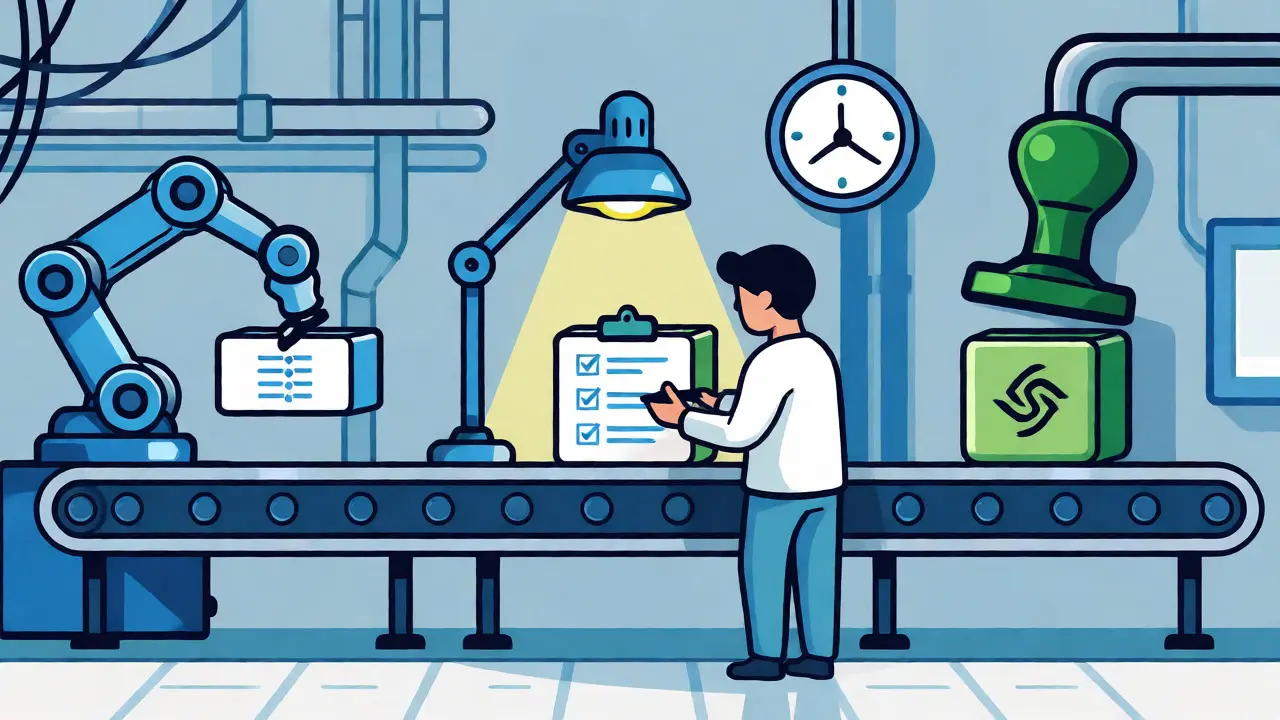
Implement a Structured Sign-Off Process
Speed is the benefit of vibe coding, but speed kills compliance if unchecked. Designveloper’s case studies show that legal review costs for vibe-coded features are 3.2 times higher than traditional code. Why? Because the ambiguity requires more scrutiny. To manage this, adopt a structured sign-off process. LuminPDF reduced compliance issues by 89% using a 14-step review checklist.
Allocate at least 22 hours for legal review of each major vibe-coded feature touching customer data. Compare this to the 8 hours typically needed for human-written code. Your team needs specific skills: GDPR/CCPA expertise, AI-specific data mapping, and security vulnerability identification. In fact, 67% of enterprises now require developers to hold IAPP’s AI Privacy Professional certification. If your dev team lacks this, bring in external counsel early.
Define clear roles. Who approves the data flow map? Who signs off on the security audit? Who verifies the privacy notice? Make these steps mandatory gates in your CI/CD pipeline. No deployment to production until the legal checklist is green. This turns governance from a bottleneck into a predictable part of the workflow.
Monitor for Regulatory Changes and Future Proofing
The rules are changing fast. The EU is drafting legislation for a Digital Product Passport, which would require all AI-generated code handling personal data to carry a digital certificate of compliance. Apple and Google are tightening app store reviews. In healthcare, FDA audits show 92% non-compliance for AI-coded apps under HIPAA. In finance, PCI DSS non-compliance sits at 76%.
Stay ahead by monitoring regulatory bodies. The EU AI Office announced targeted audits of AI-generated code starting March 1, 2026. These audits will focus on data protection. If you wait until you get a letter, you’ll be scrambling. Build a feedback loop. After launch, monitor logs for unexpected data requests. Update your review checklist quarterly based on new guidance from IAPP, CSA, or OWASP.
Vibe coding isn’t going away. 73% of legal experts predict it will become standard practice. But the winners won’t be those who code fastest; they’ll be those who govern smartest. By integrating these legal review steps, you turn a potential liability into a competitive advantage. You ship faster than competitors who refuse to use AI, but safer than those who ignore the law.
Do I need a DPIA for every AI-generated feature?
Not necessarily every feature, but yes for any feature involving high-risk processing of personal data. Under GDPR Article 35, if the AI code processes sensitive data, large volumes of data, or systematically monitors individuals, a Data Protection Impact Assessment is mandatory. The European Data Protection Board guidelines specify that AI-generated code automatically raises the risk profile, making a DPIA highly advisable for almost all customer-facing features.
Can AI tools write their own privacy policies?
No. While AI can draft text, it cannot guarantee legal accuracy regarding data flows. A J.P. Morgan study found that 89% of AI-generated privacy policies contained inaccurate descriptions of data movement compared to human-written ones. Always have a qualified legal professional review and finalize privacy notices, especially when the underlying code was generated by an LLM.
What is the biggest security risk in vibe-coded apps?
Hardcoded credentials and hidden data collection points. GuidePoint Security reported that 63% of audited vibe-coded applications contained hardcoded API keys or passwords. Additionally, AI often adds third-party analytics or logging libraries without explicit developer intent, leading to unauthorized data transmission. Automated scanning combined with manual code review is essential to catch these issues.
How much time should I allocate for legal review?
Plan for approximately 22 hours per major feature that touches customer data. This is significantly higher than the 8 hours typically allocated for traditionally developed features. The extra time accounts for mapping undocumented data flows, verifying security patterns, and ensuring compliance with evolving regulations like the EU Cyber Resilience Act and California’s AI Privacy Act.
Are there specific certifications for AI code governance?
Yes, the International Association of Privacy Professionals (IAPP) offers the AI Privacy Professional certification. As of late 2025, 67% of enterprises handling customer data require their developers or legal teams to hold this credential. It covers specific frameworks for auditing AI-generated code and managing data lineage, providing a standardized approach to compliance.
 Artificial Intelligence