Training a massive generative AI model is less like teaching a student and more like steering a supertanker through a storm. You have billions of parameters, limited compute resources, and a high risk of the whole system crashing if you push too hard or not hard enough. If your loss curve spikes, vanishes, or just refuses to move, you aren't dealing with bad data-you're likely dealing with broken optimization. The difference between a model that hallucinates nonsense and one that generates coherent text often comes down to three specific technical levers: how you update weights (AdamW), how you pace those updates (learning rate schedules), and how you handle numerical instability (gradient scaling).
We are past the era where default settings work for large-scale transformers. In 2026, building efficient generative models requires a surgical approach to these optimization techniques. Let's break down why AdamW replaced standard Adam as the industry standard, how to schedule your learning rates for maximum stability, and why gradient scaling is non-negotiable for distributed training.
Why AdamW Is the New Standard for Large Models
For years, Adam (Adaptive Moment Estimation) was the go-to optimizer. It combined the best parts of AdaGrad and RMSProp, offering adaptive learning rates for every parameter. But Adam had a fatal flaw when applied to massive neural networks: it mishandled weight decay.
In standard Adam, weight decay (a form of L2 regularization) is baked directly into the gradient update. This means the regularization affects the adaptive learning rate calculation itself. For small models, this doesn't matter much. For a transformer with billions of parameters, it creates noise that interferes with convergence. The model struggles to generalize because the optimizer is fighting its own regularization mechanism.
AdamW (Adam with Decoupled Weight Decay) fixes this by separating the two processes completely. Here is how it works in practice:
- Gradient Update: AdamW calculates the adaptive step based purely on the gradient's first and second moments (mean and variance). No regularization here.
- Weight Decay Step: After the gradient step, AdamW applies weight decay directly to the parameters. This shrinks large weights independently of the learning rate.
This decoupling ensures that regularization remains consistent regardless of the adaptive learning rate. The result? Better generalization. Studies on models like BERT and Vision Transformers (ViT) showed that AdamW consistently achieves higher validation accuracy than standard Adam. When you are fine-tuning a large language model (LLM) or training a diffusion model, AdamW prevents the model from memorizing noise in the training data, leading to cleaner outputs.
The Art of Learning Rate Schedules
Picking an optimizer is only half the battle. How fast you train matters just as much. Using a static learning rate throughout training is like driving a car at 60 mph through a school zone, a highway, and a parking lot. You need to adjust speed based on context. This is where Learning Rate Schedules (Strategies to change the learning rate over time) come in.
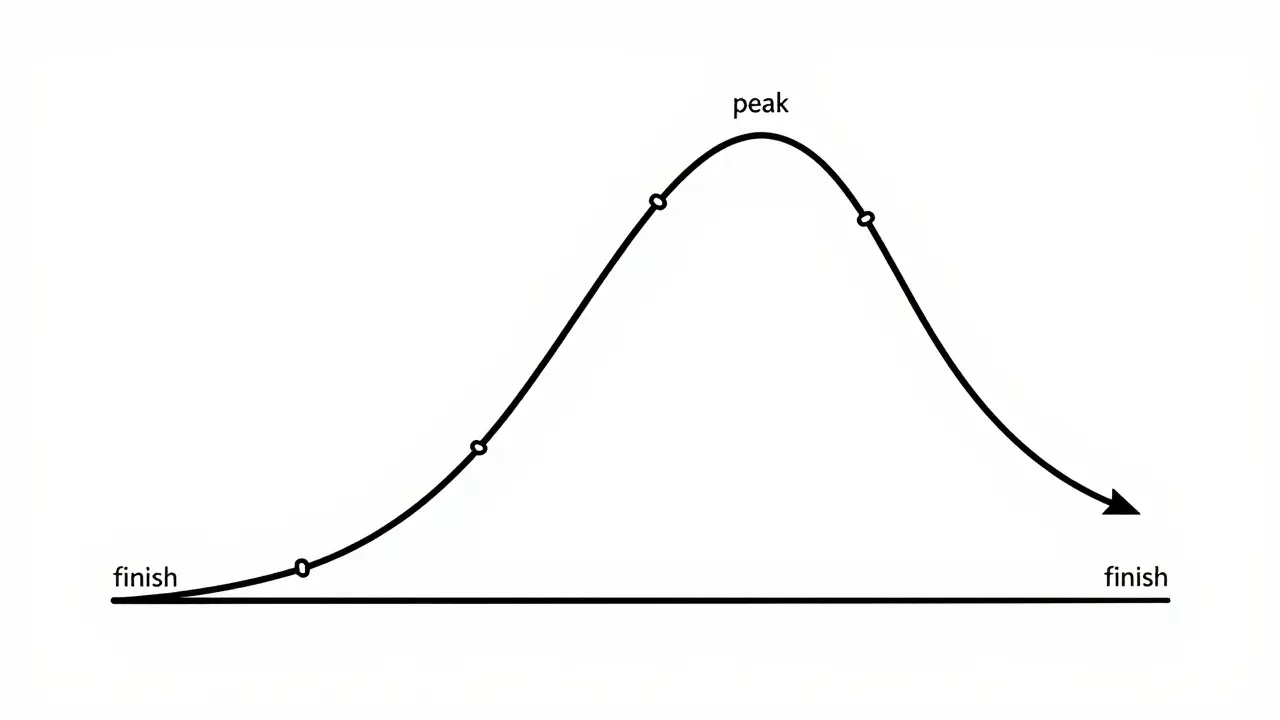
For generative AI, particularly transformer-based architectures, the most effective strategy is the Cosine Annealing Schedule with Linear Warmup. Here is why this specific combination dominates modern training pipelines:
- Linear Warmup (The Start): At the beginning of training, gradients are noisy and unstable. If you start with a high learning rate, the model can diverge immediately. A linear warmup gradually increases the learning rate from near zero to its peak value over the first few percent of training steps (e.g., 2-5%). This allows the model to find a stable trajectory before accelerating.
- Peak Learning Rate: Once warmed up, you maintain the highest learning rate possible without causing instability. This phase drives rapid progress down the loss landscape.
- Cosine Decay (The Finish): As training progresses, you don't want to stop abruptly. Instead, you reduce the learning rate following a cosine curve. This gentle taper helps the model settle into the deepest part of the loss minimum, refining details without overshooting. It’s crucial for final model quality.
Step decay (reducing the rate by a factor every N epochs) is simpler but often leads to suboptimal convergence in complex landscapes. Cosine annealing provides a smoother path, which is essential when navigating the rugged error surfaces of generative models.
Gradient Scaling: Preventing Numerical Collapse
When you scale up to multiple GPUs or TPUs, you introduce a new problem: numerical precision. Modern hardware uses mixed-precision training (FP16 or BF16) to save memory and speed up computation. However, smaller number formats have a limited range. Gradients can become so tiny they round to zero (underflow) or so large they explode to infinity (overflow).
Gradient Scaling (Techniques to adjust gradient magnitudes for stability) solves this. There are two main approaches you need to know:
| Technique | How It Works | Best Use Case |
|---|---|---|
| Dynamic Loss Scaling | Multiplies the loss by a scalar factor before backpropagation. If gradients overflow, the scaler reduces; if no overflow, it increases. | Mixed Precision Training (FP16/BF16) |
| Gradient Clipping | Caps the norm of the gradient vector at a specific threshold (e.g., 1.0). Prevents explosive updates. | RNNs, LSTMs, and unstable GAN training |
Dynamic Loss Scaling is critical for mixed-precision training. Without it, FP16 gradients would vanish almost instantly. Frameworks like PyTorch and JAX handle this automatically, but understanding the mechanism helps you debug training crashes. If your training stops with a NaN (Not a Number) error, check your loss scaler-it’s likely set too high.
Gradient Clipping is a safety net. Even with AdamW, occasional outlier gradients can occur, especially in generative adversarial networks (GANs) or reinforcement learning setups. Clipping ensures that no single update can derail the entire model. A common rule of thumb is to clip gradients at a global norm of 1.0, though this varies by architecture.
Putting It All Together: A Practical Workflow
So, how do you combine these techniques for a real-world generative AI project? Here is a robust configuration pattern used in state-of-the-art training runs:
- Optimizer: AdamW with a weight decay of 0.01 to 0.1. Higher decay helps prevent overfitting in very large models.
- Learning Rate: Start with a peak LR of 1e-4 to 3e-4 for fine-tuning, or lower (1e-5) for pre-training large models. Use a linear warmup over 100-1000 steps, followed by cosine decay.
- Precision: Use BF16 (Brain Floating Point) if your hardware supports it (modern NVIDIA GPUs and TPUs). BF16 has the same dynamic range as FP32 but half the storage, making it safer than FP16 for gradient scaling.
- Stability: Enable dynamic loss scaling. Set gradient clipping to 1.0 as a baseline, adjusting only if you observe specific instability patterns.
This stack minimizes the chance of catastrophic failure while maximizing convergence speed. It transforms optimization from a guessing game into a predictable engineering process.
Common Pitfalls to Avoid
Even with the right tools, mistakes happen. Watch out for these common issues:
- Ignoring Warmup: Skipping the warmup phase is the fastest way to crash a large transformer. Never jump straight to peak learning rate.
- Too High Weight Decay: While AdamW handles weight decay well, setting it too high (e.g., >1.0) can crush important features, leading to underfitting.
- Static Learning Rates: Don't stick with a constant LR. The end of training requires finesse, not brute force.
- Disabling Mixed Precision: Unless you have infinite VRAM, use mixed precision. Just ensure your loss scaler is active.
Optimization isn't magic. It's math applied with discipline. By mastering AdamW, scheduling your learning rates intelligently, and scaling your gradients correctly, you give your generative AI models the best possible chance to succeed.
What is the main difference between Adam and AdamW?
The key difference is how they handle weight decay. Standard Adam includes weight decay in the gradient update, which can interfere with adaptive learning rates. AdamW decouples weight decay, applying it separately after the gradient step. This leads to better generalization and stability, especially in large models.
Why is a learning rate warmup necessary?
Warmup is necessary because initial gradients in large models are noisy and unstable. Starting with a high learning rate can cause the model to diverge immediately. Gradually increasing the learning rate allows the model to stabilize before aggressive training begins.
When should I use gradient clipping?
Use gradient clipping when you encounter exploding gradients, which is common in RNNs, GANs, or when using very large batch sizes. It caps the magnitude of gradient updates to prevent them from destabilizing the model. A global norm of 1.0 is a good starting point.
Is BF16 better than FP16 for training generative AI?
Yes, generally. BF16 (Brain Floating Point) has the same dynamic range as FP32 but uses half the memory. This makes it much less prone to underflow and overflow issues compared to FP16, reducing the need for aggressive loss scaling adjustments.
What is a good default weight decay value for AdamW?
A weight decay between 0.01 and 0.1 is typical for most transformer-based models. Lower values (0.01) are safer for fine-tuning, while higher values (0.1) can help prevent overfitting in large-scale pre-training scenarios.
 Artificial Intelligence