
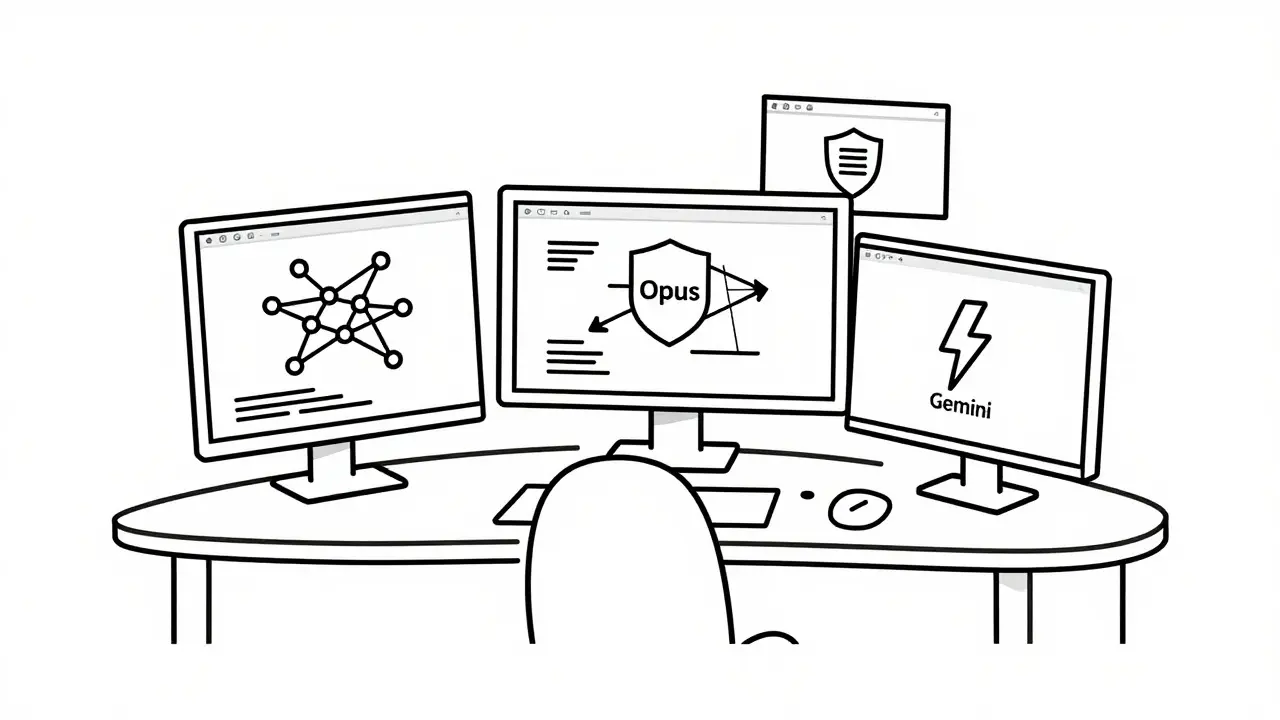
Stop paying premium prices to have an AI write a basic button. If you are using Claude Opus to generate simple CRUD operations, you are burning cash faster than a server farm in July. The era of "one model fits all" is dead. In the world of vibe coding-where you describe intent and the machine writes the code-the secret isn't just picking the smartest model. It's picking the right one for the specific task at hand.
We are in August 2026, and the landscape has shifted dramatically since this trend exploded in 2024. Developers no longer just ask ChatGPT to "write me a app." They orchestrate workflows where different models handle different phases. This strategic selection can slash your development costs by nearly 40% while actually improving code quality. Let's break down exactly how to choose between the big three: Anthropic's Claude series, OpenAI's GPT-4 lineup, and Google's Gemini family.
The Core Players: Who Is Who?
To make smart choices, you need to know what you're buying. These aren't just different brands; they are fundamentally different tools with distinct strengths, weaknesses, and price tags.
Claude Opus 3.5, released by Anthropic in October 2025, is the heavyweight champion of reasoning. With a massive 1.2 million token context window, it excels at complex architectural decisions. It scored 87.4% on the HumanEval coding benchmark, but that power comes at a cost-literally and computationally. It requires about 16GB of RAM for optimal local operation and consumes roughly 20 credits per complex database schema task.
On the other side, we have GPT-4 Turbo from OpenAI. Released in November 2024, it remains a stalwart for stability and security. It offers a 128K token context and hits 82.1% on HumanEval. It’s the reliable workhorse that handles general development tasks well, costing around 18 credits per similar database task. Its newer sibling, GPT-5.2 (released December 2025), pushes long-horizon accuracy higher but still struggles with tasks requiring continuous focus beyond two hours.
Then there is Gemini Flash 2.0 from Google. Launched in September 2025, this is the speed demon. It boasts a 1 million token context but only achieves 73.6% on HumanEval. However, it costs just 5 credits per task. It needs only 8GB of RAM and responds 47% faster than premium models on simple queries. It is not built for deep philosophical debate about system architecture; it is built to churn out code quickly and cheaply.
The Tiered Workflow: Matching Model to Task
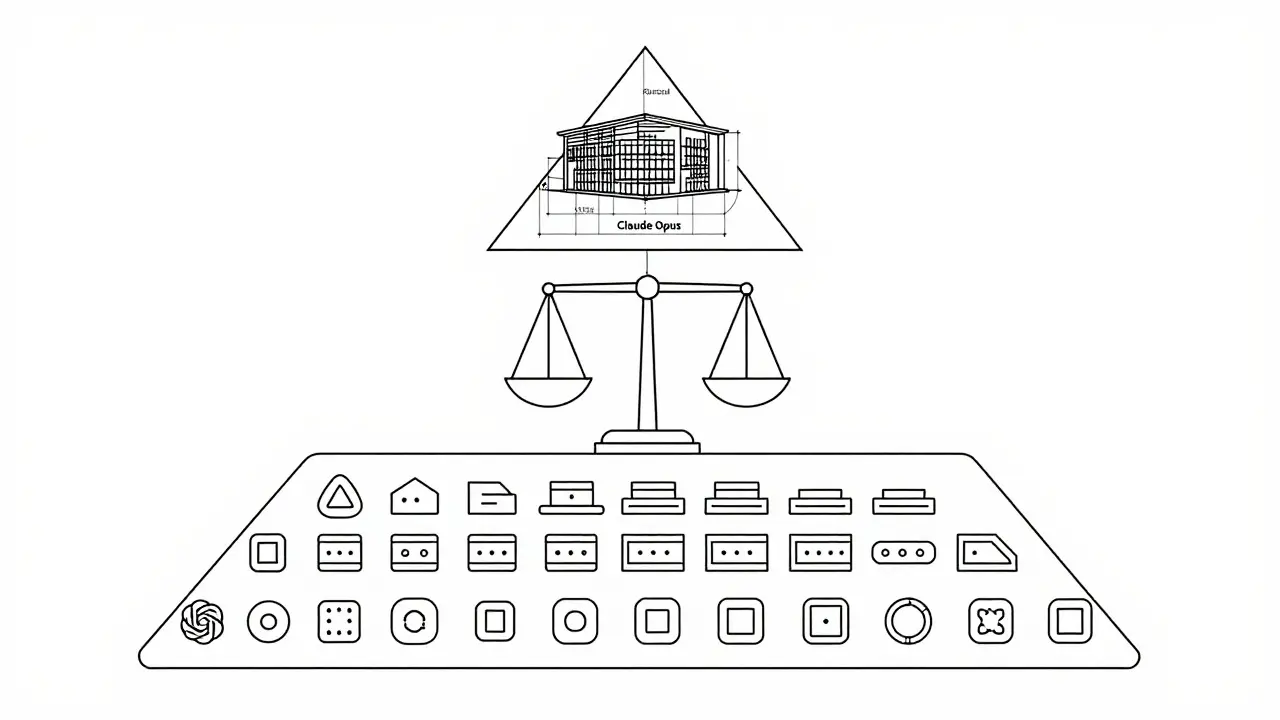
The biggest mistake developers make is treating all coding tasks as equal. They aren't. A Vooster AI analysis from January 2026 identified a clear hierarchy of tasks that dictates which model you should use. Think of this as your personal decision tree.
Critical Design Phase: When you are defining database schemas, system architecture, or security protocols, you need depth. Use MAX models like Claude Opus or GPT-4. Dr. Elena Rodriguez from MIT’s Computer Science Lab noted that using lighter models here introduces blind spots. For example, when designing a user permission system, Opus might propose five tables for robustness, while Gemini might suggest two for simplicity. Both are correct, but only Opus explains the trade-offs in detail. You want that explanation during design.
General Development Phase: Once the architecture is set, you move to implementation. This is where PRO models like Claude Sonnet 4.5 or GPT-4 mini shine. They handle product requirement documents (PRDs) and task breakdowns efficiently without the overhead of the largest models. This is the sweet spot for most daily coding activities.
Repetitive Tasks: Generating boilerplate, simple UI components, or standard API endpoints? Hand this off to FREE or low-cost models like Gemini Flash. Windsurf’s benchmarks show Gemini Flash dominates simple UI component creation with 93.5% accuracy compared to GPT-4’s 85%. Why pay 20 credits when 5 will do the job perfectly?
| Model | Best For | HumanEval Score | Cost Efficiency | RAM Requirement |
|---|---|---|---|---|
| Claude Opus 3.5 | Complex Reasoning & Architecture | 87.4% | Low (High Cost) | 16GB |
| GPT-4 Turbo | Security & Stability | 82.1% | Medium | 12GB |
| Gemini Flash 2.0 | Speed & Repetitive Tasks | 73.6% | High (Low Cost) | 8GB |
Real-World Impact: Cost and Quality
Let's talk numbers. The AI coding assistant market hit $1.2 billion in Q4 2025, growing at a staggering 63% year-over-year. But growth doesn't mean efficiency. A developer on Reddit reported switching from a single-model approach to a tiered strategy and cut monthly AI costs from $1,200 to $450. That is a 63% reduction. More importantly, they improved schema quality because they used Gemini to review Opus designs, catching over-engineering issues that slowed them down by weeks.
This isn't just anecdotal. GitHub’s January 2026 survey of 12,500 developers found that 68.3% now use multiple models strategically, up from just 32.7% in mid-2025. Enterprise adoption is even higher, with 89% of teams implementing strict model selection policies. The data is clear: the teams that win are the ones that treat model selection as a core engineering skill, not an afterthought.
However, there are pitfalls. Context switching between models is frustrating. Stack Overflow’s January 2026 survey showed 63% of developers struggle with this. To mitigate this, use tools like Continue (the open-source extension) which manages multiple model contexts automatically. This reduced context switching time by 72% in Windsurf’s case studies. Don't try to juggle tabs manually; let the tool handle the routing.

Future-Proofing Your Workflow
The landscape is moving fast. By March 2026, Anthropic announced Opus 4.6 with enhanced database optimization, and Google revealed plans for Gemini 2.1 with a 2 million token context specifically for codebase analysis. OpenAI introduced GPT-5.3 with better multi-model coordination features. What does this mean for you?
It means specialization will deepen. Gartner predicts the "one model fits all" approach will vanish entirely by 2027. The future belongs to orchestration. You won't just be a coder; you'll be a conductor, directing traffic between specialized AI agents. Start building your mental map of these strengths now. Learn when to trust Opus's chain-of-thought reasoning (which processes 14.7 logical steps per schema versus GPT-4's 11.3) and when to let Gemini Flash sprint ahead on simple tasks.
Adopting this mindset takes about 27 hours of learning curve, according to Vooster AI. But the payoff is significant. Teams using optimized model patterns achieve 3.2x development velocity. In a market projected to reach $2.8 billion by 2027, that speed advantage is everything.
Frequently Asked Questions
What is vibe coding?
Vibe coding is a development paradigm where developers describe desired functionality at a conceptual level rather than writing detailed code line-by-line. AI models then generate the implementation based on these high-level descriptions. It relies heavily on the AI's ability to infer intent and structure.
Which model is best for database schema design?
Claude Opus 3.5 is currently considered the best for database schema design due to its superior chain-of-thought reasoning capabilities. It processes more logical steps per schema than competitors, leading to more robust and secure architectural decisions, although it is more expensive.
Is Gemini Flash good enough for production code?
Yes, but with caveats. Gemini Flash 2.0 is excellent for repetitive tasks, simple UI components, and boilerplate code, offering 93.5% accuracy in those areas. However, for complex business logic or critical security implementations, it lacks the depth of Claude Opus or GPT-4 Turbo and should be verified by a human or a stronger model.
How much can I save by using a tiered model approach?
Developers report saving approximately 37% to 63% on AI coding costs by matching model complexity to task difficulty. For example, using Gemini Flash for simple tasks instead of Claude Opus can reduce credit consumption from 20 to 5 per task, significantly lowering monthly bills.
Do I need powerful hardware to run these models locally?
Requirements vary. Claude Opus 3.5 needs about 16GB of RAM for optimal performance, GPT-4 Turbo functions well with 12GB, and Gemini Flash 2.0 only requires 8GB. If you are running local instances, ensure your machine meets these minimums to avoid latency issues.
What is multi-model verification?
Multi-model verification is a best practice where critical code outputs are run through two different AI models to catch blind spots. For instance, generating code with Claude Opus and reviewing it with Gemini Flash can identify over-engineering or errors, reducing critical bugs by up to 41%.
Will one model eventually replace the need for multiple models?
Unlikely in the near term. Analysts predict that specialization will increase, with models becoming better at specific niches (e.g., security, speed, architecture). The "one model fits all" approach is expected to disappear by 2027, replaced by orchestrated workflows using multiple specialized models.
 Artificial Intelligence


Brandon Olvera
August 10, 2026 AT 09:40Another day another american dev burning cash on overpriced tech while the rest of the world figures out how to actually ship products. You guys are obsessed with these fancy 'orchestration' workflows when you should just be writing code yourself like we did back in the day. It's pathetic that you need a tiered strategy just to save $750 a month. Fix your own economy instead of relying on foreign AI models to do your basic CRUD for you.
Elizabeth Brooks
August 11, 2026 AT 09:47i totally get what ur saying but honestly the cost savings are real. i switched my team to using gemini flash for all the boilerplate stuff and it saved us so much money. its not about being lazy its about being smart with resources. also dont forget that claude opus is still the king for architecture even if it costs more. just gotta know when to use which one lol
Deb Kortyna, MBA
August 13, 2026 AT 05:14The notion that developers must now act as conductors of an orchestra of artificial intelligences is nothing short of absurd. We are witnessing the degradation of professional competence into mere prompt engineering. The formal structure of software development has been replaced by a chaotic juggling act of context windows and credit limits. One wonders if the MIT researchers cited in this article have considered the long-term implications of such fragmented workflows on code integrity and maintainability. It is a spectacle of inefficiency disguised as innovation.
alex kobri
August 14, 2026 AT 07:17you miss the point entirely. its not about losing skill its about amplifying intent. the vibe coding paradigm shifts the burden from syntax to semantics. when you describe the soul of the application the machine handles the skeleton. yes it requires orchestration but isnt that always true in complex systems? we used to manage dependencies manually now we manage model contexts. same energy different scale. under-punctuated thoughts flow better sometimes anyway
Zach Loescher
August 14, 2026 AT 13:24I find myself sitting on the fence here. On one hand, the efficiency gains reported by the Reddit user are compelling. Cutting costs by 63% is significant for any startup or small team. On the other hand, the cognitive load of switching between three different models with distinct personalities and strengths seems exhausting. I wonder if there is a middle ground where we automate the routing more aggressively without losing control over the critical architectural decisions made by the heavier models.
Quintin Franzese
August 14, 2026 AT 15:21Oh look, another post telling us how to be lazy while pretending it's strategic genius. Sure, let Gemini Flash write your button components while you sip your oat milk latte and worry about 'context switching.' Meanwhile, I'm over here wondering why we can't just trust one damn model to do everything without needing a PhD in AI orchestration. But hey, keep burning those credits, folks. It's not like electricity is cheap or anything.
Susan Cole
August 16, 2026 AT 06:36This approach makes sense for large teams with dedicated infrastructure managers but feels overwhelming for solo developers or small shops. The learning curve mentioned in the article is steep and I appreciate the honesty about the 27 hours required. However, the benefit of having specialized tools for specific tasks does seem worth the initial investment of time. Just wish there was a simpler way to integrate them without managing multiple API keys and contexts manually.