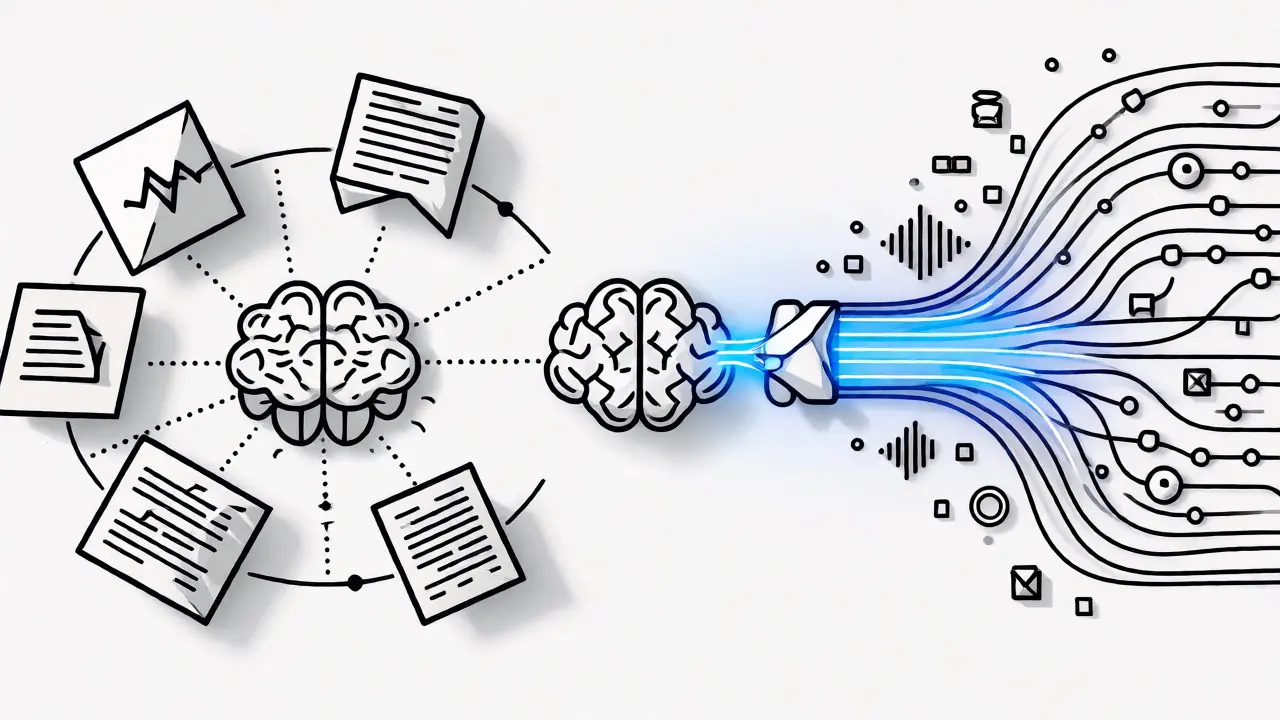
You ask an AI to describe a photo. It looks at the pixels, runs them through one brain, turns them into text, and sends that text to another brain that writes your answer. That’s how it worked for years. But in 2026, that approach feels like trying to understand a movie by reading the script after watching only the audio track. You’re missing half the story.
The real shift happening right now isn’t just about better chatbots. It’s about multimodal evolution. We are moving from systems that stitch together separate senses to ones that perceive the world as a single, continuous stream of data. This transition involves more than just adding video to text. It includes 3D spatial awareness, haptic feedback loops, and raw sensor fusion. If you’re building products or investing in tech today, understanding this architecture change is critical. The old way-late fusion-is becoming obsolete. The new way, unified multimodality, changes what machines can actually do.
Why Late Fusion Was Just an Illusion
Before we look forward, let’s be clear about what we are leaving behind. For most of the last decade, "multimodal" AI was a marketing term for a patchwork solution. Researchers call this "late fusion." Imagine you have two experts in a room: one who speaks only English and one who sees only pictures. They don’t talk to each other directly. Instead, the picture expert describes what they see to a translator, who then tells the English speaker. By the time the information reaches the decision-maker, nuance is lost. Context is flattened.
This architecture dominated until recently because it was easier to build. You could take a pre-trained language model and bolt on a vision encoder. Done. But this created a ceiling on performance. The system couldn’t reason deeply about the relationship between sound and sight because those signals never truly mixed. They were kept in separate silos until the very end of the processing pipeline.
The breakthrough came when engineers realized that if you want true understanding, you need shared representations. You need the machine to learn that the sound of glass breaking and the visual shatter pattern are part of the same event, not two separate facts to be correlated later. This realization drove the move toward architectures where all data types enter the model as equivalent tokens.
The Rise of Unified Tokenization
The core technical enabler of modern generative AI is unified tokenization. Think of tokens as the basic units of meaning for a neural network. In traditional models, text had its own dictionary, images had their own grid-based encoding, and audio had spectral features. These were different languages spoken by different parts of the model.
Unified tokenization solves this by converting everything-text, pixels, waveforms, even LiDAR point clouds-into the same mathematical space. When GPT-4o launched, it wasn’t just faster; it processed audio and images natively alongside text. It didn’t translate them first. It perceived them directly. This allows the model to learn connections between modalities from the ground up.
| Feature | Late Fusion (Legacy) | Unified Multimodal (Current/Future) |
|---|---|---|
| Processing Method | Separate encoders per modality | Shared transformer layers |
| Data Representation | Different vector spaces | Unified token space |
| Cross-Modal Reasoning | Limited, post-hoc correlation | Native, deep integration |
| Efficiency | High latency due to translation steps | Lower latency, parallel processing |
This shift means the model learns that a specific texture in an image correlates with a specific friction coefficient in haptic data. It doesn’t need a human programmer to tell it that rule. It discovers it during training. This is why models like Gemini can handle long-context video analysis without losing the plot-they aren’t stitching clips together; they are watching the whole scene as one continuous signal.
Beyond Text and Images: The 3D and Spatial Frontier
Most current AI discussions stop at text and images. But the physical world is three-dimensional. Robots, autonomous vehicles, and augmented reality devices operate in space. To interact with these environments, AI needs to understand depth, volume, and spatial relationships, not just flat projections.
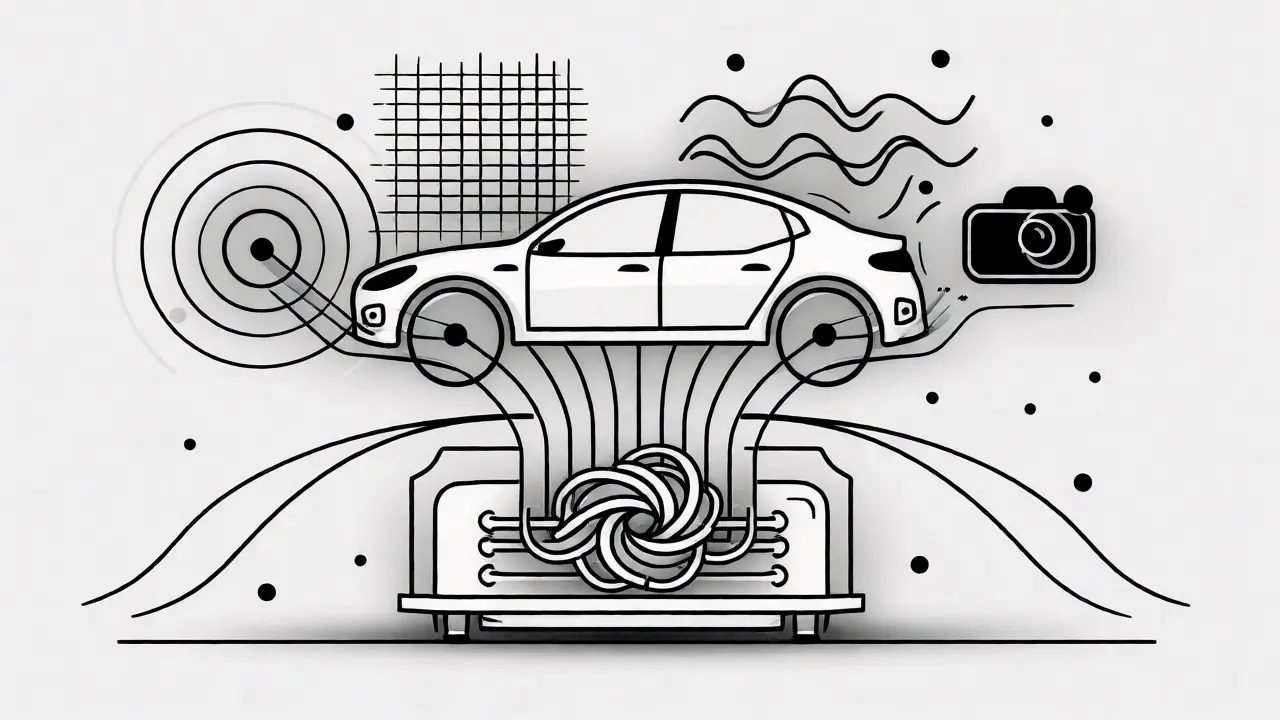
Enter 3D generative AI. Tools like Sora create video, but next-generation models are generating interactive 3D scenes. This requires processing LiDAR data, depth maps, and mesh structures alongside standard RGB images. Sensor fusion plays a huge role here. A self-driving car doesn’t just "see" a pedestrian; it fuses camera input with radar distance and lidar density to build a probabilistic map of reality.
In consumer tech, this enables better AR experiences. Instead of overlaying a static graphic on a screen, future AI will understand the geometry of your living room in real-time. It knows where the couch ends and the floor begins, allowing virtual objects to cast realistic shadows and collide with physical walls. This spatial intelligence relies on integrating multiple sensor streams into a coherent 3D understanding.
Haptics: The Missing Sense in Digital Interaction
We have solved seeing and hearing digitally. Touch is still primitive. When you touch a touchscreen, you feel glass, regardless of whether you’re tapping a button or dragging a heavy weight. This disconnect breaks immersion, especially in VR and remote work applications.
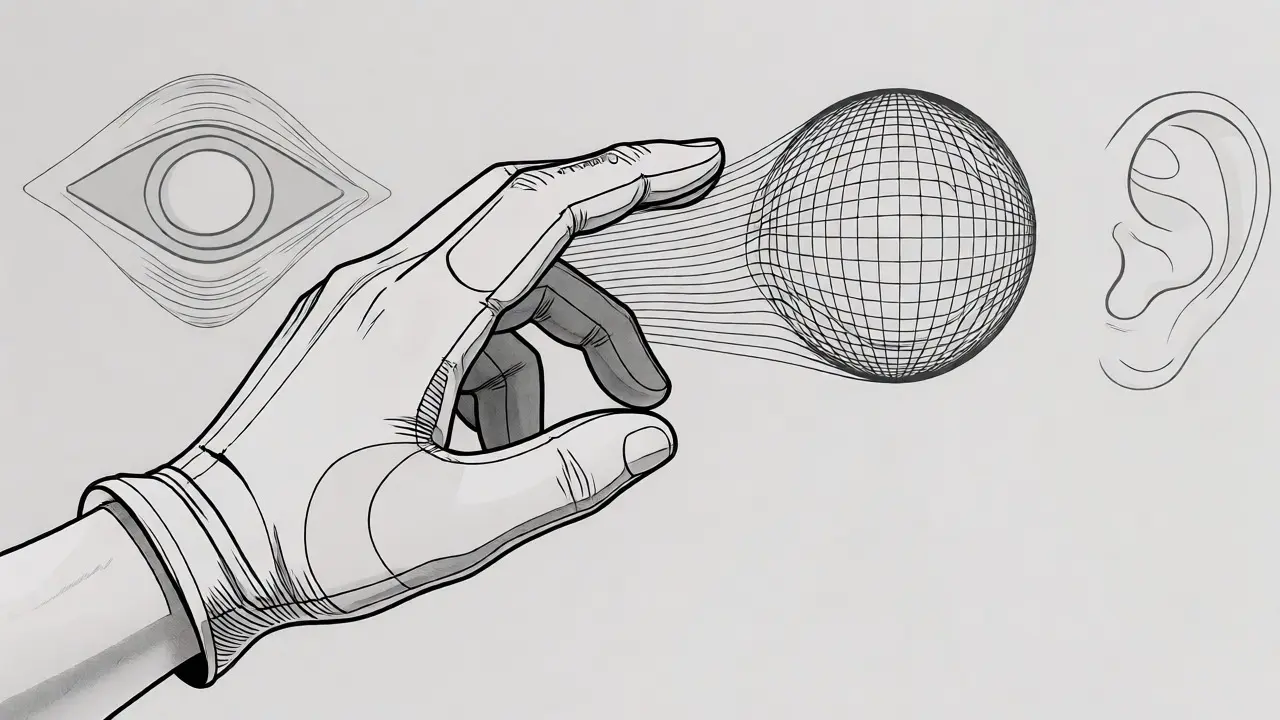
Multimodal AI is changing this by linking visual and auditory cues to haptic feedback. Imagine a surgeon practicing remotely. They see the tissue on a high-res screen, hear the scalpel cutting, and feel the resistance through a robotic glove. The AI system processes all three inputs simultaneously. If the visual texture changes (indicating denser tissue), the AI adjusts the haptic motor resistance instantly. This isn’t just playback; it’s predictive simulation.
Companies are already experimenting with ultrasonic haptics and electro-tactile interfaces driven by AI. The goal is to make digital interactions feel physically real. This requires low-latency inference. The AI must predict the tactile sensation before the user’s finger even makes contact, based on the visual context. This tight loop between perception and action is a hallmark of advanced multimodal systems.
Sensor Fusion and the IoT Explosion
The final piece of the puzzle is sensor fusion beyond cameras and microphones. We live in an age of ubiquitous sensors: temperature, humidity, chemical composition, motion, pressure. Internet of Things (IoT) devices generate massive amounts of structured and unstructured data that traditional LLMs ignore.
Future generative AI won’t just read reports; it will ingest raw sensor streams. Consider smart agriculture. Drones capture multispectral images, soil sensors measure moisture and pH, and weather stations provide wind speed. A multimodal AI fuses these disparate data sources to generate actionable advice: "Delay irrigation by two hours; humidity is rising, and leaf wetness suggests fungal risk."
This capability extends to industrial maintenance. Vibration sensors, thermal cameras, and acoustic monitors feed into a single model. The AI detects anomalies by correlating subtle changes across all channels. It might notice that a slight increase in vibration frequency coincides with a temperature spike, predicting a bearing failure weeks before it happens. This holistic view reduces false alarms and improves accuracy compared to analyzing each sensor in isolation.
Market Reality and Commercial Viability
Is this hype or business? The numbers suggest it’s the latter. According to Grand View Research, the global multimodal AI market was valued at $1.73 billion in 2024 and is projected to reach $10.89 billion by 2030. That’s a compound annual growth rate of 36.8%. Investors aren’t betting on sci-fi concepts; they’re funding practical applications.
Major players are aligning their roadmaps accordingly. Meta’s Llama 4 series emphasizes multi-modal capabilities, aiming to process text, video, and audio efficiently. Google’s Gemini line focuses on native multimodality, ensuring that smaller, on-device models can handle complex sensory tasks without relying on cloud servers. OpenAI continues to push the boundaries of real-time interaction, reducing latency to make voice and video conversations feel natural.
For businesses, the implication is clear: siloed data strategies are failing. If your customer support team analyzes chat logs while your product team watches usage metrics separately, you’re using late-fusion thinking. Integrating these streams allows for deeper insights. You can correlate sentiment in support tickets with specific UI interactions, revealing exactly which design flaws cause frustration.
Challenges on the Road Ahead
Despite the progress, significant hurdles remain. Compute costs are skyrocketing. Processing video and 3D data requires vastly more resources than text alone. Training unified models demands enormous datasets of aligned modalities-pairs of videos with accurate captions, or sensor logs with corresponding outcomes. Gathering this labeled data is expensive and time-consuming.
There’s also the issue of hallucination in non-text modalities. Models can invent details in images or misinterpret ambiguous sensor readings. Ensuring reliability in safety-critical applications, like autonomous driving or medical diagnostics, requires robust verification mechanisms. We need AI that knows what it doesn’t know, flagging uncertainty rather than guessing confidently.
Finally, privacy concerns intensify. Multimodal systems collect rich biometric and environmental data. Facial recognition, voice patterns, and location history combine to create detailed profiles of individuals. Regulations will likely tighten, requiring transparent data handling and consent frameworks specifically designed for multimodal ingestion.
What This Means for Developers and Creators
If you’re building software today, assume multimodality is the default. Don’t design apps that expect users to type queries. Design for voice, gesture, and image input. Use APIs that support unified context windows, allowing you to pass a PDF, a screenshot, and a voice note in a single request.
For creators, the tools are evolving rapidly. You can now generate 3D assets from text prompts, animate characters with voice lines, and simulate physical interactions. The barrier to entry for creating immersive content is dropping. However, the skill set required is shifting. It’s no longer enough to be good at writing prompts. You need to understand how different modalities interact. How does the pacing of audio affect the perception of visual motion? How does color influence the feeling of weight?
The future belongs to those who can orchestrate these senses. As hardware catches up-better cameras, cheaper LiDAR, responsive haptic gloves-the software will unlock experiences we can barely imagine today. The separation between digital and physical is dissolving, mediated by intelligent systems that speak the language of all our senses.
What is the difference between multimodal and generative AI?
Multimodal AI refers to the ability to process and understand multiple types of data (text, image, audio) simultaneously. Generative AI refers to the ability to create new content. Modern systems often combine both: they use multimodal inputs to generate creative outputs, such as turning a sketch into a photorealistic render or a text prompt into a video.
Why is unified tokenization important for AI models?
Unified tokenization converts all data types into a common format, allowing them to be processed by the same neural network layers. This enables deeper cross-modal reasoning and efficiency, as the model learns direct relationships between different senses (like sight and sound) rather than translating between separate systems.
How does sensor fusion improve autonomous vehicles?
Sensor fusion combines data from cameras, radar, LiDAR, and GPS to create a comprehensive model of the environment. Cameras provide detail and color, radar measures speed and distance, and LiDAR creates precise 3D maps. Fusing these inputs helps the vehicle detect obstacles accurately even in poor lighting or bad weather conditions.
Can multimodal AI run on mobile devices?
Yes, recent advancements like Gemini Nano demonstrate that lightweight multimodal models can run on-device. This reduces latency and improves privacy by processing sensitive data locally instead of sending it to the cloud. Optimization techniques like quantization and mixture-of-experts architectures make this possible.
What are the main challenges of adopting multimodal AI?
Key challenges include high computational costs, the difficulty of acquiring large datasets of aligned multimodal data, potential biases in training data, and privacy concerns related to collecting biometric and environmental data. Additionally, ensuring reliable performance in safety-critical applications remains a hurdle.
 Artificial Intelligence