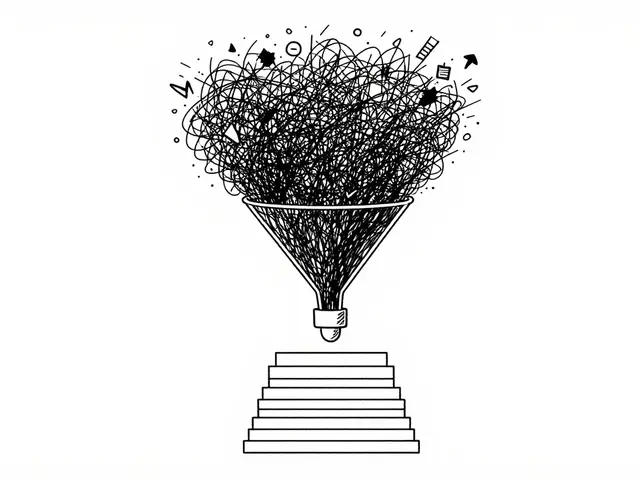
You might look at the code for a modern Large Language Model (LLM) like GPT-3 or Llama and feel underwhelmed. You expect to see a complex, evolving set of instructions where layer one does something totally different from layer ten. Instead, you find the exact same block of code repeated dozens-sometimes nearly a hundred-times in a row. It looks like a copy-paste error. But this repetition isn't laziness; it is the secret sauce behind why these models can reason, write poetry, and debug code.
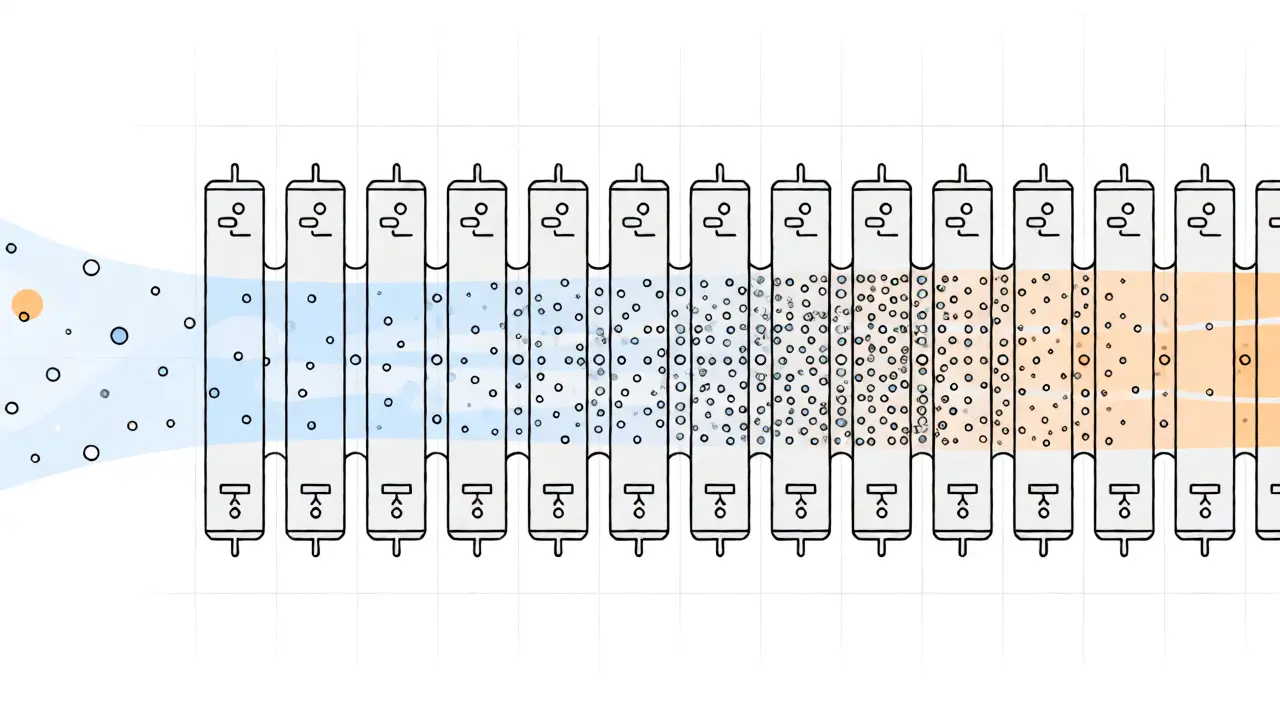
The core idea is surprisingly simple: Transformer Blocks are not designed to do everything at once. They are designed to refine information incrementally. Think of it less like a single brain cell firing and more like a team of editors passing a document down a line. The first editor fixes typos, the second checks grammar, the third improves flow, and the last one ensures the argument makes sense. Each person uses the same basic editing skills, but they apply them to a progressively better version of the text. This article breaks down exactly why we stack these identical blocks, how they build abstraction from raw data, and why this specific architecture won the AI race.
The Anatomy of a Single Transformer Block
To understand why we repeat the block, you first need to know what’s inside it. A standard transformer block is a standardized unit that performs two main jobs: mixing information between tokens and processing each token individually. It doesn’t matter if you’re using GPT-2, GPT-3, or an open-source model like Mistral; the internal structure remains remarkably consistent.
Every block contains four critical components working in harmony:
- Multi-Head Self-Attention: This allows every word (token) in a sequence to look at every other word simultaneously. If the sentence is "The bank rejected the loan," the attention mechanism helps the model link "bank" with "loan" and "rejected," understanding that this is a financial institution, not a river edge.
- Feed-Forward Network (MLP): After attention mixes the context, the MLP processes each token independently. It expands the data into a higher dimension, applies non-linear transformations, and compresses it back. This is where the model learns complex patterns about individual words within their new context.
- Residual Connections: Also known as skip connections, these add the input of the layer directly to its output. This creates a shortcut for gradients during training, preventing the signal from dying out as it travels through deep networks.
- Layer Normalization: This stabilizes the learning process by ensuring the inputs to each layer have a mean of zero and a variance of one. Without it, stacking many layers would cause numerical instability, making training impossible.
The magic isn’t in any single part being revolutionary on its own. The power comes from how these parts interact when stacked. A single block can capture local relationships, but it struggles with long-range dependencies or abstract reasoning. That’s where depth comes in.
From Tokens to Meaning: The Hierarchy of Abstraction
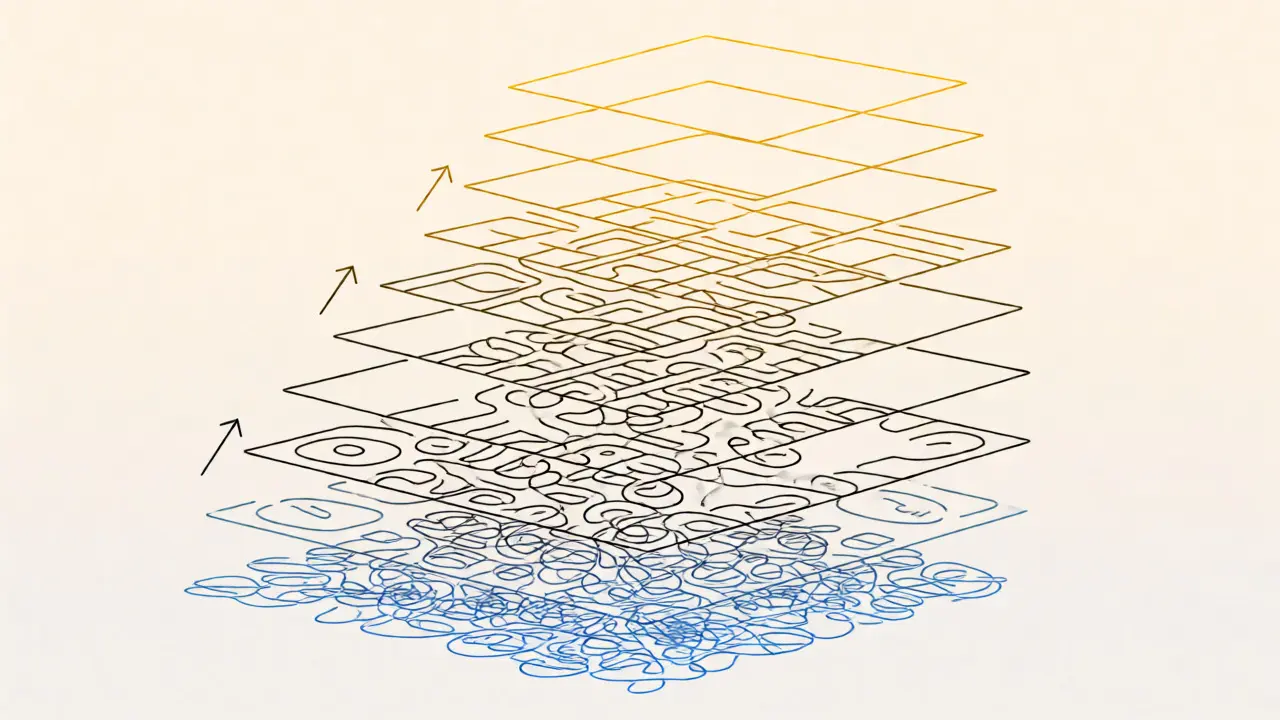
When you feed text into an LLM, it starts as raw numbers-token embeddings combined with position embeddings. These initial vectors don’t "know" what a sentence is; they just know which vector corresponds to the word "cat." As this data passes through the first few transformer blocks, the model begins to build a hierarchy of understanding. This process is often called Hierarchical Feature Extraction.
Research and empirical analysis show that different layers specialize in different levels of abstraction. Early layers act like linguists focusing on syntax. They learn to identify parts of speech, group words into phrases, and resolve immediate grammatical structures. For example, layer 1 might determine that "running" is a verb associated with "dog," while layer 5 might recognize "the big dog" as a noun phrase.
Middle layers shift focus to semantics. Here, the model starts connecting concepts across longer distances. It understands that "Apple" in one context refers to fruit and in another to a tech company, based on surrounding words hundreds of positions away. Later layers handle high-level reasoning and task-specific logic. By the time the data reaches the final blocks, the representation of a simple token has been transformed into a rich, contextual vector that encodes meaning, intent, and relationship to the entire prompt.
| Layer Depth | Primary Function | Example Capability |
|---|---|---|
| Early (Layers 1-10) | Syntax & Local Patterns | Identifying nouns vs. verbs; resolving pronoun antecedents nearby. |
| Middle (Layers 11-40) | Semantics & Entity Relations | Understanding topic consistency; linking related concepts across paragraphs. |
| Late (Layers 41+) | Reasoning & Task Logic | Following complex instructions; multi-step logical deduction; tone adjustment. |
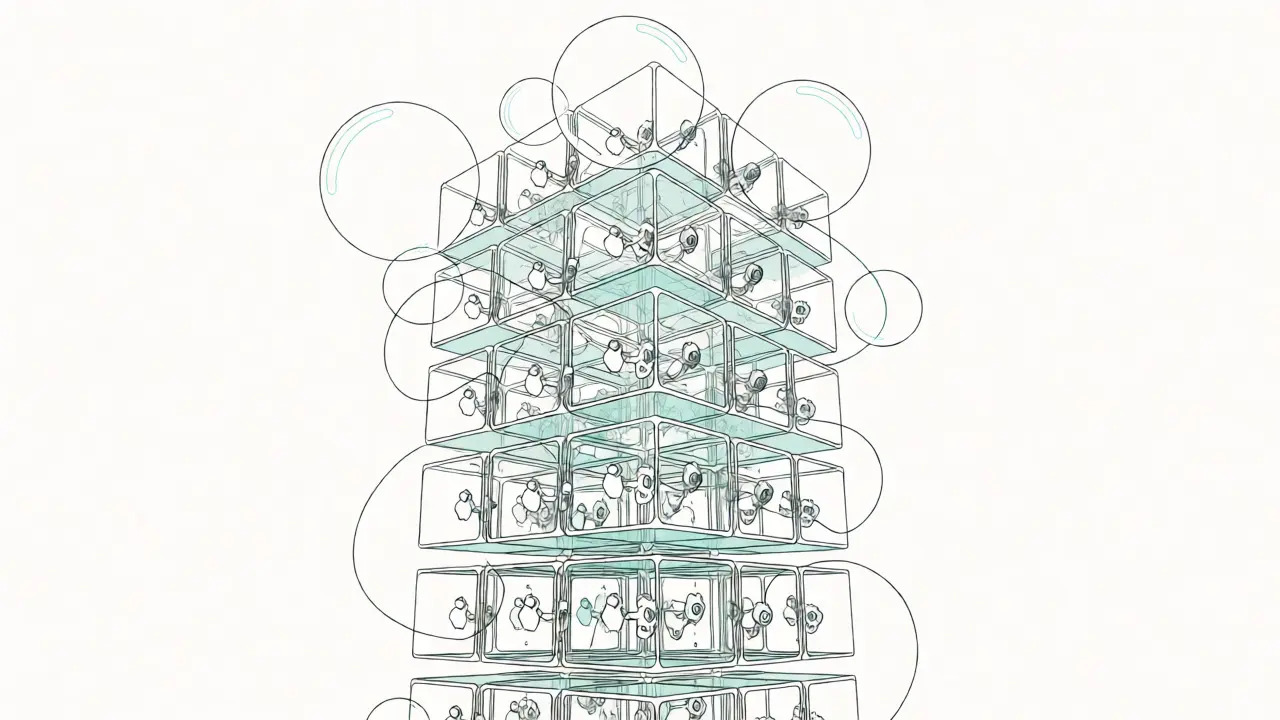
This specialization emerges naturally from training. We don’t hard-code "layer 10 handles semantics." Instead, the loss function encourages the network to distribute the work efficiently. Because each block refines the output of the previous one, the model builds complexity on top of simplicity, much like constructing a skyscraper floor by floor.
Why Repetition Beats Complexity
You might ask: Why not design unique layers for each stage? Why make layer 1 different from layer 2? There are three practical reasons why uniformity wins.
First, trainability. Deep neural networks suffer from vanishing gradients-the signal from the output gets weaker as it propagates backward to update early weights. Residual connections help, but having a consistent structure simplifies optimization. When every layer behaves similarly, hyperparameters like learning rates tend to work uniformly across the entire stack. Designing bespoke layers for each position would require tuning dozens of separate parameters, making training brittle and slow.
Second, parallelism. Transformers were built to replace Recurrent Neural Networks (RNNs), which processed data sequentially. In an RNN, you had to finish step 1 before starting step 2. Transformers use self-attention to process all tokens in parallel within a layer. However, the layers themselves still process sequentially in depth. Because the block structure is identical, hardware accelerators like GPUs and TPUs can optimize kernels specifically for this one pattern. You get massive speedups because the hardware knows exactly what math to perform next, over and over again.
Third, scalability. If you want to double the size of your model, you simply add more blocks. You don’t need to redesign the architecture. This modularity allowed researchers to scale from small models with 12 layers to GPT-3’s 96 layers without rewriting the core logic. It turns model scaling into a linear engineering problem rather than a theoretical nightmare.
The Role of Residuals in Deep Stacks
If you remove residual connections from a deep transformer stack, the model often fails to train. Why? Because without them, each layer must completely rewrite the representation passed from the previous layer. In a 96-layer model, asking layer 50 to reconstruct the original meaning from scratch is incredibly difficult. Small errors compound rapidly.
Residual connections allow each layer to learn a delta-a small correction to the existing representation. Layer 10 doesn’t need to rebuild the concept of "finance" from scratch; it just needs to tweak the vector slightly to account for the word "interest." This incremental refinement strategy makes deep stacks stable. It transforms the problem from "learn a complex function" to "learn a small adjustment," which is far easier for gradient descent to solve.
This stability is crucial for emergent capabilities. Features like in-context learning-where the model adapts to new tasks based only on examples in the prompt-rely on the ability of deep stacks to propagate subtle signals from the beginning of a long sequence to the end. Residuals ensure those signals survive the journey.
Emergent Capabilities Through Depth
Some abilities simply don’t exist in shallow models. You cannot teach a 4-layer transformer to follow a five-step logical instruction reliably. These behaviors emerge only when you have sufficient depth. This phenomenon is known as Emergent Abilities.
Consider multi-step reasoning. To answer "If Alice gives Bob her apple, and Bob eats it, who has no apple?", the model must track state changes. Early layers parse the grammar. Middle layers track the entities (Alice, Bob, Apple). Late layers simulate the transfer of ownership and deduce the final state. This chain of thought requires distinct stages of processing that only become possible when there are enough layers to dedicate resources to each sub-task.
In-context learning works similarly. When you provide few-shot examples, the model must compare the query against the examples. Attention mechanisms allow it to attend to relevant examples, but deeper layers are needed to generalize the pattern from those examples to the new input. Shallow models memorize; deep models generalize. The repetition of blocks provides the necessary computational depth to move from surface-level pattern matching to true semantic understanding.
Is All That Depth Necessary?
Recent research challenges the assumption that every layer is equally important. A 2024 study titled "What Matters in Transformers? Not All Attention is Needed" found significant redundancy in attention modules. The authors demonstrated that you could drop entire attention blocks or even specific heads without severely degrading performance on certain tasks. This suggests that while depth is essential for building abstractions, not every repeated component contributes uniquely to the final output.
This finding has sparked interest in sparse architectures and dynamic routing. Future models might activate only a subset of layers depending on the difficulty of the input, saving compute power. However, even in these optimized scenarios, the underlying principle remains: abstractions are built by composing multiple transformation steps. Whether you run all 96 layers or dynamically select 60, the architectural backbone is still a stack of similar units.
Furthermore, specialized architectures for long documents still rely on stacking. Some designs inject document-level summaries into every layer, allowing global context to influence local processing at every depth. Even here, the repetition of the base block structure persists, proving that the modular approach is robust even when augmented with extra pathways.
Practical Implications for Developers
If you are building or fine-tuning an LLM, this architecture dictates your workflow. You don’t need to invent new layer types. Your job is to tune the width (embedding size, number of heads) and depth (number of layers) of the standard block. Frameworks like PyTorch and JAX provide highly optimized implementations of the `GPT2Block` or equivalent, so you benefit from community-tested stability.
Debugging also becomes easier. If your model fails, you can isolate issues to specific depths. Visualizing attention maps in early layers reveals syntactic errors; looking at late layers reveals reasoning failures. This diagnostic clarity is a direct result of the hierarchical nature of stacked blocks.
Why don't transformers use recurrent connections like RNNs?
Transformers replaced recurrence with self-attention to enable parallel processing. RNNs process tokens one by one, creating bottlenecks and vanishing gradient problems. Transformers let every token attend to every other token simultaneously within a layer, allowing for massive parallelization on GPUs and better handling of long-range dependencies.
Do all layers in a transformer do the same thing?
Structurally, yes-they have the same weights initialization scheme and architecture. Functionally, no. Due to training dynamics, early layers specialize in low-level features like syntax, while later layers specialize in high-level semantics and reasoning. The identical structure allows for efficient implementation, but the learned weights differentiate their roles.
What happens if I remove residual connections?
Training becomes unstable or impossible for deep models. Residual connections allow gradients to flow backward easily and let layers learn incremental updates rather than complete transformations. Without them, deep stacks suffer from vanishing gradients and degradation, where adding more layers actually hurts performance.
Can we reduce the number of layers without losing quality?
Sometimes, yes. Research shows redundancy in attention heads and layers. Techniques like layer dropping or pruning can remove some layers with minimal impact. However, significantly reducing depth usually harms complex reasoning and long-context understanding, as these capabilities rely on the cumulative effect of many transformation steps.
How does stacking layers help with long contexts?
Each layer can propagate information further. While self-attention connects all tokens directly, deeper layers integrate this information into more coherent representations. This allows the model to maintain consistency and reference distant parts of a document effectively, enabling capabilities like summarizing a whole book or tracking characters in a novel.
 Artificial Intelligence