
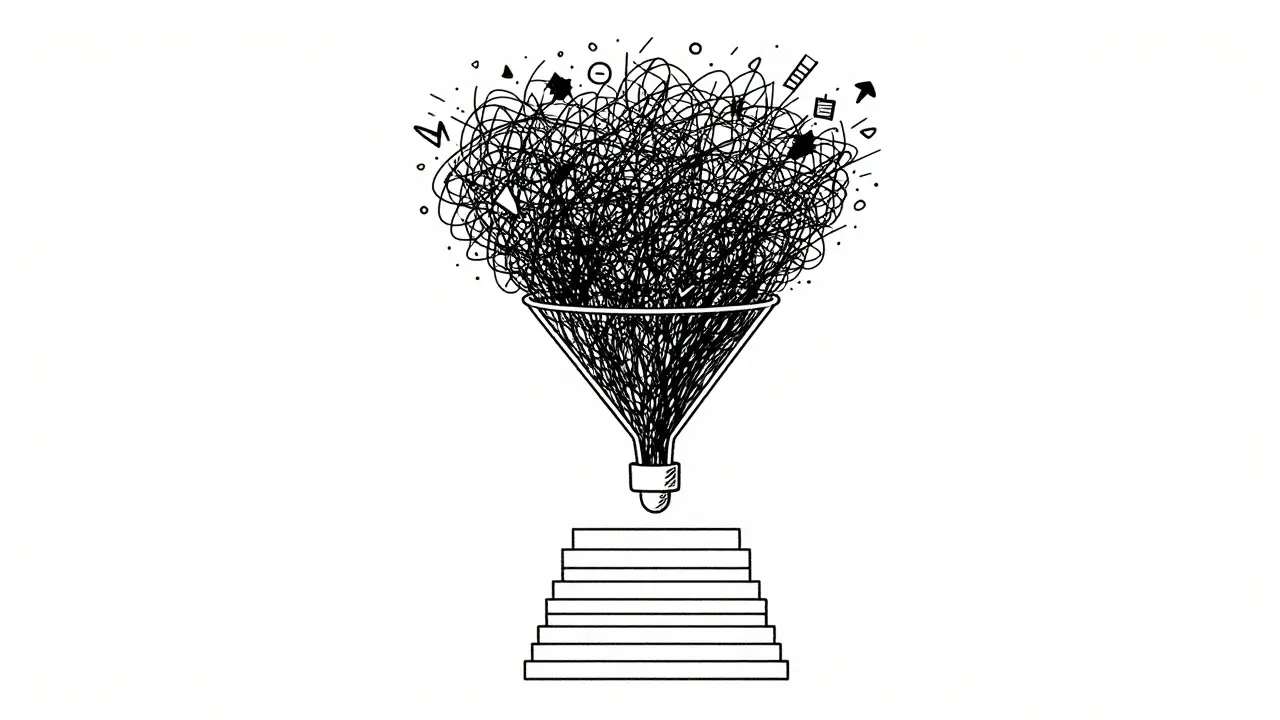
You spend millions on GPU compute to train your large language model. You tune hyperparameters until they shine. But if the text you feed into that model is noisy, biased, or nonsensical, all that power goes to waste. This is the "garbage in, garbage out" reality of modern AI development. The difference between a mediocre chatbot and a world-class assistant often comes down to one thing: data quality.
For years, researchers assumed more data meant better models. That logic held up until datasets hit the trillion-token scale. Now, we know that unfiltered web scrapes can degrade performance by up to 37% on key benchmarks like MMLU and GSM8K. The industry has shifted from hoarding data to curating it. The challenge? How do you measure quality when you have petabytes of text?
The answer lies in a two-pronged approach: lightweight heuristic filters are rule-based checks that remove obvious noise quickly and sophisticated model-based classifiers are machine learning systems that evaluate semantic quality and coherence. Let’s break down how these tools work, their trade-offs, and how to build a pipeline that actually works.
The Foundation: Heuristic Filters
Before you run expensive neural networks, you need to clean up the obvious mess. Heuristic filters are simple, fast, and rule-based. They don’t understand context, but they are excellent at removing structural garbage. Think of them as the bouncer at the club door checking IDs, not judging personality.
Most pipelines start with basic text statistics. Here are the standard thresholds used by top-tier teams:
- Word Count: Documents outside the 50-5,000 word range are usually discarded. Too short, and there’s no signal. Too long, and it might be a corrupted dump or a book chapter that needs splitting.
- Alphabetic Ratio: If less than 75-85% of characters are letters, the text likely contains code, binary data, or excessive punctuation spam.
- Average Word Length: Keeping words between 3.5 and 6.5 characters helps filter out gibberish or overly dense technical jargon that lacks readability.
Beyond length, heuristics tackle duplicates and language purity. Duplicate content removal uses exact or fuzzy matching (95-98% similarity) to prevent the model from overfitting on repeated phrases. Code-switching detection flags documents where non-target languages exceed 10-15%, ensuring linguistic consistency.
The benefit here is speed. These rules process terabytes of data in hours. However, they lack nuance. A strict word count filter might accidentally delete high-quality technical abstracts or poetry. That’s why heuristics are never the final step-they are just the first sweep.
The Middle Ground: N-Gram and BERT Classifiers
Once the obvious noise is gone, you need something that understands structure without the cost of running a full LLM. This is where n-gram classifiers and transformer-based models come in.
fastText is a lightweight library for efficient text classification using n-grams remains a popular choice for initial model-based filtering. It requires minimal training data (100k-1M samples) and processes about 1,200 documents per second on a single NVIDIA A100 GPU. It catches patterns that heuristics miss, like repetitive sentence structures or low-information density, achieving 78-82% accuracy in identifying low-quality content.
If you need higher precision, you move to BERT-style classifiers are transformer models fine-tuned to assess text quality based on semantic coherence. These are slower-processing only 85-120 documents per second on the same hardware-but they offer 28-35% better precision. They can detect subtle issues like logical inconsistencies or poor narrative flow. For example, the FineWeb-Edu classifier, developed by Carnegie Mellon University, specializes in educational content, achieving 87% precision while processing 450GB of web text per hour on an H100 GPU.
The trade-off is clear. BERT classifiers cost 4.7x more in compute than n-gram approaches. You pay for accuracy. Most teams use n-grams for broad filtering and reserve BERT for critical subsets of data where quality is paramount.
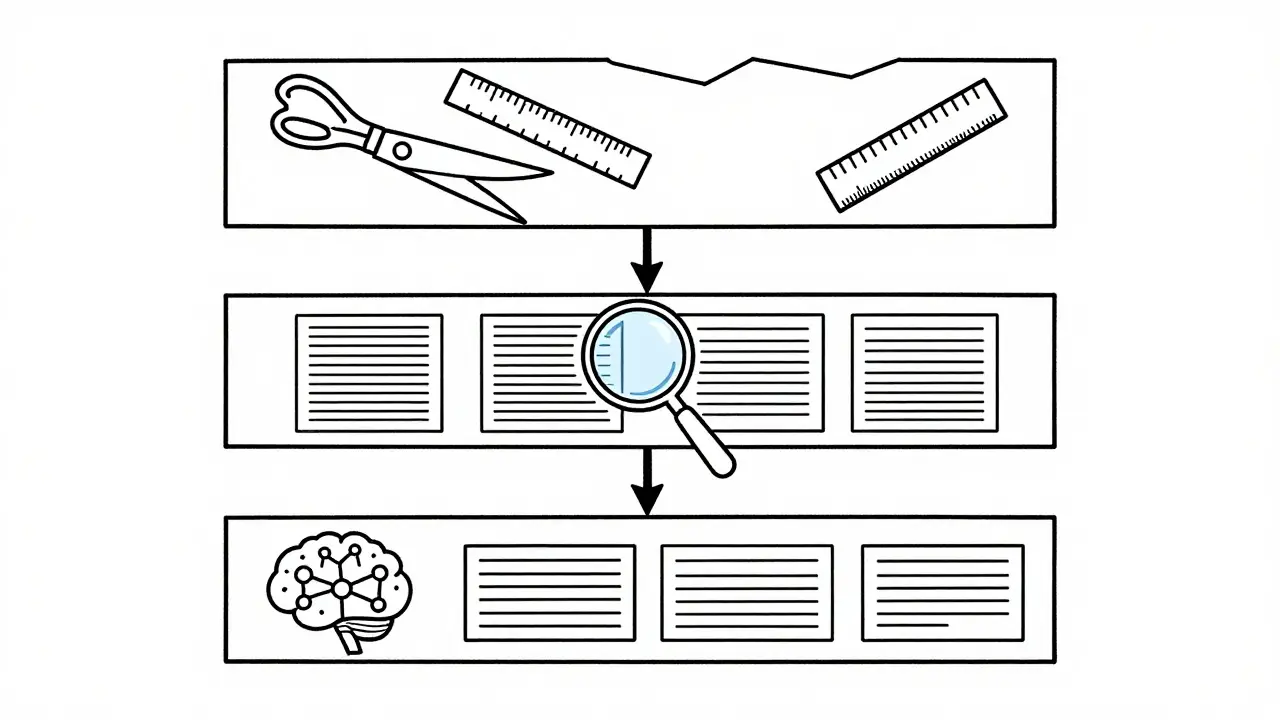
The Gold Standard: LLM-as-Judge and Reward Models
At the top of the food chain are methods that use LLMs themselves to judge data quality. Known as "LLM-as-judge," this approach achieves 92-95% correlation with human judgments. It evaluates dimensions like helpfulness, correctness, and coherence.
Specialized reward models, such as NVIDIA’s Nemotron-4-340B, assess data across five key attributes: Helpfulness, Correctness, Coherence, Complexity, and Verbosity. In benchmark tests, these models showed 89% alignment with human expert evaluations across 10,000 sampled documents. This level of scrutiny is essential for high-stakes domains like healthcare or finance, where factual accuracy must exceed 99.2%.
However, the cost is prohibitive for massive datasets. Processing 15-25 documents per minute on eight A100 GPUs means filtering a trillion-token dataset would take months and cost tens of thousands of dollars. As Dr. James Thewlis from NVIDIA noted, investing heavily in data quality pays off by reducing downstream refinement costs by 30-40%. But you can’t afford to run an LLM judge on every line of raw web crawl.
Building a Cascaded Filtering Pipeline
Because no single method is perfect, 73% of practitioners use a cascaded approach. This strategy balances speed, cost, and accuracy. Here is how a typical enterprise pipeline looks:
- Heuristic Sweep: Remove 18-22% of raw data using length, character ratio, and duplicate checks. This is free and instant.
- N-Gram Classification: Run fastText or similar tools to remove another 12-15% of structurally poor content. This handles the bulk of the remaining noise efficiently.
- BERT/Transformer Assessment: Apply deeper semantic filters to critical datasets, removing 5-8% more low-value content. This targets logical flaws and coherence issues.
- LLM-as-Judge Sampling: Use expensive LLM evaluation on a small sample (0.5-1.5%) or only for the highest-priority data segments. This ensures the final output meets human-level standards.
This hybrid approach achieves 89-92% overall quality while keeping compute costs manageable. By contrast, using only heuristics results in 75-78% quality, while using only LLMs for a 10TB dataset could cost $18,500-$22,000 in cloud resources alone.

Common Pitfalls and Bias Risks
Data quality measurement isn’t just about technical metrics; it’s about fairness and representativeness. Dr. Emily M. Bender from the University of Washington warns against the "illusion of objectivity." Classifiers trained primarily on English web text often devalue content from non-Western perspectives by 22-27%. If your quality filter penalizes diverse dialects or cultural contexts, your model will inherit those biases.
Another risk is "heuristic overfiltering." Strict rules can accidentally remove 8-12% of high-quality technical content, such as code snippets or mathematical proofs, which naturally deviate from standard alphabetic ratios. Regular audits are necessary. Teams typically sample filtered data for human review, costing around $3,200-$4,800 per million documents, to catch these errors.
Model drift is also a concern. Web content evolves rapidly. A static classifier becomes less effective over time, requiring retraining every 45-60 days to stay relevant. Without regular updates, your quality metrics decay, and so does your model’s performance.
| Method | Accuracy | Speed (Docs/sec) | Compute Cost | Best Use Case |
|---|---|---|---|---|
| Heuristics | Low (75-78%) | Very High (>10,000) | Negligible | Initial noise removal |
| fastText (N-Gram) | Medium (78-82%) | High (~1,200) | Low | Broad-scale filtering |
| BERT Classifier | High (85-89%) | Medium (~100) | Medium | Semantic coherence check |
| LLM-as-Judge | Very High (92-95%) | Low (~0.3) | Very High | Critical data sampling |
Future Trends in Data Quality
The field is moving toward "quality-aware training," where models dynamically adjust learning rates based on real-time data quality assessment during training. NVIDIA plans to integrate multimodal quality assessment by mid-2026, extending these principles to images and audio. As datasets grow larger, the margin for error shrinks. With Meta’s Llama 3.1 trained on 15.6 trillion tokens, even 99.9% filtering accuracy leaves 15.6 billion low-quality tokens. The goal is now 99.95-99.99% cumulative accuracy through layered, complementary techniques.
What is the most cost-effective way to filter LLM training data?
A cascaded approach is most cost-effective. Start with heuristic filters to remove obvious noise, then use fastText for broad classification, and reserve expensive BERT or LLM-based judges for critical subsets. This balances speed and accuracy while minimizing compute costs.
How much does data quality impact LLM performance?
Significantly. Research shows that filtered datasets can improve benchmark accuracy by 12-18% and reduce bias indicators by 15-25%. Conversely, unfiltered data with 15% low-quality content can degrade performance by up to 37%.
What are the risks of using automated quality filters?
Automated filters can introduce bias, particularly against non-Western perspectives or diverse dialects. They may also overfilter, removing valuable technical content. Regular human-in-the-loop audits and retraining every 45-60 days are essential to mitigate these risks.
When should I use LLM-as-judge for data filtering?
Use LLM-as-judge for high-stakes domains like healthcare or finance where factual accuracy is critical, or for sampling small portions of data to validate other filters. It is too slow and expensive for filtering entire trillion-token datasets.
What is the role of heuristic filters in a modern pipeline?
Heuristic filters serve as the first line of defense, quickly removing duplicates, code, binary data, and extremely short or long documents. They reduce the volume of data passed to more expensive model-based filters by 18-22%.
 Artificial Intelligence





Geet Ramchandani
May 24, 2026 AT 15:32Look, I’ve been in this game long enough to know that half of these 'experts' are just selling snake oil wrapped in fancy jargon. You think a simple heuristic filter is going to save your ass when the underlying data is fundamentally corrupted by corporate bias? Please. The whole industry is built on a foundation of sand, and you’re here talking about word counts like it’s some holy grail. It’s laughable how much money we throw at GPUs while ignoring the fact that the models themselves are becoming more dangerous with every iteration. We need to stop pretending that 'quality' is a metric that can be quantified by a script written by someone who hasn’t read a book since 1995. It’s all a facade.
Priti Yadav
May 25, 2026 AT 09:41The grammar in this post is atrocious, and I mean that literally.
You cannot possibly expect anyone to take your 'cascaded pipeline' seriously when you fail to capitalize proper nouns consistently and use passive voice where active would suffice. It is obvious that the author has not proofread this text, which suggests a lack of attention to detail that is terrifying when applied to AI safety protocols. If they cannot manage basic syntax, how can we trust their data filters? The conspiracy is clear: they want us to believe complexity equals quality so they can charge more for their cloud services. Wake up people! Check your sources and fix your punctuation before you lecture us on coherence.
Ajit Kumar
May 25, 2026 AT 18:50I must express my profound disappointment with the ethical vacuum that permeates this discussion, as it seems entirely focused on computational efficiency rather than the moral implications of filtering human knowledge through algorithmic lenses that inevitably carry the prejudices of their creators. When we speak of removing 'noise,' we are often engaging in a form of cultural erasure, discarding dialects and perspectives that do not conform to the narrow standards of Western academic English, thereby reinforcing existing power structures under the guise of technical optimization. It is a moral imperative for those developing these systems to recognize that data is not merely inert information but a reflection of lived experiences, and thus, any attempt to curate it without rigorous ethical oversight is an act of violence against diversity itself. We must demand transparency and accountability from these tech giants, ensuring that their pursuit of accuracy does not come at the cost of inclusivity and fairness, for otherwise, we are building tools that will perpetuate inequality on a global scale.
Diwakar Pandey
May 26, 2026 AT 01:08I guess everyone has strong opinions today.
It’s interesting to see such intense reactions to what is essentially a technical breakdown of standard practices. Maybe if we took a step back and looked at the actual utility of these methods, we could find some common ground. Not everything needs to be a moral crisis or a grammatical war zone. Sometimes, cleaning data is just about making things work better. Just saying.
Pooja Kalra
May 27, 2026 AT 09:08The essence of truth is obscured by the veil of statistics. One must look beyond the numbers to see the soul of the machine.
Sumit SM
May 27, 2026 AT 17:02Indeed!; And furthermore;; One must consider; That the very act of filtering; Is a form of judgment; Which reflects; The biases of the filterer!; It is a philosophical quagmire; Where logic meets chaos!; Who are we; To decide what is noise?; Perhaps the noise; Is the signal!; Think about it!