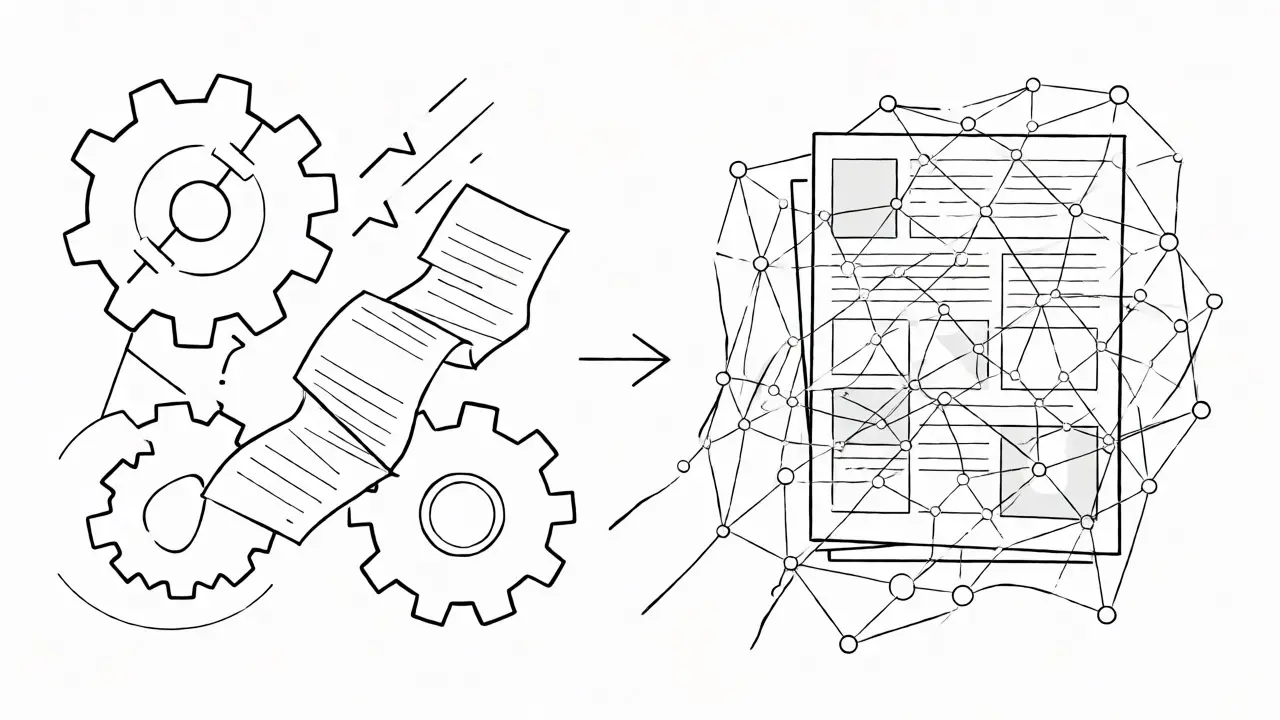
You have a stack of invoices, a pile of handwritten notes, or a complex financial report. You need the data out of them and into your database. For decades, this meant using Optical Character Recognition (OCR) tools that were great at reading clear text but terrible at understanding context. They would see "100" and tell you it was a number, but they couldn't tell if it was a total, a tax amount, or a page number without rigid templates.
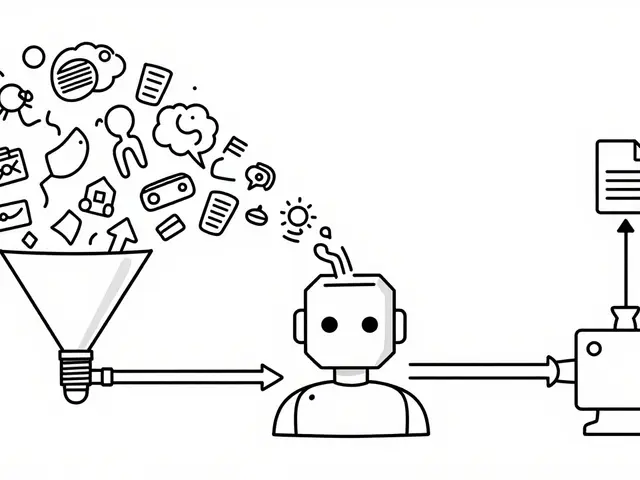
Today, that landscape has shifted dramatically. We are no longer just extracting characters; we are extracting meaning. By combining traditional OCR with Multimodal Generative AI, which integrates visual processing with language models, businesses can now pull structured data from messy images with near-human accuracy. This isn't just about speed-it's about reliability in the face of chaos. Whether you're dealing with distorted scans, handwriting, or complex tables, modern systems like Google Document AI and NVIDIA NeMo Retriever are changing how we handle unstructured documents.
The Shift from Pattern Matching to Contextual Understanding
Traditional OCR, such as Tesseract (version 5.3.0), relies on pattern matching. It looks for shapes that resemble letters. If the image is clean, it works well-achieving roughly 94% accuracy on scanned documents. But throw in a crumpled receipt, a low-resolution photo taken on a phone, or a table with merged cells, and accuracy plummets below 70%. The system sees pixels, not information.
Multimodal AI changes the game by introducing context. These systems use Vision-Language Models (VLMs) that understand both what an image looks like and what the text means. For instance, GPT-4o doesn't just read the word "Total"; it understands that "Total" usually precedes a monetary value at the bottom of a document. According to benchmarks from Roboflow in August 2024, multimodal approaches maintain over 85% accuracy on distorted text where traditional OCR fails completely. This contextual awareness allows the AI to correct errors based on logic rather than just pixel comparison. If a digit looks ambiguous, the model checks the surrounding context to decide if it’s a '1' or a '7'. This shift from mechanical recognition to intelligent interpretation is why enterprises are rapidly adopting these tools.
Key Technologies Powering Modern Extraction
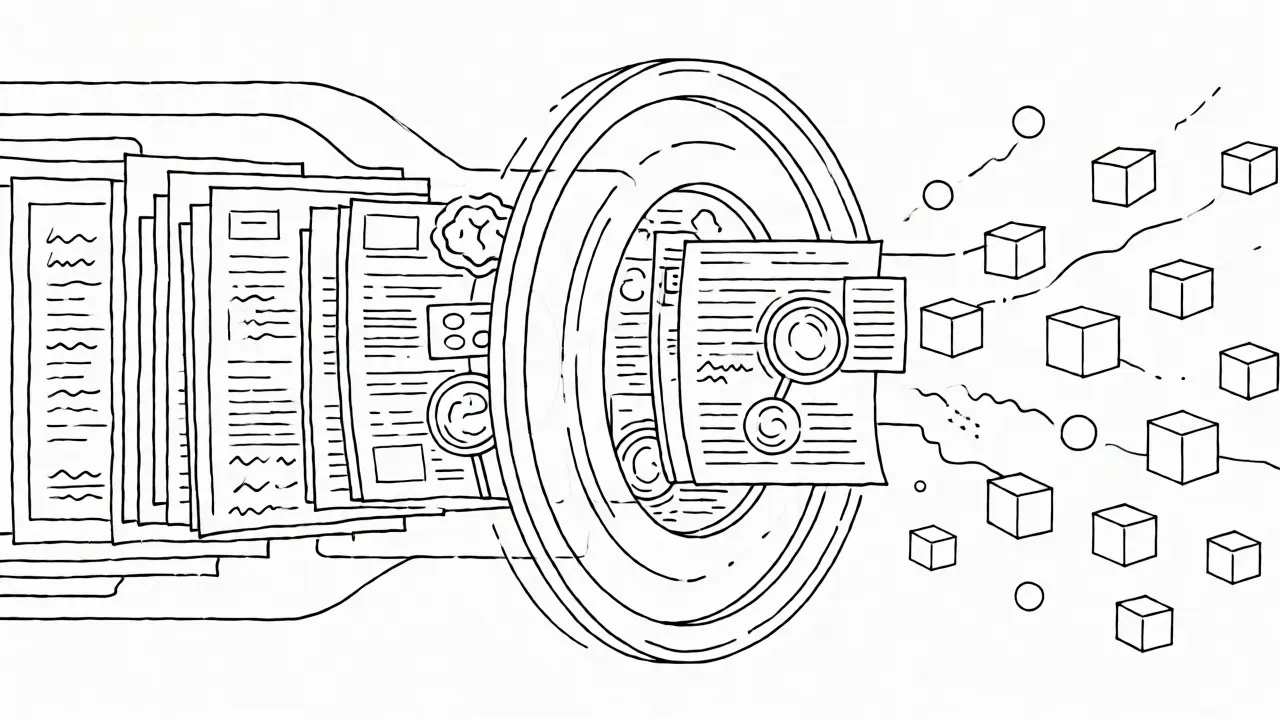
Several technologies underpin this new wave of document intelligence. One standout is TrOCR (Transformer-based OCR). Unlike older systems that separate text detection from recognition, TrOCR uses a unified Transformer architecture. It processes the entire image region to predict the text sequence directly. While it achieves impressive results-98.7% accuracy on printed text-it still struggles with handwriting, dropping to 89.2%. This highlights a current limitation: even advanced models find human scrawl difficult.
Another major player is Google Document AI. As of October 2024, its Workbench allows developers to build custom extractors using foundational models. You don't need thousands of training examples anymore; providing just 5-10 sample documents is often enough to fine-tune the model for specific tasks. This drastically reduces the barrier to entry. Similarly, NVIDIA NeMo Retriever offers a microservices architecture capable of processing over 1,200 documents per minute on a single A100 GPU. For high-volume operations, this throughput is critical.
Azure AI Document Intelligence (formerly Form Recognizer) focuses on layout analysis, preserving document structure with 95.2% fidelity. This is vital for legal and financial documents where the position of text matters as much as the content itself. Each of these tools serves a different niche, but all share the common goal of turning pixels into usable JSON data.
Comparing Major Platforms: Accuracy, Cost, and Use Cases
Choosing the right tool depends on your specific needs. Do you need raw speed? High accuracy on handwriting? Or deep integration with existing cloud ecosystems? Below is a comparison of leading platforms based on recent data.
| Platform | Key Strength | Pricing Model | Accuracy Notes |
|---|---|---|---|
| Google Document AI | Custom extraction with few samples; strong domain-specific models | $1.50 per 1,000 pages (specialized processors) | 96.3% field extraction accuracy for invoices (Q3 2024) |
| AWS Textract | Deep integration with AWS ecosystem; AnalyzeDocument API | $0.0015/page (basic); $0.015/page (analytic) | Struggles with complex tables; ~30% manual restructuring needed |
| Azure Form Recognizer | Layout preservation; Microsoft ecosystem compatibility | Free tier (500 pages/mo); $1.00 per 1,000 pages | 95.2% layout fidelity; steep learning curve for non-.NET devs |
| GPT-4o (Multimodal LLM) | Contextual understanding; handles messy/handwritten inputs | Token-based pricing (variable) | 85%+ on distorted text; higher computational cost |
Notice the trade-offs. Google Document AI excels when you have consistent document types, like invoices or receipts. Its Custom Extractor feature lets you train it quickly. AWS Textract is powerful but users on Hacker News reported significant frustration with table extraction, noting that nearly a third of extracted tables required manual fixing. Azure is robust for enterprise environments already using Microsoft products but can be tricky for developers outside that stack. GPT-4o offers the best general-purpose understanding but comes with higher latency and cost due to the heavy computational load of large language models.
Real-World Implementation Challenges
It’s not all smooth sailing. Even with advanced AI, real-world data is messy. One common issue is hallucination. Professor Emily Bender from the University of Washington highlighted concerns about over-reliance on LLMs for document processing. Her team found that when processing 5,000 business cards through GPT-4o, the hallucination rate reached 12.3%. The model sometimes invented details that weren't there because it tried to make sense of ambiguous input.
To mitigate this, experts recommend implementing validation layers. Don't trust the output blindly. Use JSON Schema to validate the structure of the extracted data. For example, if you expect a date, ensure the output matches a date format. If you expect a currency, check for numeric values. OpenAI’s November 2024 guide to structured outputs emphasizes this approach. Additionally, pre-processing images with tools like OpenCV can enhance quality before feeding them into the model, reducing errors caused by poor lighting or blur.
Another challenge is handling non-standard formats. Microsoft acknowledges that documents with highly variable layouts may require 20-30% more training samples to achieve acceptable accuracy. This means your initial setup might take longer than expected. A user on Reddit reported successfully processing 12,000 invoices with Google Document AI after providing just 8 training examples, achieving 94.7% accuracy. However, another user struggled with AWS Textract for financial statements, spending hours restructuring tables. The lesson? Test extensively with your own data before committing to a platform.

The Future: Integration with RAG and Enterprise Adoption
The trajectory of this technology points toward deeper integration with Retrieval-Augmented Generation (RAG) frameworks. Instead of just extracting data, companies want to query it. Imagine uploading a 500-page technical manual and asking, "What are the safety warnings for Model X?" Multimodal RAG systems can retrieve the relevant section and generate an answer based on both text and diagrams. According to a C3 survey in November 2024, 73% of enterprise AI leaders plan to implement multimodal RAG solutions by the end of 2025.
Regulatory pressures are also shaping development. The EU AI Act, effective February 2025, requires transparency in AI systems used for legally binding decisions. Vendors are responding by enhancing explainability features, allowing users to see exactly which parts of an image led to a specific extraction. This is crucial for industries like finance and healthcare, where audit trails are mandatory.
Market growth supports this trend. The global intelligent document processing market is projected to reach $3.92 billion by 2027, growing at a CAGR of 17.9%. Gartner predicts that by 2026, 80% of enterprise document workflows will incorporate multimodal AI, up from 25% in 2023. Early adopters report 40-60% reductions in manual review time, proving that the ROI is tangible.
Quick Summary / Key Takeaways
- Context is King: Multimodal AI outperforms traditional OCR by understanding the relationship between visual elements and text, especially in messy or complex documents.
- Choose Based on Needs: Use Google Document AI for custom, high-accuracy extraction with few samples; Azure for layout-heavy docs in Microsoft stacks; GPT-4o for general-purpose, hard-to-read inputs.
- Validate Outputs: Always implement schema validation to catch AI hallucinations, which can occur at rates up to 12.3% in unstructured data scenarios.
- Pre-process Images: Enhance image quality with tools like OpenCV before sending them to the model to improve accuracy significantly.
- Future-Proof with RAG: Plan for integration with RAG frameworks to enable natural language queries against your extracted document data.
How does multimodal AI differ from traditional OCR?
Traditional OCR identifies characters based on pixel patterns, while multimodal AI combines visual processing with language models to understand context. This allows it to interpret complex layouts, handwriting, and ambiguous text more accurately by leveraging semantic understanding rather than just shape recognition.
Which platform is best for extracting data from handwritten documents?
While no system is perfect, multimodal LLMs like GPT-4o generally perform better on handwriting than traditional OCR engines like Tesseract. However, specialized services like Google Document AI also offer improved handwriting capabilities compared to legacy systems, though accuracy still lags behind printed text recognition.
What are the main costs associated with using these services?
Costs vary by provider. Google Document AI charges approximately $1.50 per 1,000 pages for specialized processors. AWS Textract ranges from $0.0015 to $0.015 per page depending on complexity. Azure offers a free tier for low volumes and paid plans starting around $1.00 per 1,000 pages. LLM-based approaches typically use token-based pricing, which can be higher due to computational intensity.
Can I train a custom extractor with limited data?
Yes, modern tools like Google Document AI Custom Extractor allow fine-tuning with as few as 5-10 sample documents. This is a significant improvement over previous requirements of hundreds of examples, making it feasible for small teams to create tailored extraction pipelines quickly.
How do I handle AI hallucinations in document extraction?
Implement strict validation rules using JSON Schema to ensure extracted fields match expected formats (e.g., dates, numbers). Additionally, use confidence scores provided by some APIs to flag low-confidence extractions for human review. Pre-processing images to improve clarity also reduces the likelihood of misinterpretation.
 Artificial Intelligence