

For years, building a powerful artificial intelligence model meant having billions of dollars in venture capital or working for one of the tech giants. That wall has crumbled. Today, you can run state-of-the-art language models on a laptop, generate studio-quality images with open weights, and contribute to projects that rival proprietary systems. This shift isn't just about saving money; it’s about who controls the future of intelligent software.
The trajectory of open-source generative AI is defined by a move from isolated experiments to robust, community-governed ecosystems. We are seeing a transition where transparency, security, and collaborative innovation drive adoption faster than any single corporation could manage alone. But this freedom comes with complexity. Navigating licenses, managing hardware constraints, and ensuring quality control require a new set of skills and strategies.
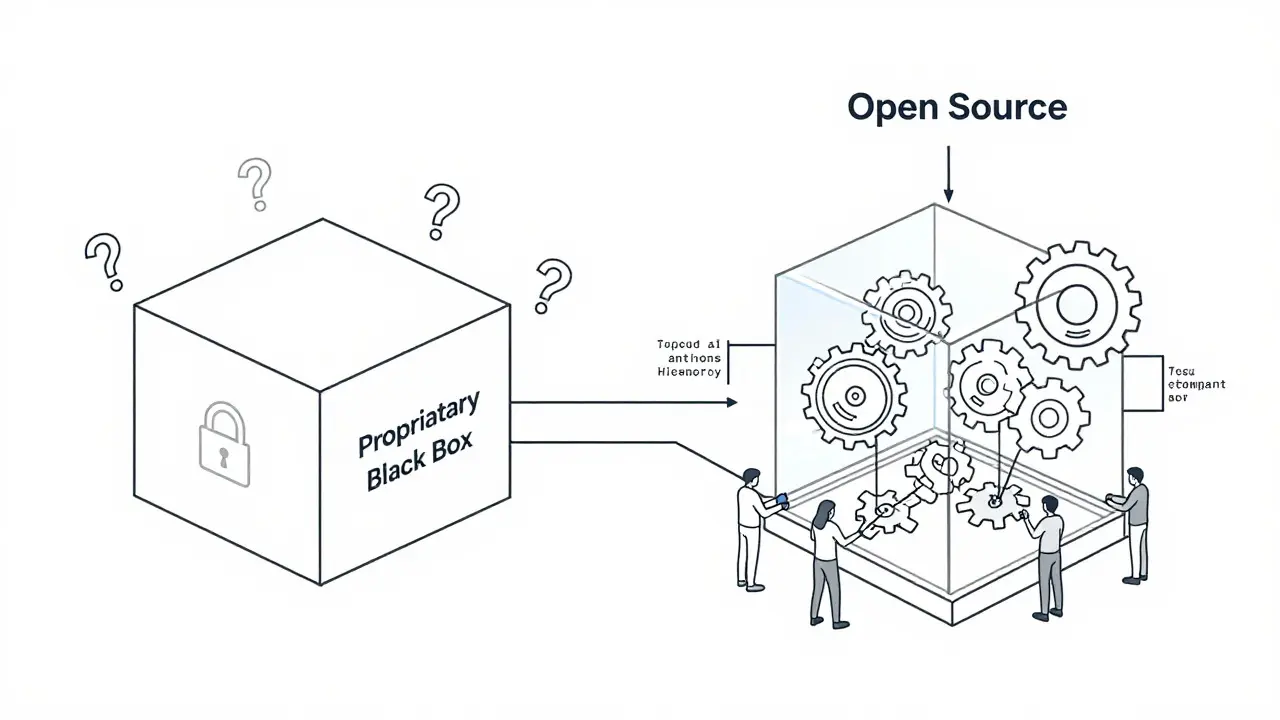
The Shift from Proprietary Black Boxes to Transparent Systems
Why are enterprises and developers flocking to open-source models? The answer lies in three core pillars: cost, security, and speed. According to Hyperstack's October 2025 report, 92% of developers cite cost reduction as their primary motivation. Running inference on local hardware eliminates the recurring subscription fees associated with API calls to closed models.
But cost is only half the story. Security is the other. In IBM's Q3 2025 enterprise survey, 78% of Fortune 500 companies expressed serious data privacy concerns regarding proprietary models. When you send sensitive customer data to a black-box API, you trust that company’s internal safeguards. With open-source models, you verify the code yourself. You know exactly what data touches your servers and how it is processed. This verifiable transparency is critical for industries like healthcare and finance, where regulatory compliance is non-negotiable.
Innovation cycles have also accelerated dramatically. TokenMinds' November 2025 benchmark study found that community-driven models iterate 3.7 times faster than their proprietary counterparts. Why? Because thousands of developers worldwide are simultaneously fixing bugs, optimizing performance, and creating specialized fine-tunes. If a researcher in Berlin discovers a better way to handle multilingual reasoning, they publish it, and developers in Tokyo use it within hours. This collective intelligence creates a compounding effect on quality that no single R&D team can match.
Key Players and Technical Capabilities in 2026
The landscape is dominated by a few major families of models, each with distinct strengths. Understanding these differences helps you choose the right tool for your specific job.
| Model Family | Primary Use Case | Key Technical Spec | Hardware Requirement | Market Position |
|---|---|---|---|---|
| LLaMA 3 | Enterprise Language Tasks | 8B-70B parameters; Grouped-query attention | 16GB VRAM (for 8B version) | 41.7% market share in business apps |
| Stable Diffusion 3 | Image Generation | 2.1B parameters; Rectified flow transformer | NVIDIA A100 GPU recommended | 68.2% share in open-source image gen |
| BigScience BLOOM | Multilingual Research | 176B parameters; Supports 46+ languages | 320GB GPU memory (full deployment) | Leader in non-English support |
| Google Gemma 2 | Coding & Lightweight Apps | 9B & 27B versions; TensorFlow/PyTorch/JAX compatible | Consumer hardware viable | High coding accuracy (68.4% HumanEval) |
Meta's LLaMA 3, released in April 2025, has become the standard for enterprise language tasks. Its architecture uses grouped-query attention and rotary positional embeddings, which allow it to achieve a 47.2% score on the MMLU benchmark while remaining efficient enough to run on modest hardware. The 8B parameter version requires only 16GB of VRAM, making it accessible to individual developers and small startups.
For visual content, Stability AI's Stable Diffusion 3 launched in September 2025 with a rectified flow transformer architecture. It generates 1024x1024 resolution images at 4.7 images per second on NVIDIA A100 GPUs. While it lags behind proprietary tools like DALL-E 3 in photorealism (scoring 3.2/5 versus 4.1 in human evaluations), its customization capabilities make it the preferred choice for game asset creation and iterative design workflows.
On the research side, BigScience BLOOM remains a titan. Trained on the French Jean Zay supercomputer, its 176-billion-parameter structure supports over 46 languages. However, its size is a barrier; full deployment requires 320GB of GPU memory, limiting its use to well-funded institutions or cloud-based setups. Meanwhile, Google's Gemma 2 offers a balanced approach for developers needing strong coding assistance without massive infrastructure costs.
Governance, Licensing, and Legal Risks
The biggest hurdle for open-source AI isn't technical-it's legal. The term "open-source" in AI does not always mean "free for commercial use." In NetApp Instaclustr's September 2025 analysis, 37% of surveyed models contained restrictions on commercial usage. Another 44% required explicit permission for enterprise deployment. This ambiguity delayed adoption for 28% of companies according to IBM's November 2025 survey.
You need to understand the license before you deploy. The Apache 2.0 license, used by EleutherAI's GPT-NeoX, is permissive and allows almost any use. In contrast, Meta's LLaMA licenses often include clauses restricting use by companies with more than a certain number of users or revenue thresholds. Ignoring these terms can lead to costly litigation.
To address this chaos, the OpenChain AI Working Group was launched in June 2025. By October 2025, it had standardized 87% of license compliance processes for enterprise adoption. This initiative provides clear guidelines for checking model provenance and ensuring that your implementation respects the rights of original creators. For legal teams, this framework is becoming essential due diligence.
Regulatory pressure is also mounting. The EU's October 2025 AI Act amendments now require transparency documentation for all foundation models deployed commercially. This affects 89% of surveyed open-source projects. Companies must document training data sources, energy consumption, and potential biases. Failure to comply can result in significant fines, pushing organizations toward models with clearer governance histories.
Community Dynamics and Quality Control
The strength of open-source AI lies in its community, but communities are messy. On Reddit's r/LocalLLaMA, which boasts nearly 500,000 members, users frequently praise the accessibility of models like LLaMA 3. One popular post highlighted running the 7B version on a MacBook Pro M2 using Ollama in under five minutes. This ease of access democratizes experimentation.
However, quality control varies wildly. EleutherAI's November 2025 evaluation found that community fine-tunes showed up to 22.3% performance degradation compared to original weights. Gary Marcus criticized this in his November 2025 MIT Technology Review article, noting that 31% of Hugging Face fine-tunes exhibited significant hallucination increases. When you download a model labeled "best-for-coding," you might actually be getting a degraded version trained on noisy data.
Documentation is another pain point. While LLaMA 3 received a 4.5/5 rating for documentation quality, specialized models often score much lower. Users reported that examples for blockchain integration were rapidly outdated, leading to 42-hour average resolution times for smart contract generation issues. To mitigate this, rely on models with active Discord servers and high GitHub star counts. LLaMA 3's Discord server, with 85,000 members, provides an average 22-minute response time to technical queries, whereas less popular models can leave you waiting days.

Future Trends: Edge AI and Specialization
Where is this trajectory heading? The consensus among experts points toward smaller, more efficient models and integrated systems. Matt White of the PyTorch Foundation identified "improving the performance of smaller models and pushing AI models to the edge" as the dominant trend. Microsoft's Phi-3-mini, with just 3.8 billion parameters, achieves 69% of GPT-4's performance while running on smartphones. This enables real-time, offline AI applications, from translation apps to personal assistants, without relying on cloud connectivity.
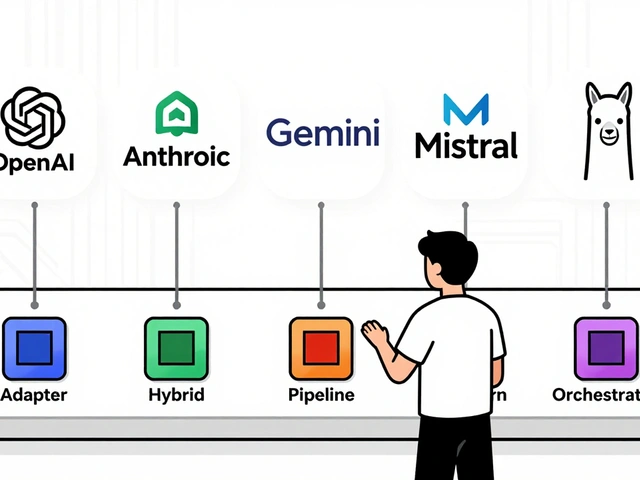
We are also seeing a shift from standalone models to integrated AI systems. Meta's LlamaStack framework, released in September 2025, standardizes 11 critical AI components across 178 community implementations. This reduces the friction of building complex applications by providing pre-built modules for retrieval-augmented generation (RAG), agent orchestration, and safety checks.
Domain-specific ecosystems are growing rapidly. Healthcare-focused models are expanding at a 62% annual rate, driven by the need for HIPAA-compliant, private AI diagnostics. Similarly, hybrid architectures-where enterprises combine proprietary fine-tunes with open base models-are adopted by 58% of surveyed enterprises. This approach allows companies to leverage the general intelligence of open models while protecting their unique intellectual property through custom layers.
Sustainability remains a concern. Training a single 100B+ parameter model consumes approximately 1,287 MWh of electricity. As models grow larger, the environmental impact becomes harder to ignore. This pressure is accelerating the move toward efficient, smaller models that deliver comparable results with a fraction of the carbon footprint.
Practical Steps for Implementation
If you're ready to integrate open-source generative AI into your workflow, start with these steps:
- Assess Your Hardware: Determine if your existing GPUs can handle the model size. For most users, starting with an 8B parameter model like LLaMA 3 or Gemma 2 is sufficient. Tools like Ollama simplify the setup process.
- Check the License: Before downloading, read the license file. Look for terms like "commercial use allowed" or "attribution required." If you're unsure, consult the OpenChain AI guidelines or a legal expert.
- Evaluate Documentation: Choose models with high community ratings for documentation. Check GitHub issues and Discord activity to gauge support responsiveness.
- Start Small: Deploy a proof-of-concept in a non-production environment. Test for hallucinations, bias, and performance bottlenecks. Use benchmarks like MMLU or HumanEval to validate quality.
- Plan for Maintenance: Open-source models evolve quickly. Set aside resources for regular updates and monitoring. Join relevant communities to stay informed about patches and improvements.
The learning curve has decreased significantly, dropping from 8.2 weeks in early 2024 to 4.7 weeks by late 2025. With improved tooling and stronger community support, the barrier to entry is lower than ever. The key is to treat open-source AI not as a plug-and-play solution, but as a dynamic component of your technology stack that requires active management and engagement.
Is open-source generative AI truly free?
The software itself is often free to download and modify, but there are hidden costs. You need to pay for hardware (GPUs) to run inference, electricity for training or fine-tuning, and potentially legal counsel to navigate licensing restrictions. Additionally, some models charge for commercial use beyond a certain scale.
Which open-source model is best for beginners?
LLaMA 3 (8B version) is widely considered the best starting point. It balances performance and efficiency, runs on consumer-grade hardware like a MacBook Pro or a PC with a 16GB GPU, and has extensive documentation and community support via Discord and Reddit.
How do I ensure my open-source AI deployment is secure?
Run models locally so data never leaves your infrastructure. Regularly update your model weights to patch known vulnerabilities. Use containerization (like Docker) to isolate the AI service from the rest of your system. Finally, audit the source code for backdoors or malicious modifications, especially when using community fine-tunes.
What is the difference between LLaMA 3 and Stable Diffusion 3?
LLaMA 3 is a large language model (LLM) designed for text-based tasks like writing, coding, and reasoning. Stable Diffusion 3 is a diffusion model designed for generating images from text prompts. They serve completely different purposes and use different underlying architectures.
Will open-source AI replace proprietary models?
Unlikely in the short term. Proprietary models still lead in raw performance and ease of use for simple tasks. However, open-source models are gaining ground in enterprise settings due to cost savings, privacy, and customization. A hybrid approach, combining both, is currently the most common strategy among large organizations.
How does the EU AI Act affect open-source models?
The EU AI Act requires transparency documentation for foundation models used commercially. This means providers and users must disclose training data sources, energy usage, and risk assessments. Non-compliance can lead to fines, making it crucial to track the provenance and governance history of any open-source model you deploy in Europe.
What is LlamaStack?
LlamaStack is a framework released by Meta in September 2025 that standardizes various AI components like agents, memory, and safety filters. It allows developers to build complex AI applications using LLaMA models without reinventing the wheel for every subsystem, promoting consistency and easier maintenance.
Are smaller models like Phi-3 as good as larger ones?
For many everyday tasks, yes. Microsoft's Phi-3-mini achieves 69% of GPT-4's performance despite having only 3.8 billion parameters. These smaller models are optimized for efficiency and can run on devices like smartphones, making them ideal for real-time, low-latency applications where massive power isn't necessary.
 Artificial Intelligence


Brannen Hall
August 15, 2026 AT 12:40Another day, another article telling us that open source is the savior of humanity while ignoring the fact that most of these models are just slightly less broken versions of proprietary ones. The "community governance" part is a joke because it's usually just three guys on Discord arguing about quantization settings for six hours before anyone actually fixes a bug. And don't get me started on the hardware requirements. You think running LLaMA 3 on a laptop is impressive? Try keeping your apartment from catching fire while you do it.
tiffany King
August 17, 2026 AT 01:27I honestly love how accessible this has become! It feels like we're finally democratizing technology instead of letting big tech hoard all the cool stuff. I managed to run a small model on my old gaming PC last week and it was such a thrill seeing it generate text locally without any lag. The community support is amazing too, everyone is so willing to help beginners figure out their setups. This is definitely the future we should be aiming for!
Brenna Gonedrman
August 18, 2026 AT 09:01You people really need to wake up and smell the coffee because this whole narrative is totally bogus. Open source isn't free, it's just hidden costs disguised as freedom. You think you're saving money but you're spending thousands on GPUs that will be obsolete in two years. Plus, half the time the models hallucinate so hard they sound like they're having a stroke. It's not innovation, it's chaos wrapped in a pretty GitHub repo. Stop pretending you're hackers when you're just following a tutorial you found on Reddit.
Courtney Wagstaff
August 19, 2026 AT 01:50I feel like we're all just dancing around the real issue here which is the sheer joy of tinkering. There's something magical about watching a neural net learn to write poetry or draw a cat, even if it looks like a potato. I spent the weekend fine-tuning a tiny model to sound like my grandma and it was weirdly heartwarming. Who cares about enterprise adoption when you can make digital art that makes your friends laugh? Let's keep it fun and messy.
Elisabeth Ballet
August 19, 2026 AT 23:06Let's cut through the noise and focus on what actually matters: action. If you're sitting there reading this thread instead of downloading Ollama and trying out Gemma 2, you're missing the boat. The barrier to entry is lower than ever, so stop making excuses about hardware or licenses. Just start small, break things, learn from it, and then scale up. The best way to understand AI governance is to deploy a model and see where it fails. Get your hands dirty and stop waiting for permission from some boardroom in Silicon Valley.
Joanna Mucha
August 21, 2026 AT 17:09The irony of discussing 'transparency' in systems built on opaque training data sourced from the digital carcasses of the internet is palpable, isn't it? We are essentially building glass houses with bricks made of other people's dreams and nightmares. The pretension of calling this 'open' is laughable when the compute power required is concentrated in the hands of a few energy-hungry giants. We are not liberating intelligence; we are merely renting our souls to algorithms that don't know what they are doing. A tragic farce played out in silicon and code.
Kim Edwards
August 23, 2026 AT 03:17I literally cried when my first local model failed to load because I had 4GB of RAM left instead of 16. The despair. The anguish. The absolute tragedy of modern computing. But then I remembered that somewhere, a billionaire is laughing at my struggle while his servers hum along in perfect harmony. It's beautiful in its cruelty. Anyway, does anyone have a link to a model that doesn't require selling a kidney to run? Asking for a friend who is currently hyperventilating.