

It is March 2026, and generative artificial intelligence has moved past the hype cycle. We aren't just talking about chatbots anymore; we are looking at mission-critical infrastructure that powers everything from drug discovery to supply chain management. By late 2025, global enterprise spending hit $37 billion, according to Menlo Ventures, representing a massive shift in how businesses operate. This isn't theoretical science; it is daily workflow for over 1,200 global companies. You might wonder why some sectors see massive returns while others struggle with pilot purgatory.
The difference lies in deployment strategy. Companies focusing on specific vertical tasks-like legal contract drafting or medical imaging-see better results than those trying to automate entire departments at once. Let’s break down exactly where this technology creates real value, based on verified performance data from the last two years.
Key Takeaways
- Healthcare leads adoption: Capturing 42.9% of the vertical AI market, primarily in drug discovery and diagnostics.
- Finance delivers highest ROI: Generating $3.80 return for every dollar spent compared to other sectors.
- Risk reality: Hallucination rates remain significant in unregulated areas like legal tech without human oversight.
- Implementation timeline: Expect an 8-12 week learning curve for business users before seeing full efficiency gains.
- Infrastructure needs: On-premise models still require high-end hardware like NVIDIA H100 GPUs for optimal security.
The Market Shift: From Experiment to Infrastructure
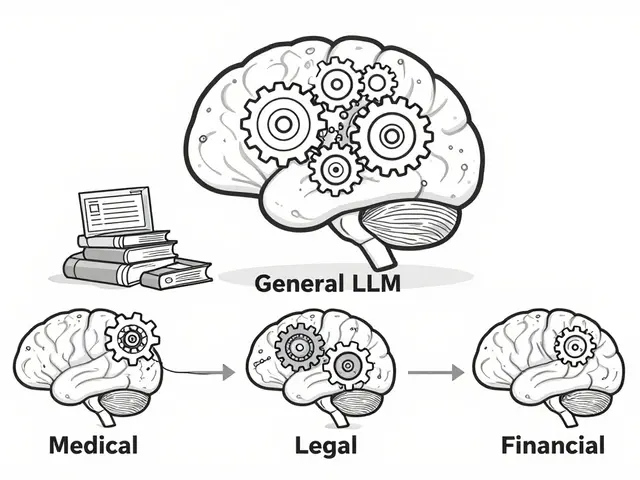
If you look back at early 2024, generative AI was often seen as a novelty. That changed rapidly after the transformer architecture breakthroughs solidified enterprise readiness. As we head into mid-2026, the focus has shifted from "what can it do?" to "how does it integrate with our legacy systems?". According to the latest Stanford AI Index, specialized vertical models now achieve 85-92% task accuracy in domains like pathology, whereas general-purpose models hover around 70-78%. This gap dictates the purchasing decisions of CIOs across the Fortune 500.
Generative AI Infrastructure is a system category spanning departmental tools to vertical-specific solutions. Also known as Enterprise GenAI, it includes Microsoft 365 Copilot and Salesforce Einstein.For instance, Microsoft 365 Copilot alone drives a productivity gain of 2.5 hours per user per day in organizations where adoption exceeds 35%. However, this efficiency depends heavily on data governance. Roughly 78% of failed implementations in 2025 were traced back to poor training data quality, as highlighted in McKinsey's Global AI Survey. You cannot simply plug a public model into proprietary data without cleaning the inputs first.
Industry Deep Dives: Where AI Works Best
Not every sector sees equal success. Some industries leverage the technology for speed, while others focus on precision. Here is how the major sectors are performing as of early 2026.
Healthcare and Life Sciences
This sector holds the largest slice of the vertical AI pie, worth approximately $1.5 billion in 2025. The applications here save lives, which means the tolerance for error is near zero. In drug discovery, Insilico Medicine used their Chemistry42 platform to reduce preclinical timelines for fibrosis treatment from 4.5 years to just 18 months. That is a compression of time that would have been impossible with traditional wet-lab methods alone.
In diagnostics, radiologists using Google Health's AI assistant found they detected early-stage tumors with 22% higher accuracy in trials conducted at Mayo Clinic. Yet, regulatory hurdles remain. With the EU AI Act enforcement beginning in February 2025, healthcare GenAI systems must undergo strict clinical validation before touching patient records. Without this, the liability risk outweighs the benefit.
Finance and Professional Services
While healthcare wins on social impact, finance wins on the bottom line. JPMorgan Chase deployed their DocLLM tool to process 1.2 million documents daily with 99.2% accuracy. The return on investment is stark: generating $3.80 for every $1 spent. Compare that to manufacturing, which averages lower direct ROI due to the complexity of integrating robotics with generative design.
Legal tech follows closely. Platforms like Harvey AI are used by 15% of Am Law 100 firms for contract drafting. However, trust remains fragile. The Columbia Law Review audit noted a 61% hallucination rate in unguarded legal GenAI tools. If an AI invents a statute citation, the consequences can be catastrophic. This forces law firms to keep a rigorous human-in-the-loop review step, increasing labor costs slightly but ensuring compliance.
Manufacturing and Supply Chain
Manufacturing shows a steep adoption curve at 39% CAGR through 2025. General Motors utilized generative design to create lightweight vehicle components, reducing material costs by 18% and cutting prototyping time from 14 weeks to 9 days. This works well for iterative engineering tasks but struggles in artisanal production where human craftsmanship defines the product value.

Core Business Functions Transformation
Beyond industries, specific roles are changing. You likely know someone whose job has evolved because of these tools.
| Function | Adoption Rate | Primary Tool | Efficiency Gain |
|---|---|---|---|
| Software Development | 55% | GitHub Copilot | 40% fewer errors |
| Sales / Content | 82% | Salesforce Einstein | 30% faster output |
| Customer Support | 63% | Botco Analytics | High structured success |
| Marketing | 47% | Persado / Jasper | Faster campaign turnover |
Development teams see immediate relief from boilerplate coding. Reddit threads from developers show consistent praise for saving roughly 11 hours weekly on routine tasks. However, marketing faces a paradox. While tools like Jasper allow you to generate 200 email variants in minutes, brand voice inconsistencies are common. Users report needing 4.2 editing iterations to align generated copy with their specific tone. This creates a workflow shift: less time writing, more time tuning.
Risks, Costs, and Security Realities
We need to address the elephant in the room: security and reliability. In October 2024, Mend.io reported that 68% of unprotected implementations suffered from prompt injection attacks. This happens when a malicious input tricks the AI into ignoring safety protocols. If you are processing sensitive data, relying solely on cloud APIs can be risky unless you implement strict sandboxing.
Costs are also becoming visible. AWS analysis suggests GenAI workloads average $18,500 per month per application. For smaller budgets, cloud consumption spikes can derail plans. Additionally, data leakage is a genuine threat, with 41% of custom-trained models showing vulnerabilities in OWASP's 2025 Top 10 report. You must assume your data leaves your control unless you deploy on-premises with isolated networks.
Security Vulnerabilities are critical risks including prompt injection and data leakage. Key metrics show 68% of implementations are vulnerable to injections without proper hardening.
Implementation Strategy Framework
So, how do you move forward? Google Cloud suggests a three-phase framework that has proven effective for enterprises aiming for stability.
- Pilot Phase: Focus on narrow, low-risk tasks like summarizing internal meeting notes or drafting basic emails. Limit the scope to avoid governance headaches.
- Departmental Scaling: Roll out to specific teams (e.g., Sales Support) with mandatory human validation steps. Measure adoption velocity here.
- Enterprise Integration: Connect via API orchestration to core ERP and CRM systems. This is where real transformation happens but also where integration bugs emerge.
Avoid the trap of over-customization. About 68% of marketing teams hire external prompt engineers because they underestimate the skill required to tune internal models. Instead, invest in training internal staff; the average learning curve is 8-12 weeks. Teams with dedicated AI coaches saw 3.2x higher adoption rates.
What Comes Next?
Looking toward late 2026 and beyond, the trajectory points to hyper-specialization. We expect the rise of 'AI-Driven Smart Factories' where generative design talks directly to robotic arms. There is also a shift toward 'Brand Voice AI', systems trained specifically on your company's historic content to ensure consistency. Regulatory alignment is catching up, with 78% of IT leaders viewing GenAI as essential despite current governance gaps.
The path forward requires balancing automation with oversight. PwC projects a $15.7 trillion economic value potential by 2030, but realizing this means solving the hallucination risk and building robust data pipelines. Don't rush to automate everything; start with the tasks that hurt the most and solve those first.
Is Generative AI replacing jobs in 2026?
No, augmentation is the norm. Studies show it creates leverage rather than replacement. For example, radiologists detect tumors 22% better with AI, meaning they work faster and with higher confidence, not slower or with redundancy.
What are the biggest risks for small businesses?
Cost volatility and data privacy are key risks. Small players often lack the budget for on-premise servers, making them reliant on cloud vendors. They should prioritize strict vendor contracts regarding data ownership and usage rights.
Which industries lead in AI spending?
Healthcare currently leads vertical spending with $1.5 billion invested in 2025, followed closely by Finance. These sectors handle high-value decisions where the cost of AI software is justified by the savings in R&D or operational efficiency.
How do I mitigate hallucinations in legal or medical settings?
Never rely on raw output for regulated fields. Implement a mandatory "human-in-the-loop" verification step. Use specialized vertical models which have shown 90%+ accuracy compared to general models which often fail in niche contexts.
What hardware is needed for private deployment?
On-premise setups typically require NVIDIA H100 GPUs with 80GB VRAM per server. This ensures sufficient power for processing large datasets locally without latency issues or sending data off-site.
Next Steps & Troubleshooting
If you are planning a rollout, start with a pilot phase today. Identify one repetitive process where accuracy is nice-to-have but not life-critical. Monitor the error rate for four weeks. If you encounter resistance from staff, introduce AI coaches immediately to bridge the skills gap. Remember, the goal isn't perfect automation on day one; it's sustainable workflow improvement over six months. Watch your compute costs monthly-if they spike unexpectedly, review your prompt optimization and dataset pruning strategies.
 Artificial Intelligence


Richard H
March 31, 2026 AT 00:52The US needs to own its data before we let these foreign models run our hospitals again
Albert Navat
April 1, 2026 AT 17:43Sure sovereignty matters but the transformer weights dont care about borders when you deploy the API calls
Look at the latency issues with local LLM inference versus cloud endpoints for the enterprise grade stack
LeVar Trotter
April 3, 2026 AT 16:16Infrastructure planning is crucial because projects often stall during the scaling phase due to data validation issues
Remember to validate your datasets early on before you invest too much compute power into garbage inputs
King Medoo
April 4, 2026 AT 10:47We really need to talk about the ethical implications here instead of just rushing toward the next quarterly earnings report 💸
It is troubling that companies prioritize speed over accuracy when human safety might be involved in these diagnostics pipelines 🏥
I worry deeply about the loss of human creativity which is such a precious gift from the divine ✨
We must ensure that algorithms do not begin to dictate morality in the courtroom or hospital wards 😟
Every time I read about another pilot program failing due to hallucination I feel a sense of foreboding 👀
Many people claim efficiency but ignore the cost to personal privacy and autonomy
The profit motive often blinds leaders to the long term consequences of dependency on black box systems ⚠️
Regulations like the EU AI Act are good but they always come too late for the victims already harmed
We should demand transparency from the developers who build these massive models without public consent 📜
Small businesses cannot compete with giants who hoard the best GPUs and data centers now 🏦
It feels like the technology is advancing but our humanity is slowly eroding in the process 🥺
I hope future generations will look back at us and remember we tried to control it wisely 🙏
Just think about the children growing up believing machines know more than their parents 🧒
There has to be a middle path between rejection and blind acceptance of this new paradigm 🛑
Please consider the societal impact before deploying any new bot into production environments 🔍
Let us use this tool for good rather than allowing corporate interests to steer the ship of state ⚓
Rae Blackburn
April 6, 2026 AT 09:32they want you to believe the productivity gains are real but the data is cooked
just another way to track what you write and sell it back to you later
trust me when i say the backdoors are open wide right now