
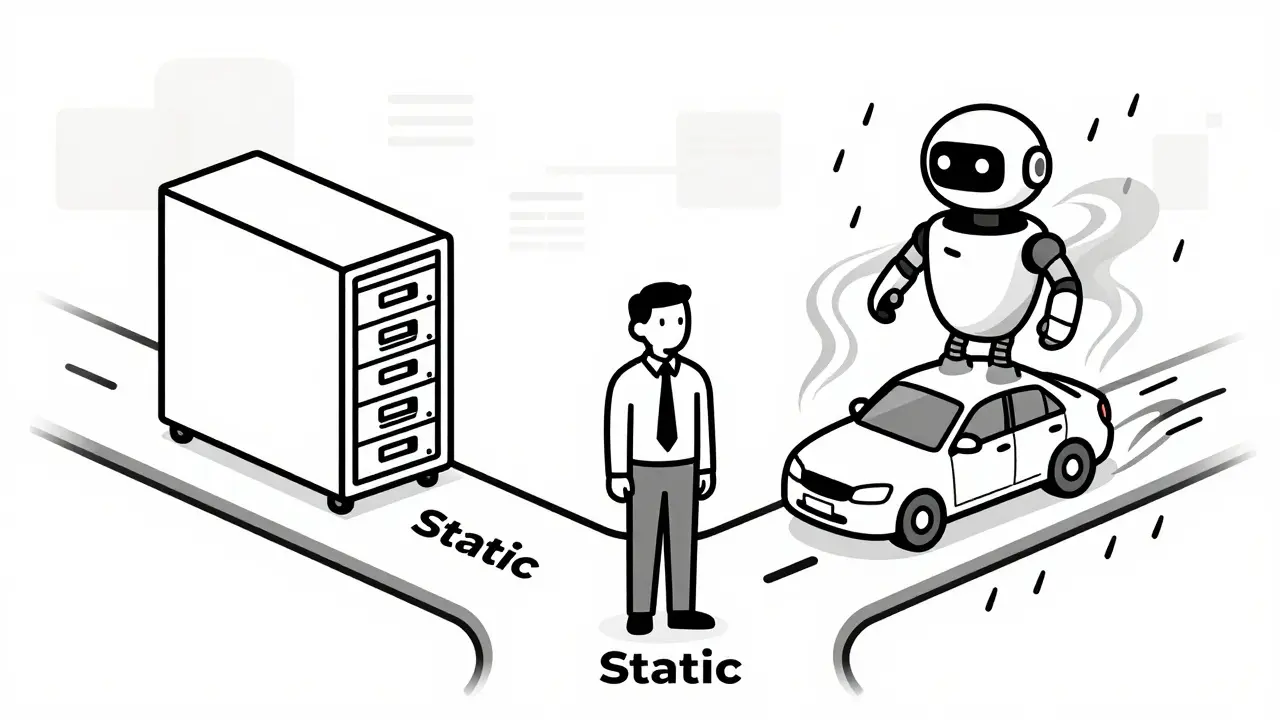
Signing a standard software-as-a-service agreement for a Large Language Model provider is like buying a car that drives itself but changes its destination every time it rains. The old rules of IT procurement simply do not apply here. In 2026, managing relationships with AI service providers requires a completely different playbook. You are not just buying code; you are buying a dynamic, evolving system that processes your data and generates outputs that can impact your business reputation, legal standing, and bottom line.
The shift from traditional vendor management to specialized LLM vendor management is no longer optional. It is a survival strategy. With regulatory bodies like the Office of Management and Budget (OMB) mandating strict compliance by March 2025 and the EU AI Act enforcing heavy penalties for high-risk systems, the stakes have never been higher. This guide breaks down exactly how to structure these contracts, what metrics matter, and how to avoid the costly pitfalls that trap most organizations.
Why Traditional IT Contracts Fail with AI
You might be tempted to slap an "AI" addendum onto your existing SaaS template. Do not do it. Traditional contracts focus on static deliverables, uptime guarantees, and clear-cut liability limits. These elements are insufficient for AI because the product itself changes. An LLM does not break; it drifts. Its accuracy degrades over time as language evolves or as new data patterns emerge. If your contract only measures server uptime at 99.9%, you could be paying full price for a model that is generating hallucinations or biased outputs.
According to Bamboo Data Consulting’s 2024 analysis, effective AI vendor management is an "organic, end-to-end discipline" that mirrors the evolving nature of the ecosystem. Standard indemnification clauses are obsolete when dealing with generative AI. You need explicit terms addressing liability for AI-generated outcomes, including damages from misinformation, bias propagation, and unforeseen failures. Without these specific clauses, you are left holding the bag when the model makes a mistake.
The Five Critical Dimensions of LLM Contracts
To protect your organization, your contract must address five fundamental shifts in the vendor relationship. These dimensions separate successful AI integrations from disastrous ones.
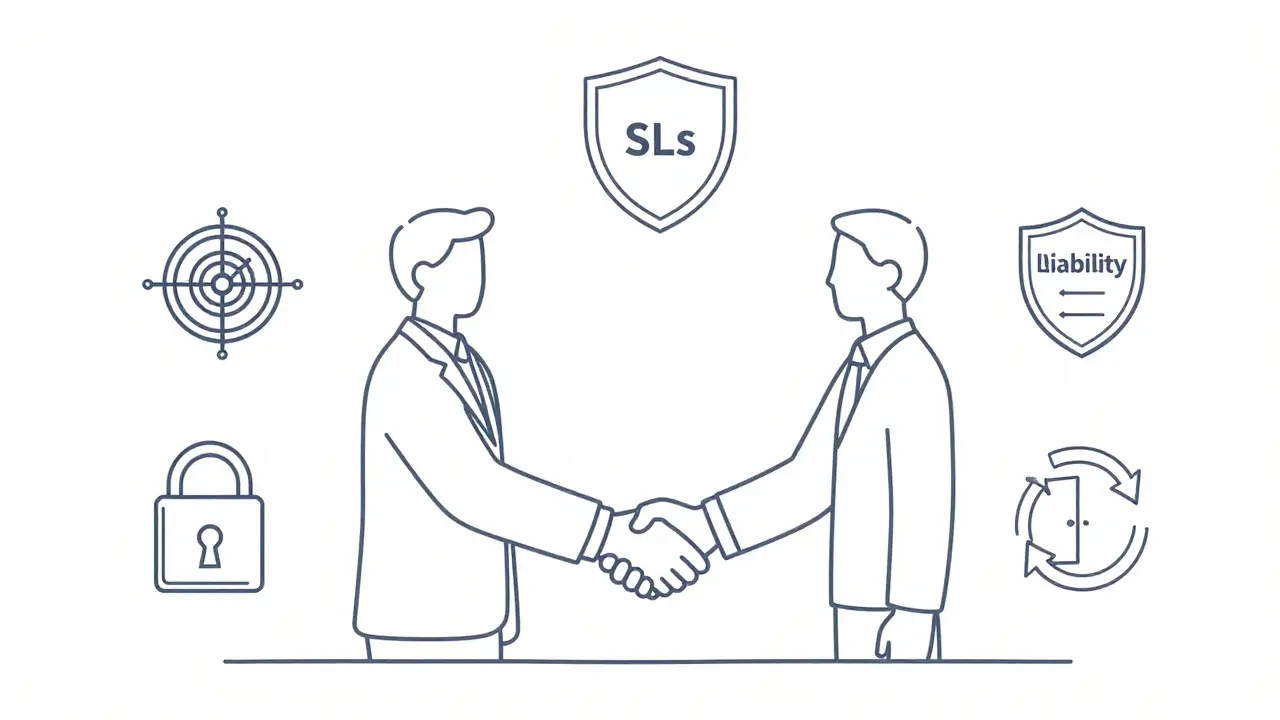
- Dynamic SLAs Over Static Uptime: Move beyond simple availability metrics. Your Service Level Agreements (SLAs) must include performance KPIs such as model accuracy thresholds (typically 85-95% depending on use case), drift detection limits (e.g., no more than 0.5-2% monthly degradation), and explainability standards. Sirion AI’s 2025 benchmarking study suggests that at least 80% of automated decisions must be interpretable to meet basic governance standards.
- Granular Data Ownership: Who owns the prompt? Who owns the output? Who owns the fine-tuned model? Icertis’ 2024 report shows that while traditional contracts spend 5-10% of negotiation time on data rights, LLM contracts require 30-40%. You must explicitly state that your input data remains yours and define whether the vendor can use your anonymized data to improve their base model.
- Expanded Liability Structures: Traditional contracts cap liability at the contract value. Effective LLM contracts establish tiered liability. For instance, executivegov.com’s 2025 analysis recommends 3-5x annual fees for bias-related damages and uncapped liability for security breaches involving proprietary data leakage.
- Interoperability and Exit Strategies: Vendor lock-in is a major risk. Your contract must include clauses for interoperability to ease transitions to other vendors or in-house solutions. Define a clear, pre-negotiated exit strategy that covers secure data retrieval and a timeline for transitioning to an alternative solution without losing context or history.
- Ongoing Partnership vs. Transactional Review: The relationship must shift from periodic reviews to continuous collaboration. Include provisions for shared accountability and joint commitments to responsible AI development, including regular audits and feedback loops.
Navigating Regulatory Compliance: OMB and the EU AI Act
Regulatory pressure is driving contract standardization faster than market forces alone. The OMB’s March 2025 memo required federal agencies to implement specific contractual requirements for LLM procurement. While this directly targets government entities, private enterprises are adopting these standards to ensure they can bid for future contracts and maintain best practices. Agencies were required to request acceptable use policies, model cards, end-user resources, and mechanisms for end-user feedback.
Simultaneously, the EU AI Act imposes mandatory requirements for high-risk AI systems. If your LLM application involves automated decision-making in areas like hiring, credit scoring, or law enforcement, your contract must explicitly address the level of human review and oversight. Failure to comply can result in fines up to 6% of global turnover. As of February 2026, these regulations are fully enforceable, making compliance a non-negotiable clause in any international vendor agreement.
| Feature | Traditional IT/SaaS Contract | LLM Provider Contract |
|---|---|---|
| Primary Metric | Uptime (99.5-99.9%) | Model Accuracy, Drift Thresholds, Explainability |
| Data Rights Focus | 5-10% of negotiation time | 30-40% of negotiation time |
| Liability Cap | Contract value or 1-2x annual fees | Tiered: 3-5x for bias, uncapped for security breaches |
| Vendor Relationship | Transactional, periodic review | Partnership, continuous monitoring |
| Exit Strategy | Standard data export | Interoperability clauses, transition timelines |
Implementing a Robust Vendor Management Framework
Building a robust framework takes time. Expect a 6-9 month deployment cycle for enterprise-level implementations. The learning curve is steep, with procurement teams requiring 120-160 hours of specialized training according to Procurable AI’s 2025 benchmark report. You cannot rely on generalist lawyers alone. You need a cross-functional team including legal counsel with AI expertise, data scientists for model validation, and procurement specialists who understand the technical nuances.
A common pitfall is underestimating the resource commitment for ongoing monitoring. Sarah Chen of Baker McKenzie noted in her firm’s 2025 client survey that 68% of early adopters failed to allocate sufficient personnel for continuous contract compliance verification. This leads to "contract drift," where the operational reality diverges from the agreed terms. To mitigate this, integrate your contracts into your business systems. Pricing, discounts, and performance metrics should be enforced automatically through procurement platforms.
Consider using specialized AI contract management platforms. Companies like Sirion AI and Icertis are capturing significant market share by offering tools that leverage both Large Language Models and Small Data Models. As Rajesh Gupta, CTO of Sirion AI, warned in a 2025 briefing, "LLMs alone are insufficient - Small Data Models add precision." These hybrid approaches provide the broad contextual understanding of LLMs with the reliability needed for critical contract tasks.

Real-World Risks and User Feedback
What does this look like in practice? The risks are tangible. On Reddit’s r/ContractManagement forum, 73% of procurement managers reported unexpected costs from model drift remediation, averaging 22% of the initial contract value in the first year. One user, 'ProcurementPro2025', shared a cautionary tale: "We signed a 3-year deal with an LLM vendor without proper drift thresholds. By month 10, accuracy dropped from 92% to 78% on our critical use case, and the vendor refused to compensate because our SLA only specified uptime, not performance metrics."
This scenario highlights the importance of defining "performance" clearly. Is performance measured by token generation speed? Or by the factual accuracy of the output? For most enterprise applications, it is the latter. Ensure your contract includes "canary deployment" clauses, which require phased rollouts of model updates. This allows you to test new versions in a controlled environment before they affect your entire operation, giving you the right to reject updates that degrade performance.
Market Landscape and Future Trends
The market for AI vendor management is growing rapidly, projected to reach $4.8 billion by 2027. However, the competitive landscape is bifurcated. Hyperscalers like AWS, Google, and Microsoft control 58% of enterprise LLM contracts, often imposing standardized terms that favor the vendor. Enterprise platforms like Icertis serve 29% of the market, offering specialized management tools. Specialized startups capture the remaining 13% with niche solutions.
Looking ahead, the industry is moving toward "self-updating contracts." Sirion AI’s 2025 survey found that 81% of experts predict contracts will automatically adjust terms based on real-time model performance metrics by 2027. Additionally, the International Association for Contract and Commercial Management (IACCM) launched a working group in January 2025 to create the first industry-wide LLM vendor contract framework. This standardization will likely reduce negotiation friction but may also reduce the ability to customize terms for unique organizational needs.
Organizations that mature their LLM vendor management practices now will see a 28-35% higher ROI from AI investments, according to McKinsey’s 2025 outlook. Those that stick to traditional contracting face a 42% higher risk of AI project failure due to vendor misalignment. The choice is clear: adapt your contracts to the technology, or risk being left behind.
What is the biggest difference between an LLM contract and a traditional SaaS contract?
The biggest difference lies in performance metrics and liability. Traditional SaaS contracts focus on uptime and static functionality. LLM contracts must address dynamic performance, including model accuracy, drift thresholds, and explainability. Furthermore, LLM contracts require expanded liability clauses for issues like bias and misinformation, whereas traditional contracts typically cap liability at the contract value.
How do I prevent vendor lock-in with an LLM provider?
To prevent vendor lock-in, include explicit interoperability clauses in your contract. These clauses should ensure that data and models can be easily transferred to other vendors or in-house solutions. Additionally, negotiate a clear exit strategy that defines secure data retrieval processes and transition timelines, allowing you to move away from the vendor without losing critical business context.
What specific metrics should I include in my LLM SLA?
Your SLA should go beyond uptime. Include model accuracy thresholds (typically 85-95%), drift detection limits (e.g., maximum 0.5-2% monthly degradation), and explainability standards (e.g., 80% of decisions must be interpretable). You should also specify response times for token generation and error rates for specific use cases.
Does the OMB memo apply to private companies?
Technically, the OMB memo applies to federal agencies. However, many private companies are adopting these standards voluntarily to align with best practices and prepare for potential future government contracts. The requirements, such as providing model cards and acceptable use policies, are becoming industry norms regardless of direct legal mandate.
How much time should I spend negotiating data rights in an LLM contract?
According to Icertis' 2024 report, you should dedicate 30-40% of your negotiation time to data rights. This is significantly higher than the 5-10% allocated in traditional contracts. Key areas to cover include ownership of input data, ownership of generated outputs, and whether the vendor can use your data to train their base models.
 Artificial Intelligence




Johnathan Rhyne
May 1, 2026 AT 13:11Look, I get the hype around 'dynamic SLAs' and all that fancy jargon about model drift, but let's not pretend we're solving anything by just adding more clauses to a contract that was already broken. The real issue isn't the paperwork; it's that these vendors are selling snake oil wrapped in a tech bro's hoodie. You want accuracy? Build your own damn model or hire humans. Relying on a black box that hallucinates because it rained is just corporate negligence dressed up as innovation. And please, for the love of all that is holy, stop using the word 'synergy' in your procurement meetings.
Jawaharlal Thota
May 2, 2026 AT 07:14I truly appreciate this comprehensive guide because it really helps us understand the nuances of vendor management in such a rapidly evolving landscape, and I think it is wonderful that you have taken the time to break down the five critical dimensions so clearly for everyone who might be struggling with these complex decisions right now, especially since many organizations are still stuck in old ways of thinking about software procurement which can lead to significant risks and inefficiencies down the line if they do not adapt quickly enough to the new realities of AI integration.
Lauren Saunders
May 3, 2026 AT 09:52Oh, how quaint. Another article pretending that 'contracts' are the silver bullet for AI chaos. As if a piece of paper can constrain a stochastic parrot trained on the entire internet's collective unconscious. The pretension of believing that legal frameworks developed for static code can somehow govern dynamic neural networks is almost adorable in its ignorance. We are not managing vendors; we are attempting to leash lightning while wearing wool socks. But sure, keep negotiating 'drift thresholds' like you're buying widgets from Alibaba.
sonny dirgantara
May 4, 2026 AT 20:59i mean the stuff about data ownership is pretty cool i guess but like do we really need a whole team of lawyers just to make sure our chatbot doesnt say something weird? seems like overkill tbh. also why does everything cost so much money now?
Andrew Nashaat
May 5, 2026 AT 01:47It is absolutely morally reprehensible that companies continue to ignore the ethical implications of bias propagation in LLMs! When you sign a contract without tiered liability for discrimination, you are complicit in systemic harm! This is not just a business decision; it is a human rights issue! We must demand uncapped liability for security breaches because privacy is a fundamental right, not a commodity! If your vendor cannot guarantee explainability, they are untrustworthy! Do not settle for less than perfect accountability!
Gina Grub
May 6, 2026 AT 22:22the market bifurcation is basically a disaster waiting to happen hyperscalers are locking everyone into their ecosystems and the startups are getting crushed under the weight of compliance costs it’s a total mess and nobody wants to talk about the fact that interoperability clauses are mostly theoretical because no one actually implements them properly until it’s too late
Nathan Jimerson
May 7, 2026 AT 08:33This is such a positive step forward for the industry! I am so excited to see more organizations prioritizing responsible AI development and continuous collaboration with their vendors. It gives me great hope for the future when we work together to build systems that are transparent and fair for everyone involved.