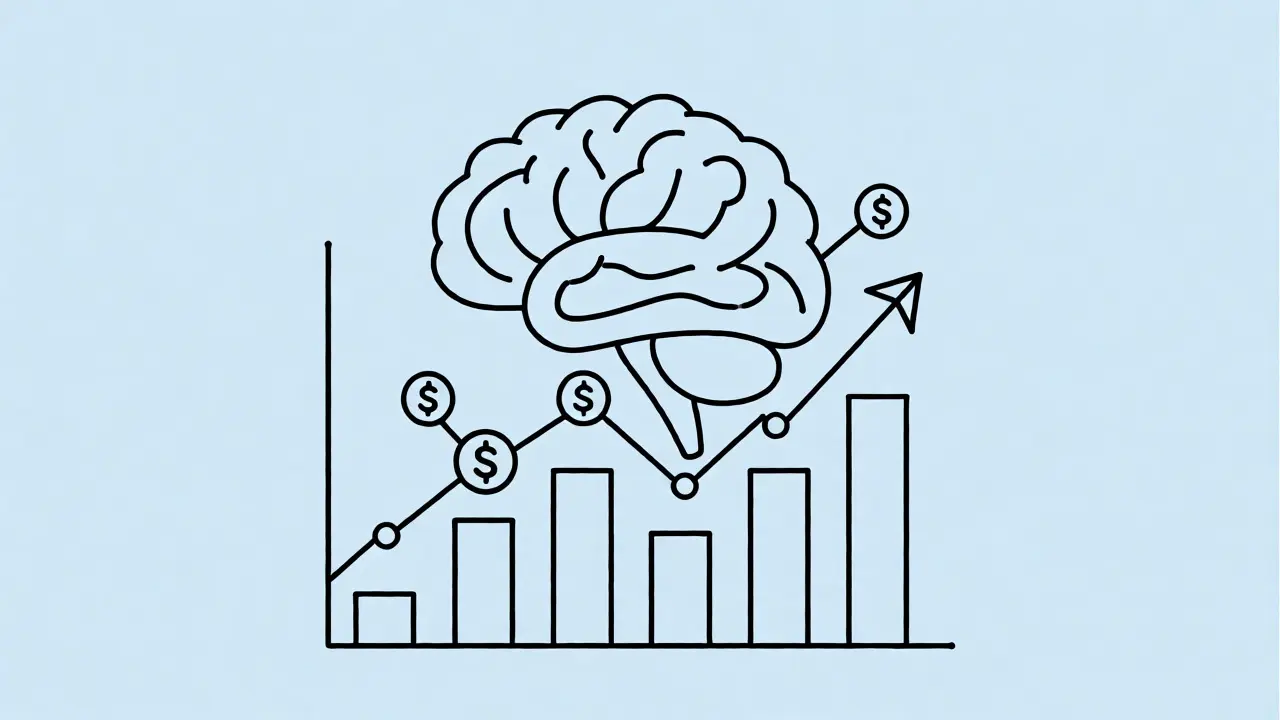
Most companies treat Generative AI as a cost center or a shiny toy. They run pilots, write press releases, and then wonder why the bank account didn't change. But for the top 15% of enterprises, this technology is a direct revenue engine. According to NTT DATA's 2026 Global AI Report, these leaders achieve 2.5x higher revenue growth than their laggard competitors. The difference isn't magic; it's specific application in sales mechanics like cross-selling, upselling, and conversion optimization.
You might be asking if your current CRM setup can actually move the needle on the bottom line. The short answer is yes, but only if you stop using AI for generic chatbots and start using it for hyper-personalized product recommendations. This guide breaks down exactly how generative AI drives measurable financial gains, what the real numbers look like in 2026, and where most implementations fail before they even start.
The Real Numbers Behind AI-Driven Revenue
Let's cut through the hype with hard data. It is not just about "efficiency" anymore; it is about cash flow. A January 2026 analysis by Master of Code reviewed over 350 statistics and found that 77% of organizations reported elevated lead acquisition directly tied to AI-powered interactions. More critically, 61% documented higher conversion rates specifically because of generative AI implementations.
Why does this happen? Traditional recommendation engines rely on rigid rules: "If user buys X, suggest Y." Generative AI analyzes unstructured data-customer service tickets, social media sentiment, browsing patterns-to understand context. This allows for nuanced suggestions that feel human rather than algorithmic. McKinsey estimates this capability could add up to $4.4 trillion annually to the global economy, with sales and marketing being primary beneficiaries. In retail alone, McKinsey projects $300 billion in annual value by 2035 from optimized cross-selling.
Here is the reality check: while the potential is massive, the gap between adopters and non-adopters is widening. High-maturity AI users see conversion lifts of 15-20%, whereas basic implementations often stall at 5-8%. If you are seeing less than 5%, your model likely lacks sufficient historical data or integration depth.
Cross-Selling: Beyond Simple Bundles
Cross-selling has traditionally been a guessing game. Sales reps push complementary products based on intuition or static lists. Generative AI changes this by identifying latent needs in real-time. For example, a Fortune 500 retailer reported an 18.7% increase in average order value (AOV) after implementing intelligent cross-sell recommendations. Their secret? The AI didn't just suggest a phone case; it analyzed the customer's recent support queries about battery life and suggested a high-capacity power bank instead.
This level of precision requires more than just purchase history. It demands access to behavioral signals. When systems integrate customer interaction histories with purchase patterns, they can predict readiness for additional products with startling accuracy. Early adopters report a 24.69% average productivity increase across sales functions, which translates directly into more qualified cross-sell opportunities per rep.
- Contextual Awareness: AI reads the tone of email exchanges to gauge interest levels.
- Dynamic Bundling: Instead of fixed bundles, AI creates custom packages based on individual usage patterns.
- Timing Optimization: The system determines the optimal moment to present an offer, avoiding fatigue.
However, beware of the "data silo" trap. A Reddit thread on r/SalesTech highlighted a company that saw only a 3.2% conversion lift initially. Why? Their customer data was fragmented across five different platforms. Integrated data platforms are non-negotiable. Without a unified view, your AI is trying to solve a puzzle with missing pieces.
Upselling: Precision Over Pressure
Upselling often feels pushy because it usually is. Generic "Would you like to upgrade?" prompts annoy customers. Generative AI refines this by offering upgrades that solve specific pain points identified in the customer's journey. Data shows that upsell offers powered by AI improved conversion rates from 12.3% to 19.8% within six months for one major retailer. That is a significant jump attributable solely to better targeting.
The mechanism here relies on predictive modeling. By analyzing similar user cohorts, the AI identifies which features or tiers provide the highest perceived value for a specific segment. It’s not about selling the most expensive option; it’s about selling the right option. For instance, in the banking sector, AI-enhanced interactions have generated $3.5 million in additional revenue per front-office employee by suggesting financial products that align with upcoming life events predicted by spending patterns.
| Metric | Traditional Rule-Based | Generative AI-Enhanced |
|---|---|---|
| Average Conversion Lift | 5-8% | 15-20% |
| Personalization Depth | Segment-based | Individual-context aware |
| Implementation Time | 2-4 weeks | 3-6 months (with data prep) |
| ROI Potential | Low to Moderate | High (26-34%) |

Conversion Rate Optimization: The Silent Killer
Getting traffic to your site is expensive. Converting that traffic is where the money lives. Generative AI impacts conversion rates by reducing friction in the decision-making process. Adobe Sensei and Salesforce Einstein GPT leverage transformer architectures to generate hyper-personalized content that addresses objections before they arise. This results in a 26-34% ROI through conversion improvements in many sales and marketing scenarios.
Consider the role of content personalization. Static landing pages convert poorly compared to dynamic ones tailored to user intent. AI-generated copy adapts in real-time based on referral sources, device type, and past behavior. One study noted a 10% revenue increase purely from content personalization enabled by generative tools. This isn't just cosmetic; it removes cognitive load for the buyer, making the path to purchase smoother.
Moreover, AI helps capture leads that would otherwise slip away. With 24/7 availability, AI assistants engage visitors during off-hours, qualifying them instantly. Trustpilot reviews indicate users appreciate this immediate response, though they criticize initial setup complexity. The key takeaway: speed matters. If your AI takes too long to load or provides irrelevant answers, you lose the trust required for conversion.
Implementation Pitfalls and Success Factors
So, why do some projects fail? Often, it’s not the technology-it’s the preparation. Successful organizations dedicate 3-6 months to data integration before launching revenue-focused applications. You need clean, structured data. Most models require at least 12 months of historical customer interaction data to train effectively. If your data is messy, your predictions will be noisy.
Another common hurdle is team alignment. 41% of enterprises struggle to align sales incentives with AI recommendations. Reps often ignore AI suggestions if they don’t trust them or if their commission structure doesn’t reward AI-driven actions. Fixing this requires transparent opt-in mechanisms and revised KPIs. Additionally, privacy concerns remain a barrier for 37% of businesses. Clear communication about how data is used builds trust and encourages adoption.
Resource allocation is also critical. You cannot implement this with IT alone. Successful deployments involve data scientists (67%), CRM specialists (58%), and sales operations experts (49%). Cloud-based services reduce training time to 4-8 weeks, while custom solutions may take 12-16 weeks. Choose your platform maturity wisely; established platforms like IBM Watson offer faster implementation cycles compared to fully custom builds.

Sector-Specific Performance Variations
Not all industries benefit equally. Consumer services, finance, and healthcare show the highest near-term growth potential. Retail sees 22-35% higher conversion rates compared to traditional methods. Hospitality experiences 5-20% revenue boosts from personalization. However, sectors with complex physical workflows, like construction (1.4% adoption) and agriculture, lag significantly behind.
If you operate in a digital-first industry, the pressure to adopt is intense. 92% of Fortune 500 firms already use the technology. Companies like Coca-Cola, Walmart, and Amazon are setting the standard. If you are in a slower-moving sector, focus on narrow, high-impact scenarios rather than broad experimentation. NTT DATA suggests focusing on 3-5 specific revenue scenarios to avoid dilution of effort.
Frequently Asked Questions
How much data do I need to start generating revenue with AI?
You typically need at least 12 months of historical customer interaction data. This includes purchase history, support tickets, and browsing behavior. Without this baseline, the model cannot accurately predict cross-sell or upsell opportunities.
What is a realistic conversion lift expectation for a new implementation?
For basic implementations, expect a 5-8% lift. High-maturity adopters with integrated data platforms often see 15-20% increases. Initial pilots may show lower results due to data silos, so plan for a 3-6 month ramp-up period.
Do I need to hire data scientists to implement AI for sales?
Yes, in most cases. 67% of successful implementations involve data scientists, alongside CRM specialists and sales ops experts. While cloud platforms simplify deployment, interpreting the output and integrating it into sales workflows requires specialized skills.
Which industries see the highest ROI from generative AI in sales?
Retail, consumer services, finance, and healthcare currently show the highest ROI. These sectors have high transaction volumes and rich digital footprints, allowing AI to quickly identify patterns and drive measurable revenue gains.
How does AI improve cross-selling compared to traditional methods?
Traditional methods use static rules (e.g., "buy shampoo, get conditioner"). AI analyzes contextual signals like recent support issues or browsing intent to suggest relevant products dynamically. This leads to higher acceptance rates and increased average order value.
 Artificial Intelligence