You built an app with AI. It works great. Users love it. But here is the scary part: you have no idea if it’s being hacked until something breaks loudly. Traditional security tools watch for broken code or stolen passwords. They don’t watch for a model that’s quietly getting confused by bad data. If you’re running AI-generated applications, standard logs aren't enough. You need specialized security telemetry.
This isn't just about adding more dashboards. It's about understanding how your AI thinks and spotting when someone tries to trick it. Let's break down exactly what you need to monitor, how to set up alerts that don't drive you crazy, and why this matters more than ever in late 2026.
Why Standard Logs Fail for AI Apps
Think about a normal web app. If a user sends a weird request, the server might throw a 400 error. The log says "Bad Request." Easy to spot. Now think about an AI app. A user sends a slightly altered prompt. The AI returns a valid answer, but it’s wrong because of a subtle attack called prompt injection. The status code? 200 OK. The response time? Normal. Your traditional SIEM (Security Information and Event Management) sees nothing suspicious. It looks like happy traffic.
Security telemetry for AI goes deeper. It doesn't just ask "Did the server crash?" It asks "Is the model behaving normally?" This shift requires collecting different data points. You need to track things like confidence scores, input anomalies, and output consistency. Without these, you are blind to attacks that exploit the probabilistic nature of AI.
According to recent industry reports, organizations using specialized AI telemetry detect threats 45% faster. But there is a catch. During the first few months, false positives can jump by 30%. Why? Because AI models are naturally noisy. Learning to tell the difference between "normal weirdness" and "attack weirdness" is the core challenge.
The Core Data Points You Must Collect
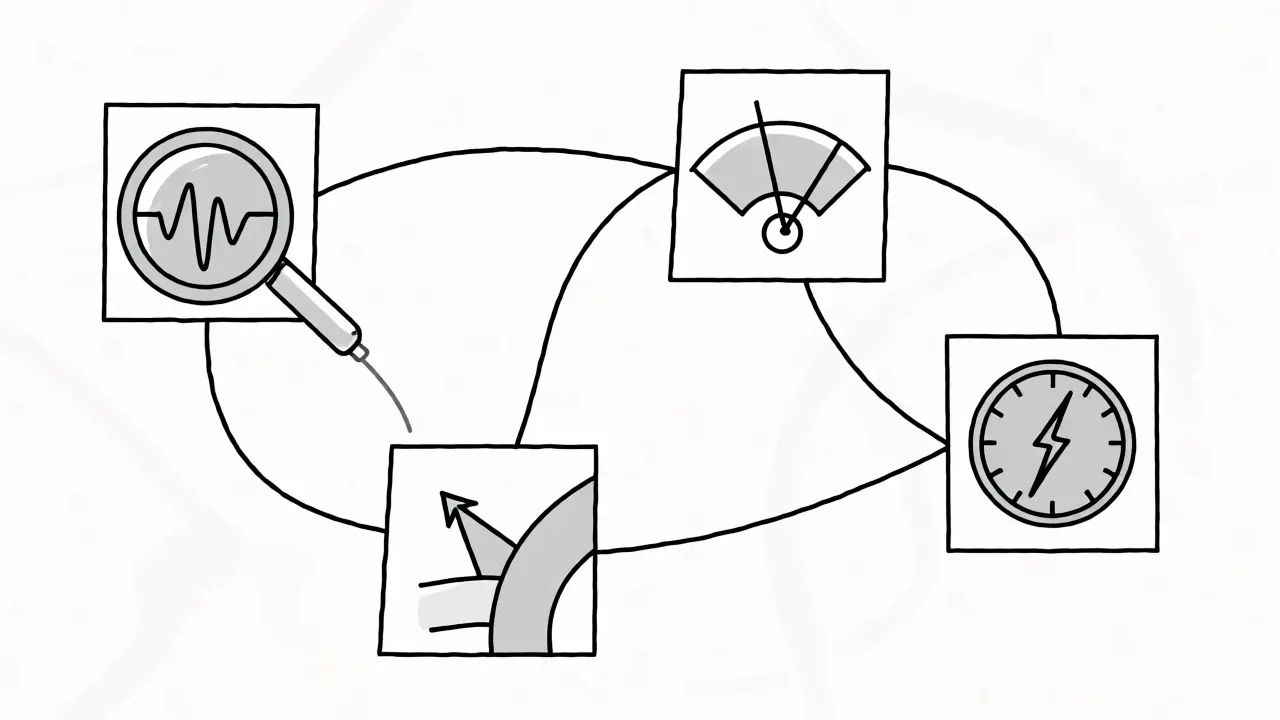
To build effective telemetry, you need to gather specific types of data. Don't try to log everything. Focus on signals that indicate compromise or degradation. Here are the four pillars of AI security telemetry:
- Input Anomalies: Watch for prompts that deviate significantly from historical norms. Are users suddenly sending 10x longer strings? Are they using special characters rarely seen before? Tools like Web Application Firewalls (WAF) integrated with AI logic can flag these.
- Model Confidence Scores: Most modern LLMs provide a confidence metric for their outputs. A sudden drop in average confidence across many requests often signals an adversarial attack or data poisoning.
- Output Consistency: Does the same input produce wildly different outputs over time? While some variance is expected, extreme inconsistency might mean the model weights are being manipulated or corrupted.
- Inference Latency Spikes: Adversarial inputs often require more computational power to process. Unexplained latency increases can be a side-channel indicator of an attack.
Collecting this data requires instrumentation at the API gateway level. You need to capture the raw input, the processed features, the model's internal state (if accessible), and the final output. This creates a rich dataset that allows you to correlate events later.
Setting Up Alerting That Doesn't Scream Wolf
Alert fatigue is real. If your SOC team gets 500 alerts a day about "unusual token usage," they will ignore them all. The goal is high-fidelity alerts. How do you achieve that?
Start with baselining. Before you turn on alerts, let your system run for two weeks. Record the normal range for confidence scores, latency, and input lengths. Use statistical methods, not fixed thresholds. For example, instead of saying "Alert if confidence < 0.8," say "Alert if confidence drops below the 5th percentile of the last hour." This adapts to natural fluctuations.
| Metric Category | Traditional App Metric | AI-Generated App Metric | Why It Matters |
|---|---|---|---|
| Performance | Response Time (ms) | Inference Latency + Token Count | Adversarial inputs often increase compute cost disproportionately. |
| Error Handling | HTTP Status Codes (4xx, 5xx) | Confidence Score Drop & Output Hallucination Rate | AI errors often return HTTP 200 with bad content. |
| User Behavior | Page Views / Clicks | Prompt Complexity & Input Entropy | Detects automated bots or scripted attacks trying to confuse the model. |
| Data Integrity | Database Checksums | Training Data Drift & Embedding Norms | Catches data poisoning attempts during retraining or live inference. |
Another key strategy is correlation. Don't alert on a single metric. Combine signals. For instance, trigger a high-priority alert only if: (1) Input entropy spikes AND (2) Confidence score drops AND (3) Latency increases. This reduces false positives significantly. According to Splunk research, combining three correlated metrics reduces noise by nearly half compared to single-metric alerts.
Handling the 'Black Box' Problem
One of the biggest hurdles is explainability. When an alert fires, your team needs to know *why*. Is the model confused because of a new attack pattern, or did it just have a bad day? Current telemetry solutions struggle here. MITRE's ATT&CK for AI framework notes that we currently capture less than 40% of the attack surface effectively because we can't always see inside the model's decision process.
To mitigate this, integrate Explainable AI (XAI) tools into your telemetry pipeline. These tools generate human-readable reasons for model decisions. When an alert triggers, attach the XAI explanation to the ticket. Instead of seeing "Anomaly Detected," your analyst sees "Model focused on irrelevant keywords 'banana' and 'purple' in prompt." This context speeds up investigation dramatically.
Also, consider edge-based processing. Sending every single inference request to a central cloud SIEM is expensive and slow. Process basic anomaly detection at the edge or within the application container. Only send flagged events to the central dashboard. This approach, highlighted by vendors like NetScout, reduces bandwidth costs and keeps critical alerts fast.

Implementation Roadmap: From Zero to Hero
You don't need to boil the ocean. Start small. Here is a practical phased approach recommended by industry experts:
- Phase 1: Visibility (Months 1-2). Instrument your API gateway. Log inputs, outputs, and metadata. Do not set alerts yet. Just collect data. Build your baseline.
- Phase 2: Basic Alerts (Months 3-4). Set up alerts for obvious outliers. Extreme latency, zero-confidence responses, or massive input sizes. Tune these aggressively to reduce noise.
- Phase 3: Correlation & Context (Months 5-6). Integrate with your existing SIEM. Link AI alerts with user identity data and network logs. Implement multi-signal triggers.
- Phase 4: Automation (Month 6+). Add automated responses. If a specific IP shows consistent low-confidence queries, automatically rate-limit it. Feed this feedback back into your model training pipeline.
Budget wisely. Specialized AI telemetry tools often cost 25-40% more than traditional equivalents due to higher processing needs. However, the ROI comes from faster incident response. IBM Security reported a 52% reduction in response times for teams using specialized AI telemetry.
Common Pitfalls to Avoid
Many teams stumble because they treat AI apps like regular apps. Here are the traps to watch out for:
- Ignoring Model Drift: Models change over time as you retrain them. Your telemetry baselines must update accordingly. A static threshold will become useless after one major model update.
- Overlooking Data Provenance: Ensure you log where the input data came from. Was it user-typed? API-driven? Scraped? Knowing the source helps trace attacks back to their origin.
- Neglecting Privacy: AI telemetry often involves storing prompts and outputs. These can contain PII (Personally Identifiable Information). Ensure your storage complies with GDPR or CCPA. Mask sensitive data before logging it.
- Underestimating Staff Skills: Your security team needs to understand basic ML concepts. They don't need to be data scientists, but they need to know what a "confidence score" means. Invest in cross-training.
The landscape is evolving fast. By 2026, Gartner predicts that 70% of security telemetry solutions will use causal AI to distinguish between coincidence and causation. This will further reduce false positives. Stay ahead by building flexible pipelines that can adapt to new tools and techniques.
What is the main difference between traditional and AI security telemetry?
Traditional telemetry focuses on deterministic errors like crashes, timeouts, and invalid syntax. AI security telemetry monitors probabilistic behaviors such as confidence scores, input anomalies, and output consistency. It detects attacks that result in valid but incorrect or manipulated AI responses, which traditional tools miss because the HTTP status remains 200 OK.
How do I handle high false positive rates in AI alerting?
Use dynamic baselines instead of fixed thresholds. Adjust alert criteria based on recent historical data. Additionally, implement multi-signal correlation, triggering alerts only when multiple indicators (e.g., latency spike, confidence drop, and input entropy increase) occur simultaneously. This approach significantly reduces noise compared to single-metric alerts.
Do I need specialized tools for AI telemetry?
While general SIEMs can ingest AI logs, specialized tools offer pre-built detectors for AI-specific threats like prompt injection and model drift. These tools often integrate with MLOps pipelines and provide better visualization of model behavior. However, you can start with custom rules in existing platforms like Splunk or Datadog if you have the engineering resources to tune them.
How long does it take to implement AI security telemetry?
Typically, it takes 3 to 6 months to fully operationalize. The first 1-2 months are for instrumentation and baseline collection. Months 3-4 involve setting up initial alerts and tuning. Months 5-6 focus on integrating with broader security workflows and automating responses. Rushing this process leads to alert fatigue and missed threats.
What are the biggest risks if I skip AI-specific telemetry?
You risk missing sophisticated attacks like data poisoning, prompt injection, and model inversion. These attacks manipulate the AI's output without breaking the application, leading to silent failures, biased results, or leaked proprietary information. Over time, undetected drift can also degrade user trust and business value.
 Artificial Intelligence