You’re building an AI feature. The demo looks great in the browser. But when you push it to production, things get messy. Your users complain about lag. Legal asks where the customer data is going. Finance wants to know why the cloud bill is spiking. You’re stuck between two paths: call a big provider’s API or run the model yourself.
This isn’t just a tech choice; it’s a business strategy decision. As of late 2026, with Large Language Models becoming standard infrastructure, the gap between cloud convenience and local control has narrowed but hasn’t disappeared. Choosing wrong can mean paying double for slow responses or spending months managing servers instead of shipping features. Let’s break down exactly where each option wins and loses so you can pick the right lane for your specific workload.
The Latency Reality Check
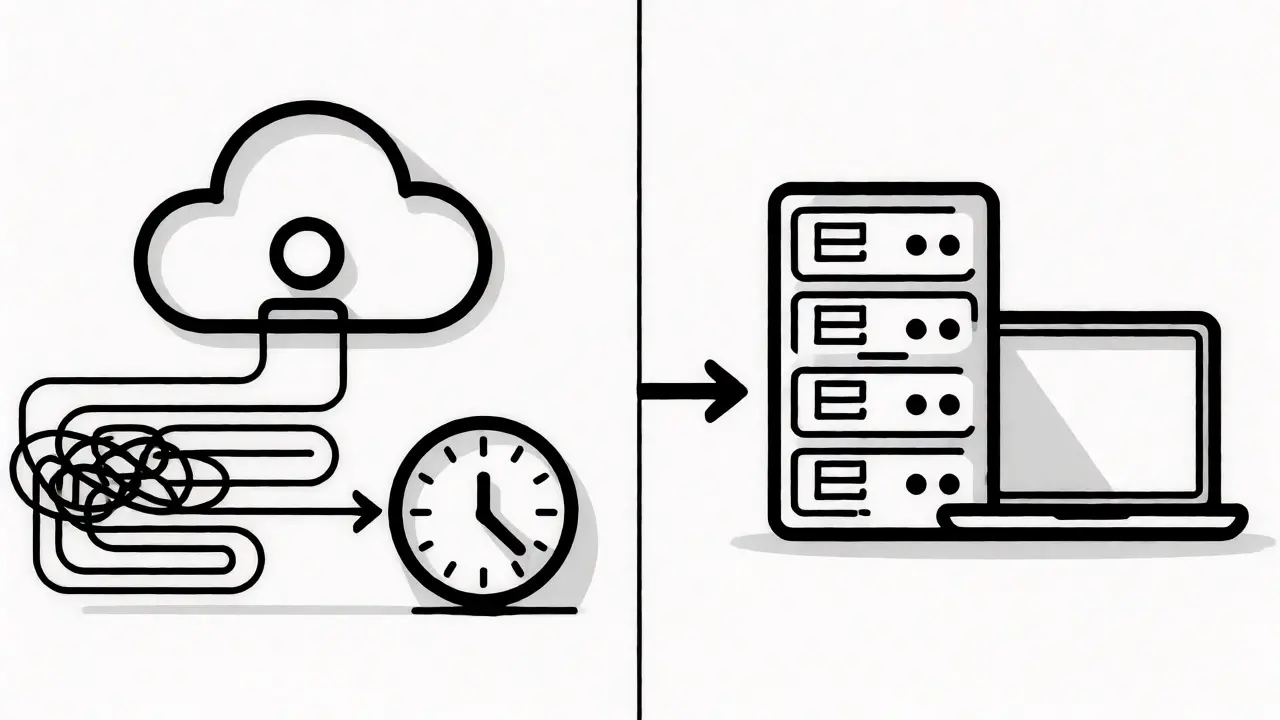
Let’s talk numbers, because "fast" is subjective. When you hit an API endpoint from OpenAI or Anthropic, you’re sending data across the internet, waiting for a GPU cluster somewhere else to process it, and waiting for the result to come back. In most enterprise scenarios, this round trip takes between 1.4 and 1.8 seconds per request. For a chatbot? That’s acceptable. For a real-time trading bot or a manufacturing robot arm? It’s an eternity.
On-premises deployment, by contrast, eliminates the network hop. If you have the right hardware-say, NVIDIA B200 GPUs or even high-end consumer cards like the RTX 5090-you can generate tokens locally at speeds of 50 to 100 tokens per second. More importantly, you remove the jitter. Cloud APIs throttle. They queue requests during peak hours. Your latency becomes unpredictable. Local inference is consistent. If your app requires sub-second response times for every single interaction, such as live translation or interactive coding assistants, on-prem gives you deterministic performance that the public cloud simply cannot guarantee.
However, don’t assume on-prem is always faster. Modern cloud providers use specialized serving stacks (like vLLM or TensorRT-LLM) optimized for massive throughput. For batch processing thousands of documents overnight, a cloud API might actually finish the job faster than your single local server because they can spin up hundreds of instances instantly. Latency matters for user experience; throughput matters for cost efficiency. Know which one your users care about.
Control, Data Sovereignty, and Compliance
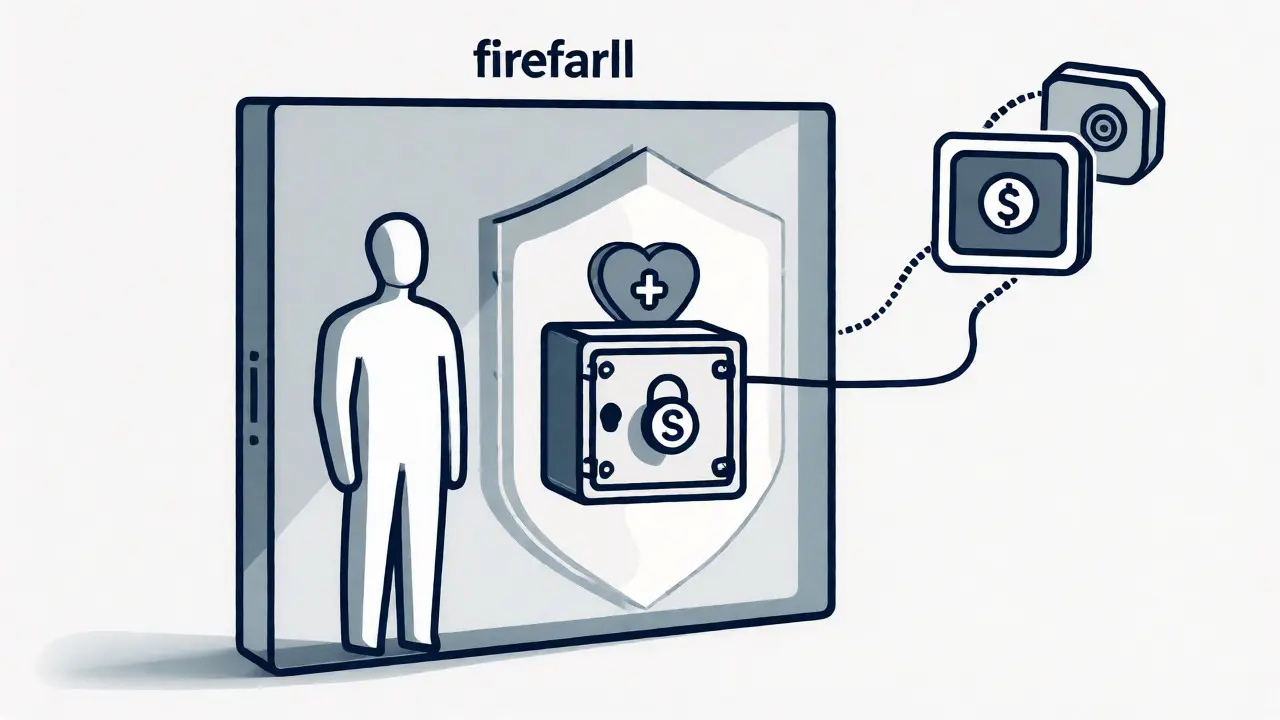
If your data is sensitive, the conversation changes immediately. Sending customer records, financial logs, or medical histories to a third-party API means trusting their security posture. For banks and hospitals, this is often a non-starter due to regulations like HIPAA or GDPR. Data sovereignty refers to the requirement that data stays within specific geographic or legal boundaries. On-prem deployment solves this by keeping data inside your own firewall. No packets leave your data center. Period.
Beyond compliance, there’s intellectual property. When you fine-tune a model via API, you’re often limited to parameter adjustments. You can’t change the architecture. With on-prem access to open-source weights like Llama 4 or Qwen 3, you have total control. You can prune layers, quantize aggressively for specific hardware, or integrate proprietary knowledge bases directly into the model context without worrying about vendor terms of service changing next quarter. Vendor lock-in is a real risk with APIs; migrating away from a provider that deprecates a model version can take weeks of re-engineering.
Scalability: Elasticity vs. Predictability
Here is where the cloud shines. Imagine your marketing team launches a campaign that triples traffic overnight. With an API, you scale infinitely. You pay for what you use. With on-prem, you need capacity. Did you buy enough GPUs last year? If not, you’re queuing requests while users rage. Scaling up on-prem involves procurement cycles, hardware delivery, rack mounting, and integration-processes that take days or weeks, not minutes.
But elasticity comes with a price tag. Cloud costs are variable. A sudden spike in usage can blow your budget if you aren’t monitoring token counts closely. On-prem costs are fixed. Once you buy the server, running it costs electricity and cooling, regardless of whether it handles 10 requests or 10,000. This makes on-prem attractive for workloads with predictable, steady volume. If you process 2 million tokens daily, consistently, owning the hardware usually beats renting it over a three-year horizon.
The Hidden Costs of Each Path
People often compare the $0.0001 per token API rate against the sticker price of a GPU. That’s lazy math. You need to look at Total Cost of Ownership (TCO).
| Cost Factor | API / Cloud | On-Premises |
|---|---|---|
| Infrastructure | Pay-as-you-go; no upfront CAPEX. | High upfront CAPEX for GPUs/servers. |
| Engineering | Low initial effort; managed services handle updates. | High effort; requires MLOps staff ($135k+/yr avg). |
| Operational Overhead | Monitoring tools, prompt caching infra (20-40% of ops cost). | Electricity ($0.10-$0.30/kWh), cooling (15-30% overhead). |
| Risk | Vendor lock-in; price hikes; rate limits. | Hardware obsolescence; maintenance burden. |
With APIs, hidden costs include prompt caching infrastructure, complex logging for token-level billing, and the engineering time spent handling rate limits and retries. With on-prem, the hidden costs are human. You need engineers who know how to manage CUDA drivers, optimize memory bandwidth, and update model weights. You also pay for power and cooling. An NVIDIA B200 draws nearly 1kW. Multiply that by 24/7 operation and add 30% for cooling inefficiencies. Suddenly, that "free" compute isn't so free.
Hybrid Architectures: The Best of Both Worlds
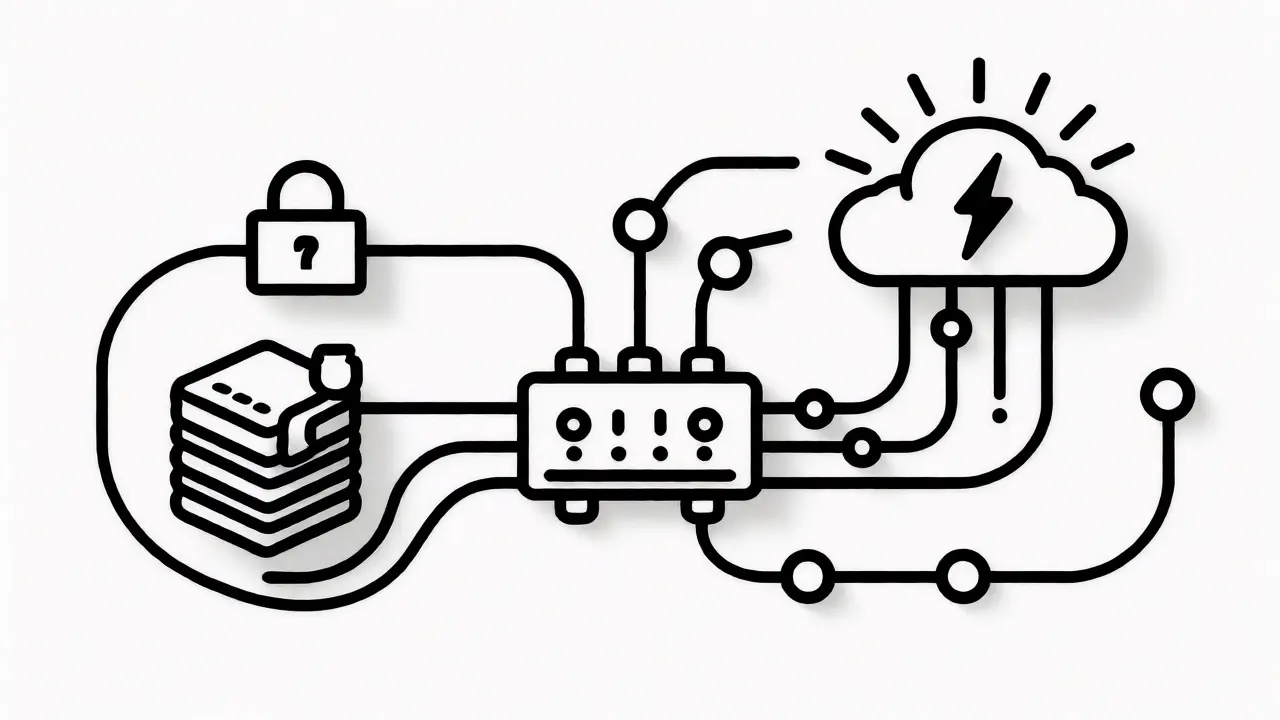
Most sophisticated enterprises in 2026 don’t pick one side. They build hybrid systems. Think of it as routing traffic based on sensitivity and urgency.
- Route Sensitive Data Locally: Any request containing PII (Personally Identifiable Information) goes to your on-prem Llama 4 instance. No data leaves the building.
- Route General Queries to Cloud: Public information lookups, creative brainstorming, or low-priority background tasks go to GPT-4o or Claude 3.5 Sonnet via API.
- Handle Bursts in Cloud: During Black Friday sales, offload overflow traffic to the API to prevent your local servers from crashing.
This approach minimizes risk while maximizing flexibility. You keep your core IP and compliance under control, but you retain the ability to scale rapidly when demand spikes. Tools like Kubernetes make this orchestration easier, allowing you to define policies that automatically route requests based on metadata tags.
Decision Framework: Which One Do You Choose?
Still unsure? Use this quick heuristic to decide your primary deployment strategy.
- Choose On-Prem if:
- You process >2 million tokens daily with consistent patterns.
- Data privacy is legally non-negotiable (HIPAA, FedRAMP).
- You need sub-second latency for real-time interactions.
- You have in-house MLOps expertise.
- Choose API if:
- You are a startup needing speed-to-market.
- Your workload is highly variable or bursty.
- You lack dedicated infrastructure teams.
- Data sensitivity is low (e.g., public content generation).
The landscape is shifting fast. Open-source models like DeepSeek R1 are closing the capability gap with closed-source giants. Hardware like the RTX 5090 offers incredible bandwidth for local inference. What was impossible for small teams five years ago is now feasible. But remember: technology choices should serve business goals, not the other way around. Don’t buy a supercomputer if a simple API call gets the job done. And don’t rely on an API if losing that connection shuts down your business.
Is on-prem LLM deployment cheaper than API calls?
Not necessarily. For low-volume or sporadic usage, APIs are significantly cheaper because you avoid upfront hardware costs and maintenance labor. However, for high-volume, consistent workloads (typically over 2 million tokens daily), on-prem deployment often becomes more cost-effective over a 2-3 year period due to amortized hardware costs and lower marginal cost per token.
How does latency differ between API and on-prem LLMs?
Cloud APIs typically have higher average latency (1.4-1.8 seconds) due to network round-trips and potential throttling. On-prem deployments eliminate network hops, offering lower and more consistent latency (often under 1 second for first token, with stable generation speeds). On-prem is preferred for real-time applications requiring deterministic response times.
What is the biggest risk of using LLM APIs?
The primary risks are vendor lock-in, data privacy concerns, and unexpected cost spikes. Switching providers can be complex if you've built dependencies on specific API features. Additionally, sending sensitive data to third-party clouds may violate compliance regulations like GDPR or HIPAA.
Can I switch from API to on-prem later?
Yes, but it requires significant engineering effort. You'll need to procure hardware, set up inference servers, and potentially re-engineer prompts if you switch model families (e.g., from GPT-4 to Llama 3). Hybrid architectures allow you to start with APIs and gradually migrate sensitive or high-volume workloads to on-prem infrastructure.
Do open-source models match closed-source API quality?
As of 2026, top-tier open-source models like Llama 4, Qwen 3, and DeepSeek R1 have reached capabilities comparable to leading closed-source models like GPT-4o for many general tasks. While closed-source models may still lead in niche reasoning or multimodal tasks, the gap is narrow enough that on-prem deployment is a viable alternative for most enterprise use cases.
 Artificial Intelligence