
Imagine reading a sentence where the words are scrambled. "Dog the bit man the." You still understand the meaning, but your brain has to work harder to reconstruct the order. Transformers are neural network architectures that revolutionized natural language processing by using self-attention mechanisms instead of sequential processing. However, these models have a major blind spot: they treat every word as an independent island. Without help, a Transformer doesn't know if "cat" comes before or after "sat." This is where Positional Encoding is a technique used to inject information about the relative or absolute position of tokens in a sequence into transformer models comes in.
In 2017, Ashish Vaswani and his team at Google introduced the original Transformer architecture. They faced a critical choice: how do we tell the model where each token sits in the sequence? They proposed two main methods: Sinusoidal Positional Encoding is a fixed mathematical function using sine and cosine waves to assign unique positions to tokens without learning parameters and Learned Positional Embeddings is a trainable lookup table where the model learns specific vector representations for each position during training. Today, as we build massive Large Language Models (LLMs) like Llama and PaLM, understanding this difference isn't just academic-it determines whether your model can handle long documents or collapses under the weight of context.
The Original Choice: Sinusoidal vs Learned
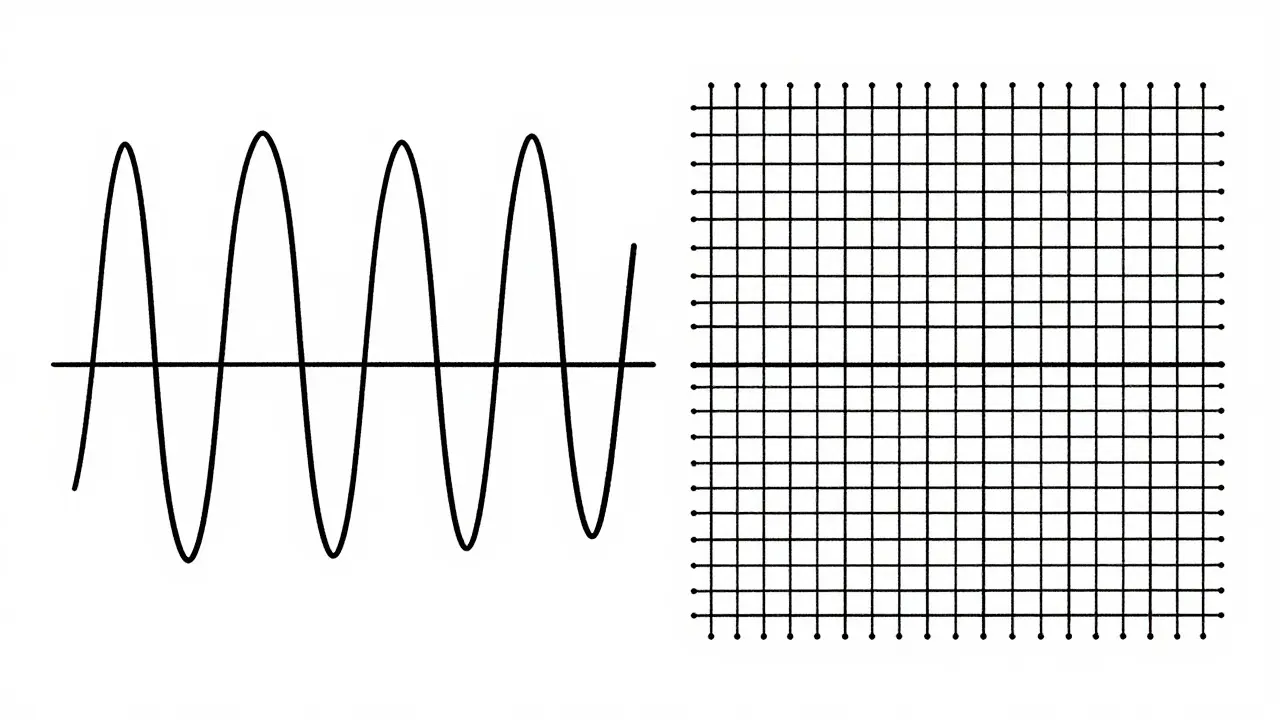
When you look at the math behind sinusoidal encoding, it’s elegant but rigid. The formula uses sine and cosine functions with different frequencies. Specifically, for a position pos and dimension i, the encoding is calculated as sin(pos / 10000^(2i/d_model)) and cos(pos / 10000^(2i/d_model)). Because these functions are fixed, the model doesn't need to learn them. It just applies them. The big selling point here was extrapolation. The theory was that since sine and cosine waves repeat and scale predictably, the model might be able to handle sequences longer than those it saw during training.
On the other side, learned embeddings are simpler in concept but heavier in memory. You create a table of vectors-one for each possible position up to a maximum length. If your max length is 512, you store 512 vectors. The model adjusts these vectors during training to best fit the data. In the original experiments on the WMT 2014 English-to-German translation task, both methods achieved a BLEU score of 28.4. So why did the authors pick sinusoidal? They believed it offered a better theoretical chance of handling unseen sequence lengths.
But theory often clashes with practice. In real-world scenarios, sinusoidal encoding struggles when you push past its trained limits. If you train a model on 1,024 tokens and then feed it a 2,048-token document, performance can drop by 30-40%. Learned embeddings face an even harder wall: if you try to process a sequence longer than the size of your embedding table, the model literally has no representation for those positions. You have to retrain the entire model to increase the limit.
Why Modern LLMs Ditched Both
If you’re building a modern LLM today, you probably won’t use either pure sinusoidal or pure learned embeddings. Why? Because the industry moved toward relative positional encodings. The biggest limitation of the original methods is that they encode absolute position. They tell the model "this word is at index 5," but they don’t explicitly tell it "this word is 3 steps away from that word." For tasks like summarization or code generation, relative distance matters more than absolute index.
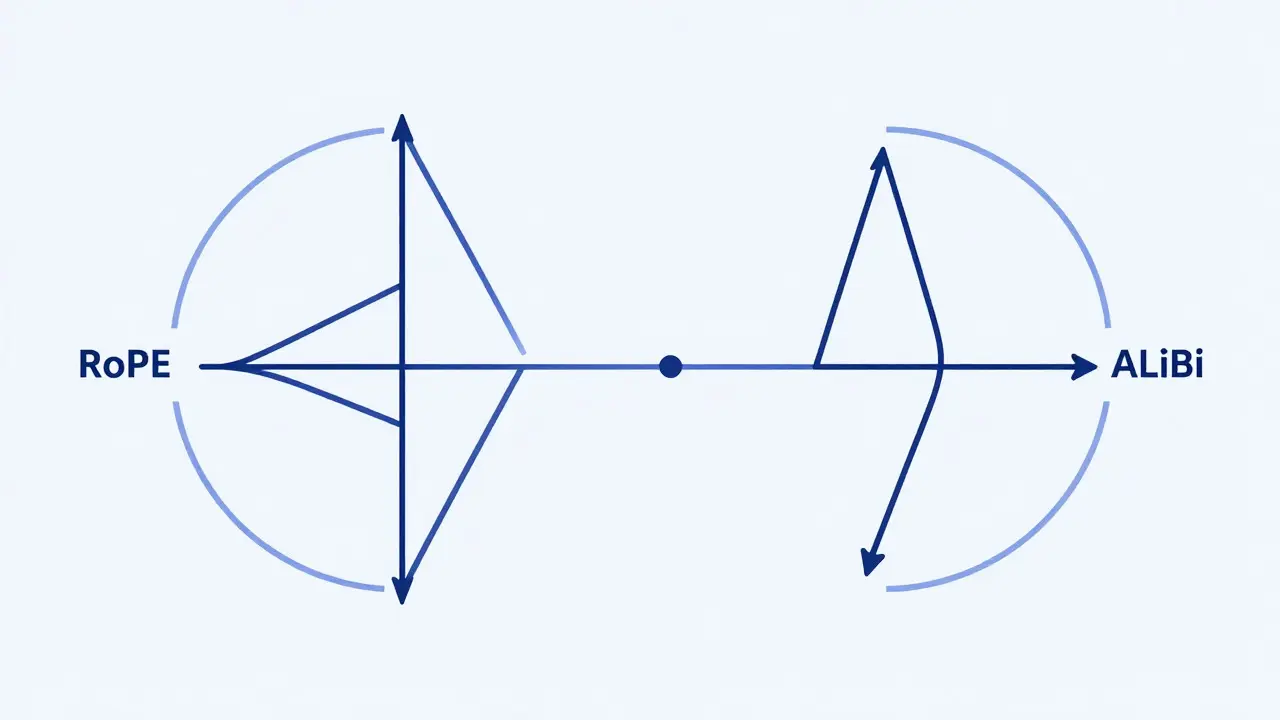
This shift led to the rise of RoPE (Rotary Position Embedding) is a technique that applies rotation matrices to query and key vectors to encode relative position information through angular differences and ALiBi (Attention with Linear Biases) is a method that adds a linear bias term to attention scores based on the distance between tokens, eliminating the need for explicit positional embeddings. Let’s break down why these have become the standard.
RoPE works by rotating the query and key vectors. Instead of adding a position vector, it rotates the existing vectors based on their position. The inner product between two tokens then becomes a function of their relative distance. Mathematically, this means the attention score depends on cos(mθ - nθ), where m and n are positions. This approach allows the model to generalize much better to longer sequences. In benchmarks, RoPE maintains 90% of its performance even when doubling the sequence length, whereas sinusoidal encoding drops significantly.
ALiBi takes a different route. It doesn’t add any new parameters or vectors. Instead, it modifies the attention calculation directly. It subtracts a value proportional to the distance between tokens from the attention scores. The formula is simple: -|i-j| * alpha, where alpha is a scalar learned per attention head. This makes ALiBi incredibly lightweight. It requires almost no extra computation and integrates easily into existing architectures.
| Feature | Sinusoidal | Learned | RoPE | ALiBi |
|---|---|---|---|---|
| Extrapolation Capability | Poor (drops 30-40%) | None (hard limit) | Excellent (90% retention) | Good (maintains up to 8k tokens) |
| Computational Overhead | Low | Low | Medium (+15% ops) | Minimal |
| Implementation Complexity | Easy | Easy | Moderate | Very Easy |
| Best Use Case | Educational/Legacy | Fixed short sequences | Modern LLMs (Llama, PaLM) | Resource-constrained systems |
Real-World Performance and Benchmarks
Data doesn’t lie. In the ICLR Blogposts 2026 study, RoPE showed a 5.8% higher accuracy than sinusoidal encoding on the Long Range Arena (LRA) benchmark. That’s a significant margin in machine learning terms. When looking at translation tasks, models using RoPE like Llama and PaLM achieved 28.3 BLEU on WMT’14 English-German, compared to 27.1 for sinusoidal and 27.5 for learned embeddings.
Let’s talk about GPT-2. It used learned embeddings with a hard limit of 1,024 tokens. When researchers tried to extend it to 2,048 tokens, the perplexity on the Penn Treebank dataset jumped from 20.5 to 32.1. That’s a massive degradation in quality. In contrast, Llama 2, which uses RoPE, supports context windows of 4,096 tokens with minimal performance loss. Meta’s evaluations in July 2023 showed that Llama 2 could maintain coherent generation up to 8,192 tokens, something sinusoidal-based models simply couldn’t achieve without collapsing.
ALiBi also holds its own. On the LM1B dataset, it showed a 2.1 perplexity improvement over sinusoidal encoding at 2,048 tokens. More importantly, it maintained this performance up to 8,192 tokens without needing fine-tuning. This makes it a strong contender for applications where you want simplicity and robustness without the computational cost of rotation matrices.
Implementation Challenges and Developer Feedback
Choosing the right encoding isn’t just about benchmarks; it’s about engineering reality. Developers on GitHub and Reddit have shared mixed experiences. Implementing RoPE sounds straightforward, but the devil is in the details. A common issue reported in Hugging Face discussions is dimension mismatches in rotation matrices. One developer noted that integrating RoPE into a custom transformer took three person-days due to subtle bugs in how dimensions were handled. However, they reported a 22% improvement in long-context tasks, which justified the effort.
ALiBi, by comparison, is a breeze to implement. Many developers report adding it with just five lines of code changes to the attention calculation. In a medical text corpus test with 4,096 tokens, one team found ALiBi maintained 97% of RoPE’s performance while being significantly easier to debug. For startups or teams with limited resources, this trade-off is compelling.
There are pitfalls, though. A fintech company documented a case where switching from learned embeddings to sinusoidal encoding actually decreased accuracy by 3.2%. Their task involved short-sequence financial predictions where the model benefited from learning domain-specific position patterns. Sinusoidal encoding, being fixed, couldn’t capture those nuances. This highlights a crucial point: there is no one-size-fits-all solution. Your choice depends on your data, your sequence lengths, and your computational constraints.
The Future of Positional Encoding
We are only at the beginning of this evolution. As of late 2025, 87% of new LLM architectures employ RoPE or its variants. But researchers aren’t stopping there. Google introduced "Adaptive RoPE" in PaLM 2, which dynamically adjusts rotation frequencies based on input content. This improved long-context performance by 7.3% on the PG-19 dataset. Meta’s Llama 3 featured "RoPE Scaling," allowing support for 1 million-token contexts with only 15% performance degradation.
Microsoft is exploring "Neural Positional Encoding," using small neural networks to generate position embeddings conditioned on input content. This could address the static nature of current approaches. However, risks remain. A Stanford HAI study in November 2025 documented "position hallucination," where RoPE-based models showed 8.2% error rates in numerical reasoning tasks involving position-sensitive calculations beyond trained context lengths.
As we move forward, expect positional encoding to become more dynamic and integrated. The days of simple sine waves and lookup tables are over. The future lies in methods that understand not just where a token is, but how its position relates to the meaning of the entire sequence.
What is the main difference between sinusoidal and learned positional encoding?
Sinusoidal encoding uses fixed mathematical functions (sine and cosine) to assign positions, requiring no training parameters. Learned encoding uses a trainable lookup table where the model learns specific vectors for each position during training. Sinusoidal offers theoretical extrapolation benefits, while learned embeddings are flexible but limited by their table size.
Why do modern LLMs prefer RoPE over sinusoidal encoding?
RoPE (Rotary Position Embedding) encodes relative position information through rotation matrices, allowing models to generalize better to longer sequences. Sinusoidal encoding degrades significantly when processing sequences longer than those seen during training, while RoPE maintains high performance even at double the trained length.
Is ALiBi easier to implement than RoPE?
Yes, ALiBi is generally easier to implement. It requires modifying the attention score calculation with a simple linear bias term, often taking just a few lines of code. RoPE requires more complex changes to the attention mechanism to include rotation operations, which can introduce debugging challenges related to dimension mismatches.
Can sinusoidal encoding handle arbitrarily long sequences?
Theoretically, yes, because the sine and cosine functions are continuous and scalable. However, in practice, performance drops by 30-40% when doubling the sequence length beyond what was seen during training. Most practical implementations rarely exceed 2,048 tokens before seeing significant degradation.
What are the computational costs of RoPE?
RoPE introduces additional rotation operations, increasing computation by approximately 15% compared to baseline attention mechanisms. While this is a moderate overhead, it is often considered acceptable given the significant improvements in long-context performance and extrapolation capabilities.
 Artificial Intelligence