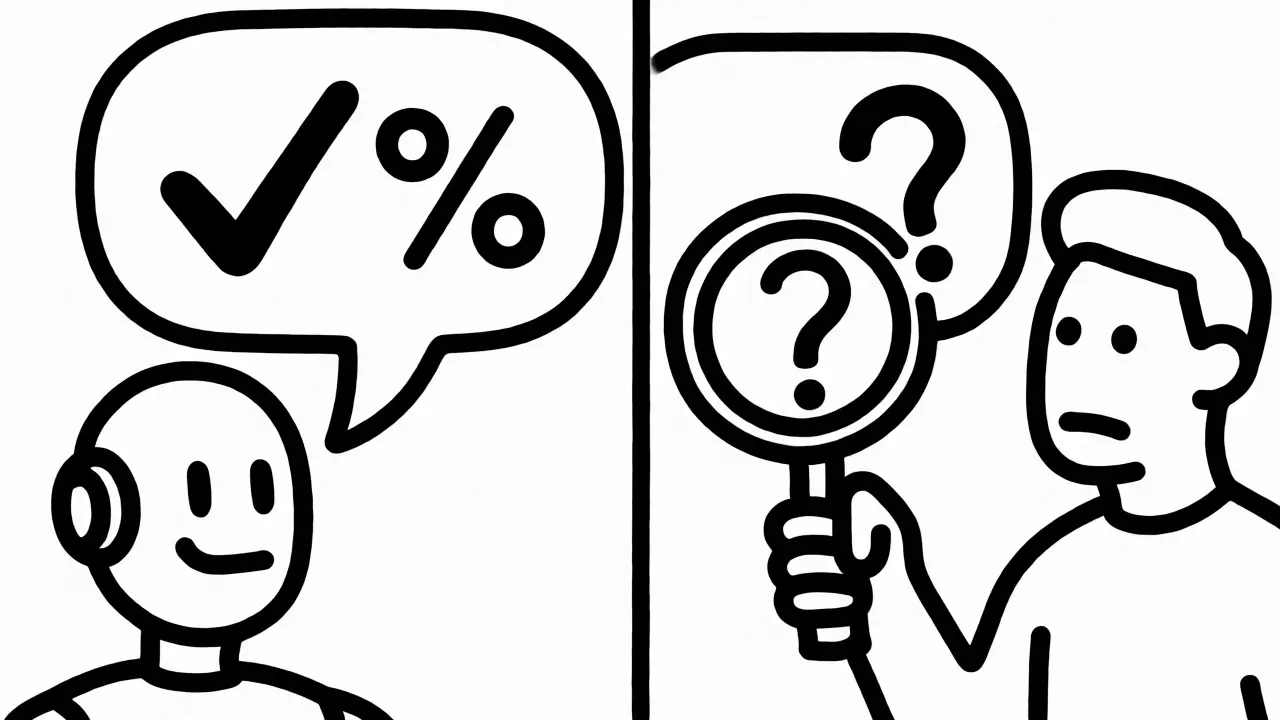
You ask a large language model (LLM) a tricky question. It answers instantly, confidently, and sounds completely right. But when you check the facts, it’s wrong. This is the classic hallucination problem, but there’s a deeper issue hiding behind it: calibration. If a model says it’s 90% sure about an answer, you should expect it to be correct 9 out of 10 times. In reality, many generative models are wildly miscalibrated. They might say they’re 95% confident on questions they get wrong half the time. This mismatch between stated confidence and actual accuracy creates a massive trust gap. You can’t automate decisions if you don’t know when to trust the machine.
Calibration isn’t just about making the AI sound smarter. It’s about making its internal probability estimates match real-world outcomes. When we fix this, we reduce hallucination risks and make AI systems safer for critical tasks like medical diagnosis or legal research. Let’s break down why current models fail at this, how new techniques like CGM are changing the game, and what you can do today to align confidence with accuracy.
The Core Problem: Why Your AI Is Overconfident
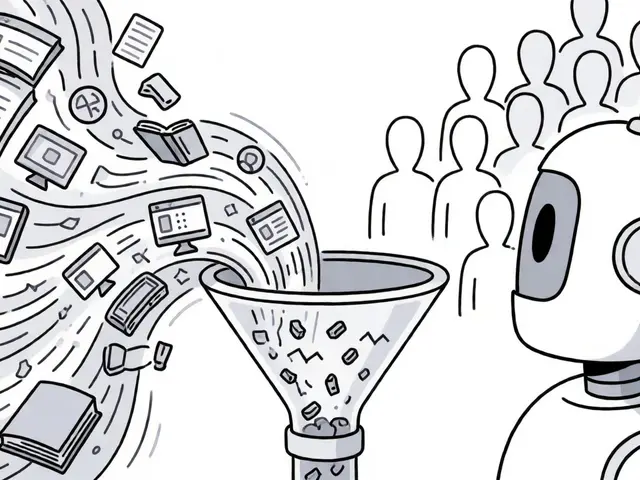
Most modern AI models are trained to maximize likelihood-essentially, to predict the next word as accurately as possible during training. However, high likelihood doesn’t guarantee well-calibrated probabilities. A model can be very good at guessing the next token while still having skewed probability distributions. This leads to overconfidence, where the model assigns near-certainty (like 99%) to outputs that are actually quite uncertain.
This issue is particularly acute in Large Language Models (LLMs) fine-tuned with Reinforcement Learning from Human Feedback (RLHF). RLHF optimizes models to produce responses humans prefer. Humans often prefer confident-sounding answers, even if they’re slightly off. So, the model learns to sound authoritative, suppressing uncertainty. The result? A model that looks confident but lacks the statistical grounding to back it up. Research shows that RLHF can actively degrade calibration because the reward signal prioritizes preference adherence over probabilistic accuracy.
Think of it like a weather forecast. If a meteorologist says there’s an 80% chance of rain every day, and it rains only 40% of those days, their forecasts are poorly calibrated. For AI, this means your "high-confidence" answers are essentially noise wrapped in a confident tone. Fixing this requires more than just better data; it requires specific algorithmic adjustments to the sampling and output layers.
Traditional Calibration Methods: Platt Scaling and Isotonic Regression
Before diving into complex generative fixes, it helps to understand the basics. Traditional machine learning uses post-hoc calibration methods. These are simple mathematical adjustments applied after the model has already made its prediction. Two methods dominate this space: Platt scaling and isotonic regression.
Platt scaling is also known as sigmoid calibration. It fits a logistic regression model to the raw output scores (logits) of the original classifier. It learns two parameters, typically denoted as 'A' and 'B', which scale and shift the logits to map them to calibrated probabilities. It’s simple, fast, and works well for binary classification tasks. If your model outputs a score of 2.5, Platt scaling transforms that into a true probability, like 0.75, based on historical performance.
Isotonic regression is a non-parametric method. Instead of assuming a specific curve shape (like the S-curve in Platt scaling), it fits a free-form piecewise constant function. It’s more flexible and can handle non-monotonic relationships between scores and probabilities. However, it requires more data to avoid overfitting. Both methods aim to correct the "calibration line," ensuring that predicted probabilities match observed frequencies.
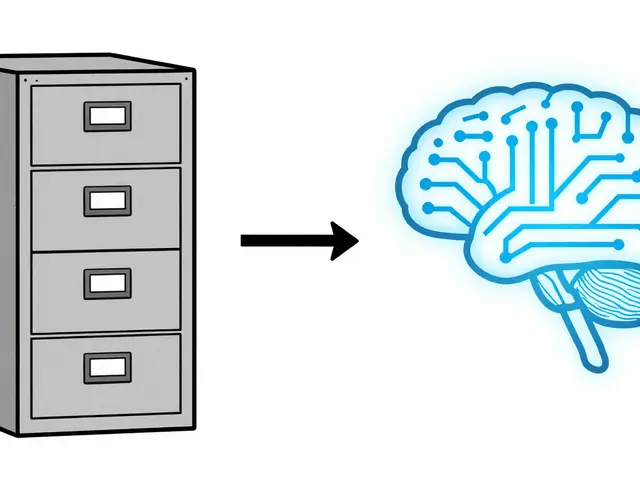
While effective for classifiers, these methods struggle with generative models. Generative AI produces sequences of tokens, not single class labels. The probability distribution spans thousands of potential continuations, making simple logit adjustments insufficient. You need methods that respect the structure of sequence generation.
The CGM Framework: Calibrating Generative Models
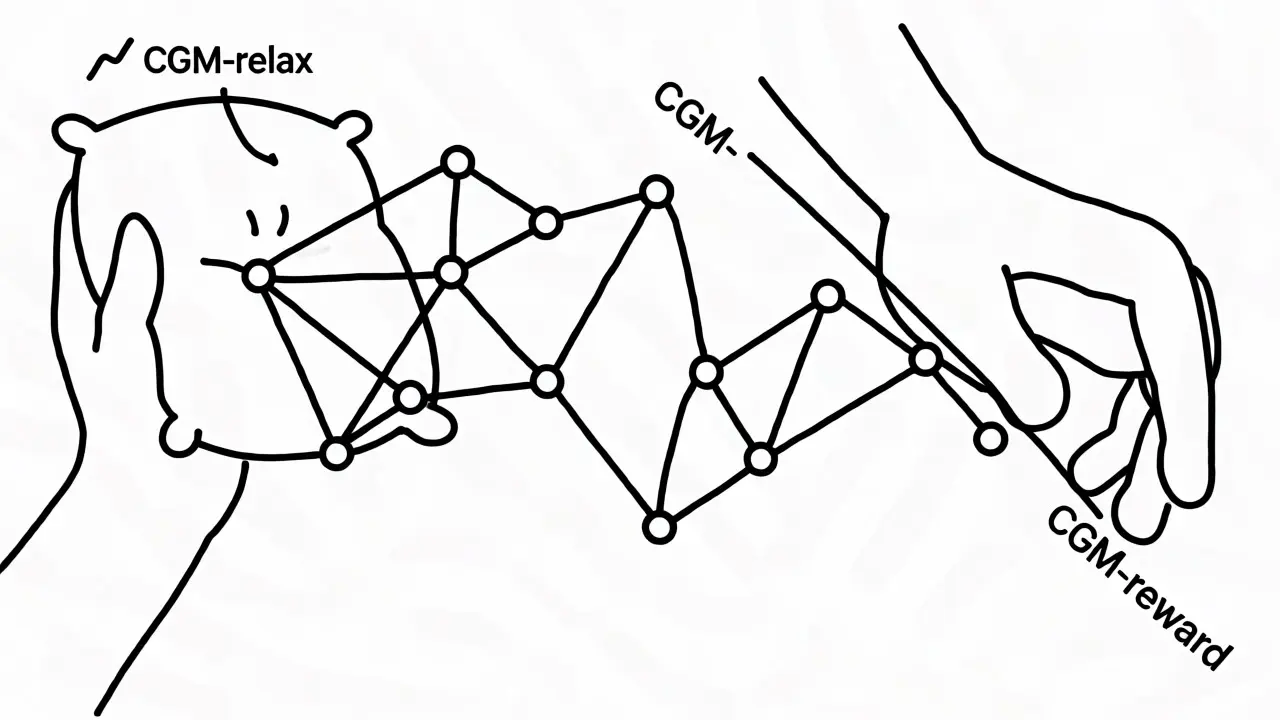
Enter the Calibrating Generative Models (CGM) framework. This approach treats calibration as a constrained optimization problem. The goal is to find a new distribution that is close to the base model (in terms of Kullback-Leibler divergence) but satisfies specific expectation constraints. Essentially, you’re nudging the model’s output distribution until its statistics match reality, without breaking the model entirely.
Two algorithms stand out in this framework: CGM-relax and CGM-reward. CGM-relax replaces hard constraints with a penalty term in the loss function. If the model’s output deviates from the desired calibration stats, it gets penalized. This soft constraint makes the optimization tractable. CGM-reward, on the other hand, frames calibration as a reinforcement learning task. It rewards the model for producing outputs that meet calibration targets. Both methods have shown impressive results across diverse domains, from protein design to image generation.
| Method | Mechanism | Best Use Case | Complexity |
|---|---|---|---|
| Platt Scaling | Logistic regression on logits | Binary classification, simple classifiers | Low |
| Isotonic Regression | Piecewise constant fitting | Non-linear calibration needs | Medium |
| CGM-relax | KL-divergence constrained optimization | Generative models with multiple constraints | High |
| Verbalized Confidence | Prompt-based self-assessment | LLMs without access to logits | Low |
Research indicates that CGM reduces the majority of calibration error across hundreds of simultaneous constraints. For instance, in protein structure diffusion models, CGM-relax yielded a nearly fivefold improvement in sample diversity for Genie2. Crucially, this improvement didn’t come at the cost of generation quality. The model remained coherent and relevant, just statistically more honest.
Prompting Strategies: Verbalized Confidence and Self-Consistency
Not everyone has the resources to retrain or fine-tune massive models. For many developers, prompt engineering is the primary tool. Can you calibrate an LLM just by asking it nicely? Sometimes, yes.
Verbalized Confidence asks the model to explicitly state its certainty. Instead of just giving an answer, you prompt it: "Answer the following question and rate your confidence from 0 to 100%." Studies show that while models aren’t perfect at this, verbalized confidence often correlates better with accuracy than raw logits, especially in black-box API scenarios where you can’t see the underlying probabilities.
A more robust technique is Self-Consistency. This involves generating multiple answers to the same question using different reasoning paths (often via chain-of-thought prompting). If 8 out of 10 generated answers agree, the confidence is high. If they diverge widely, confidence is low. This mimics human decision-making: if you’re unsure, you check your work from different angles. While computationally expensive, it provides a practical proxy for calibration without touching the model weights.
Another emerging method is LITCAB, which adds a tiny linear layer to the end of the model. This layer tweaks predicted likelihoods based on input text, requiring less than 2% additional parameters. It’s efficient and effective, offering a middle ground between full retraining and pure prompting.
Measuring Success: How to Audit Your Model’s Calibration
You can’t fix what you don’t measure. To audit calibration, you need to plot predicted confidence against actual accuracy. This is often visualized using a Reliability Diagram. A perfectly calibrated model lies on the diagonal line (y=x). Most LLMs bow below the line, indicating overconfidence.
Use metrics like Expected Calibration Error (ECE). ECE divides predictions into bins (e.g., 0-10%, 10-20%) and calculates the average difference between confidence and accuracy in each bin. Lower ECE means better calibration. Another metric is Brier Score, which measures the mean squared difference between predicted probabilities and actual outcomes. For decision-making, focus on high-confidence regions. If your model claims 90%+ confidence, does it actually hit 90% accuracy? If not, you need to adjust your threshold for automation.

Practical Implications for Deployment
Why does this matter for your product? Because misaligned confidence breaks user trust. Imagine a customer support bot that confidently gives wrong refund policies. Users stop trusting the bot, and support costs go up. Conversely, a well-calibrated bot knows when to say, "I’m not sure, let me transfer you to a human."
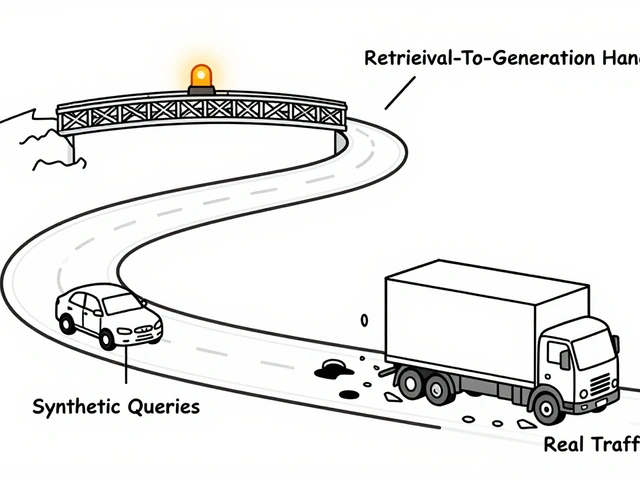
For developers, the takeaway is clear: don’t treat model outputs as ground truth. Treat them as probabilistic suggestions. Implement fallback mechanisms triggered by low-confidence signals. If you’re building RAG (Retrieval-Augmented Generation) systems, use calibration scores to decide whether to retrieve more documents or accept the current answer. Calibration turns AI from a magic box into a reliable tool.
Frequently Asked Questions
What is the difference between accuracy and calibration?
Accuracy measures how often the model is correct overall. Calibration measures whether the model's stated confidence matches its actual accuracy. A model can be highly accurate but poorly calibrated (e.g., always saying 99% confidence even when wrong).
Does RLHF improve or worsen calibration?
RLHF often worsens calibration. By optimizing for human preference, models learn to sound confident, which can lead to overconfidence in uncertain situations. Specialized calibration techniques like CGM are often needed post-RLHF.
Can I calibrate an API-based LLM without retraining?
Yes. Techniques like Verbalized Confidence, Self-Consistency, and Prompt Ensembling allow you to estimate calibration using prompts alone, without accessing the model's internal weights or logits.
What is Expected Calibration Error (ECE)?
ECE is a metric that quantifies the discrepancy between predicted probabilities and actual outcomes. It groups predictions into bins and averages the absolute difference between confidence and accuracy within each bin. Lower values indicate better calibration.
How does temperature affect calibration?
Temperature controls the randomness of sampling. Lower temperatures make outputs more deterministic and potentially more confident, but may hide uncertainty. Higher temperatures increase diversity, which can help reveal uncertainty through variance in outputs, aiding calibration assessment.
 Artificial Intelligence