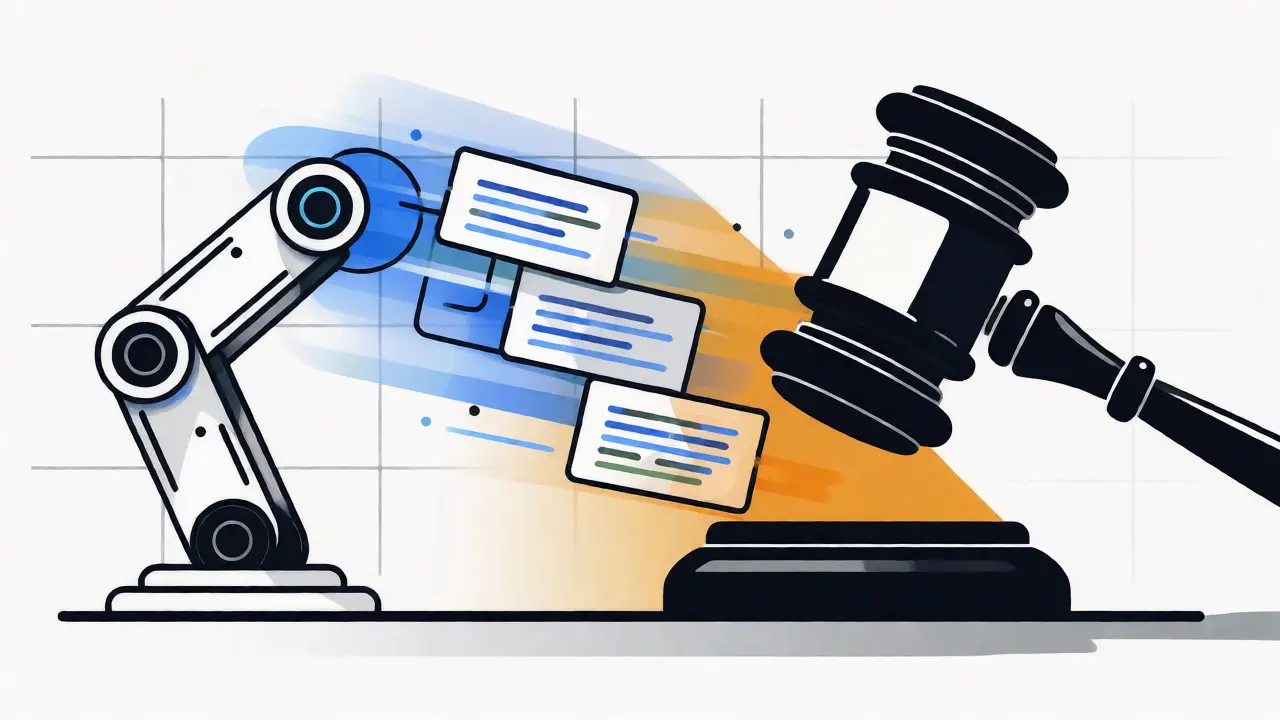
You just asked an AI coding assistant to write a function. It spat out clean, readable Python in seconds. You merged the pull request. Three weeks later, your production server is leaking user data because that "clean" code skipped input validation on a rarely used API endpoint. This isn't a hypothetical nightmare; it's the new normal. As we move deeper into 2026, the industry consensus has shifted from "AI helps us code faster" to "AI makes us code faster but potentially sloppier." The solution? Treat every line of AI-generated code as guilty until proven secure.
This isn't about hating on robots. It's about acknowledging a fundamental truth: Large Language Models (LLMs) are probabilistic engines, not deterministic compilers. They predict the next likely token based on patterns, not logical proofs of security. If you don't have a framework to catch these probabilistic slips before they hit production, you're building your house on sand. Here is how smart teams are shifting from ad-hoc reviews to a structured AI Code Security Policy.
The Myth of Inherently Safe AI Code
Let's kill the biggest misconception right now: AI doesn't write more secure code than humans by default. In fact, research from the Center for Security and Emerging Technology (CSET) found that nearly half of the code snippets generated by major models contained bugs, many of which were exploitable. Why? Because LLMs optimize for functionality and syntax correctness, not necessarily for edge-case security handling.
Think of an AI model like a brilliant junior developer who has read every book on programming but has never been burned by a production outage. It knows the syntax for SQL queries, but it might forget parameterized queries if the context isn't screamingly obvious. It generates code that looks right. Contrast Security points out that while AI code isn't inherently worse than human code, the sheer volume of output expands your attack surface. If your team ships 10x more code because of AI tools, but your security testing capacity stays flat, vulnerabilities slip through the cracks simply due to bandwidth constraints.
The risks aren't just in the code itself. There are three distinct layers of danger:
- Insecure Generation: Missing authentication checks, hardcoded secrets, or unsafe memory handling.
- Model Vulnerabilities: Adversarial prompts can trick the model into generating insecure patterns.
- Supply Chain Propagation: If insecure AI code gets into open-source libraries, it infects downstream projects globally.
Defining "Guilty Until Proven Secure"
So, what does this policy actually look like? It’s an adaptation of the Zero Trust network principle applied to software development. In a Zero Trust network, no device is trusted just because it’s inside the firewall. Similarly, in a Zero Trust Code environment, no code is trusted just because it was written by a senior engineer or an AI. But AI gets extra scrutiny because its failure modes are different.
The core tenet is simple: AI-generated code must pass explicit, automated security verification before it merges. No exceptions. This isn't about slowing down developers; it's about automating the gatekeeping so humans can focus on logic, not linting. Cisco’s Project CodeGuard, for example, offers an open-source framework that embeds secure-by-default rules directly into AI agents. It acts as a translator, ensuring that when an AI suggests code, it’s already checked against a community-driven ruleset.
Here is how traditional security differs from a guilty-until-proven-secure approach:
| Feature | Traditional DevOps | AI-Secure DevOps |
|---|---|---|
| Trust Model | Trust by role (Senior devs trusted) | Zero Trust (All AI code untrusted) |
| Review Focus | Logic and readability | Logic, readability, AND pattern-based security |
| Tooling | SAST/DAST post-commit | Real-time IDE scanning + CI/CD gates |
| Responsibility | Security Team | Shared (Dev, Sec, Ops) |
| Speed Impact | Low | Mitigated via automation |
Building Your Policy Framework
You can’t just tell developers to "be careful." You need a written policy that defines boundaries. Checkmarx’s 2025 CISO guide emphasizes granular usage policies. Not all AI code is created equal. Writing a UI button handler with AI? Low risk. Writing the cryptographic module for your payment gateway? High risk.
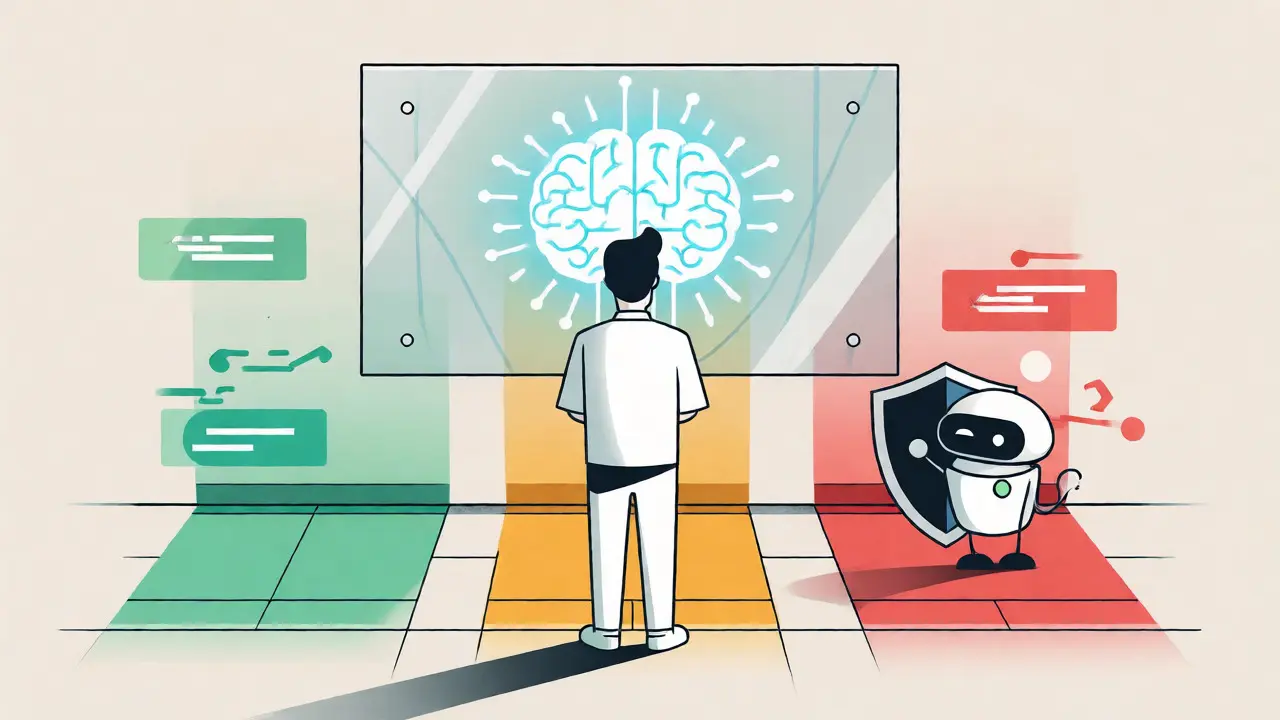
Your policy should categorize components by sensitivity. Create a matrix:
- Green Zone: Prototypes, internal tools, non-sensitive CRUD operations. AI code allowed with standard peer review.
- Yellow Zone: Business logic, API endpoints. AI code allowed but requires mandatory SAST scan and senior review.
- Red Zone: Authentication, cryptography, financial transactions. AI code prohibited or requires manual rewrite after AI suggestion.
Once you’ve defined zones, you need technical enforcement. Manual review doesn’t scale when AI generates thousands of lines a day. You need policy engines. Tools like ZeroPath allow you to define rules in natural language-e.g., "No hardcoded API keys in any file"-and automatically enforce them at commit time. This turns human-readable requirements into machine-enforceable checks. If the AI violates the rule, the commit fails. Simple.
The Technical Stack for Verification
Policy without tools is just wishful thinking. To make "guilty until proven secure" work, you need a layered technical stack that integrates into the developer workflow, not just a nightly batch job.
Start in the IDE. Developers shouldn't wait for CI to find basic errors. Use real-time scanners that hook into VS Code or IntelliJ. When the AI plugin inserts code, the scanner immediately flags issues like missing input sanitization. This provides instant feedback loops, teaching the developer (and indirectly, their prompting habits) what constitutes secure code.
Next, harden the CI/CD pipeline. Static Application Security Testing (SAST) is essential here. However, generic SAST often produces false positives. Modern approaches use AI-augmented AST (Application Security Testing) to understand context. For instance, if a variable is named `userInput`, the tool knows to check for XSS vulnerabilities. If it’s named `configFlag`, it might skip that check. This contextual awareness reduces noise and keeps developers from ignoring alerts.
Finally, don't ignore runtime. Some vulnerabilities only appear under load or specific conditions. Runtime Application Self-Protection (RASP) or Application Detection and Response (ADR) can catch anomalies in production. If AI-generated code introduces a subtle race condition, runtime monitoring will alert you before customers complain.
Governance and Shared Responsibility
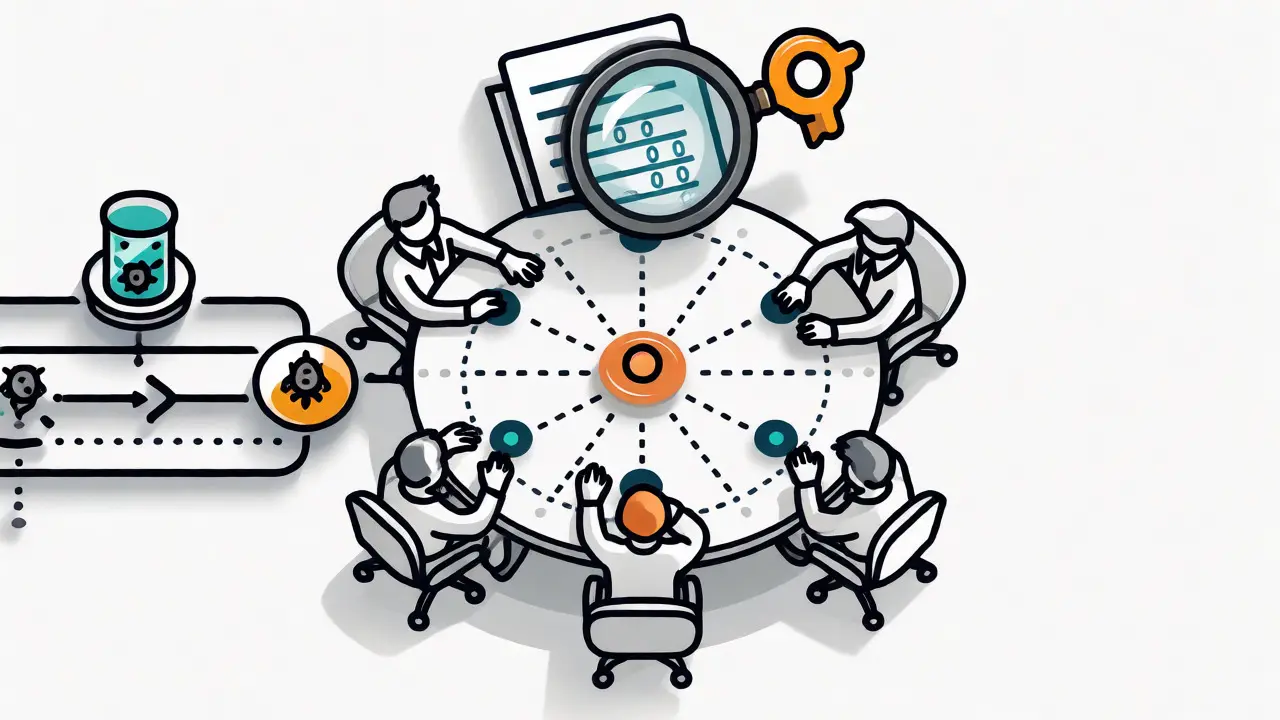
Who owns the security of AI code? The old model where Security throws tickets over the wall to Devs is dead. You need a shared responsibility model. ArmorCode highlights that successful teams maintain audit trails of AI usage. Who prompted the model? What version was used? Was the output reviewed?
Integrate security reviews into Pull Requests (PRs). If a PR contains significant AI-generated changes, tag it automatically. Require a second reviewer who specifically looks for AI pitfalls-like hallucinated library functions or outdated security practices. This isn't busywork; it’s quality assurance.
Training is also critical. Developers need to know *why* AI fails. They should be trained to recognize common insecure patterns, such as using weak random number generators or failing to validate deserialized objects. Education shifts the culture from "AI is magic" to "AI is a powerful, fallible tool."
Implementation Roadmap
Don’t try to boil the ocean. Start small. ArmorCode suggests beginning with discovery. Where are you using AI? Which repositories have the most AI-generated commits? Map this footprint first.
Then, pilot the policy in one team. Implement IDE plugins and basic CI scans. Measure the impact. Are false positives high? Is velocity dropping? Adjust your rules. Once you have a stable baseline, expand to other teams. Remember, perfection is the enemy of progress. A flawed policy enforced consistently is better than a perfect policy ignored.
Looking ahead, expect tighter integration between AI agents and security validators. We’re moving toward a future where the AI coding agent itself consults a security knowledge graph before suggesting code. It won’t just guess; it will verify. Until then, keep the burden of proof on the code.
Does this mean I can't use AI for critical systems?
Not necessarily. It means AI-generated code in critical systems requires stricter controls. You might prohibit AI from writing the initial draft of cryptographic modules but allow it to suggest optimizations after a human writes the base logic. The key is risk-based classification, not a blanket ban.
How do I handle false positives from security scanners?
False positives are the main friction point. Mitigate them by using contextual AI-augmented scanners rather than legacy regex-based tools. Also, implement a triage process where developers can mark known safe patterns as "approved," training the system to ignore similar instances in the future.
Is AI code more vulnerable than junior developer code?
Studies suggest they share similar vulnerability profiles, particularly regarding business logic errors and missing validations. However, AI can generate insecure code much faster and in larger volumes, meaning the aggregate risk to the organization can be higher if not managed properly.
What tools support a "guilty until proven secure" workflow?
Look for platforms that offer IDE integration, CI/CD gating, and policy-as-code capabilities. Examples include Cisco’s Project CodeGuard for rule enforcement, ZeroPath for natural language policy definition, and established AppSec vendors like Checkmarx or Contrast Security that have added AI-specific features to their suites.
Do I need to change my entire SDLC?
No. Most frameworks integrate into existing Agile/DevOps workflows. You add security gates to your current Pull Request and CI/CD stages. The goal is augmentation, not replacement. Keep your sprint cycles, just tighten the acceptance criteria for AI-assisted tasks.
 Artificial Intelligence