You built your Retrieval-Augmented Generation (RAG) system. It answers questions accurately, pulls from your private data, and looks impressive in demos. Then you check the monthly bill. The numbers don’t match the demo’s charm.
Most teams assume the biggest expense in a RAG pipeline is storing vectors or generating embeddings. They spend weeks tweaking chunk sizes or hunting for cheaper vector databases. But here is the hard truth: those efforts are like trying to save money on a luxury vacation by switching from name-brand toothpaste to generic.
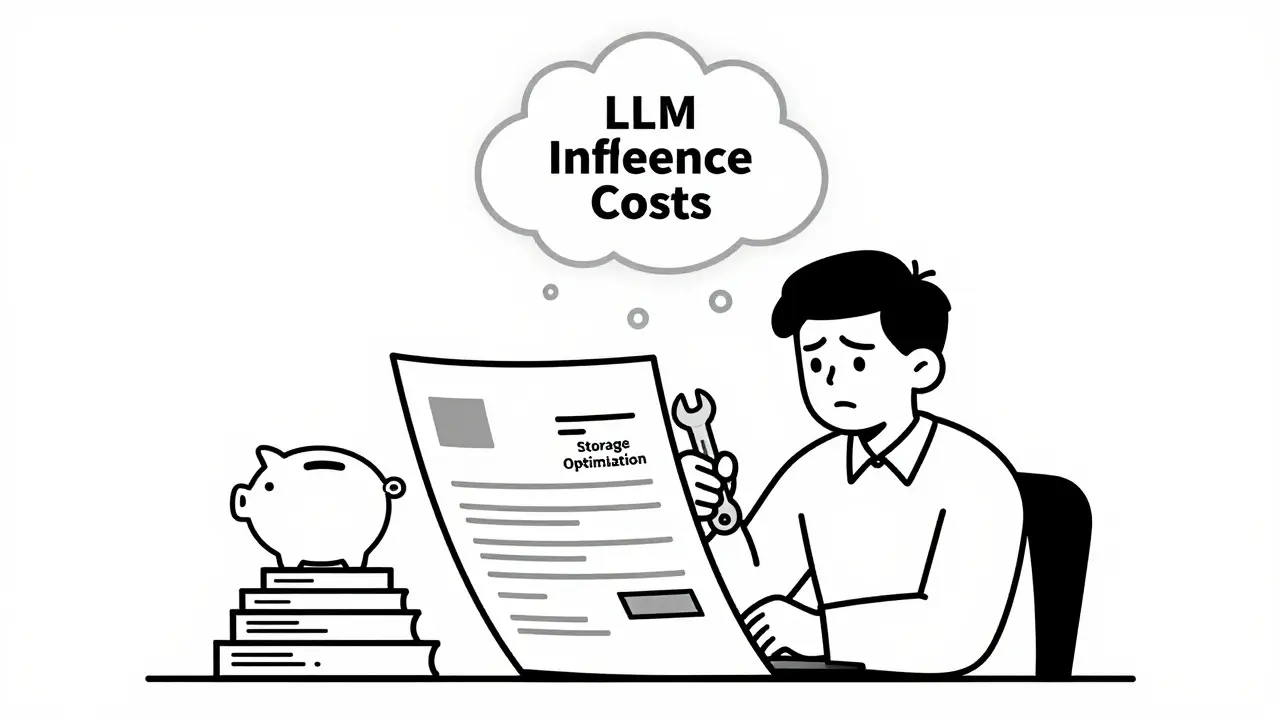
According to analysis from CostLens.dev, large language model (LLM) inference accounts for 90-95% of operational costs in production RAG systems. Reranking services take up 3-7%, vector database operations sit at 1-2%, and embedding generation is less than 1%. If you want to cut costs, you need to stop obsessing over storage and start managing your context budget.
The Real Cost Hierarchy of RAG Systems
To optimize effectively, you have to look at where the money actually goes. The cost structure of a RAG pipeline is not flat; it is heavily skewed toward the final step where the LLM generates the answer.
| Component | Estimated Cost Share | Optimization Priority |
|---|---|---|
| LLM Inference | 90-95% | Critical |
| Reranking Services | 3-7% | High |
| Vector Database Operations | 1-2% | Low |
| Embedding Generation | <1% | Negligible |
This hierarchy changes how you approach engineering decisions. Saving $10 on vector storage means nothing if you are wasting $1,000 on unnecessary LLM tokens. Your first job is to reduce the amount of text sent to the expensive model. Everything else is secondary.
Context Budget Optimization: The Highest Impact Lever
Since LLM inference dominates your bill, reducing the context window size is the single most effective way to lower costs. This doesn’t mean giving the AI less information; it means giving it *better* information.
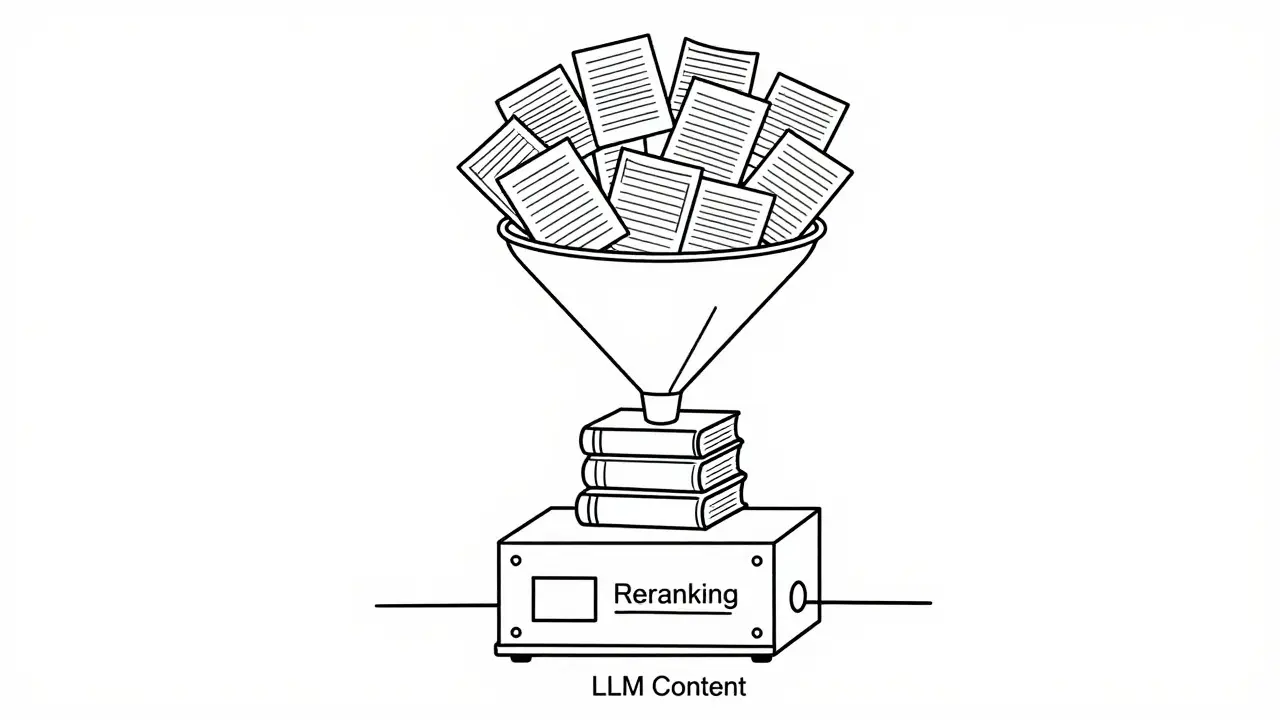
Many teams retrieve ten documents, concatenate them, and send the whole bundle to the LLM. This is inefficient. Instead, implement intelligent reranking. A reranker scores the retrieved documents and selects only the top two or three most relevant passages. Yes, reranking adds a small cost (that 3-7% slice), but it drastically cuts the token count for the LLM. The savings from fewer LLM tokens almost always exceed the cost of the reranker.
Consider these specific tactics:
- Truncate aggressively: Strip headers, footers, and navigation links before sending content to the LLM. Keep only the core semantic payload.
- Hierarchical retrieval: Start with a broad search, then refine. Only pass the refined results to the generator.
- Limit document count: Cap the number of retrieved chunks. Five highly relevant chunks often outperform twenty mediocre ones and cost significantly less.
Also, look at your model selection. Using a massive frontier model for every query is overkill. Use smaller, more efficient models for simple queries and reserve the heavy hitters for complex reasoning tasks. This "smart routing" can slash inference bills by half without noticeable quality drops for end-users.
Storage Optimization: Quantization and Dimensionality Reduction
While storage is a small part of the total cost, it scales linearly with your data volume. If you are storing millions of vectors, even small efficiencies add up. Recent research published on arXiv (2505.00105v1) provides a clear path forward using quantization and dimensionality reduction.
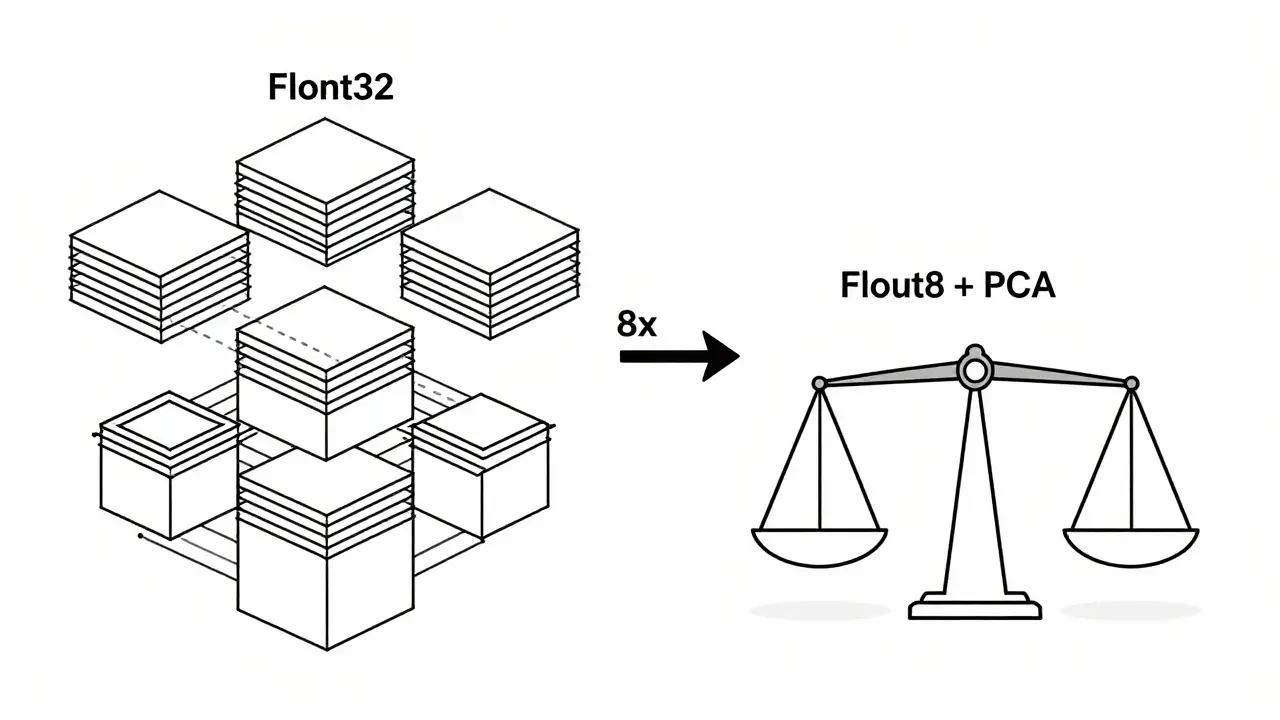
Traditionally, engineers used float32 (full precision) for embeddings. This is wasteful. Switching to float8 quantization reduces storage by 4x compared to float32 while keeping performance degradation below 0.3%. This is simpler to implement than int8 quantization and offers better trade-offs.
You can go further by combining this with dimensionality reduction. Principal Component Analysis (PCA) is the most effective technique here. By retaining just 50% of the original dimensions via PCA and then applying float8 quantization, you achieve an 8x total compression ratio. Surprisingly, this compressed format often performs better than standard int8 quantization alone.
Here is how the math works for storage sizing:
Storage (bytes) = N × (Original Dimensions × PCA Ratio%) × Bytes per Dimension
For example, if you have 1 million vectors originally in 1536 dimensions (float32):
- Baseline (float32): 1,000,000 × 1536 × 4 bytes = ~5.8 GB
- Float8 only: 1,000,000 × 1536 × 1 byte = ~1.5 GB
- PCA (50%) + Float8: 1,000,000 × 768 × 1 byte = ~0.75 GB
This 8x reduction frees up memory and reduces cloud storage fees, all while maintaining high retrieval accuracy.
Embedding Model Selection and Data Ingestion
Choosing the right embedding model matters more than you think. You don’t always need the largest model. OpenAI’s text-embedding-3-small costs $0.02 per 1 million tokens, while text-embedding-3-large costs $0.13 per 1 million tokens. For many applications, the small model delivers sufficient semantic quality at a fraction of the compute and storage cost.
Smaller specialized models often outperform general-purpose giants in specific domains. A 384-dimensional model reduces storage by roughly 62.5% compared to a 1024-dimensional one. Test these smaller models against your specific dataset using benchmarks like MTEB (Massive Text Embedding Benchmark). If the retrieval quality holds up, switch to the lighter model.
Data ingestion pipelines also leak money through redundancy. Implement incremental processing. Use content hashing to detect new or modified documents. Only re-embed what has changed. Avoid re-processing static knowledge bases every night.
Deduplication is another critical step. Duplicate content inflates storage and skews retrieval results. Use algorithms like MinHash or SimHash to identify near-duplicate chunks before embedding. This cleans your index and saves on both embedding generation and vector storage.
Vector Database and Index Tuning
Vector databases like Pinecone offer transparent pricing. Serverless tiers might charge $0.30 per 1 million queries and $0.25 per GB per month for storage. For a typical deployment with 100,000 monthly queries, that’s about $0.03 in query costs. It’s cheap, but it’s not free.
Optimize your index type. Hierarchical Navigable Small World (HNSW) is common, but its parameters matter. Tuning the `ef_construction` and `M` values affects build time, storage overhead, and query speed. Inverted File with Flat Clustering (IVF_FLAT) is another option, where tuning the number of centroids impacts performance. Choose the index that matches your read/write ratio. If you read far more than you write, prioritize query speed over index build time.
Don’t ignore response caching. High-traffic systems see repeated queries. Cache the final responses for identical or semantically similar inputs. This eliminates the LLM inference cost entirely for those hits, providing a high-return optimization with minimal architectural change.
Prioritizing Your Optimization Strategy
Don’t boil the ocean. Follow this priority list to maximize ROI on your engineering hours:
- Maximize LLM Efficiency: Reduce context window size, use smarter reranking, and select appropriate model sizes.
- Implement Reranking: Improve quality while reducing token consumption for the LLM.
- Optimize Embedding Models: Switch to smaller, domain-specific models where possible.
- Apply Storage Optimizations: Use float8 quantization and PCA for vector storage.
- Refine Ingestion Pipelines: Deduplicate data and process incrementally.
By focusing on the 90-95% cost driver first, you ensure that every dollar spent on optimization yields tangible savings. Storage tweaks are nice-to-haves; context management is a must-have.
Does reducing embedding dimensions hurt retrieval quality?
It depends on the method. Simple truncation hurts quality. However, using Principal Component Analysis (PCA) to reduce dimensions retains the most important variance in the data. Research shows that combining PCA with float8 quantization maintains high performance while achieving 8x compression.
Is reranking worth the extra cost?
Yes. Reranking typically costs 3-7% of total expenses but allows you to pass fewer, higher-quality documents to the LLM. Since LLM inference is 90-95% of the cost, the savings from reduced context windows usually outweigh the reranking fee.
What is the best quantization format for vector storage?
Float8 is currently recommended over int8. It offers a 4x storage reduction compared to float32 with less than 0.3% performance degradation. It is also simpler to implement and compatible with modern hardware accelerators.
How do I prevent redundant embedding costs?
Use incremental processing with content hashing. Calculate a hash for each document before embedding. Only generate new embeddings for documents whose hashes have changed. This avoids reprocessing static data.
Should I switch to a smaller embedding model?
Test it. Models like text-embedding-3-small are significantly cheaper and produce smaller vectors than larger counterparts. If benchmark tests (like MTEB) show comparable retrieval accuracy for your specific domain, switch to the smaller model to save on compute and storage.
 Artificial Intelligence