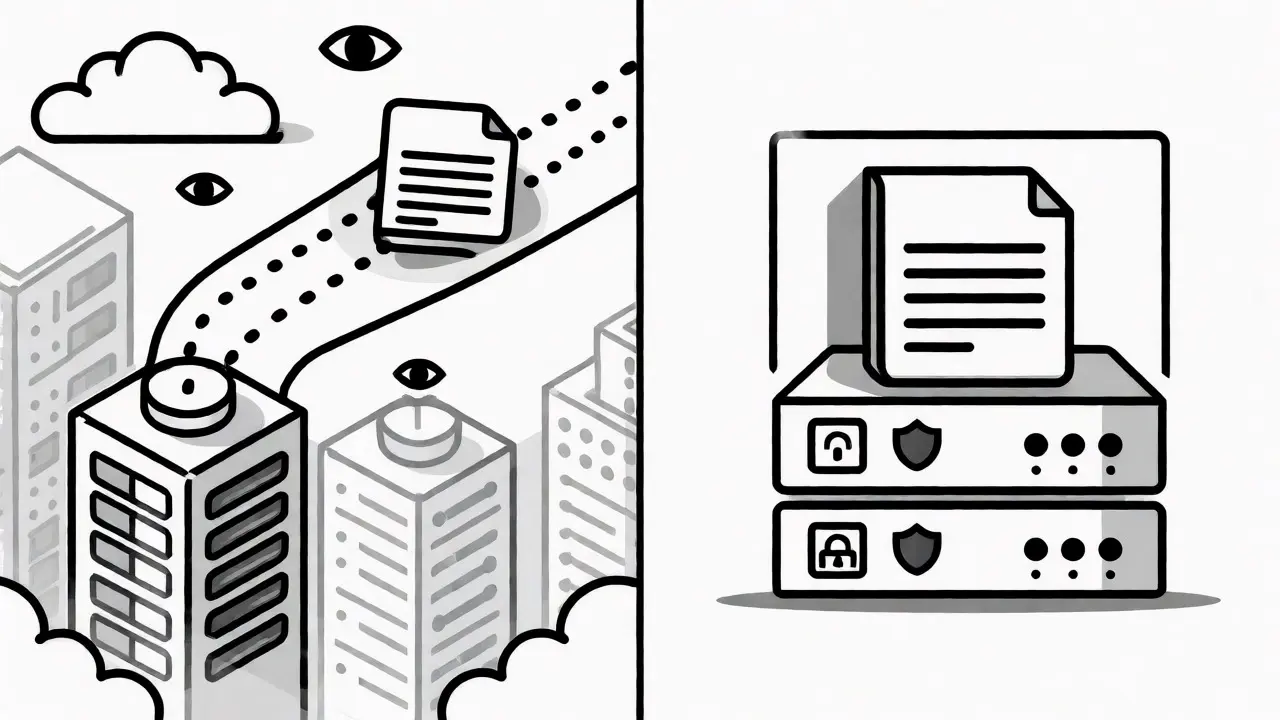
You send a patient record to an AI chatbot. It gives you a brilliant summary in seconds. But where did that data go? If you used a public API, it likely left your building, sat on someone else's server, and maybe even trained their next model. For hospitals, banks, or government agencies, that’s not just a privacy headache-it’s a lawsuit waiting to happen. This is the core problem driving the shift toward self-hosting large language models. By running these models on your own infrastructure, you keep data inside your walls. You control who sees it, how long it stays, and exactly what happens to it.
But don’t let the simplicity of "keeping it local" fool you. Self-hosting isn't just about plugging in a GPU and walking away. It turns your IT team into the new security perimeter for AI. You are now responsible for patching vulnerabilities, managing access controls, and proving compliance to auditors who might not even understand how transformers work. Let’s break down exactly what you need to handle to make self-hosted AI safe and legal.
Why Cloud APIs Fail the Compliance Test
When you use services like OpenAI or Anthropic via API, you are effectively renting intelligence. The trade-off is convenience for control. For most startups, this is fine. But if you operate in healthcare, finance, or government, the rules change fast. Regulations like HIPAA (Health Insurance Portability and Accountability Act), GDPR (General Data Protection Regulation), and FedRAMP have strict requirements about where sensitive data lives and who can touch it.
The main issue with cloud providers is data residency and ownership. When you send a prompt containing Protected Health Information (PHI) to a cloud API, you often lose visibility into its journey. Did it cross international borders? Was it stored in logs for six months? Did it get used to fine-tune the provider’s global model? With self-hosting, you answer "no" to all those questions because the data never leaves your network segment. You maintain data sovereignty, which means you retain ultimate authority over your information assets.
Consider a federal agency handling classified info. They can’t risk a third-party vendor having access to their queries. As GitLab notes in their analysis of government AI, self-hosted environments allow agencies to implement specific audit trails and governance frameworks that meet strict mandates like FISMA. You aren't just avoiding a breach; you're satisfying an auditor who needs to see exactly where the bits went.
The New Attack Surface: What Changes When You Host?
Moving from API to self-hosting removes one big risk-vendor exposure-but creates others. Your model weights become a critical asset. If someone steals your fine-tuned Llama 3 or Mistral model, they steal your intellectual property. Unlike code, which is easy to obfuscate, model weights are complex numerical tensors that are hard to protect once extracted.
You also face new types of threats. Prompt injection attacks still apply, but now you’re responsible for detecting them without a vendor’s proprietary filter layer. If your model generates malicious code or hallucinates sensitive data back to the user, your internal guardrails must catch it. EPAM SolutionsHub highlights that "opaque training data" and "reasoning transparency exploits" mean local deployment requires considerable effort to manage risks effectively. You are no longer protected by the black box; you own the box.
Another blind spot is model drift and decay. In the cloud, the provider updates the model silently. On-prem, you decide when to update. If you forget to patch the underlying library (like PyTorch or TensorFlow), you might be running a version with known CVEs (Common Vulnerabilities and Exposures). Palo Alto Networks warns that self-managed models can become "blind spots" if you don’t actively monitor them. An old, unpatched inference server is just as vulnerable as an old web server.

Core Security Controls for Self-Hosted LLMs
So, how do you secure this beast? It comes down to three pillars: Access Control, Data Encryption, and Output Monitoring. You can’t just open port 8000 to your whole office.
- Strict Access Controls: Implement strong authentication and authorization protocols. Only trusted users and applications should interact with the model. Use role-based access control (RBAC) so interns can’t query the same datasets as senior analysts.
- Encryption at Rest and in Transit: Model artifacts (the weights) must be encrypted at rest. Integrity checks, like hash verifications, ensure the model hasn’t been tampered with during loading. All traffic between your app and the inference engine should be TLS-encrypted, even if it’s internal.
- Outbound Traffic Management: This is crucial. Prevent the model from exposing sensitive information through generated outputs. If your model summarizes a contract, ensure it doesn’t accidentally leak a Social Security Number included in the context window. Monitor outbound traffic to block unauthorized data transfers.
Think of your LLM endpoint like a database. You wouldn’t let anyone run raw SQL queries against your production DB without limits. Similarly, rate-limiting and usage monitoring help detect attempts to extract the model’s knowledge or manipulate its behavior. If a user suddenly sends 10,000 prompts in a minute, that’s either a bot or a denial-of-service attempt. Block it.
Navigating the Regulatory Maze
Compliance isn't a checkbox; it's a continuous process. Depending on your industry, different frameworks apply. Here’s a quick breakdown of what matters most:
| Framework | Target Industry | Key Requirement for Self-Hosting |
|---|---|---|
| HIPAA | Healthcare | Protect PHI; ensure no data retention by vendors; audit access logs. |
| GDPR | EU Operations | Data minimization; right to be forgotten; clear consent for processing. |
| FedRAMP/FISMA | US Government | Controlled environment; encryption standards; detailed audit trails. |
| SOX | Public Companies | Financial data integrity; segregation of duties; change management logs. |
For GDPR, the "Right to be Forgotten" is tricky with LLMs. If a user asks you to delete their data, you can easily remove it from your database. But if that data was used to fine-tune your local model, deleting it from the weights is nearly impossible without retraining. Most organizations solve this by keeping the base model generic and using Retrieval-Augmented Generation (RAG) for personal data. RAG keeps user data in a vector database where deletion is simple, while the LLM itself remains static.
In healthcare, HIPAA requires Business Associate Agreements (BAAs) with vendors. With self-hosting, you become the business associate. You must prove to your clients that your infrastructure meets the physical and technical safeguards required by law. This means documenting everything: who has root access to the GPU servers, how backups are encrypted, and how incidents are reported.

Implementation Pitfalls to Avoid
Many teams underestimate the operational burden. They think buying GPUs solves the problem. It doesn’t. You need a dedicated MLOps pipeline. Without proper orchestration, your inference servers will crash under load, or worse, serve stale models.
A common mistake is ignoring "model hygiene." Palo Alto Networks suggests identifying and removing inactive models. In a self-hosted environment, you might spin up multiple instances for testing, A/B comparisons, or different departments. Over time, these accumulate. Unused models consume resources and expand your attack surface. Regularly audit your inventory. If a model hasn’t been called in 30 days, shut it down.
Another pitfall is relying solely on the model’s internal safety mechanisms. Open-source models like Llama 3 or Mistral have alignment built-in, but they aren’t perfect. They can be jailbroken. You need external guardrails. Implement content moderation systems and prompt injection detection tools that sit between the user and the model. These rule-based filters act as a bouncer, checking inputs and outputs before they reach the heavy lifting engine.
Finally, don’t neglect performance tuning. Security overhead (encryption, logging, auth) adds latency. If your response time slows from 200ms to 2 seconds, users will complain, and developers might bypass security checks to speed things up. Balance is key.
The Cost-Benefit Reality Check
Is self-hosting worth it? For high-volume, regulated use cases, yes. Plural.sh notes that while demanding initial investment, self-hosting eliminates recurring subscription fees, providing predictable long-term cost management. However, Private AI cautions that "residual privacy issues" persist. Just because data stays local doesn’t mean it’s automatically private. Insider threats remain. A rogue employee with admin access can dump your entire vector store.
You also face hardware costs. High-end GPUs (like NVIDIA H100s) are expensive and power-hungry. Cooling, space, and electricity add up. Compare this to the per-token pricing of APIs. For low-volume apps, APIs win. For enterprises processing millions of tokens daily with sensitive data, self-hosting breaks even quickly and then saves money.
Ultimately, self-hosting shifts the responsibility from "trust me" to "prove it." You have to build the trust yourself. That takes engineering muscle, security maturity, and clear governance. But for industries where data leaks mean fines or lost patients, that control is non-negotiable.
Does self-hosting an LLM guarantee GDPR compliance?
No, self-hosting facilitates compliance but does not guarantee it. You must still implement proper data governance, obtain user consent, and ensure you can fulfill rights like data deletion. Self-hosting helps primarily with data residency and minimizing third-party exposure, which are key components of GDPR, but other aspects like purpose limitation and data minimization require active policy enforcement.
How do I handle PII redaction in self-hosted models?
Use pre-processing pipelines with Named Entity Recognition (NER) tools to identify and mask Personally Identifiable Information (PII) before sending text to the LLM. Alternatively, use post-processing to scan outputs for accidental leakage. Some advanced setups use specialized small models trained specifically for PII detection to run alongside the main LLM.
What is the biggest security risk with open-source LLMs?
Prompt injection and model theft are significant risks. Since the weights are downloadable, competitors or attackers can copy your fine-tuned model. Additionally, open-source models may lack the robust safety filters of commercial counterparts, making them more susceptible to jailbreaking unless you implement external guardrails and input validation.
Do I need special hardware for self-hosting?
Yes, typically GPUs (Graphics Processing Units) are required for efficient inference, especially for larger models (7B+ parameters). While smaller models can run on CPUs, latency becomes unacceptable for real-time applications. High-memory bandwidth GPUs (like NVIDIA A100 or H100) are standard for enterprise-grade self-hosting to handle concurrent requests.
Can self-hosted LLMs train on my private data securely?
Yes, this is a primary benefit. Fine-tuning or training on private data occurs entirely within your infrastructure. No data leaves your network, eliminating concerns about third-party vendors using your proprietary data to improve their general models. Ensure your storage volumes are encrypted and access is strictly logged during the training process.
 Artificial Intelligence