You built a sophisticated Large Language Model. It handles customer queries, writes code, and summarizes reports. Then, one Tuesday morning, it starts hallucinating product prices or leaking internal emails. Traditional firewalls didn't catch it. Your antivirus is silent. This isn't a standard server crash; it's an AI-introduced defect, and your current incident response plan likely wasn't built for this.
Most organizations treat AI systems like black boxes until they break. When they do, teams scramble because the failure modes are unique to machine learning architectures. The Coalition for Secure AI (CoSAI) released Version 1.0 of their AI Incident Response Framework to fix this gap. It adapts the trusted NIST lifecycle specifically for AI threats. If you're running GenAI in production, understanding this framework isn't optional-it's survival.
Why Traditional Security Fails Against AI Threats
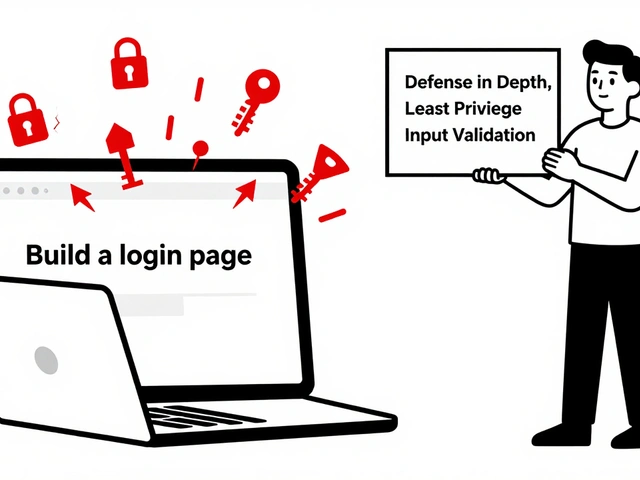
Classic cybersecurity focuses on perimeter defense: patching servers, blocking ports, and scanning for known malware signatures. AI breaks these rules. An attacker doesn't need to hack your server to compromise your AI; they just need to trick the model. Consider Prompt Injection. This is the SQL injection of the AI world. By crafting specific inputs, attackers can force a model to ignore its safety guidelines or execute unintended commands. Traditional WAFs (Web Application Firewalls) often miss these because the input looks like normal text, not malicious code.
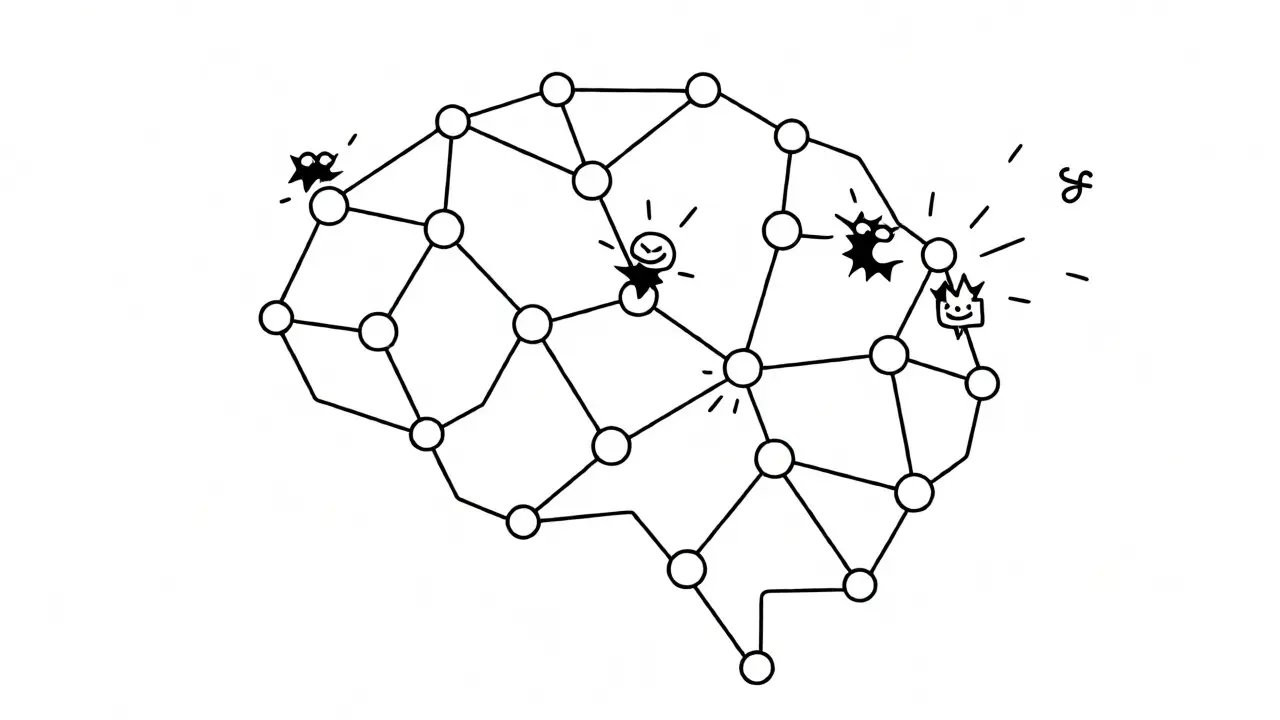
Then there's Data Poisoning. Imagine someone subtly corrupting the training data before your model even learns. The model itself becomes defective from the start. No amount of runtime monitoring catches this if you don't validate the dataset integrity first. These defects aren't bugs in the traditional sense; they are vulnerabilities in the logic and data flow of the neural network. You can't just "reboot" a poisoned model. You have to retrain it, which takes hours or days, not seconds.
| Feature | Traditional IT Incident | AI-Introduced Defect |
|---|---|---|
| Detection Signal | Error logs, CPU spikes, known signatures | Model drift, unusual output patterns, semantic anomalies |
| Root Cause | Buggy code, misconfiguration, malware | Poisoned data, adversarial prompts, weight manipulation |
| Remediation | Patch, restart, rollback binary | Retrain model, purge memory, rebuild vector DB |
| Impact Scope | Specific service or user | All users interacting with the compromised model version |
Preparation: Building the Right Telemetry Stack
You can't respond to what you can't see. Standard infrastructure logs tell you that a request happened, but they don't tell you *why* the AI said something weird. Preparation requires capturing AI-specific telemetry. This goes beyond HTTP status codes. You need to log every Prompt sent to the system, the resulting Inference Output, and any tool executions triggered by the agent.
Think of it as a flight recorder for your brain-in-a-box. If a RAG System (Retrieval-Augmented Generation) starts pulling irrelevant documents, your logs should show exactly which document IDs were retrieved and why. Did the embedding similarity score drop? Was there a sudden spike in token usage? Without this granular visibility, your analysts are guessing. Establishing a comprehensive inventory of all AI assets-from simple chatbots to complex agentic workflows-is step one. Know where your models live, who accesses them, and what data feeds them.

Detection: Spotting the Invisible Attacks
Detecting AI incidents is tricky because the system rarely crashes. Instead, it behaves strangely. We call this Model Drift. It might be gradual performance degradation, or it might be sudden, bizarre outputs indicating a jailbreak attempt. Rule-based alerts struggle here because "strange" is subjective. That's where AI-powered detection comes in. Ironically, you use AI to watch AI.
Modern Security Operations Centers (SOCs) now employ machine learning models to analyze behavior patterns. They look for anomalies that signature-based tools miss. For instance, a sudden shift in the sentiment of generated text or an unexpected change in the length of responses could signal a Memory Injection Attack (MINJA). In MINJA, attackers manipulate the short-term memory context of an LLM, causing it to forget instructions or adopt a new persona. Behavioral modeling detects these shifts faster than human analysts scanning logs.
Containment and Eradication: Not Just a Reboot
Once you've confirmed an incident, containment differs wildly from traditional IT. You can't just isolate a container. If a Vector Database is poisoned, isolating the API endpoint stops new bad data from entering, but the existing corrupted embeddings still affect results. You might need to roll back to a previous model checkpoint or flush the entire conversation history cache.
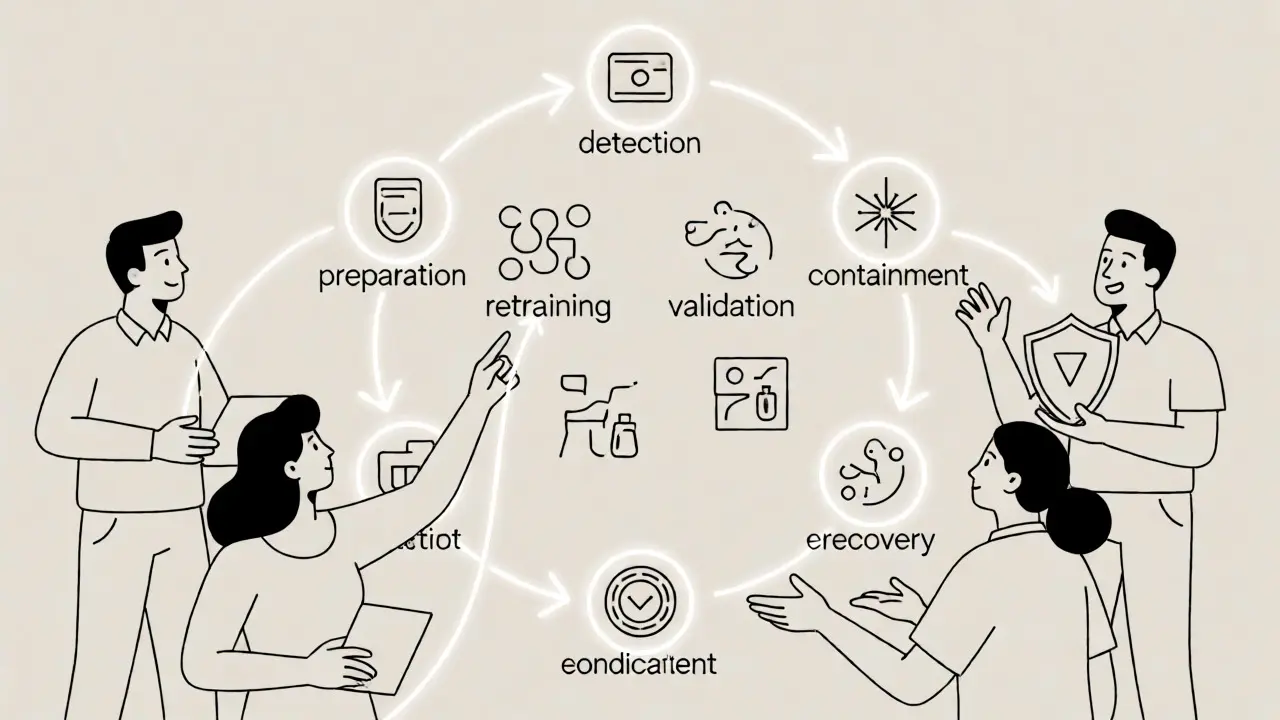
The CoSAI framework provides playbooks written in the OASIS CACAO standard for these scenarios. For a Prompt Injection attack, containment might involve temporarily disabling specific high-risk tools available to the agent. For data poisoning, eradication means identifying the tainted batch of training data, removing it, and triggering a partial retraining pipeline. Recovery isn't instant. It involves validating the restored model against a golden dataset to ensure integrity before bringing it back online. Automation helps here. SOAR platforms can orchestrate these steps, locking down accounts or switching traffic to a backup model automatically when thresholds are breached.
Post-Incident: Learning and Disclosure
After the dust settles, the work isn't done. Post-incident analysis must focus on how the defect slipped through. Did your input validation fail? Was the training data source compromised? The AI Security Incident Response Team (AISIRT) at Carnegie Mellon emphasizes coordinated vulnerability disclosure. Unlike software bugs, AI vulnerabilities are often subtle and hard to reproduce. Documenting the exact prompt sequence and environmental state is crucial for sharing knowledge with the community.
Update your playbooks based on what you learned. If a new type of jailbreak emerged, add a detection rule for it. Feed crafted "false threat" scenarios into your SOC to test if your AI detectors can resist misdirection. This continuous improvement loop builds resilience. Remember, the goal isn't just to fix the current bug, but to make the next one harder to introduce.
What is the biggest difference between traditional and AI incident response?
The main difference lies in detection and remediation. Traditional incidents rely on known signatures and quick fixes like restarting services. AI incidents often involve subtle behavioral changes (drift) and require complex remediations like retraining models or purging vector databases, which take significantly longer.
How do I detect prompt injection attacks?
Use a combination of input sanitization, anomaly detection on output semantics, and dedicated guardrail models that classify incoming prompts for intent. Monitoring for unusual token lengths or sudden shifts in response tone also helps identify potential injections.
What is data poisoning in AI?
Data poisoning occurs when malicious actors contaminate the training dataset used to build an AI model. This causes the model to learn incorrect associations or biases, leading to defective behavior that persists even after deployment, requiring retraining to fix.
Do I need specialized staff for AI incident response?
Yes. While general security analysts can handle initial triage, resolving AI-specific incidents requires collaboration with ML engineers who understand model architecture, training pipelines, and inference mechanics to properly diagnose and remediate issues.
What is the CoSAI framework?
The Coalition for Secure AI (CoSAI) framework is a standardized guide for managing AI security incidents. It adapts the NIST incident response lifecycle to address AI-specific threats like prompt injection and data poisoning, providing playbooks and best practices for preparation, detection, and recovery.
 Artificial Intelligence