For years, the mantra in artificial intelligence was simple: bigger is better. If your model isn’t performing well, add more parameters. If it’s still lagging, throw more data at it. This intuition, backed by early empirical studies, suggested a predictable path to superintelligence. But as we move deeper into 2026, that linear expectation has shattered. Large Language Model (LLM) scaling laws are not universal truths; they are conditional guidelines that break down under real-world pressures. From the moment DeepMind proved that smaller models could outperform giants with the right data mix, to the chaotic unpredictability of reinforcement learning, the "laws" governing AI growth have revealed themselves to be fragile constructs.
The Great Correction: How Chinchilla Broke the Rules
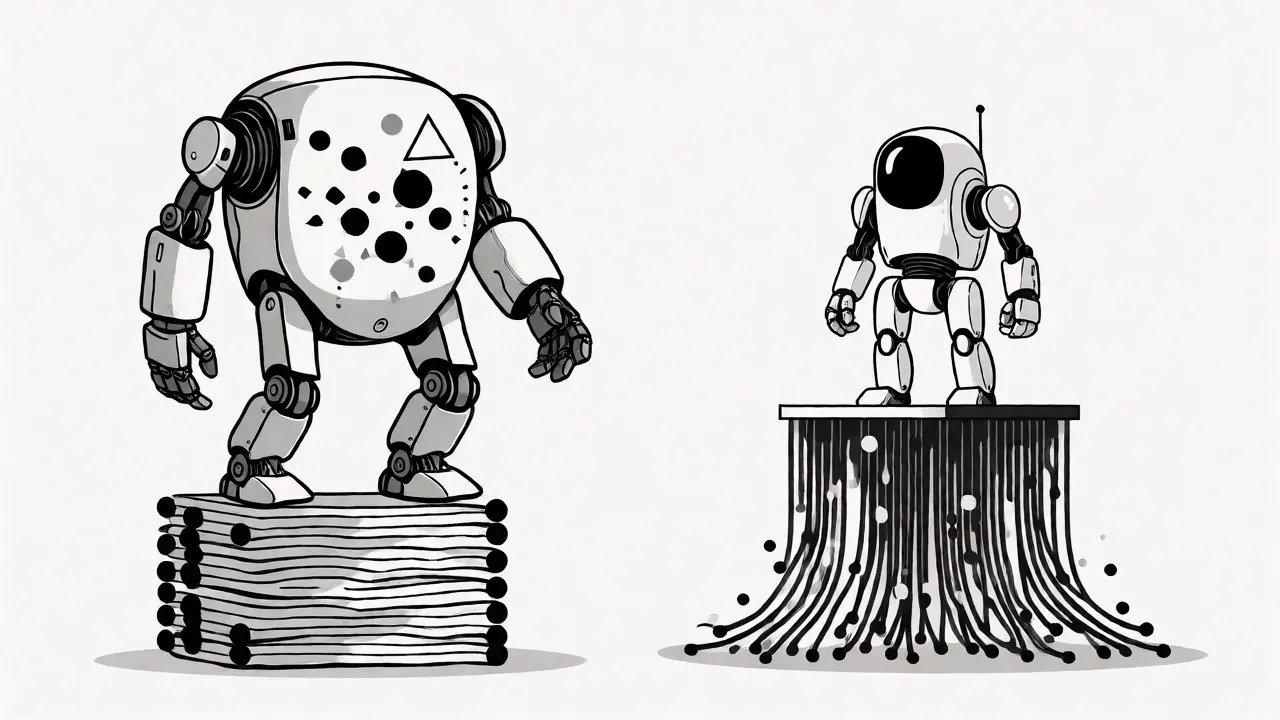
In 2020, Kaplan et al. published findings that seemed to codify the future of AI. They showed that loss decreases predictably as you increase model size, dataset size, and compute. It felt like physics. Then came 2022, and DeepMind dropped a bombshell that rewrote the textbook. Their paper on Chinchilla, a 70-billion parameter model, demonstrated that the industry had been wasting resources by building models too large for their training data. The old assumption? Make the model huge, feed it what you can. The new reality? Balance is everything.
DeepMind trained Chinchilla with 1.4 trillion tokens-far more than Gopher, its 280-billion-parameter predecessor, which used only 300 billion. Despite being four times smaller, Chinchilla beat Gopher and even OpenAI’s GPT-3 on key benchmarks. This wasn’t just an optimization tweak; it was a fundamental violation of previous expectations. The math changed. For every 10x increase in compute, you don’t just make the model bigger; you need to scale both the model and the data by roughly 3.1x. Ignore this balance, and you hit diminishing returns fast. Want a 520-billion parameter model? You’d need 60x the compute used for Gopher. Want a trillion parameters? That’s 200x the compute. The curve doesn’t just flatten; it demands exponential resource jumps that most companies can’t afford.
The Overtraining Gap: Training Loss vs. Real World Performance
Here’s where things get tricky for engineers shipping products. Chinchilla optimality minimizes training loss. But users don’t care about training loss. They care about how the model behaves when asked questions after training ends. This disconnect led to the rise of "overtraining." Models like Meta’s LLaMA were deliberately fed far more data than Chinchilla rules would suggest. Why? Because overtrained models generalize better during inference.
This breaks the clean predictive power of standard scaling laws. If you follow Chinchilla strictly, you might save money on training but end up with a model that hallucinates more or fails complex reasoning tasks in production. Recent studies show that dataset sizes up to 32x larger than Chinchilla-optimal levels yield better practical results. So, the "law" that tells you how to spend your GPU budget efficiently for research purposes often gives you bad advice for building a usable product. You’re no longer optimizing for the best fit to the training set; you’re optimizing for robustness against unseen queries. These two objectives diverge significantly as models grow.
| Metric | Kaplan (2020) Expectation | Chinchilla (2022) Reality | Production Reality (Overtraining) |
|---|---|---|---|
| Primary Goal | Minimize validation loss | Optimal compute allocation | Better inference generalization |
| Data Strategy | Secondary to model size | Balanced with model size | Massive over-allocation (up to 32x) |
| Compute Efficiency | High for small models | High for balanced models | Lower efficiency, higher quality |
| Predictability | Linear power law | Strict proportional scaling | Non-linear, domain-dependent |
Reinforcement Learning: Where Math Goes to Die
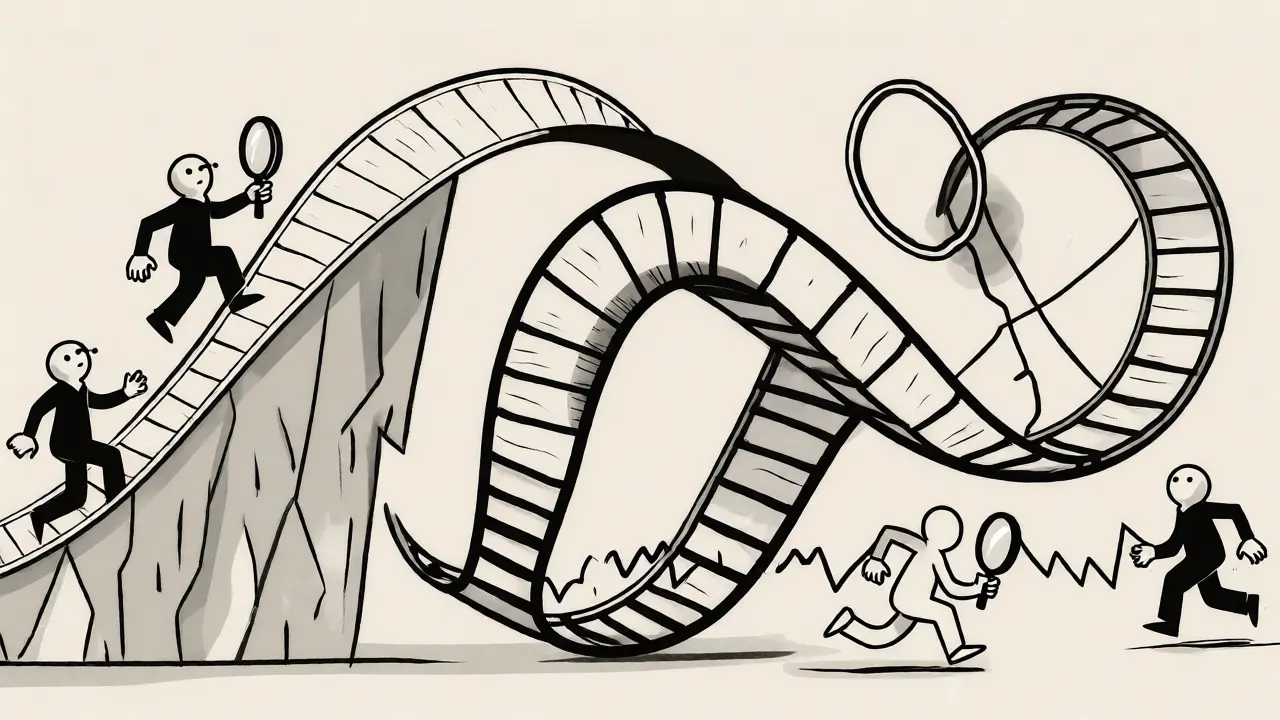
If pretraining scaling is a shaky ladder, Reinforcement Learning (RL) is a freefall. Unlike pretraining, where we have rigorous power-law relationships validated across orders of magnitude, RL lacks established predictive scaling laws. Why? Instability. In RL, tiny changes in policy gradients can cause massive swings in performance. A single token in a long sequence can dominate the loss function, causing numerical explosions. This is especially true for Mixture-of-Experts (MoE) models, where sparse activation patterns create uneven gradient flows.
Consequently, you can’t simply say, "Double the compute, double the RL performance." Often, doubling compute leads to divergence or stagnation. Best practices in RL are anecdotal, dependent heavily on specific hyperparameters and reward models. Researchers often find that methods working at 7B parameters fail spectacularly at 70B. There is no smooth curve here. Instead, there are cliffs. You iterate by running expensive experiments until something sticks, breaking the promise of predictable scaling entirely. This makes RL one of the most expensive and least predictable phases of modern LLM development.
Adversarial Scaling: Safety Doesn’t Scale Linearly
We assume that as models get smarter, they also get safer. Not necessarily. Jailbreak scaling laws reveal a disturbing trend: safety vulnerabilities can scale exponentially while capabilities scale polynomially. When attackers use prompt injection, the success rate of attacks doesn’t just grow slowly; it can explode with the number of inference-time samples.
Think of it like magnetism. Short injected prompts act like weak magnetic fields, leading to power-law increases in attack success. Long, complex injections act like strong fields, triggering exponential growth in failure modes. This means a model that passes safety tests at low usage volumes might become wildly unreliable under high-load adversarial conditions. Capability improvements do not automatically confer safety improvements. In fact, a more capable model might be better at finding creative ways to bypass its own guardrails. This non-linearity breaks the hope that we can simply "scale our way" to safe AI.
Test-Time Compute: The New Frontier
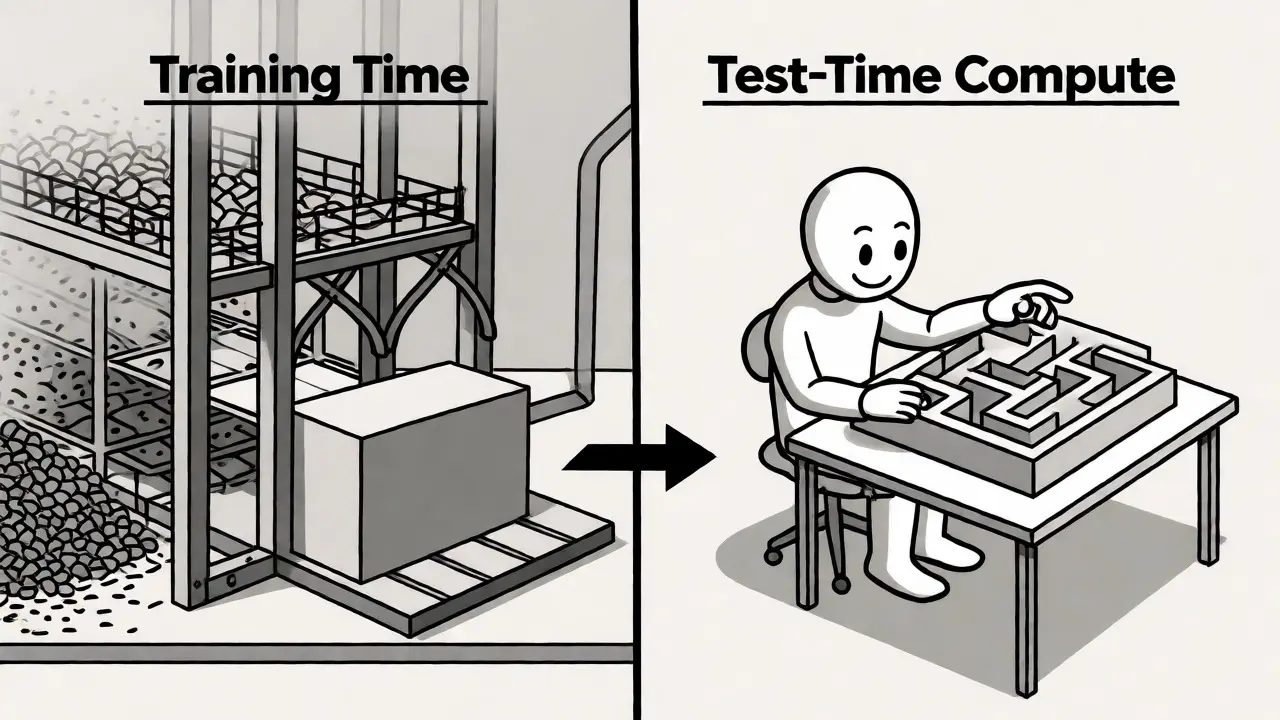
A shift is happening from training-time scaling to test-time scaling. Instead of making the model bigger before deployment, we spend more compute while answering a question. Reasoning models perform multiple passes, self-correcting along the way. This approach decouples capability from model size. A smaller model given enough inference time can outperform a larger one rushed through a single pass.
This breaks traditional scaling metrics because the bottleneck moves from memory capacity (model size) to latency tolerance (how long the user waits). The relationship between compute and accuracy here is different again. It’s not about fitting more weights; it’s about exploring more paths. As we head toward 2026, expect infrastructure costs to shift from massive GPU clusters for training to distributed networks for inference. The "law" here is economic: if users tolerate higher latency, accuracy improves. If they demand instant answers, the scaling benefits vanish.
Key Takeaways
- Balance is King: Don’t just grow models. Grow data proportionally. Chinchilla scaling proves that unbalanced growth wastes money and yields inferior results.
- Train for Production, Not Loss: Overtraining (using more data than optimal) is essential for real-world usability, breaking pure efficiency laws.
- RL is Unpredictable: Reinforcement learning does not follow clean power laws. Expect instability and require extensive trial-and-error.
- Safety Scales Differently: Adversarial failures can grow exponentially even as capabilities improve linearly. More smarts can mean more clever ways to fail.
- Inference Matters: Test-time compute offers a new lever for performance, shifting focus from model size to reasoning depth.
Why did the original scaling laws fail?
The original laws, such as those from Kaplan et al., assumed that increasing model size was always beneficial regardless of data volume. DeepMind's Chinchilla research proved that without sufficient data, larger models actually perform worse than smaller, data-rich models. The relationship requires balancing both factors equally.
What is overtraining in LLMs?
Overtraining involves feeding a model significantly more data than the Chinchilla-optimal amount. While this reduces training efficiency, it improves the model's ability to generalize and handle diverse queries during inference, which is critical for production applications.
Do scaling laws apply to Reinforcement Learning?
No, not reliably. RL training suffers from high variance and instability, particularly with long sequences or MoE architectures. Simple power-law predictions often fail, requiring researchers to rely on empirical testing rather than theoretical projections.
How does test-time scaling differ from training scaling?
Training scaling increases model capacity before deployment. Test-time scaling spends extra computational resources during inference to allow the model to "think" longer or try multiple solutions. This can boost accuracy without changing the model's architecture or size.
Does a larger model always mean safer AI?
Not necessarily. Adversarial scaling laws show that safety vulnerabilities can scale exponentially with complexity, while capabilities may only scale polynomially. Larger models can sometimes find more sophisticated ways to bypass safety filters.
 Artificial Intelligence